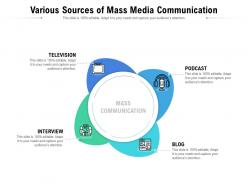
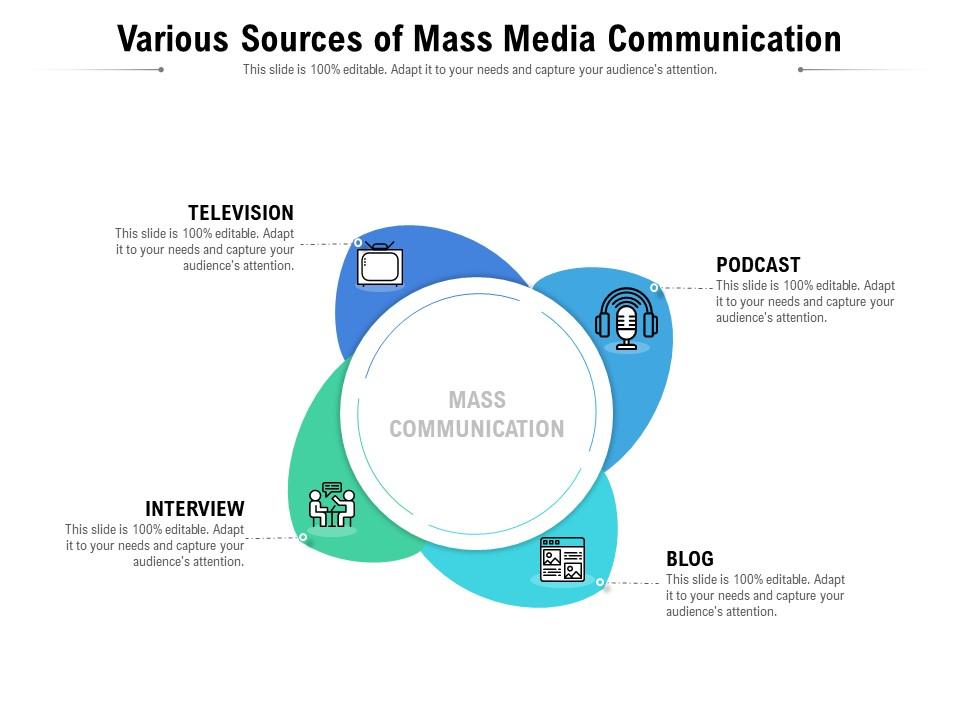
Various sources of mass media communication
Try Before you Buy Download Free Sample Product
Audience
Editable
of Time
Our Various Sources Of Mass Media Communication are topically designed to provide an attractive backdrop to any subject. Use them to look like a presentation pro.
People who downloaded this PowerPoint presentation also viewed the following :
Various sources of mass media communication with all 2 slides:
Use our Various Sources Of Mass Media Communication to effectively help you save your valuable time. They are readymade to fit into any presentation structure.
FAQs for Various sources of
Mass media communication significantly influences public opinion by setting agendas, framing narratives, providing information sources, and amplifying specific viewpoints across diverse audiences. Through strategic content distribution, broadcasting networks, social platforms, and print publications, media organizations shape discourse around political issues, social movements, and consumer behaviors, ultimately delivering widespread influence while presenting both opportunities for informed dialogue and considerations regarding bias and information accuracy.
Digital media has transformed traditional mass communication by enabling real-time interaction, personalized content delivery, and direct audience engagement through social platforms, streaming services, and mobile applications. Traditional one-way broadcasting has evolved into dynamic, multi-directional communication networks, with media organizations increasingly integrating digital strategies to reach fragmented audiences, enhance viewer engagement, and deliver targeted content experiences.
Mass media communication shapes political discourse by setting public agendas, framing narratives, amplifying candidate messages, facilitating voter engagement, and influencing opinion formation across diverse demographics. Through television broadcasts, social media platforms, and digital news outlets, media organizations streamline information dissemination while enabling real-time political dialogue, ultimately delivering enhanced democratic participation and more informed electoral processes.
Mass media enhances public health campaigns by delivering consistent messaging across television, radio, digital platforms, and print outlets, reaching diverse populations simultaneously. Through strategic combinations of educational content, behavioral nudges, and community storytelling, healthcare organizations streamline awareness efforts while reducing communication costs, with many campaigns finding that multimedia approaches ultimately deliver broader reach and measurable behavior change outcomes.
Mass media communication requires considering accuracy and truthfulness, respect for privacy, avoiding harmful stereotypes, protecting vulnerable populations, and maintaining editorial independence from commercial pressures. These ethical frameworks help media organizations build audience trust while delivering responsible content, with many news outlets and broadcasters finding that strong ethical standards ultimately enhance credibility and long-term viewer loyalty.
Cultural diversity significantly shapes mass media content through varied storytelling approaches, language choices, visual representations, cultural references, and value systems that resonate with different audiences. This influences reception as viewers from diverse backgrounds interpret messages through their own cultural lenses, with many media organizations finding that culturally inclusive content enhances audience engagement and delivers broader market reach.
Media organizations can combat misinformation through fact-checking protocols, source verification systems, transparent editorial processes, algorithmic content filtering, and collaborative industry partnerships. These strategies enhance credibility by establishing clear correction policies, partnering with verification services, and implementing real-time monitoring tools, with many newsrooms finding that proactive transparency ultimately delivers stronger audience trust and competitive advantage.
Mass media communication drives social change by amplifying marginalized voices, exposing injustices, and mobilizing public opinion through widespread reach and emotional storytelling. Through campaigns like anti-smoking initiatives, environmental awareness programs, and social justice movements, media platforms enable organizations, activists, and institutions to shift cultural narratives, influence policy decisions, and ultimately deliver measurable behavioral changes across diverse communities.
Audience engagement significantly enhances mass media effectiveness by creating active participation, emotional connection, and message retention rather than passive consumption. Through interactive content, social media discussions, and feedback mechanisms, broadcasters and publishers achieve higher brand recall, increased trust, and measurable behavioral changes, with many organizations finding that engaged audiences become advocates who amplify messaging reach.
Different demographics respond to mass media formats based on age, cultural background, education levels, and technology adoption patterns, with younger audiences gravitating toward digital platforms while older generations prefer traditional media. Through targeted content strategies, organizations can leverage television for broad reach among mature demographics, social media for millennials and Gen Z engagement, and radio for commuter audiences, ultimately delivering personalized experiences that enhance brand connection and message effectiveness across diverse market segments.
Media consolidation reduces diversity by concentrating ownership among fewer corporations, limiting editorial perspectives, homogenizing content across platforms, and reducing local news coverage. While consolidation can streamline operations and reduce costs, it presents challenges for democratic discourse, with many media markets finding that concentrated ownership ultimately limits viewpoint diversity and reduces community-specific programming that serves local audiences.
Social media proliferation presents both challenges and opportunities for mass media credibility, with traditional outlets facing increased scrutiny while also gaining direct audience engagement channels. Many news organizations are enhancing transparency through real-time fact-checking, audience interaction, and behind-the-scenes content, ultimately delivering stronger accountability and more responsive journalism in an increasingly connected media landscape.
Journalists face challenges including information overload, pressure for real-time reporting, declining trust in traditional media, competition from citizen journalism, and the need to verify sources across multiple platforms. These pressures can compromise accuracy and depth, with many news organizations finding that balancing speed with credibility while adapting to digital-first audiences ultimately determines their competitive advantage.
Mass media communication shapes gender norms by consistently portraying stereotypical roles, behaviors, and expectations across television, advertising, films, and digital platforms. Through repeated representation patterns, targeted messaging, and cultural storytelling, media outlets reinforce traditional gender concepts while increasingly recognizing opportunities to challenge these norms, ultimately influencing societal perceptions and consumer behaviors across diverse demographics.
Mass media enhances cross-cultural communication by broadcasting diverse perspectives, translating content across languages, showcasing global news, and facilitating real-time international dialogue through digital platforms. Through television, social media, and streaming services, organizations increasingly leverage these channels to build cultural bridges, expand market reach, and foster global understanding, ultimately delivering broader audience engagement and competitive advantage in international markets.
-
Illustrative design with editable content. Exceptional value for money. Highly pleased with the product.
-
Excellent Designs.
-
Excellent products for quick understanding.
-
Graphics are very appealing to eyes.