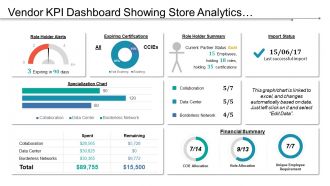
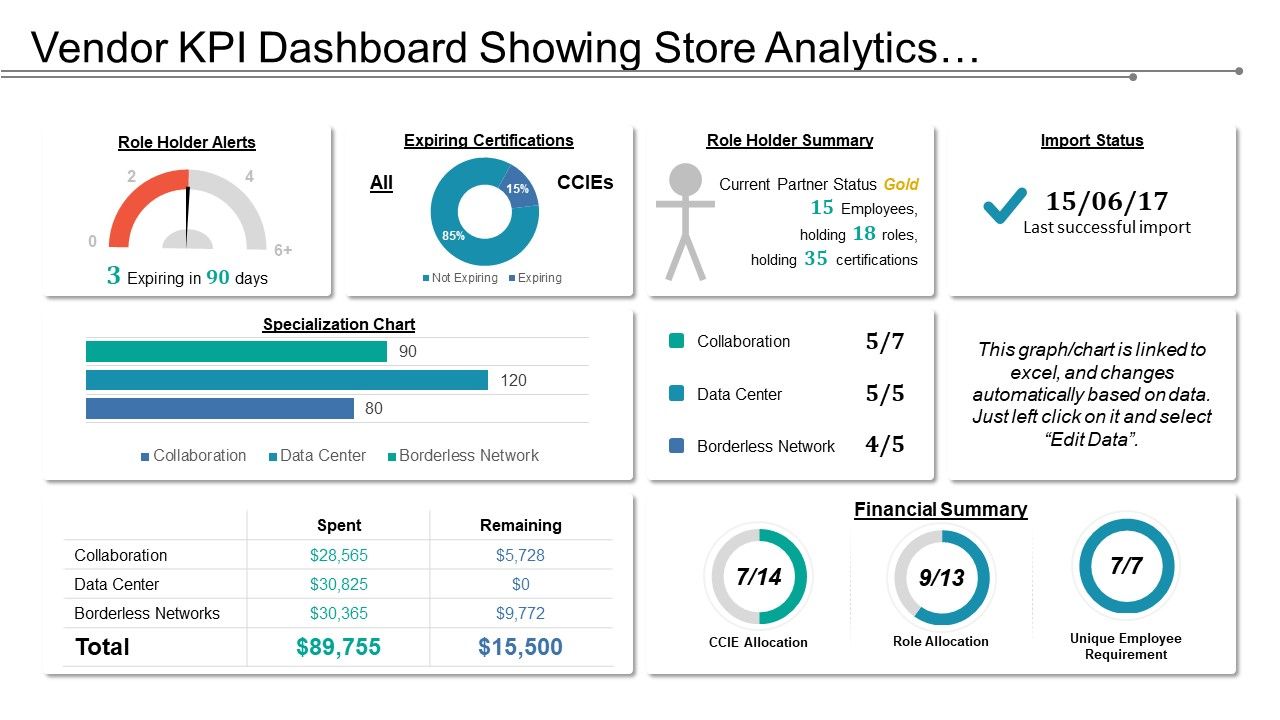
Vendor kpi dashboard showing role holder alerts and specialization chart
Try Before you Buy Download Free Sample Product
Audience
Editable
of Time
Keeping a track of your organization’s Key Performance Indicator becomes much easier with our Vendor KPI Dashboard Showing Role Holder Alerts And Specialization Chart PowerPoint presentation slide. This impeccable template will help you measure and present the various metrics which are a part of KPI effectively. This PPT slide can be used by PSUs, BPOs, small enterprises, hospitality industry and MNCs. The design can be used to measure the overall performance or that in a particular area like sales, marketing, employee engagement, customer satisfaction and manufacturing. After extensive research, our team has compiled the essential features of an effective vendor KPI which includes role holder alerts, exploring certifications, role holder summary, import status, specialization chart and financial summary in this Presentation slide. The PPT design includes various graphic representations like images, line graphs, bar graphs, circular diagrams, etc which give individuality to the various indicators. You can conveniently download the template at the click of a button! Clear gnawing doubts with our Vendor Kpi Dashboard Showing Role Holder Alerts And Specialization Chart. Ensure folks don't feel inhibited.
People who downloaded this PowerPoint presentation also viewed the following :
Vendor kpi dashboard showing role holder alerts and specialization chart with all 6 slides:
Ideas get discussed in an amicable fashion due to our Vendor Kpi Dashboard Showing Role Holder Alerts And Specialization Chart. It allows for an informal exchange.
FAQs for Vendor kpi dashboard showing role holder alerts
Track the essentials first: defect rates, on-time delivery, cost variance, and how fast they respond when stuff goes wrong. Quality and service matter most. Don't go crazy with dashboards - I've seen people track like 20 metrics and it's useless noise. Pick maybe 5-6 things that actually move the needle for your business. If you're dealing with key suppliers (not just random vendors), throw in relationship stuff too. Are they sticking to contracts? Bringing new ideas? Lead times are huge right now with all the supply chain weirdness. Start simple, add more later once you've got the basics working.
Honestly, you need one of those vendor KPI dashboards - they're super helpful. Track delivery times, quality scores, cost savings, stuff like that. Way better than waiting around for manual reports that take forever. You'll spot problem suppliers before they mess up your projects, plus it makes contract negotiations way easier when you have actual data. I'd probably start with just 3-5 metrics that matter most to your team (don't go overboard at first). The real-time thing is what makes it worth it though - you can see instantly which vendors are pulling their weight and which ones... aren't.
Honestly, start with on-time delivery percentage - that's what everyone's gonna ask about first. Then track if they're sending the right stuff in the right amounts (delivery accuracy). Lead time performance is huge too, like are they actually hitting their promised dates? Order fill rates matter, and don't forget quality metrics because fast but broken doesn't help anyone. I'd also look at cost per delivery and damage rates. Oh, and return rates can tell you a lot about whether vendors are being sloppy. Start simple with these basics - you can always get more detailed once you see what's actually causing problems.
Look, bad vendor data will completely screw up your KPI dashboard. Your metrics become useless when the underlying info is wrong - classic garbage in, garbage out situation. Clean data means you can actually spot real performance trends and make smart calls about renewals. Messy or old data? You're just guessing at that point. Honestly, most companies don't realize how much this bites them until it's too late. Set up some regular validation checks and get your vendors to agree on reporting standards from day one. Makes everything way smoother down the road.
Honestly, customer feedback is like your reality check for vendor KPIs. You might be obsessing over delivery speed, but then customers complain about crappy packaging instead. That's your cue to shift priorities. I've watched companies build these fancy dashboards that totally missed what customers actually cared about - such a waste. Use the feedback to weight metrics differently, add stuff you hadn't thought of, and dump the useless ones. Just review feedback every quarter and tweak your KPI focus from there. Way better than guessing what matters.
Honestly, APIs are a game changer for this stuff. You can pull vendor data straight from your ERP or procurement systems into dashboards without doing any manual work. Power BI and Tableau are solid options, though custom solutions work too if you've got the budget. The setup takes some time upfront - getting those data connections right is crucial. But once it's running? Your KPIs update automatically and you're not stuck copy-pasting numbers from spreadsheets all day. I probably save like 5+ hours a week this way. Focus shifts to actually analyzing the data instead of just gathering it.
Ugh, data formats are gonna be your nightmare. Every vendor does their own thing - JSON here, XML there, and some have the most ridiculous field names you've ever seen. Rate limits will bite you when you're hitting multiple APIs at once. Token expiration times? All different, naturally. Half these vendors still only do CSV exports instead of real-time feeds, which is honestly just insulting in 2024. Build your transformation layer first and add tons of error handling. Trust me, everything breaks right when you need it most. Also authentication is a pain but you probably expected that already.
Check your vendor KPIs monthly for most stuff, quarterly for the big picture things like contract value. Operational metrics? Weekly works great - delivery times, quality scores, that kind of thing. Daily tracking is honestly overkill unless something's really broken. Match your review schedule to how fast things actually change. No point obsessing over metrics you can't influence anyway. Set up alerts for the critical thresholds so you're not glued to dashboards all day. I'd start monthly across everything, then tweak based on what you're seeing. Way easier than overthinking it upfront.
Color-coded scorecards are your best friend here - executives can instantly see who's crushing it vs. falling behind. Heat maps let you compare tons of vendors across different metrics without getting overwhelmed. For tracking stuff over time, line charts work perfectly, especially delivery rates or cost changes. Oh, and sparklines are amazing for quick trend snapshots without eating up dashboard space (honestly might be my favorite feature). Don't go crazy mixing chart types on one screen though. Stick with consistent colors and remember - if your boss can't grasp what's happening in 5 seconds, you've overcomplicated it.
First thing - figure out what you actually want from your vendors before building anything. Don't just track generic "vendor spend." Get specific with stuff like cost per unit or yearly savings percentages. Here's the thing though: getting everyone to agree on what "success" means is honestly a nightmare. I learned this the hard way. Your vendor KPIs need to connect to whatever keeps leadership up at night. Review them every quarter because priorities shift constantly. Oh, and bring people from both sides into these conversations early - saves you from having to backtrack later when someone inevitably says "that's not how we measure it."
Dude, you need benchmarking or you're just guessing if your vendors are actually any good. Like, 95% uptime sounds decent until you find out everyone else is hitting 99.5%. Compare your vendors against industry standards or even each other - it's way better than just taking their word for it. Honestly, most companies skip this step and end up overpaying for mediocre service. Once you know what good performance looks like, you can negotiate harder and set realistic goals. Pick 2-3 metrics that matter most and research what the top performers are doing.
Honestly, those KPI dashboards are game-changers for vendor relationships. You're both looking at the same numbers, so no more awkward "wait, what happened here?" conversations. Vendors actually appreciate it because they can see you want them to succeed, not just waiting to bust them for screwing up. When problems pop up, you can dig into solutions together instead of playing the blame game. I'd start small though – maybe share some insights during your next check-in and see how it goes. Makes the whole thing feel more like teamwork.
Honestly, SMART goals are what save vendor relationships from turning into total disasters. You need specific, measurable targets with actual deadlines - otherwise you're stuck with useless metrics like "improve quality" that mean nothing. I've watched so many partnerships crash because nobody knew what they were aiming for. Pick 3-5 key metrics that matter most. Make each one pass the SMART test before you build your dashboard. Trust me, it makes those quarterly reviews way less awkward when you've got real data to point to instead of just gut feelings about performance.
Dude, KPI dashboards are seriously a lifesaver. You'll stop putting out fires constantly because you can actually see problems coming. Like if delivery times start getting sketchy or quality dips, you catch it before everything goes to hell. Set up alerts for when things hit certain thresholds - trust me on this one. I used to check mine monthly but weekly makes way more difference. Oh, and don't try to track everything at once. Pick your 3 biggest vendor headaches first and build alerts around those. Way less overwhelming that way.
Honestly, automated validation rules are your best friend here - catch bad data before it even touches your dashboard. I learned this the hard way lol. Run regular audits comparing dashboard numbers to your source systems, and document where everything comes from so people aren't constantly asking "wait, where's this number from?" Lock down who can edit what because otherwise it gets messy fast. Version control is clutch too. You can roll back when someone inevitably breaks something. Start with your most critical KPIs first, then expand from there.
-
Visually stunning presentation, love the content.
-
Great quality slides in rapid time.