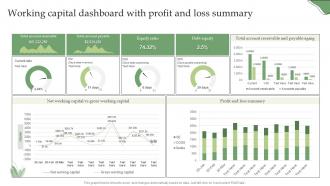
Working Capital Dashboard With Profit And Loss Summary
Try Before you Buy Download Free Sample Product
Audience
Editable
of Time
Our Working Capital Dashboard With Profit And Loss Summary are topically designed to provide an attractive backdrop to any subject. Use them to look like a presentation pro.
People who downloaded this PowerPoint presentation also viewed the following :
Working Capital Dashboard With Profit And Loss Summary with all 7 slides:
Use our Working Capital Dashboard With Profit And Loss Summary to effectively help you save your valuable time. They are readymade to fit into any presentation structure.
FAQs for Working Capital Dashboard With Profit
Look at four things: accounts receivable, inventory, accounts payable, and cash. Receivables tell you if customers are paying fast enough. Inventory shows whether you're actually moving product or just hoarding it (guilty as charged sometimes). Payables are about timing - pay suppliers smart without pissing them off. Cash seems obvious but people ignore it constantly. The goal? Collect faster, hold less stuff, pay strategically. Calculate your cash conversion cycle first - seriously, it'll show you exactly where money's getting stuck. That's where you start fixing things.
So basically, good working capital management frees up cash that's just sitting there in inventory or unpaid invoices. Less borrowing means lower interest costs - obvious but people forget this. You can actually grab those early payment discounts too (honestly, those 2/10 net 30 deals are free money). Short sentences help cash flow. Better flow means you won't scramble for emergency loans when things get tight. Don't hoard cash, but don't starve your operations either. Look at your cash conversion cycle first - that'll show you exactly where money's getting stuck and costing you.
Dude, inventory is like a cash black hole if you're not careful. Too much stock sitting around? That's money just collecting dust when you could be using it for literally anything else. Running out completely is obviously worse though - customers hate that. I'd focus on getting better at predicting what you'll actually need. Just-in-time ordering can help free up cash without leaving you scrambling. It's honestly one of those things where you're always walking a tightrope. The goal is having just enough to keep everyone happy without your warehouse turning into an expensive storage unit.
Look back at 2-3 years of cash flow data first - that's where you'll spot the real patterns. Check when receivables jump, inventory needs spike, and how your payment timing changes seasonally. Honestly, most people skip this step but it's huge. Build monthly projections around those peak/slow periods, then tack on a 10-15% cushion for weird stuff that comes up. Setting up seasonal credit lines that kick in automatically during busy periods is pretty smart too. Map out your cash conversion cycle month by month so you're not panicking when things get crazy.
Honestly, cash flow comes down to getting paid faster and paying others slower (but don't be a jerk about it). Invoice immediately - like, same day if you can. Follow up on late payments religiously. Offer small discounts for early payment, it's worth losing 2% to get cash now. With suppliers, negotiate longer terms upfront. I know it sounds super tedious, but do a 13-week cash forecast - saved my butt more times than I can count. Track how long it takes from sale to actual cash in hand. You'll be shocked at what you find.
So here's the thing - your financing mix totally controls how much cash you need sitting around. Short-term debt is honestly a pain because you're always scrambling to make payments and worrying about renewals. Equity's way more chill since there's no set payback schedule (investors still expect returns obviously). Long-term debt falls somewhere between those two. The big mistake I see people make? Using short-term money for long-term stuff. That's how you end up in cash flow hell. Just match your financing timeline to what you're actually buying and you'll save yourself major headaches.
Look into ERP systems first - SAP and Oracle both have solid cash flow modules built in. CashAnalytics and Kyriba are your go-to options for anything more advanced. Anaplan's pretty flexible too if you're dealing with weird scenarios. Treasury management systems give you real-time visibility across different accounts and currencies, which is clutch. Most of these play nice with whatever accounting software you're already using and pull data automatically. Just make sure whatever you pick updates frequently enough to matter - daily at minimum, but honestly hourly is way better if you can make it happen.
Just divide your current assets by current liabilities - basic math. Anything above 1.0 means you can pay your short-term debts, which is obviously what you want. Most businesses do well between 1.2-2.0, though honestly it depends on your industry. If it's too high, you might be hoarding cash instead of investing it back into growth. Too low and you'll stress about making payroll. I'd pull your balance sheet monthly and track this quarterly so you catch problems early. Oh, and definitely compare yourself to industry averages - that context matters way more than just the raw number.
Dude, running out of working capital is like being broke with bills due tomorrow. You can't pay suppliers or staff on time, which totally screws your relationships and credit score. The worst part? I've watched businesses actually turn away profitable orders because they couldn't afford the materials upfront - talk about frustrating. Emergency loans become your only option, but those interest rates are painful. Growth opportunities? Forget about it. Try keeping 3-6 months of expenses saved up and check your cash flow weekly. Trust me, it's way better than scrambling later.
Working capital is basically your financial buffer - you want enough to cover short-term stuff without hoarding cash that could be growing your business. Get customers to pay faster, don't overstock inventory, and time your bill payments smartly (just don't piss off suppliers). Most companies are honestly terrible at forecasting their actual cash needs. They'll sit on way more than necessary while complaining they can't invest in growth. Map out your cash conversion cycle first - when money comes in versus when it goes out. You'll probably find you're tying up cash for no good reason.
Here's the deal - asking suppliers for longer payment terms is basically free money. Instead of paying in 30 days, push for 60. You keep that cash working in your business longer, which is huge when things get tight or you're trying to grow. Honestly, most suppliers are more flexible than you'd think if you've been reliable. Pick your best relationships first and make it worth their while - maybe guarantee minimum orders or something. Just don't be weird about it. Frame it as a partnership thing, not like you're desperate for cash.
Honestly, economic conditions totally flip your working capital strategy upside down. When times are tough, you've got to get aggressive - stretch out payments to suppliers, chase down receivables like your life depends on it, and cut inventory to the bone. Cash becomes everything because customers start dragging their feet on payments. Growth periods? You can breathe a little and focus more on supporting sales instead of penny-pinching every transaction. Don't forget interest rates - they'll hit you hard when you need to finance those working capital gaps. I learned this the hard way in 2020 when everything went sideways. Track your cash conversion cycle monthly and pivot fast.
Oh that's easy - gross working capital is just all your current assets (cash, inventory, receivables, the usual stuff). But net working capital? Way more useful. That's your current assets minus what you owe short-term. Net working capital actually shows if you can cover your bills, which matters way more than just knowing how much stuff you have. Honestly, most people skip gross and go straight to net since it tells the real story about liquidity. I'd check both monthly though - you'll catch trends in your cash cycle that way. Super helpful for planning.
So basically you want to watch three ratios. Current ratio is current assets divided by current liabilities - shoot for 1.2 to 2.0. Quick ratio is the same thing but without inventory since that stuff can be a pain to sell fast. Then there's working capital turnover, which is just revenue divided by average working capital. Higher numbers mean you're being more efficient with your money. I'd set up something monthly to track these and compare against what other companies in your industry are doing. Oh and the working capital one is probably my favorite because it actually shows if you're putting your cash to good use.
Dude, the change in working capital management is crazy right now. Real-time cash flow forecasting and automated invoice processing are game changers. You can actually predict payment delays before they screw you over - which honestly should've existed years ago. Digital payments speed up collections big time, plus supply chain tech gives you way better inventory visibility. Companies crushing it right now? They're doing dynamic discounting and have their ERP systems dialed in. My advice: start with digitizing your accounts payable and receivable first. That's where you'll feel the cash flow impact immediately.
-
Editable, diversified, compatible with MS PPT and Google Slides, and on top of that finest graphics!! I mean in the words of the famous Ross Geller, “What more do you want!”
-
Thank you for offering such fantastic custom design services. The team is really helpful and innovative. In a very short time, I received my personalized template.