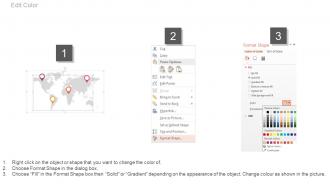
World map with multiple locations of social users powerpoint slides
Try Before you Buy Download Free Sample Product
Audience
Editable
of Time
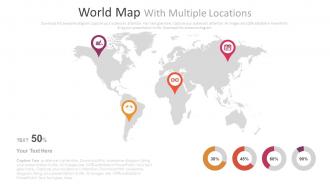
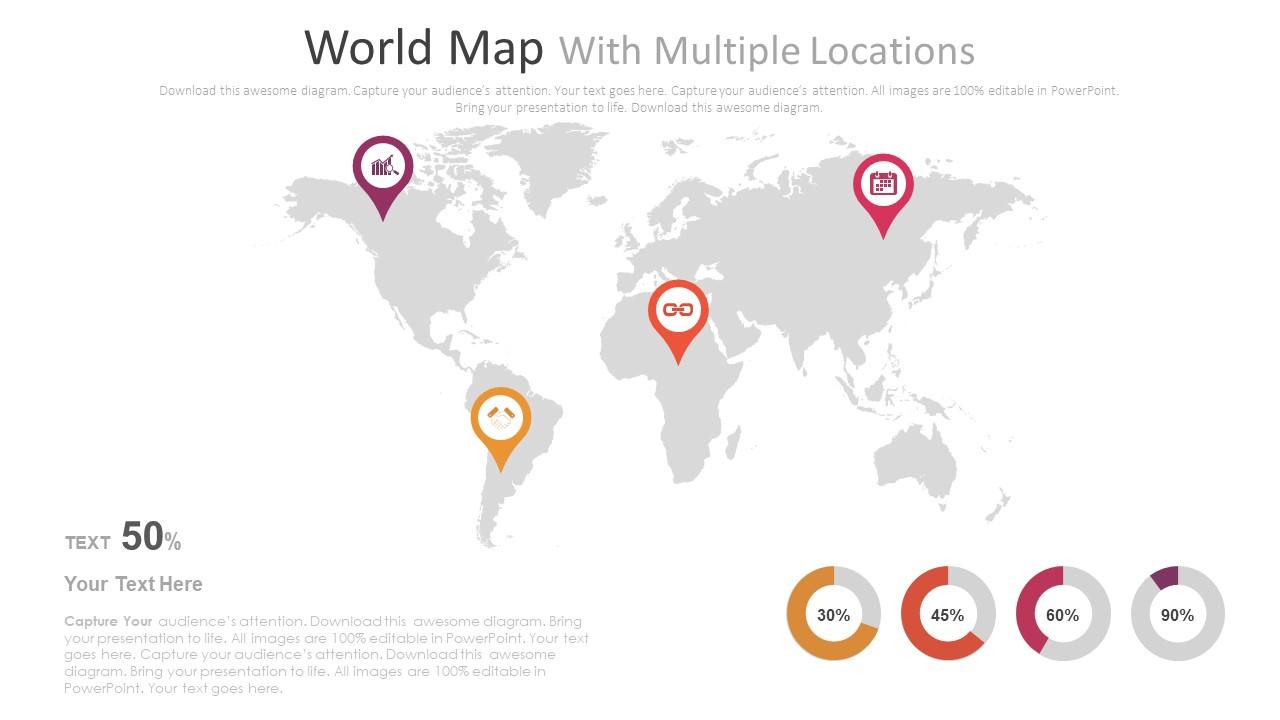
With businesses turning global, a trade organization needs to fetch the attention of international audience. The World Map with Multiple Locations of Social Users PowerPoint Slides is an ideal PPT template referring to the global attention seeking factor of the design. In this business slide template, the location icon on a certain gap signifies the various countries, states, etc. on a world map. A user can easily craft this PPT slide icon to represent the areas where one’s business is established, to represent the targeted audience or to target different location so as to carry forward the business in near future. This world map with multiple locations graphic design mainly lay focus on the social users. A business company can easily determine the audience with this location graphic design, and can further set the plans to carry on with the growth. A user can at the same time fix some targets to be achieved in a particular location while using this business template design. Each of our World Map With Multiple Locations Of Social Users Powerpoint Slides are absolutely enjoyable. They allow everyone to have a ball.
People who downloaded this PowerPoint presentation also viewed the following :
World map with multiple locations of social users powerpoint slides with all 4 slides:
Carry the baton forward with our World Map With Multiple Locations Of Social Users Powerpoint Slides. Continue giving it your absolute best.
FAQs for World map with multiple locations of social
**INPUT**: What are the key demographic trends represented in the world map social users data? **OUTPUT**: Key demographic trends in world map social users data include age distribution patterns, geographic concentration clusters, device preferences, engagement frequency variations, and platform-specific adoption rates across regions. These insights enable organizations to streamline marketing strategies, enhance targeted campaigns, and optimize resource allocation, with many businesses finding that demographic visualization ultimately delivers improved customer experiences and competitive advantage in increasingly digital markets. **Word Count**: 60 words
Businesses can leverage world map social user insights by analyzing geographic engagement patterns, demographic concentrations, platform preferences, cultural behaviors, and peak activity times across different regions. Through data visualization tools, companies streamline market segmentation, enhance content localization, and optimize ad spend allocation, with retail and financial services finding significant improvements in conversion rates and customer acquisition costs.
Microsoft PowerPoint combined with specialized mapping tools like Tableau, Canva Pro, and Adobe Illustrator delivers the most effective world map social user presentations. These platforms enable seamless data visualization, customizable geographic overlays, and interactive social media analytics integration, with many marketing teams and global organizations finding that PowerPoint's native SmartArt enhanced with third-party mapping extensions streamlines audience engagement while delivering professional, data-driven insights.
Visualizing social user distributions transforms complex demographic data into compelling visual narratives, enabling stakeholders to quickly grasp market penetration, regional opportunities, and audience concentration patterns across different territories. These world map presentations streamline decision-making by highlighting underserved markets, successful expansion areas, and strategic growth opportunities, with many organizations finding that geographic visualizations accelerate stakeholder buy-in and resource allocation decisions.
Challenges include data accuracy inconsistencies, varying privacy regulations across regions, cultural differences in social media adoption, time zone synchronization issues, and platform-specific user behavior variations. These complexities require strategic data normalization, cross-platform integration, and regional customization approaches, with many organizations finding that combining multiple data sources and implementing real-time validation ultimately delivers more reliable global social insights.
Cultural differences significantly impact social media usage patterns by influencing platform preferences, content consumption habits, communication styles, and privacy expectations across different regions. Eastern cultures often favor platforms emphasizing community and visual storytelling like WeChat and TikTok, while Western markets gravitate toward individual expression through Facebook and Instagram, with many organizations finding that localized social media strategies deliver better engagement and cultural resonance.
Visual design elements that enhance world map social user slides include interactive hotspots, color-coded regional data, animated user flow paths, responsive zoom features, and dynamic heat mapping overlays. These elements streamline data visualization by highlighting user engagement patterns, demographic concentrations, and regional performance metrics, with many marketing teams finding that strategic visual hierarchy ultimately delivers clearer audience insights and more compelling presentations.
Historical data comparisons can be integrated through timeline overlays, year-over-year progression slides, split-screen before/after visuals, animated growth trajectories, and comparative heat maps showing usage evolution. These presentation techniques enable organizations to demonstrate social media expansion patterns, identify emerging markets, and showcase growth milestones across different regions, ultimately delivering compelling narratives that highlight strategic opportunities and market penetration success.
Social media acts as a regional digital catalyst, influencing online behaviors, e-commerce adoption, communication preferences, and digital infrastructure development across different geographical areas. Through platforms like WeChat dominating Asia, WhatsApp driving business in Latin America, and Facebook shaping Western markets, organizations can strategically tailor their digital approaches, ultimately delivering localized customer experiences and competitive regional advantages.
Educators can use world map social user slides to visualize population distribution, internet penetration rates, social media usage patterns, and digital divide concepts across different continents and countries. These interactive presentations help students understand global connectivity, demographic trends, and cultural differences in technology adoption, while enhancing geography lessons with real-world data that connects traditional map skills to modern digital literacy and social studies curriculum.
**INPUT**: What type of data sources are most reliable for gathering social user information by region? **OUTPUT**: Reliable data sources for regional social user information include platform analytics APIs, government digital reports, market research firms like Statista, social listening tools, and telecom industry studies. These sources enable organizations to track user demographics, engagement patterns, and regional preferences across different markets, with many businesses finding that combining multiple data streams delivers more accurate insights for strategic planning and targeted marketing efforts.
Interactive features can be incorporated through clickable regions revealing detailed analytics, animated data flows showing real-time user activity, hover effects displaying demographic breakdowns, and dynamic filtering options by platform or time period. These elements transform static presentations into engaging experiences, with many organizations finding that interactive world maps increase audience retention and facilitate deeper discussions about global social media strategies, ultimately delivering more impactful presentations.
The digital divide creates unequal social user representation globally, with developed regions showing higher connectivity while underserved areas face limited access, outdated infrastructure, and economic barriers. This imbalance distorts global perspectives in social media analytics and marketing strategies, with many organizations finding that targeted infrastructure investments and inclusive digital policies ultimately deliver broader market reach and more authentic global engagement.
Businesses can update their world map social user presentations by integrating APIs from social platforms, utilizing dashboard software like Tableau or Power BI, and implementing automated data refresh systems. These technologies streamline data collection, enhance visualization accuracy, and enable real-time monitoring across global markets, with many organizations finding that automated updates deliver faster insights and more strategic decision-making capabilities.
**INPUT**: What storytelling techniques can be applied to enhance the narrative around world map social users? **OUTPUT**: Effective storytelling techniques include data-driven narratives, progressive disclosure, comparative analysis, trend visualization, and user journey mapping across geographic regions. These approaches enhance engagement by revealing usage patterns, demographic insights, and growth trajectories, with organizations finding that compelling visual narratives ultimately drive better strategic decisions and stakeholder buy-in.
-
Awesome use of colors and designs in product templates.
-
Thanks for all your great templates they have saved me lots of time and accelerate my presentations. Great product, keep them up!