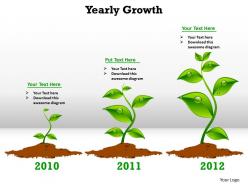
Yearly growth shown by plants growing from seedling to fully grown powerpoint diagram templates graphics 712
Try Before you Buy Download Free Sample Product
Audience
Editable
of Time
Our yearly growth shown by plants growing from seedling to fully grown powerpoint diagram templates graphics 712 have a captivating effect. Leave your audience spellbound with your brilliance.
People who downloaded this PowerPoint presentation also viewed the following :
Content of this Powerpoint Presentation
Description:
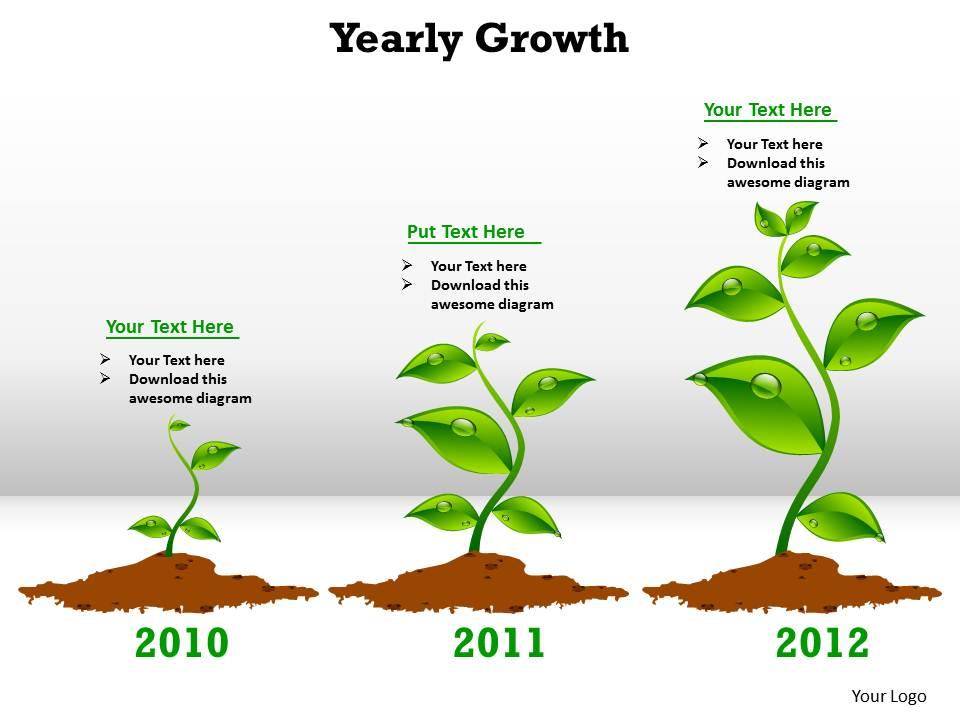
The image displays a PowerPoint slide titled "Yearly Growth," featuring a metaphorical representation of growth in the form of plants sprouting from the ground and increasing in size by the year. Each plant corresponds to a year from 2010 to 2012, progressively getting larger as a visual symbol of growth over time.
The slide allows for customization by embedding text in specific areas. The bottom part provides spaces where years are marked, which can be updated to reflect the timeline relevant to the presentation. Each plant has allocated bullet points where detailed information or achievements of respective years can be added. The left plant, corresponding to 2010, has one bullet point where the presenter can mention a starting point or an initial achievement. The middle plant, representing 2011, has two bullet points for more in-depth details or developments. The rightmost plant, for 2012, offers three bullet points, suggesting the most significant growth or success in this period.
Use Cases:
Here are seven industries where this slide can be applied, along with specific use cases, presenters, and audiences:
1. Agriculture:
Use: Illustrating annual crop yield increase
Presenter: Agricultural Scientist
Audience: Farmers and Agribusiness Investors
2. Financial Services:
Use: Presenting yearly revenue or profit growth
Presenter: Chief Financial Officer
Audience: Shareholders and Analysts
3. Education:
Use: Showing graduation rates or test score advancements
Presenter: Dean or School Administrator
Audience: School Board and Education Stakeholders
4. Healthcare:
Use: Demonstrating patient recovery rates or clinical trial phases
Presenter: Healthcare Administrator or Research Lead
Audience: Medical Staff and Investors
5. Renewable Energy:
Use: Depicting annual increase in energy production or efficiency
Presenter: Energy Analyst or Company Executive
Audience: Stakeholders and Environmental Agencies
6. Retail:
Use: Showcasing growth in store numbers or annual sales
Presenter: Retail Manager or Business Development Executive
Audience: Retail Teams and Investors
7. Technology:
Use: Outlining year-on-year growth in user base or product releases
Presenter: Chief Technology Officer
Audience: Investors and Technology Enthusiasts
Yearly growth shown by plants growing from seedling to fully grown powerpoint diagram templates graphics 712 with all 4 slides:
Convey your ideas with elan. Use our yearly growth shown by plants growing from seedling to fully grown powerpoint diagram templates graphics 712 as the medium.
FAQs for Yearly growth shown by plants growing from seedling to fully grown powerpoint diagram
Plant growth diagrams typically illustrate germination, seedling emergence, vegetative growth, flowering, fruit development, and seed maturation as key developmental stages. These visual representations enhance educational presentations by streamlining complex biological processes, enabling educators in schools, universities, and agricultural institutions to deliver clearer instruction, while organizations increasingly find that structured growth models improve training programs and ultimately deliver better learning outcomes across diverse educational environments.
A plant growth diagram illustrates photosynthesis by showing how sunlight, water, and carbon dioxide interact within plant structures like leaves, stems, and roots to produce glucose and oxygen. These visual representations help students, researchers, and educators understand the complex biochemical processes, cellular interactions, and energy transformations occurring during photosynthesis, ultimately delivering clearer comprehension of plant biology fundamentals.
Roots serve as the foundation for plant growth by anchoring the plant, absorbing water and essential nutrients from soil, and storing energy reserves for development. Growth diagrams typically illustrate how root systems expand underground while supporting above-ground growth, with many educational presentations showing this symbiotic relationship between root health and overall plant vigor, ultimately demonstrating how stronger root networks enable more robust foliage and reproductive success.
Plant growth diagrams visually represent environmental factor effects through comparative growth stages, branching pathways showing different conditions, color-coded variables like light and water levels, and measurable outcomes at each phase. These visual tools enhance understanding by displaying complex interactions between temperature, soil quality, and nutrient availability, ultimately delivering clearer insights for agricultural planning, educational presentations, and research documentation across botanical and farming sectors.
Healthy plant growth markers include increasing stem height, expanding leaf surface area, robust root system development, consistent node spacing, and progressive biomass accumulation over time intervals. These indicators enable agricultural researchers, botanists, and commercial growers to assess crop viability, optimize cultivation strategies, and predict harvest yields, ultimately delivering enhanced productivity and competitive advantage in increasingly data-driven farming environments.
Nutrient cycles integrate with plant growth stages by providing essential elements like nitrogen during vegetative growth, phosphorus for root development, and potassium throughout flowering and fruiting phases. These cycles enable plants to absorb, utilize, and recycle nutrients systematically, with agricultural operations and greenhouse facilities finding that understanding these interactions optimizes crop yields and resource efficiency.
Plant growth diagrams serve educational purposes by illustrating germination stages, root development, leaf formation, flowering processes, and photosynthesis cycles in clear, visual sequences. These diagrams enable botany students to understand complex biological processes, compare different plant species' development patterns, and grasp timing relationships between growth phases, ultimately delivering enhanced comprehension and retention of botanical concepts.
The diagram differentiates monocots and dicots through distinct structural features, growth patterns, and developmental characteristics. Monocots display parallel leaf venation, scattered vascular bundles, and fibrous root systems, while dicots show branched venation, organized vascular arrangements, and taproot systems, with many botanical presentations finding that these visual comparisons enhance understanding of plant classification.
A plant growth diagram reveals how light intensity, duration, and spectrum influence photosynthesis rates, stem elongation patterns, leaf development, and flowering timing throughout different growth stages. These visual representations help agricultural researchers, greenhouse operators, and botanical educators understand optimal lighting conditions for crop yields, with many commercial growers finding that controlled light environments significantly enhance plant productivity and harvest predictability.
Diagrams illustrate plant growth and soil health relationships by visualizing root development, nutrient absorption pathways, water uptake mechanisms, and microbial interactions within soil ecosystems. These visual tools enable agricultural researchers, environmental scientists, and farming organizations to demonstrate how soil pH, organic matter, and mineral content directly impact crop yields, ultimately helping optimize growing conditions and enhance agricultural productivity.
Plants display adaptations including root system expansion, leaf surface area optimization, stem structural reinforcement, reproductive organ development, and resource allocation shifts throughout their growth cycles. These physiological changes enable seedlings to establish foundation systems, mature plants to maximize photosynthesis and structural integrity, and reproductive-stage plants to ensure successful propagation, with many agricultural and horticultural operations finding these growth patterns essential for optimizing crop yields.
A plant growth diagram aids agricultural practices by visualizing growth stages, identifying optimal planting times, predicting harvest schedules, monitoring nutrient requirements, and tracking developmental milestones throughout crop cycles. These visual tools enable farmers to streamline irrigation timing, enhance fertilizer application strategies, and optimize resource allocation, with many agricultural operations finding that systematic growth tracking ultimately delivers improved yields and more efficient crop management practices.
**INPUT**: What technological tools can enhance the accuracy of plant growth diagrams? **OUTPUT**: Technological tools enhancing plant growth diagram accuracy include digital imaging software, time-lapse photography systems, 3D modeling applications, sensor-based measurement devices, and AI-powered analysis platforms. These technologies streamline data collection, automate growth tracking, and minimize human error, with agricultural research institutions and botanical organizations finding that precise digital documentation ultimately delivers more reliable scientific insights and improved cultivation strategies. [Word count: 60 words]
Plant growth diagrams complement scientific research by providing visual documentation of developmental stages, morphological changes, growth patterns, and physiological processes across different plant species. These detailed illustrations enable researchers to track cellular development, compare genetic variations, and analyze environmental impacts on growth cycles, while facilitating peer collaboration and educational communication, ultimately advancing botanical understanding and agricultural applications.
Seasonal changes significantly influence plant growth stages by affecting germination timing, growth rates, flowering periods, and dormancy cycles. Temperature fluctuations, daylight duration, and moisture availability determine when seeds sprout, how quickly plants develop, and when reproduction occurs, with many agricultural and horticultural operations strategically timing planting schedules to optimize these natural seasonal transitions for maximum yield and plant health.
-
Unique research projects to present in meeting.
-
Best Representation of topics, really appreciable.