



 0 Comment
 Customer Reviews

With the growth of marketing channels, it's more important than ever to focus your efforts on reaching the right audience. Poor targeting wastes resources, costing about $37 billion each year in the U.S. due to ads that miss their mark.
So, how do you modify your marketing strategy to find the correct target audience?
In 1983, Alan Cooper solved this question by introducing the concept of “personas” (now known as buyers persona). The goal was to help software developers better understand their users when designing products. Cooper later formalized this approach in his 1999 book "The Inmates Are Running the Asylum."
In it, he described buyer's personas as fictitious, detailed archetypes representing distinct user groups with attributes such as names, personalities, behaviors, and goals.
These comprehensive character sketches have become essential tools for businesses to better understand and connect with their ideal customer profiles. Moreover, this personal approach has proven incredibly successful. When companies invest in research services and take the time to create detailed customer profiles, they see their marketing tactics bring in almost triple the revenue (171%).
In this blog, we will discuss the buyer's persona in detail and examine how it elevates business growth.
Looking for professionally made, ready-to-use Buyer’s Persona templates? Click here!
What Is Buyers Persona?
A buyer persona is a detailed ideal customer profile. It is based on extensive market research done on your existing customers. Think of it as creating a character sketch of your perfect customer.
The client persona digs deeper than just market demographic information and helps to understand:
- What problems keep your customers up at night
- How they make purchasing decisions
- Where they look for information
- What might stop them from buying your product
- Their daily routines and habits
- Their professional and personal ambitions
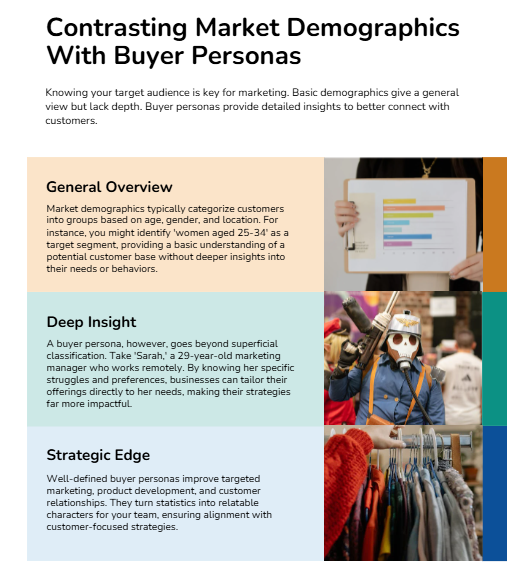
For example, you want to analyze your customer’s needs. So your audience persona would look something like this-

Tip: Get this buyer persona template today and start developing a customer persona marketing strategy!
Do You Know About Negative Buyers Persona?
A negative buyer persona (also called an "exclusionary persona") is essentially the opposite of a buyer persona. It represents the type of customer you don't want to target. Consider it a "do not sell to" list that helps businesses avoid investing time and resources in pursuing the wrong customers.
These personas typically include:
-Students or researchers who are interested in your content but will never buy.
-Professionals who are too advanced or too junior for your product.
-Window shoppers who regularly engage with your content but have no purchasing power.
-Customers whose acquisition costs would be too high compared to their lifetime value.
-People who would be likely to churn quickly after purchase.
For example, if you sell enterprise software, a negative persona might be "Tom, a small business owner with 2-3 employees, who loves exploring new technology but doesn't have the budget or infrastructure needs that would justify purchasing our solution.”
Creating negative personas is just as valuable as positive ones because they help you:
-Save marketing and sales resources.
-Improve lead quality.
-Reduce customer acquisition costs.
-Maintain a more focused marketing strategy.
-Decrease customer churn rate.
Reasons a Buyers Persona Elevates Business Growth
A buyer’s persona, as established, is a semi-fictional representation of your ideal customer based on research and data. Incorporating buyer personas into your strategy results in a focused approach to growth.
With clear insights into customer behavior, businesses stay competitive and achieve great ROI. Here’s how:
- Targeted Marketing Campaigns: Personas determine which target audience a business should engage and what pain points they have. Using this information, a marketing campaign can be created for potential customers to boost conversion rates.
- Personalized Communication: This persona will help businesses provide personalized messaging to their audience. This eventually can create engagement among customers, which further will build trust- an extremely important factor for brand loyalty.
- Efficient Resource Allocation: Knowing the audience means no resources are wasted on the wrong marketing channels. Companies can focus on those that work.
- Enhanced Product Development: Learning consumer attitudes in a better understanding that they will better design products according to what features will matter and prioritize which will best meet the market need.
- Improved Customer Retention: Personae builds stronger customer relationships by attending to the unique challenges of these customers with specific solutions.
- Better Sales Alignment: A sales team may use such personae to ascertain the right lights before launching into an explanation of further products or services that match requirements, increasing close rates.
How Many Types of Customer Persona Can You Build?
First of all, customer personas differ according to the industry, audience, and business goals. Every individual category of persona provides a different perspective on what customers want and, therefore, helps companies formulate their strategy.
Moreover, combining various types drives you to understand your audience comprehensively, and no potential customer group will be left out. Here are the main types:
- Demographic Personas: Cover basic information such as age, gender, income, education, and marital status. These form the base for understanding as many people as possible in the customer base.
- Behavioral Personas: This type of audience persona is made based on actions performed by the customer. These might be shopping behavior, interaction with different brands, or even how decision-making occurs. Predictive in nature for the customer behavior and preferences.
- Psychographic Personas: This one goes much deeper into worthwhile concepts, beliefs, attitudes, and lifestyles. It is suitable for brands that seek to touch on the emotional aspect of the audience.
- Geographic Personas: The focus of this type lies on where the customer is based and the preferences they have regarding various regions. This is essential for businesses that are operating in more than one location or catering to local markets.
- B2B Personas: The b2b buyer persona is designed especially for business-to-business models. It focuses on the internal variegates of a company, such as size, industry, decision-making role, and organizational challenges.
- Seasonal Personas: These types of client personas highlight customer behavior during a particular time of year, such as holidays or sales seasons. It gives different perspectives on the customers' needs so that the business can make personalized strategy arrangements.
What Are The Prerequisites For Marketing Personas?
Creating effective marketing personas requires thorough preparation. Here’s what you need:
- Research the public: Conduct surveys and interviews and analyze customer feedback. You can use analytics tools to gather information about demographics, behaviors, and preferences.
- Customer Segmentation: Segregate your audience into groups according to some commonality across similar age groups, interests, buying habits, etc. This step ensures that every persona maps to some specific segment.
- Competitor Analysis: Learn how the competitors reach the audience close to it. Find the gaps in their approach for capitalizing to stand out.
- Data Collection: The acquisition of online data from CRM tools, social media analytics, and site behavior gives an idea of how customers behave with the brand.
- Clear purpose: Set clear intent on what you want to achieve with these personas for increasing customer retention, improving conversions, or launching a new product.
- Internal Feedback: Find out the pain points and most common questions from the sales and customer service teams as well as marketing personnel.
- Regular Updates: marketing personas are not just frozen in time but require constant updates due to changes in trends and behavior. Thus, personas should change from time to time. This practice will help your business to answer the market immediately.
We get it! Doing all the research is hard enough, and making sense of it can feel overwhelming. This is where SlideTech comes in! We will help you design a buyer persona according to the needs of your business, be it for team discussions, marketing strategy formulation, or striking an impressive pitch deck for investors. Let your research upgrade your business and increase the ROI.
How to Create Target Audience Personas in 7 Steps?
- Define Your Goals:
Determine the purpose of creating personas. Are you aiming to increase sales, enhance customer retention, or improve engagement? - Gather Data:
Use tools like Google Analytics, CRM software, surveys, and interviews to collect data on demographics, behaviors, and preferences. - Identify Patterns:
Segment your audience by identifying common traits, challenges, and goals across your customer base. - Create Persona Profiles:
Build detailed profiles, including names, job roles, demographics, goals, pain points, and buying behaviors. This humanizes your target audience. - Validate With Real Customers:
Test your personas by interacting with customers to ensure they accurately reflect their needs and challenges. - Align With Team Goals:
Share personas with your marketing, sales, and product teams to ensure alignment and a cohesive strategy. - Update Regularly:
Keep personas relevant by revisiting them periodically to incorporate new data, trends, and feedback.
Examples of Buyers Persona With Sample Templates
# Understanding the Bargain Hunter Buyers Persona
A significant category for customers is bargain shoppers. Important consideration should be given to creating their buyer persona. Even if they do not fit the mold of your so-called perfect customer, discounts will attract them, and they are foremost among all other individuals most likely to buy.
Price hunters seek the best price possible and are usually willing to compare options to arrive at a decision. One can benefit from understanding their behavior patterns and preferences by creating offers that touch them precisely for easier conversion to loyal customers.
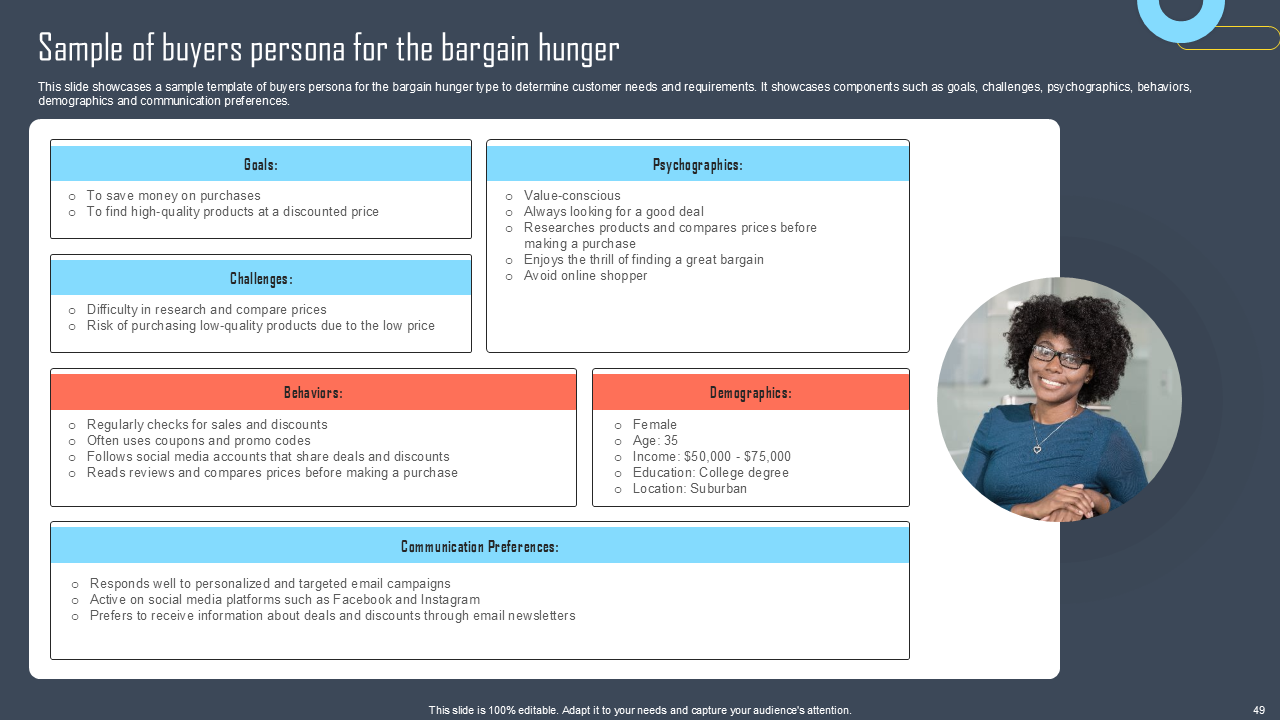
- Goals: Save money while finding a good product at a discounted price.
- Challenges: they can struggle with price comparison and avoiding sub-standard products.
- Psychographics: bargain hunters love deals, compare prices, and avoid buying online.
- Behaviors: Check on sales, use coupons, follow deal pages, and read reviews before buying.
- Demographics: Typically, these are women. They are generally suburban and usually 35 years old, earning between 50,000 and 75000 dollars.
- Communication Preferences: They will respond to personalized emails, follow the brand on Facebook and Instagram, and receive newsletters.
Why It’s Important?
This persona helps businesses:
- Understand customer needs and habits.
- Create targeted marketing campaigns.
- Focus on relevant products and channels.
Businesses can use this persona to improve engagement, align team strategies, and appeal to investors with insights into their audience.
# Understanding the Quality Seeker Buyers Persona
High-quality items are demanded at higher prices. Quality-seeking customers’ are willing to pay higher prices to get what they want. Keeping this in mind, you can pitch your products higher and connect with audiences by offering them high-end products.
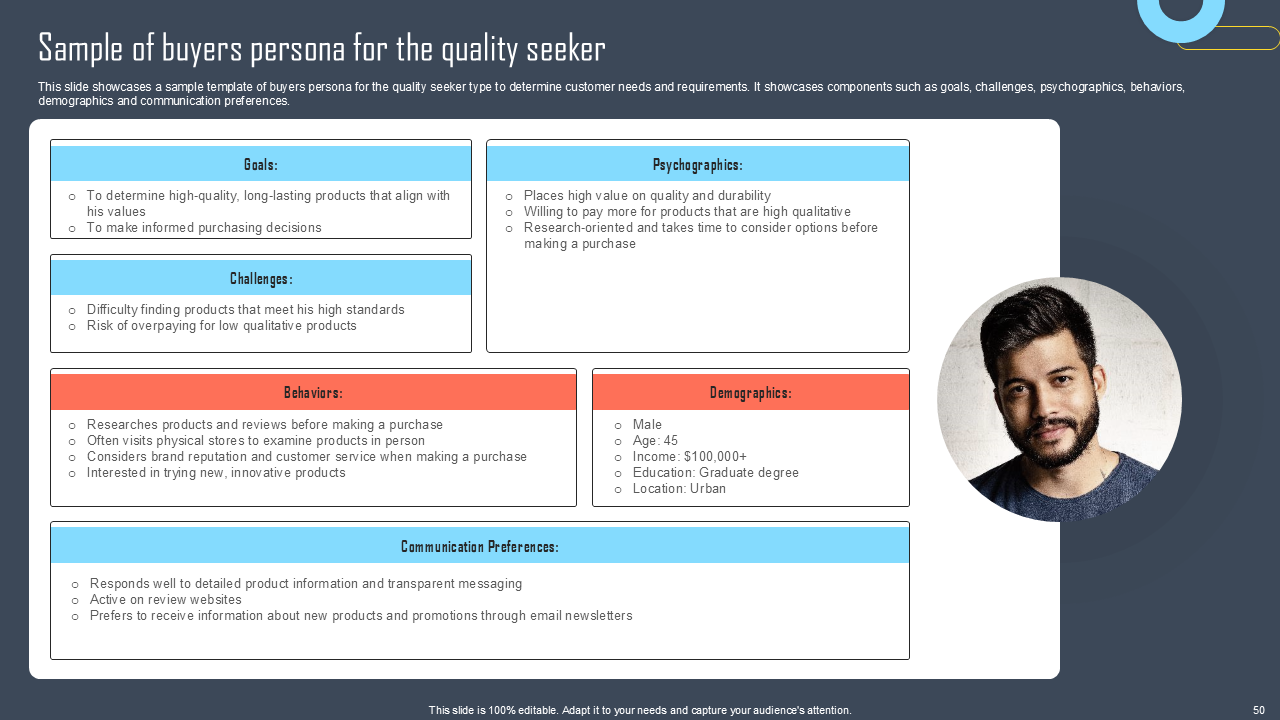
- Goals: Find durable, high-quality products and make real informed decisions.
- Challenges: Struggle to find products that meet their standards and fear overpaying for low-quality items.
- Psychographics: They prioritize quality, spend time researching, and prefer trusted brands.
- Behaviors: They read reviews, visit stores, and enjoy trying new products.
- Demographics: Urban males, around 45, with a $100,000+ income.
- Communication Preferences: They like detailed product info, trust reviews, and prefer email updates.
Why It’s Important?
This persona helps businesses:
- Understand their needs and preferences.
- Create marketing that emphasizes quality and trust.
- Build stronger customer relationships.
Focusing on this persona helps businesses attract customers who value quality and are willing to invest.
Best Practices While Designing Buyers Persona
- Start With Real Data:
Avoid assumptions; base personas on genuine customer data for accuracy. - Focus on Pain Points:
Highlight the challenges your audience faces and how your product addresses them. - Use Visuals:
Include photos, charts, and infographics in your personas for better comprehension. - Keep Them Specific:
Avoid vague descriptions; create detailed, focused personas for each customer segment. - Collaborate With Teams:
Gather input from sales, customer service, and marketing teams to get diverse perspectives. - Prioritize Scalability:
Start with a manageable number of personas and scale up as your business grows. - Test and Refine:
Use personas in campaigns and track results to identify areas of improvement.
Conclusion
Creating a buyer’s persona is key to unlocking growth. It helps you define your niche customers and target audiences. It gives you a chance to refine marketing strategies for better results. Don't let poor targeting waste your resources. Let SlideTeam’s research services help you craft accurate buyer personas that deliver success.
Contact SlideTeam today to create impactful buyer personas personalized to your business needs. Elevate your marketing strategy and increase your profits!