

Cybersecurity powerpoint presentation slides





Try Before you Buy Download Free Sample Product
 Impress Your
 Audience
 100%
100% Editable
 Save Hours
 of Time


Let your team understand the importance of Computer security with the assistance of our Cyber Security PowerPoint Presentation Deck. In today’s time, it is quite essential to pay attention towards the protection of computer systems from theft or damage as there is a every chance of your data being accessed by someone else. Our creative designing team has crafted this PPT Deck with 17 slides for you to share the information related to IT security. Although there are cyber security standards available but still there are people in the market who try to capture your data to either use it for their own purpose or sell it to some other organization. This presentation deck enables you to highlight the information related to cyber attacks that can create concerns such as backdoor, direct-access attacks, eavesdropping, phishing, spoofing, tampering etc. By taking certain security measures you can protect your data. Cyber Security standards attempt to protect the cyber environment of a user or an organization. The PowerPoint deck contains some slides which include information related to tips, initiatives, step to ensure that your data is protected at every step. So, download it and take precautionary steps to secure your IT system. Cater for crazy cravings with our Cyber Security Powerpoint Presentation Slides. Find a harmless way to fulfill deep desires.
People who downloaded this PowerPoint presentation also viewed the following :
Content of this Powerpoint Presentation
With cybersecurity becoming such an important part of our personal and professional lives today, it is imperative that the world accords it the importance it deserves.
It needs to be paid for by each of us, along with other utilities like water, power, and roads.
This milestone, however, is a fair time away, with businesses and consumers both caught in two minds about whether something that is not seen is actually worth this much money and resources.
For cybersecurity key performance indicators, we have special-purpose slides. Click here.
Until people in the industry resolve this pain point of what it costs to ensure cybersecurity on a daily basis, we will continue to have organizations lose data and put the financial security of millions of users in peril, as happened in the 2017 ransomware attack, which affected 150 counties and 200,000 computers.
To battle this inertia in cybersecurity, tips, tricks, and policy initiatives are needed. Awareness plus action that moves things forward is also needed, and SlideTeam is the best option for this. We curate templates on cybersecurity that have expert backing, world-class aesthetics, and actionable pointers to ensure users can act on the information.
These slides are provided based on your business goals, from tactical tips to a strategy that must guide your cybersecurity effort.
Each slide is 100% editable and customizable. You get structure, a starting point, and the capability to tailor each presentation to the audience’s profile.
Let’s explore these templates now!
Template 1 Cybersecurity Seven-Step Template
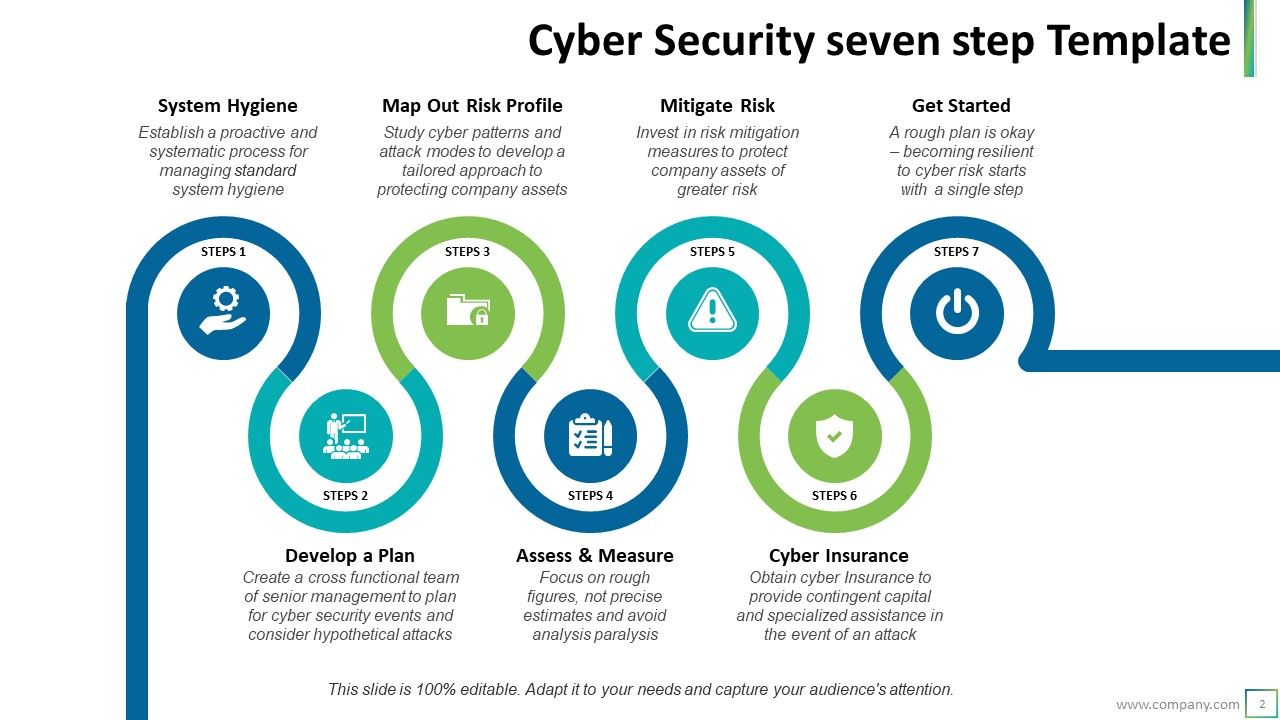
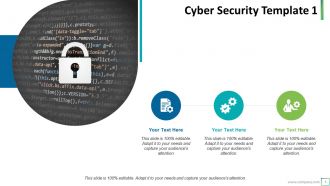
Getting started can be tricky in something that appears as scary and as complicated as ensuring cybersecurity. Use this PPT Template as the base on which to build your base to be safe against cybercrime in seven steps. The seven steps in cybersecurity that the slide puts forward are creating system hygiene and developing a plan where senior management is active. With these steps, you can map out what your company is most at risk from, with the management able to assess and measure risks, threats, and possible courses of action. Cyber insurance has to be taken, and voila, you are ready to invest in cybersecurity as a fundamental business practice.
Template 2 Cybersecurity Prevention Setting Policy
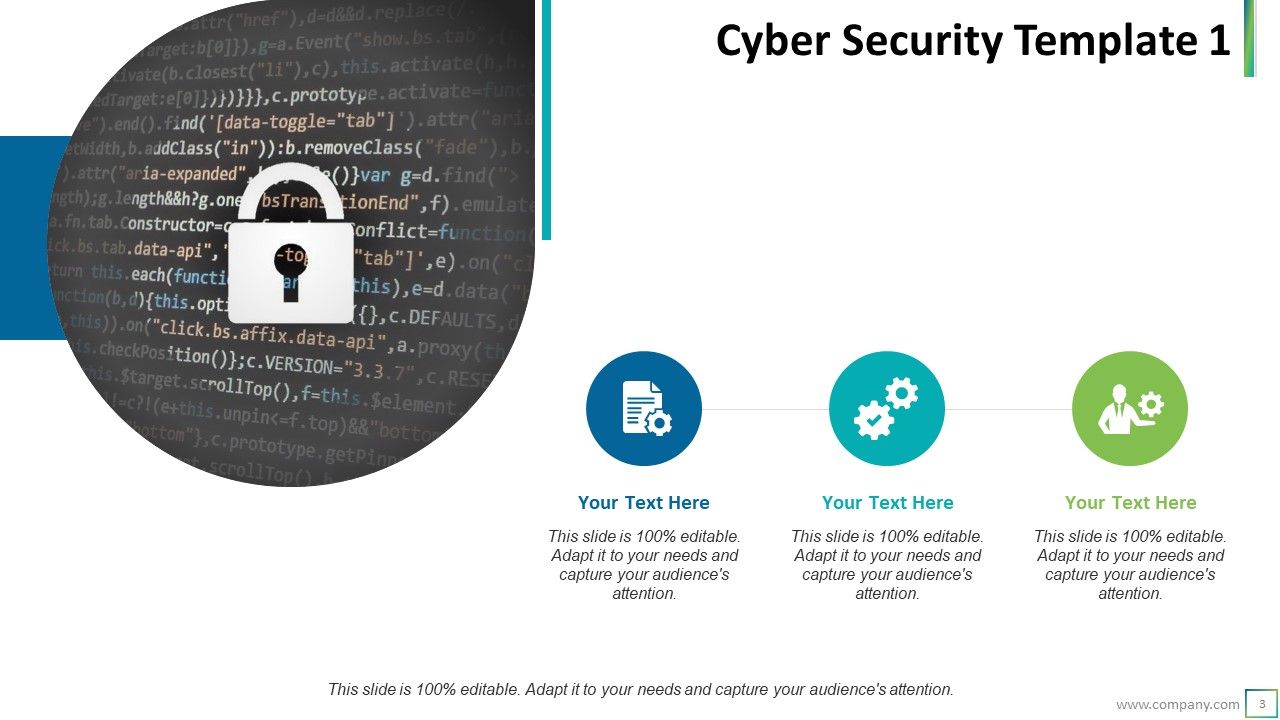
This is the point from where you can start your action plan. With this PPT Slide, signal that you mean business and list the three central planks of your fight against cybersecurity listed on it. The text can be all yours to ensure your reality is reflected through the slide. In the first step, you research and dig deep into what you can do. In step 2, there is more action as the rubber of your action plans hits the rounds. Finally, in the last step, you analyze the impact of your work.
Template 3 Cybersecurity Prevention Understanding The Requirements
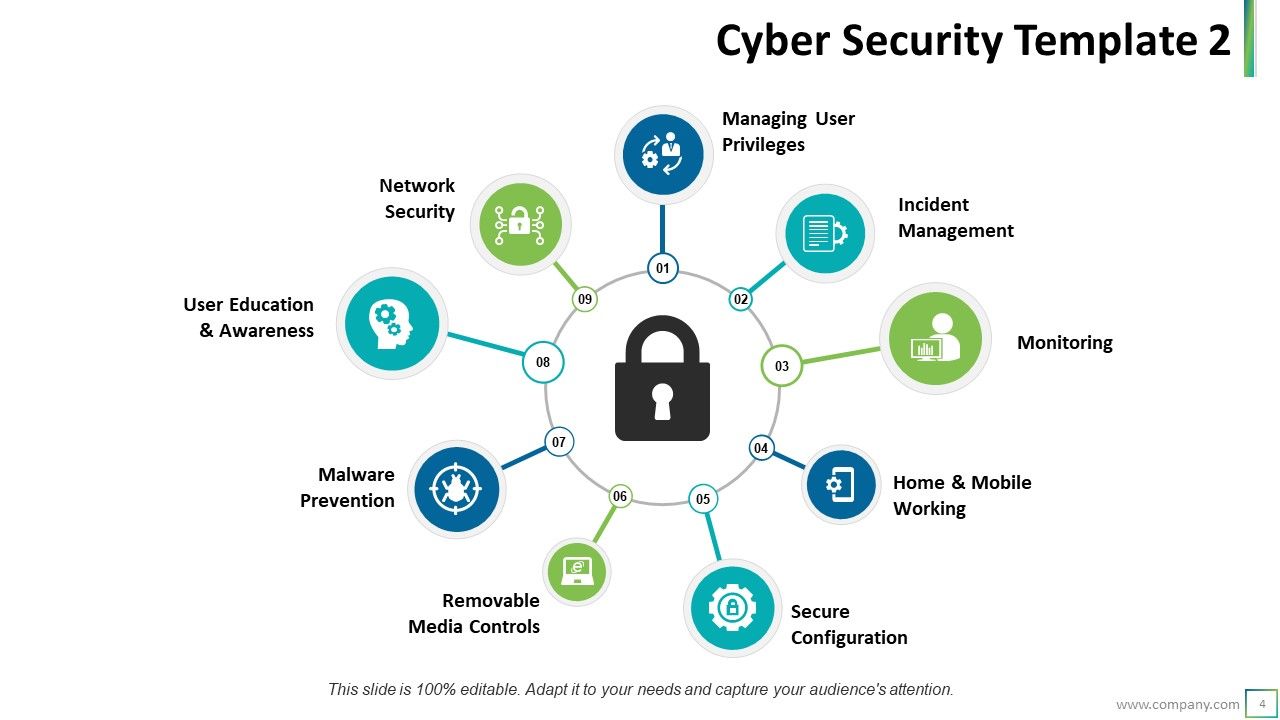
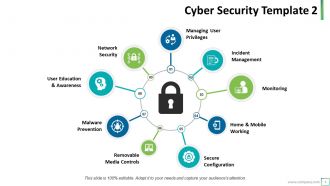
Do you want to know what are the crucial keys that feed into a robust lock on your vital installations and systems for cybersecurity? Nearly a dozen inputs are needed to ensure your cybersystems become safe. This PPT Template lists some of these as user education and awareness, home and work networking, monitoring, network security, removable media controls, and secure configuration. Understand the mechanics of a robust system of cybersecurity culture with a download of this template.
Template 4 Cybersecurity Prevention: Numbers that Reflect Need
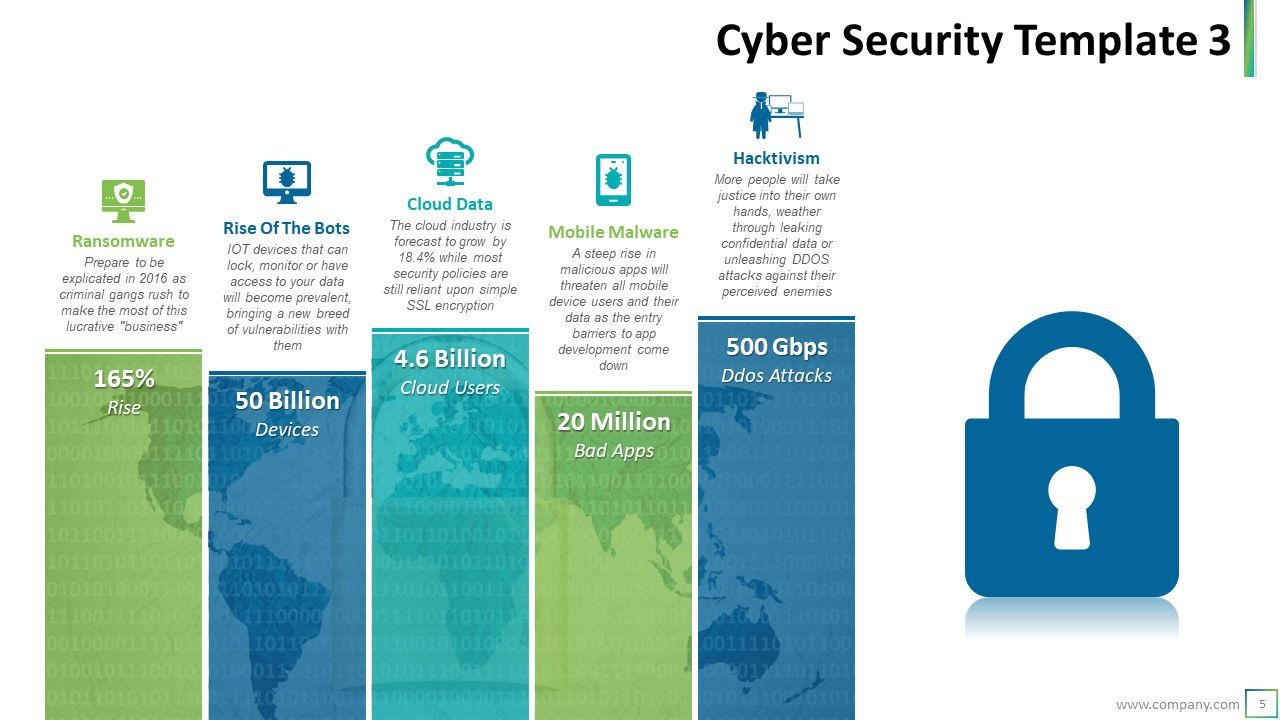
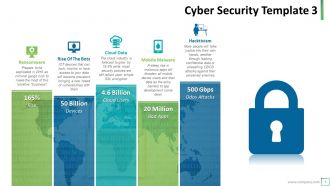
Users will find this template helpful in understanding the threat that ignoring cybersecurity poses in terms of statistics. For instance, cases of ransomware tend to double every year; mobile malware will see a steep rise, with apps specifically targeting people based on profiles as the cost of developing the app comes down. Cloud-based data will need more protection, as the slide shows. The template also depicts how hacktivism will also see a rise. Get this PPT Template now to understand how big a threat cybersecurity is.
Template 5 Cybersecurity Framework Covering all Bases PPT Template
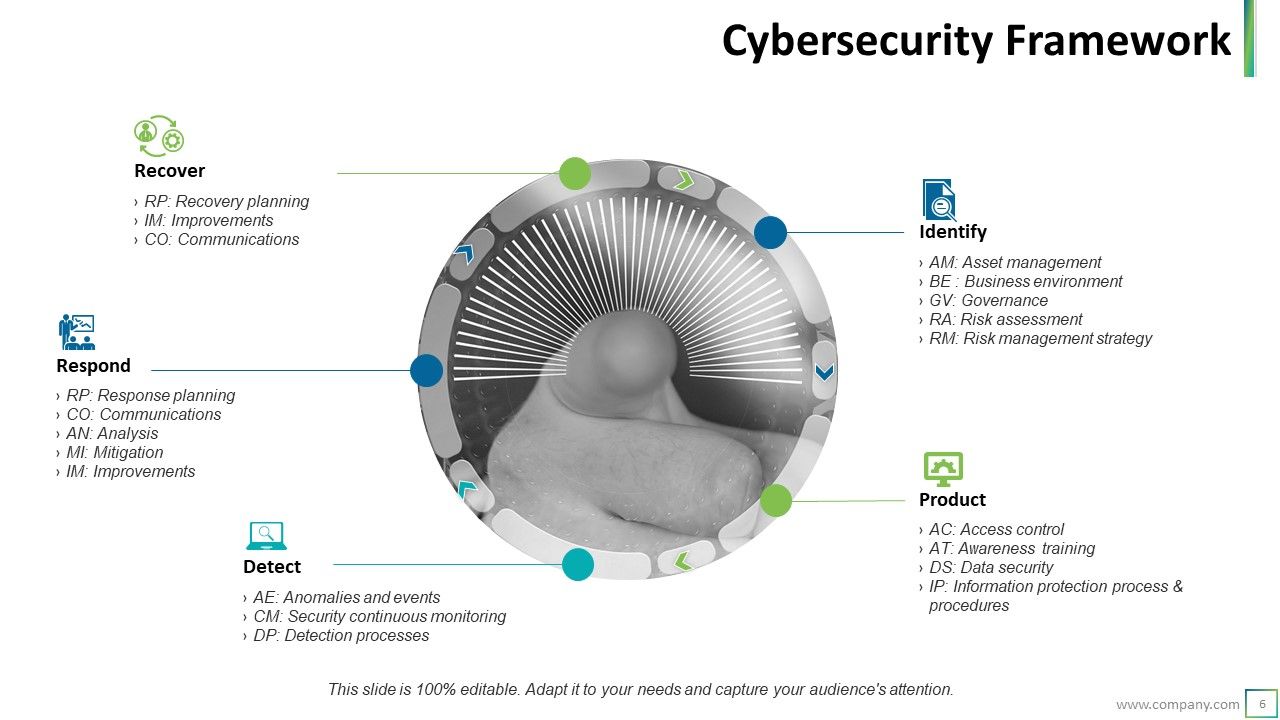
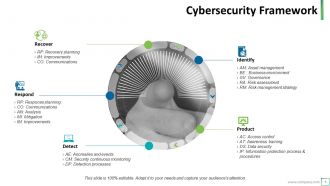
This PPT Template gives users a cybersecurity framework that starts with stage 1 of DETECT. Any framework must be adept at continuously monitoring security and excellent at detecting processes and red-flag anomalies and events. After detection, the following four stages are responding, recovering, identifying, and focusing on the product. The slide’s actionable points are abbreviated to ensure the business finds it easy to work on aspects of the cybersecurity framework.
Template 6 Cybersecurity Initiatives in Detail Outline for Complete Prevention

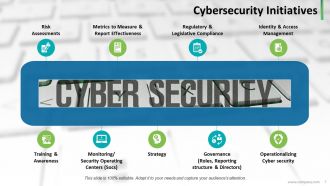
In this PPT Template, you will find the entire list of cybersecurity initiatives you can take to ensure better security at lower costs for longer. The best step in the positive direction of strengthening cybersecurity has to be to ensure training and awareness. Then, businesses must invest in risk assessments and metrics to measure and report effectiveness and operationalizing cyber security. Identity and access management and governance (roles, reporting structure & directors) become essential. Strategy and security operating centers are critical infrastructures that must be set up for a robust experience. Get this template now!
Template 7 Cybersecurity tips and tricks for daily implementation and action
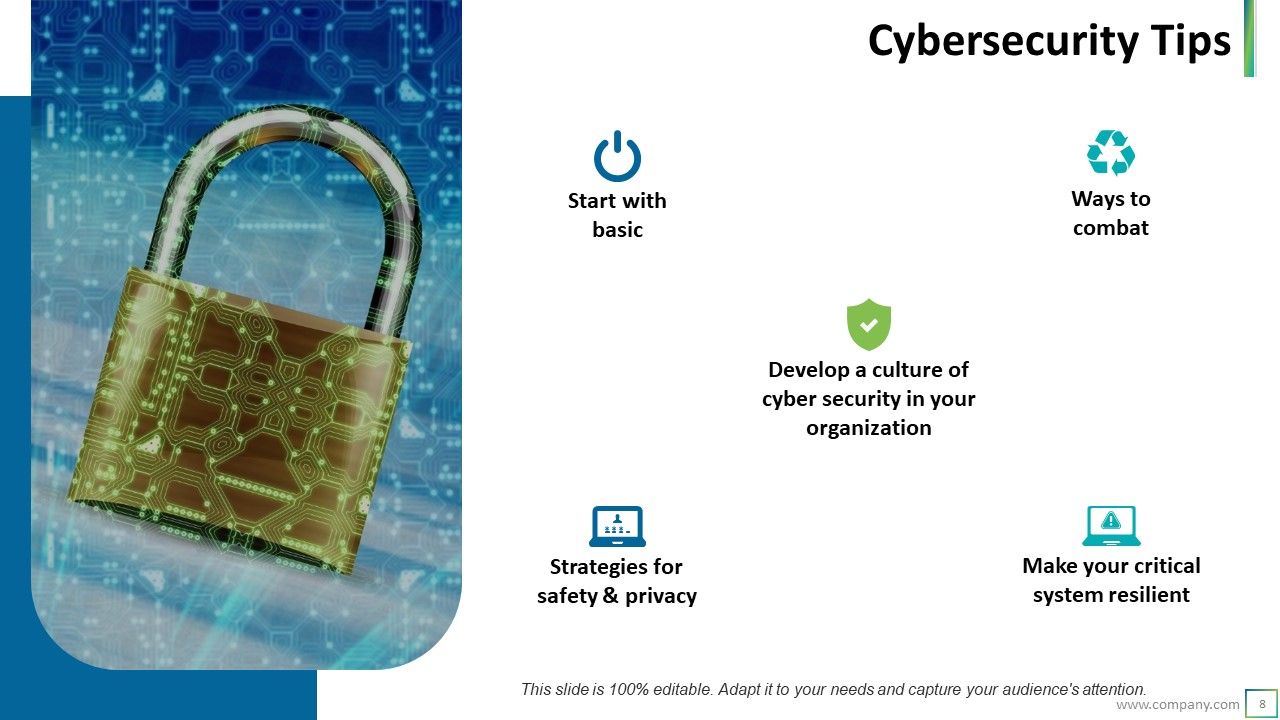
This blog lists the five significant tips needed to ensure that cybersecurity becomes a way of life at your organization. You need to start with the basics and ensure each individual knows the strategies for maintaining safety and privacy. In addition, you must make your critical system resilient, understand ways to combat threats when they arise, and develop a culture of cybersecurity in your organization.
PS For comprehensive training plans on cybersecurity awareness, please click here.
Cybersecurity powerpoint presentation slides with all 17 slides:
Clearly explain each important component with our Cybersecurity Powerpoint Presentation Slides. It helps break down the formula.
-
Cyber Security
-

Cyber Security seven step Template
-
Cyber Security Template 1
-
Cyber Security Template 2
-
Cyber Security Template 3
-
Cybersecurity Framework
-
Cybersecurity Initiatives
-

Cybersecurity Tips
-

Coffee Break
-
Cyber Security Icons Slide
-
Graphs and Charts
-
Stacked Column
-
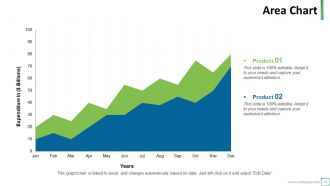
Area Chart
-
Additional Slides
-

Our Team
-

About Us
-
Cybersecurity
FAQs for Cybersecurity
Dude, phishing emails are probably already sitting in your inbox right now - that's honestly your biggest headache. Ransomware's brutal too, plus all the usual malware downloads. Your own employees can be a problem (not their fault usually, but still). DDoS attacks will knock you offline, and weak passwords are basically rolling out the red carpet for data breaches. Oh, and social engineering is everywhere - people just trick your staff into handing over info. Keep your software updated and train everyone regularly. I swear, most of this stuff is totally preventable if you stay on top of it.
Ditch those awful day-long training sessions nobody remembers anyway. Break it into smaller chunks people can actually absorb. Show them real scams hitting your industry - honestly, some of these phishing attempts are getting pretty clever. Run those fake phishing tests but don't be jerks about it when people mess up. That's how they learn. Get your executives involved because if they're skipping it, everyone else will too. Oh, and track stuff like how many people click suspicious links so you know if it's working. Interactive simulations work way better than boring PowerPoints.
So encryption is like throwing your data into a scrambler before anyone else can see it. Only people with the right key can unscramble it back to normal. It's basically a digital safe for your stuff - works whether files are just sitting on your computer or flying around the internet. Hackers might grab your encrypted data, but all they'll see is random nonsense without that key. Honestly, I'd check that whatever apps you're using have end-to-end encryption turned on. Don't mess around with weak protection for anything important.
Honestly, AI and machine learning are pretty incredible for cybersecurity right now. They can churn through tons of data super fast and catch weird patterns that traditional security would totally miss. Your system can actually predict attacks before they happen - which is wild if you think about it. Plus they respond way quicker than any human team could. But here's the thing that kinda sucks: hackers are using the exact same tech against us. So it's becoming this weird back-and-forth game. Still though, the detection speed you'll get is massive. Definitely look into AI security tools if you haven't yet.
Okay so passwords - make them long and weird, like 12+ characters with numbers and symbols mixed in. But honestly? Don't even try to remember them all because you'll just end up using "Password123!" for everything. Get Bitwarden or 1Password instead - they'll create crazy secure ones and remember them for you. For who gets access to what, just give people the bare minimum they need to do their job. Turn on two-factor authentication wherever possible (I know it's annoying but whatever). Also check regularly who has access to stuff and cut people off the second they leave or switch departments. Trust me, the password manager alone will change your life.
So first thing - you'll want to map out everything that could get hit. All your systems, data, devices, the works. Run some vulnerability scans and pen testing to see where you're actually exposed (this part's honestly pretty eye-opening). The threat landscape changes constantly though, which makes it tough to stay on top of. I'd probably bring in an outside security firm if your team's already swamped - they catch stuff you miss when you're too close to it. Document all this and build a risk matrix. That way you can tackle the critical stuff first instead of just putting out fires randomly.
First thing - get your team together. IT, legal, comms, leadership, the whole gang. Map out every step from spotting a breach to getting back online. Practice runs are huge - tabletop exercises quarterly at minimum. I can't stress this enough because finding out your plan sucks during an actual crisis is the worst. Draft your communication templates ahead of time so you're not scrambling to write emails while everything's on fire. Actually test the procedures and tweak them based on what breaks. Oh, and make sure everyone knows their role - confusion kills response time.
Look, regulations like GDPR and HIPAA actually do you a favor - they force you to build security in from the start instead of slapping it on later. You'll need specific stuff like encryption, access controls, breach notifications within certain timeframes, audit trails. Honestly, most companies should be doing this anyway but whatever. Your cybersecurity has to match these requirements whether you want it or not. So you end up with better authentication, data classification, incident response - the works. Smart move is mapping your security controls directly to what compliance needs so you're not juggling two separate headaches.
Dude, remote work totally blows up your security setup. Suddenly everyone's logging in from sketchy coffee shop WiFi and their personal laptops instead of your locked-down office. That whole "secure perimeter" thing? Yeah, that's dead now. People fall for phishing way more because they can't just turn to their coworker and go "did you actually send me this?" Plus you lose track of what's happening on devices, data starts leaking through random apps - honestly, shadow IT becomes this massive headache. My advice? Go zero-trust ASAP and get serious endpoint protection running.
APTs are sneaky as hell - think patient hackers who'll sit in your system for months. Train your people first since phishing emails are their usual entry point. Set up network segmentation so they can't hop around if they get in. Ditch basic antivirus for proper endpoint detection tools that actually catch the advanced stuff. Watch for weird network traffic patterns too. Honestly, incident response planning is boring but you'll thank me later. I mean, even doing half this stuff puts you miles ahead of most small businesses. Just make yourself harder to crack than whoever's next door.
So you're looking for weird network activity, random login failures, your computer running like crap, or sketchy pop-ups appearing. Employees getting phishing emails is huge too - that's honestly how most hackers still get in because people click on everything. Train your team regularly and keep everything updated. Oh, and get some monitoring software that'll ping you when things look off. Have a plan ready so people know what to do when stuff hits the fan. If something feels wrong, don't ignore it.
Start with a risk matrix - figure out which vendors actually touch your sensitive data first. Those are your priority. Set up automated scanning tools to monitor their systems for vulnerabilities. Yeah, most vendors will grumble about the paperwork, but make them fill out security questionnaires anyway. Check they've got proper certs like SOC 2 or ISO 27001. Your contracts need audit rights baked in so you can actually verify they're doing what they promised. Regular assessments are key too. I learned the hard way that trusting vendors at face value is basically asking for trouble.
Dude, you HAVE to stay on top of updates and patches - they're literally what keeps hackers out. Developers constantly find security holes and patch them up, but attackers know which old versions are vulnerable. Think of it like... okay weird analogy but it's like not fixing a broken window lock. The longer your software sits unpatched, the easier you become to hack. I'd set up auto-updates wherever you can, honestly saves so much headache. For anything critical, just pick a regular schedule and stick to it. Trust me, you don't want to be the guy who got pwned because he kept hitting "remind me later" for six months straight.
Basically, these attacks trick your employees into handing over info or access by messing with their heads instead of breaking into systems. Phishing emails, fake phone calls, someone following you through a locked door - they're all playing on trust and making people panic. Some of these scams are honestly getting terrifying. Train your team regularly on spotting this stuff. Set up verification steps for anything sensitive. Oh, and create an environment where questioning weird requests won't get people in trouble. Main thing? Teach everyone to stop and double-check before they click, share info, or let anyone in.
Look, the stuff you really need to pay attention to is AI-powered threat detection and zero-trust architecture. Quantum-resistant cryptography is coming too, but that's more future planning. Zero-trust is literally everywhere right now - instead of just protecting your perimeter, you're basically saying "I don't trust anyone" and verifying everything constantly. IoT security is getting bigger attention since, let's be honest, those devices are usually garbage for security. XDR platforms are getting way smarter at connecting dots across your security stack. I'd start figuring out zero-trust for your setup first though - it's actually doable unlike some of these other trends.
-
Best ppt
-
Great product with highly impressive and engaging designs.
-
The Designed Graphic are very professional and classic.
-
good
-
its very good