

Business Model Powerpoint Presentation Slides





Try Before you Buy Download Free Sample Product
 Impress Your
 Audience
 100%
100% Editable
 Save Hours
 of Time


A good plan is a head start for the successful operation of a business, recognizing sources of interest, the expected customer base, products, and details of the investment. We are proud to present, business model PowerPoint presentation slides, for projecting your module in a precise manner. We have kept a comprehensive approach and incorporated fundamental concerns like how to monetize and acquire customers, providing service and types of business models. Business development model can be discussed through key operations, knowledge management, strategies, structure and operational competitive priorities. Business model archetypes are included here and can be explained with pie charts and mentoring the idle ecosystem. Further elaboration of business model bifurcation and other aspects have been included here too. Here at SlideTeam, we are continuously working on excellent ideas for conceiving superior results and walking ahead with the technology. So, download this magnificent template for the business model related dilemma and make your exhibitions a sight to look at. Download and get started right now.
People who downloaded this PowerPoint presentation also viewed the following :
Content of this Powerpoint Presentation
Slide 1: This slide introduces a Business Model. State your company and get started.
Slide 2: This slide showcases business model which explain you the steps about the business process.
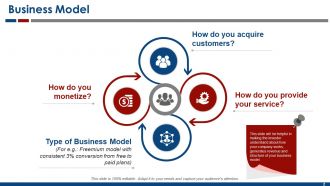
Slide 3: This slide shows Business model which includes four basic stages or steps.
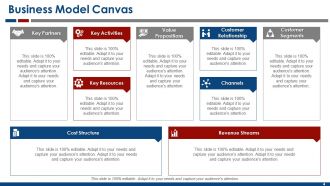
Slide 4: This slide showcases Business model canvas and also various functions working such as customer relationship, key activities, cost structure, revenue stream.
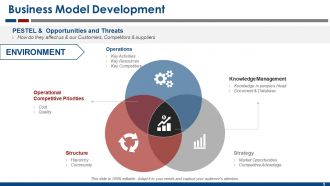
Slide 5: This slide shows Business Model Development also displays PESTEL & Opportunities and Threats. Three circles in this gives you idea about structure, strategy, operational competitive.
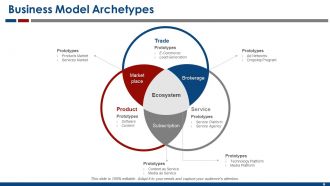
Slide 6: This slide presents Business Model Archetypes. This also shows venn diagram of trade, product and service.
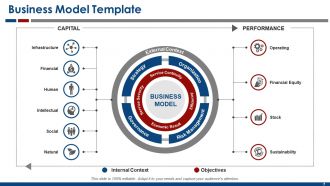
Slide 7: This slide explains Business Model Template also displaying Capital and performance parameters.
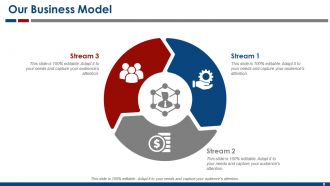
Slide 8: This slide diplays about Our Business Model. You can add your business plan, strategy in three streams
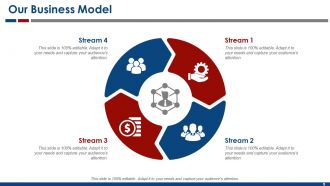
Slide 9: This slide presents a Business Model . You can add your business stages in it.
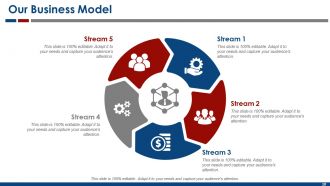
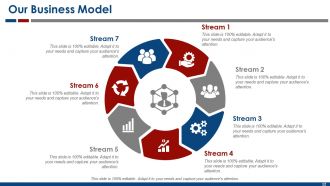
Slide 10: This slide showcases about Business Model with five circular stream. You can also add yours business requirment with suitable images.
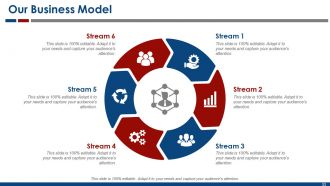
Slide 11: This Slide shows Circular Business Model with six stages. Make your data, information presentable.
Slide 12: This slide presenting Circular business model. You can make according to your requirement.
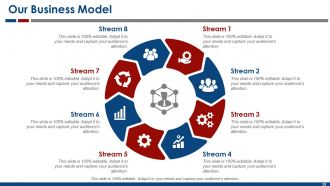
Slide 13: This slide shows eight circular steps which can be editable and used as per your requirements.
Slide 14: This slide showcase Business model Bifurcation and showing three streams with relavant icons.
Slide 15: This slide displays Business Model Bifurcation with four stream. You can add your business related requirements.
Slide 16: This slide showing five streams which is representing some specific icons. You can use it according to your requirements.
Slide 17: This slide is showing Business Model Bifurcation, You can use it according to your requirements.
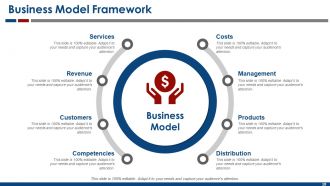
Slide 18: This slide showcases Business Model Framework showing various stages like:- Business Model, Costs, Products, Distribution, Revenue, Competencies.
Slide 19: These are some Business Model Icons. With these you can use it according to your requirement.
Slide 20: This is an additional slide you can make the best use of it .
Slide 21: This is an slide displays Agenda showing Meet The Team, About US, Welcome message.
Slide 22: This slide is displays ABOUT THE COMPANY. You can add your company details in this.
Slide 23: This slide shows about the tea break for halt.
Slide 24: This is an Our team slide you can edit the name of the employee as per your own need.
Slide 25: This slide represent an Target dartboard showing some four text boxes.
Slide 26: This slide is showcases about six years Timeline in which you can can add your business growth accordingly
Slide 27: This slide displays quotes slide which you can use and add your related stuff or information.
Slide 28: This slide shows Puzzle with bulb image and you can include your data in it.
Slide 29: This slide presents Magnifying Glass with specific icons. You can add your data and information in this.
Slide 30: This slide is titled as Charts & Graphs.
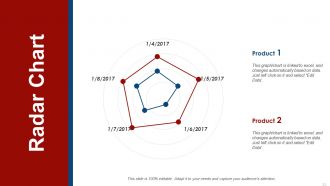
Slide 31: This slide showcases as Radar chart diagram to compare your product.
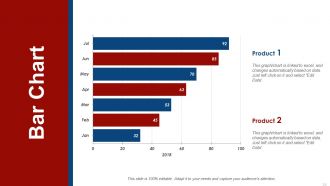
Slide 32: This slide shows bar chart with months and dates in it. It can also be used for comparison of two product.
Slide 33: This is a Thanks For Watching slide with Contact Numbers, Email Address, Address# street number city, state.
Business Model Powerpoint Presentation Slides with all 33 slides:
Augment your thoughts with our Business Model Powerpoint Presentation Slides. Add to the impact on your audience.
-
Business Model
-
Business Model
-
Business Model Example Slide
-
Business Model Canvas
-
Business Model Development
-
Business Model Archetypes
-
Business Model Template
-
Our Business Model
-
Our Business Model
-
Our Business Model
-
Our Business Model
-
Our Business Model
-
Our Business Model
-
Business Model Bifurcation
-
Business Model Bifurcation
-
Business Model Bifurcation
-
Business Model Bifurcation
-
Business Model Framework
-
Business Model Icons Slide
-
Additional Slides
-
Agenda Slide
-

About The Company
-

Let s Have a Healthiest Tea Break
-
Our Team
-
Target
-
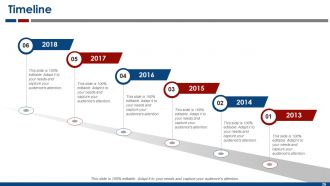
Timeline
-
Business Model
-
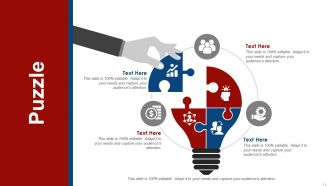
Puzzle
-
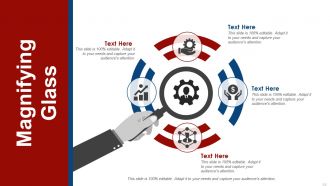
Magnifying Glass
-
Charts Graphs
-
Radar Chart
-
Bar Chart
-

Thank You
FAQs for Business Model
Okay so you need five main things sorted out. Value proposition first - what problem are you actually fixing? Then figure out who your customers are (and I mean really figure it out, not just "everyone"). Revenue streams are obviously huge - subscriptions, one-time payments, ads, whatever works. Don't forget your key resources and partnerships either. Honestly though, the cost structure part always gets me. You'll map everything out thinking you're golden, then realize you're hemorrhaging money on stuff you didn't even consider. My advice? Sketch this whole thing out before you go crazy with execution. Way cheaper to pivot on paper than after you've already launched.
Honestly, tech can be a total game-changer if you use it right. Automation handles all that boring repetitive stuff nobody wants to do anyway. Data analytics helps you actually understand what your customers want instead of just guessing. Digital platforms open up markets you couldn't reach before - it's pretty crazy how much bigger your audience can get. AI tools are everywhere now (seriously, new ones pop up constantly), but don't just grab something because it's shiny. Map out your current workflow first. Where are the biggest headaches? That's where you'll get the most bang for your buck with tech solutions.
Your value prop is literally everything - it drives who you target, pricing, channels, all of it. Say you're promising premium quality? Then your operations and pricing better match that vibe. Going for convenience instead? Your whole delivery system needs to back that up. Honestly, without a solid value prop you're just winging it and praying something works. I'd start by figuring out what makes you actually different, then build everything around delivering on that. Otherwise you'll end up all over the place trying to be everything to everyone.
Honestly, subscription models are a game changer for cash flow - you'll actually know what's coming in each month instead of scrambling for new sales constantly. Focus on keeping your current customers happy and the revenue just builds on itself. Way better than the feast-or-famine thing most businesses deal with. The math you need to watch is customer lifetime value vs what it costs to get them in the door. Investors love this stuff too since it's so predictable. Just don't get lazy with retention because losing customers kills the whole model.
So B2B means you're selling to other companies, while B2C is direct to regular people like you and me. Sales cycles are night and day different though. Companies take forever to decide - they've got committees and budgets and all that bureaucracy. Regular consumers? They'll impulse buy in five minutes. Marketing gets flipped too. Businesses want to see ROI numbers and case studies. Consumers just want to know how it'll make their life better or look cooler. Honestly, B2C feels way more fun from a creative standpoint. You'll want to nail down which one you're doing early because it changes literally everything - pricing, support, the whole deal.
So pivoting is basically changing your core business when what you're doing isn't working anymore. Could be your target customers, how you make money, or how you deliver value. Like those restaurants that went full delivery during COVID - smart move, honestly. First, figure out what's actually broken versus what's still working okay. Then test small changes before you go all-in on something completely different. Don't leave your current customers guessing though - they'll appreciate knowing what's happening. The tricky part is knowing when to pull the trigger, but waiting too long usually makes things worse.
Start with the basics - revenue growth and profit margins tell you if you're making money. Customer acquisition cost matters too, but honestly the LTV to CAC ratio is what I'd watch most closely since it shows whether you're actually building something sustainable or just bleeding cash. Churn rate and customer lifetime value round out the picture. Market share's huge - tells you if you're beating competitors or just lucky. Don't get overwhelmed though. Pick maybe 3-5 metrics that make sense for your business and stick with those consistently.
Honestly, you've got to find revenue streams that actually boost your social mission instead of working against it. Short sentences work here. Corporate CSR partnerships could be solid - companies always need those wins. Or create products that serve your beneficiaries while bringing in cash. The trick is making your money-making stuff strengthen your cause, not water it down. Grameen Bank and Patagonia crushed this approach, though obviously their models won't copy-paste to your situation. It's basically that double bottom line thing, but don't overthink it - just make sure the business side feeds the mission side.
Dude, subscription models are absolutely everywhere right now - software, razors, meal kits, you name it. People apparently love those predictable monthly charges. Platforms like Uber are pretty smart too, just connecting people and skimming off the top. Oh and freemium's still going strong, give the basics away then charge for the good stuff. The whole creator economy thing is wild - people making bank directly from their followers through Patreon and whatever else. Marketplaces are doing great too. Honestly, I'd just pick whatever matches how your customers already behave and test it small first.
Oh man, you've gotta dig deep into the cultural stuff before launching anywhere new. Payment methods alone can make or break you - some places still love cash while others are all mobile payments. In Asia, you'll spend months just building relationships before anyone buys anything, but Western customers want to get straight to business. Honestly, I'd probably just find a local partner who knows the ins and outs rather than trying to figure it all out myself. Your whole pricing strategy might need a complete flip too. Trust me, don't wing it like I did once!
Honestly, the biggest thing that'll bite you is cash flow issues - revenue takes forever to stabilize with new models. Your customers might drag their feet on adoption too, which is super frustrating. We saw that firsthand last quarter, ugh. Plus your team will probably struggle with all the new processes and metrics they're not used to. Oh, and if you're in a regulated industry? Expect some headaches there. Market uncertainty is obviously a factor, but that's always true. I'd say start small with a pilot program first. Don't rush the timeline - most people way underestimate how long this stuff actually takes.
Start with a dead simple one-sentence pitch about how you actually make money. Then throw in some visuals - seriously, diagrams save your life because people's eyes glaze over with too much talking. Tailor it depending who you're talking to though. Investors want to hear about scale and profit margins, but your team needs to get how they fit in. I'd nail down a solid elevator pitch first - like 30 seconds max. If they're nodding and asking questions, then you can dive deeper. Oh and flowcharts are weirdly effective for showing partnerships and revenue streams. Don't overthink it.
Dude, scalability is what makes or breaks businesses. Some companies hit a ceiling and just... stop growing. Others can handle massive growth without everything falling apart. Look at Netflix versus your old Blockbuster down the street - totally different stories, right? You want your revenue climbing way faster than your costs as you get bigger. The trick is setting up systems now that won't crumble when things get crazy later. Even if you're still small, start thinking about what happens when you're not. Test your model hard. Push it until something breaks, then fix that weak spot. Better to find problems early than during your big moment.
Honestly, digging into your data can totally change how you see your business. You'll spot which customers actually make you money and which ones are just... there. Look at stuff like how much it costs to get new customers versus what they're worth long-term - that gap tells you everything. I'd start with just one piece of your business model though, don't try to analyze everything at once. You might find revenue streams you didn't even know existed hiding in there. Track your churn rates too. Sometimes what we think is working really isn't.
Honestly, you've gotta be obsessed with your customers - like, actually listen to their feedback constantly. Watch what competitors are doing, but here's the thing that gets overlooked: your biggest threat might come from some random company you never saw coming. Try new revenue ideas on a small scale first. Don't go all-in immediately. Build your operations so you can actually pivot fast when shit hits the fan. I'd say do quarterly reviews where you're brutally honest about what's working and what sucks. Trust me, it's way better to change before you're forced to.
-
Very unique, user-friendly presentation interface.
-
Innovative and attractive designs.