

Digital transformation powerpoint presentation slides






Try Before you Buy Download Free Sample Product
 Impress Your
 Audience
 100%
100% Editable
 Save Hours
 of Time


The Digital Transformation is the process of using digital technologies to create new or modified business processes, products, and services. This transformation can be either a partial or complete change to how an organization functions. Many organizations are undertaking digital transformations in order to remain competitive and keep up with the changing landscape of technology. SlideTeam’s extensive set of digital transformation PowerPoint templates can help you get up to speed on everything there is to know about this important business topic. With our templates, you can create professional-quality presentations that will help educate your team and stakeholders about the benefits of digital transformation and how to go about implementing it in your organization. Download our digital transformation ppt templates now.
People who downloaded this PowerPoint presentation also viewed the following :
Content of this Powerpoint Presentation
Slide 1: This is an introductory slide to DIGITAL Transformation with imagery. Add the name of your company and begin.
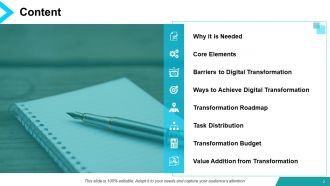
Slide 2: This slide shows Content with the following points to present- Value Addition from Transformation, Why it is Needed, Core Elements, Barriers to Digital Transformation, Ways to Achieve Digital Transformation, Transformation Roadmap, Task Distribution, Transformation Budget.
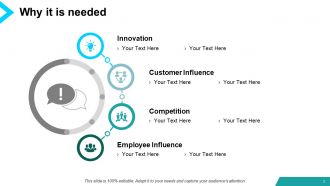
Slide 3: This slide explains Why digital transformation is needed with the following points- Customer Influence, Competition, Employee Influence, Innovation.
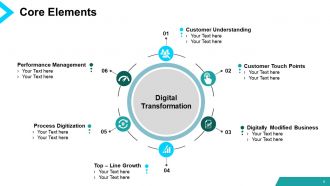
Slide 4: This slide presents a list of the Core Elements of Digital Transformation. These include- Digitally Modified Business, Process Digitization, Customer Understanding, Customer Touch Points, Top – Line Growth, Performance Management.
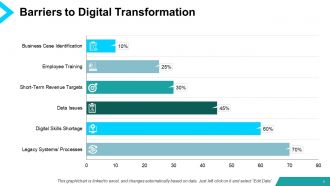
Slide 5: This slide shows Barriers to Digital Transformation graphically. Use it accordingly.
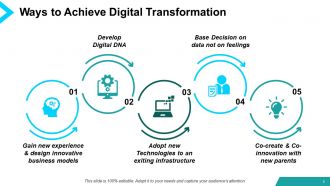
Slide 6: This slide shows Ways to Achieve Digital Transformation with their respective icons. We have mentioned five of these for your reference. You can add more of these if your business demands so.
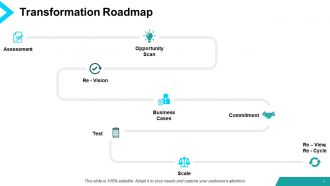
Slide 7: This slide displays Transformation Roadmap with steps mentioned- Assessment, Opportunity Scan, Re - Vision, Business Cases, Commitment, Test, Scale, Re – View, Re - Cycle.
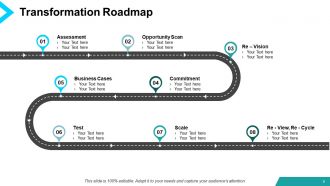
Slide 8: This is another slide showing Transformation Roadmap with the steps mentioned. Use as per your requirement.
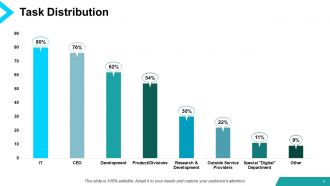
Slide 9: This slide displays Task Distribution in form of a bar graph/ chart. Use it according to your business requirement.
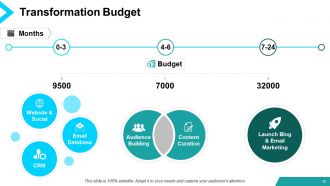
Slide 10: This slide shows monthly Transformation Budget consisting of- Website & Social, CRM, Email Database, Launch Blog & Email Marketing, Audience Building, Content Curation. You can alter these figures as per your business requirement.
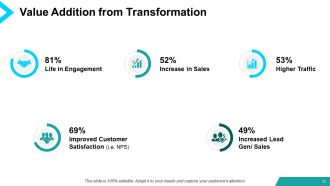
Slide 11: This slide shows Value Addition from Transformation consisting of the following information in percentage- Life in Engagement, Increase in Sales, Higher Traffic, Increased Lead Gen/ Sales, Improved Customer Satisfaction (i.e. NPS).
Slide 12: This is Digital Transformation Icon Slide. Alter as per your requirement.
Slide 13: This slide is way forward to Additional Slides. Alter the slide content as per your requirement.
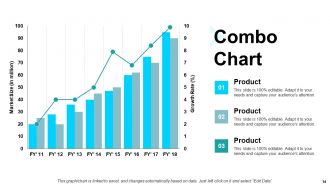
Slide 14: This slide presents Combo Chart to show product/ entity growth, comparison etc.
Slide 15: This slide represents Our Mission. State your mission, goals etc.
Slide 16: This slide section displays Our Awesome Team to state the team members/person responsible for the Project. Put Name, Designation for the team to be introduced.
Slide 17: This is an About Us slide showing Preferred by many, Values Client, and Target audiences as examples.
Slide 18: This slide shows the Financial aspects of your company.
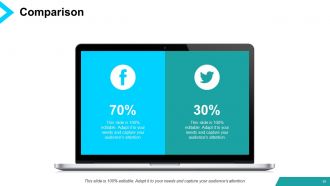
Slide 19: This is a Comparison slide to compare product/ entities etc.
Slide 20: This is a Quotes slide. State business message, beliefs etc. here.
Slide 21: This is Our Target slide. State your targets here.
Slide 22: This is a creative Bulb or Idea slide to state a new idea or highlight specifications/ information etc.
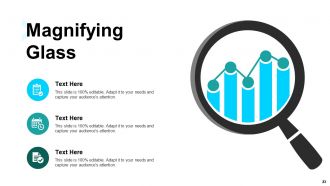
Slide 23: This is a Magnifying Glass image slide to show information, scoping aspects etc.
Slide 24: This is a Contact Us slide with Email, Address# street number, city, state, Contact Numbers.
Digital transformation powerpoint presentation slides with all 24 slides:
You have a driving passion to excel in your field. Our Digital Transformation Powerpoint Presentation Slides will prove ideal vehicles for your ideas.
-

Digital Transformation
-
Content
-
Why it is needed
-
Core Elements
-
Barriers to Digital Transformation
-
Ways to Achieve Digital Transformation
-
Transformation Roadmap
-
Transformation Roadmap
-
Task Distribution
-
Transformation Budget
-
Value Addition from Transformation
-
Digital Transformation Icon Slide
-

Additional Slides
-
Combo Chart
-
Our Mission
-
Our Awesome Team
-
About Us
-
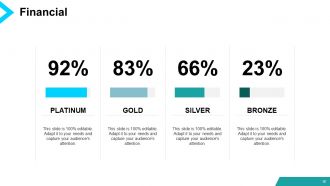
Financial
-
Comparison
-

Quotes
-
Our Target
-
Bulb or Idea
-
Magnifying Glass
-

Contact us
FAQs for Digital transformation
Honestly, it comes down to three big things. Customers are totally spoiled by how smooth Amazon and Netflix are - they expect that everywhere now. Competition's brutal too since everyone's using tech to cut costs and move way faster than old-school methods. Oh, and data analytics is a game changer because you can actually make smart decisions instead of just winging it. Automation saves so much money when wages keep climbing, which... yeah, that's not stopping anytime soon. My advice? Find where your customers get most annoyed with your current setup. That's usually the perfect place to start fixing things.
Track the hard numbers first - process improvements, cost savings, revenue from digital stuff. But here's the thing: cultural adoption matters way more than most people realize. Are teams actually using the new tools or just pretending? Customer satisfaction and employee surveys will show you what's really working. Oh, and definitely measure everything before you start changing things - you'll thank yourself later. I'd check progress every three months instead of waiting till the end to see if you're totally off track.
Honestly, your leadership team can make or break this whole thing. They need to actually get the tech - not just throw around buzzwords at meetings. Without them setting a clear vision and getting people excited about the change, you'll just end up with another expensive IT disaster nobody uses. The budget part is obvious, but what really matters is having leaders who aren't scared to try new stuff themselves. I've seen too many execs preach digital transformation while still printing out their emails. Make sure they're visibly using whatever tools you're rolling out. People follow what they see, not what they hear.
Honestly, the worst part is always people freaking out about change - your team will resist everything at first. Legacy systems are another headache since they never work with new stuff. Budget issues slow everything down too. Oh and data migration? Total disaster every single time, I swear. Finding people who actually know modern tools is brutal right now, the skills gap is insane. Start with change management though - if your team hates the idea, doesn't matter how good the tech is. Run small pilot projects first to get some wins under your belt.
Honestly, the biggest mistake is just dropping changes on people without warning. Get them involved from the start - explain what's happening and why it actually helps *them*, not just the company's bottom line. Let your team help pick the tools and build the workflows so they're not just following orders. Oh, and training is huge - don't cheap out there. I'd also grab those quick wins early and make a big deal about them. People love feeling like they're part of something that's working. Listen when they complain too, because they usually have valid points you missed.
Honestly? Cloud computing, AI, and data analytics are where most companies are putting their money right now. Automation tools and IoT stuff are big too. But here's the thing - don't get caught up in fancy tech just because it sounds cool. API integrations are actually super important since they let your different systems work together (learned that the hard way at my last job). Mobile-first platforms matter too. Really though, figure out what's actually broken in your business first. Then find tech that fixes those specific problems. Way better approach than just throwing money at the newest trending solution.
Look, digital transformation should really just be about making things better for your customers. Start by figuring out where they're getting frustrated with your current setup. Maybe checkout takes forever, or they can't get help when they need it. Those are your targets. Don't just throw money at fancy tech because it sounds cool – though I'll admit some of it is pretty tempting. Focus on stuff that actually fixes those pain points first. You want seamless experiences across all your channels, faster responses, maybe some personalization. Map out their journey, find the worst spots, then build from there.
Healthcare, retail, and finance are getting hit hard by digital transformation right now. Telehealth is everywhere, contactless payments are the norm, and mobile banking actually doesn't suck anymore. Manufacturing's also crazy right now - IoT sensors and automation are completely changing how factories work. Oh, and logistics/transportation too with all the delivery tracking stuff. Honestly, if you're career planning, I'd look at industries dealing with sensitive data or messy operations. They're throwing serious money at digital tools and desperately need people who can translate between tech teams and business folks.
Honestly, you've got a huge leg up on big corporations here - you can pivot way faster than they can. While they're stuck in endless meetings, you can just go ahead and implement cloud tools or automate the boring stuff. Start with one thing though, maybe customer management or getting your online sales sorted. Don't go crazy trying to digitize everything at once (learned that the hard way with a client last year). Social media's your friend for reaching people you never could before. Use data to actually understand what your customers want. The bureaucracy thing that kills big companies? Yeah, that's not your problem.
Honestly, consent and transparency are your biggest headaches here. People need to actually understand what data you're grabbing and why - none of those sketchy buried checkboxes we all scroll past. Algorithm bias is another nightmare since you might accidentally screw over certain groups without realizing it. Data security's obviously critical because one breach tanks your reputation instantly. Oh, and don't just bolt ethics on at the end like most companies do. Build those reviews right into your roadmap from the start or you'll regret it later.
Look, the whole "fail fast" thing sounds cliché but it actually works - people need to know they won't get fired for trying something new. Give your team dedicated innovation time (Google does 20% but let's be real, most places can't pull that off). Break down those departmental walls so ideas actually move around instead of dying in meetings. Celebrate the small stuff publicly too. Innovation can't just be the tech team's problem - everyone should feel like they can contribute. Oh, and pick one process you could digitize this quarter and just build a quick prototype. Don't overthink it.
Honestly, going digital is one of the best things you can do for sustainability. You'll slash paper waste and energy costs with smart systems. Remote tools cut travel emissions big time - we all saw that during COVID when companies' carbon footprints dropped like crazy. The coolest part? Real-time analytics let you actually see your environmental impact as it happens, which used to be impossible. I always tell people to track the green benefits when they're doing digital projects. Stakeholders eat that stuff up, and it's usually way better than you'd expect.
Honestly? Digital transformation is kinda weird with compliance - it helps and hurts at the same time. You'll get way better data tracking and automated reports, which is awesome. Real-time monitoring becomes way easier too. But then you're dealing with new headaches like data privacy rules and cybersecurity requirements that didn't exist before. My advice? Don't bolt compliance on at the end - that's where people mess up. Figure out which regulations hit your digital stuff first, then bake those rules right into your project plans from the start. Trust me on this one.
You definitely need digital literacy and data analysis skills - just being comfortable with tech in general. Adaptability is massive too since everything changes so fast now. Critical thinking helps because you're always troubleshooting new stuff. Don't sleep on soft skills though - collaboration and communication are probably more important than people realize since teams work so differently now. Oh, and get familiar with automation basics and AI/ML concepts, even if you're not super technical. My brother learned Python last year and it totally changed his job prospects. Start with one skill that fits your role - maybe Excel macros or understanding how APIs work.
Start with auditing what you've got - figure out which data and processes can't go offline. APIs are gonna be your lifesaver here, letting old systems chat with new ones without tearing everything apart. Think of it like translating between people who don't speak the same language. Don't go crazy and replace everything at once though. Middleware platforms help bridge that gap too. Pick one workflow that matters, test the hell out of it first, then expand from there. Baby steps beat disasters every time.
No Reviews