

Business Transformation Powerpoint Presentation Slides






Try Before you Buy Download Free Sample Product
 Impress Your
 Audience
 100%
100% Editable
 Save Hours
 of Time


Every organization undergoes a certain change to cope up with changing trends in the market. Its ending point must be a different from a starting point. This content ready business transformation PowerPoint presentation is a guide for your organization to have a structured and planned change. These business transformation presentation templates are perfect to achieve organizational goals and improve business processes, technologies, and productivity. Whether it’s an internal change or an external, an organization goes through several stages of transformation. This is explicitly explained in a business transformation framework slide. There could be various business areas where a change is needed such as customer service or finance. We present your business transformation PPT slides that will help you go through digital transformation, finance transformation, customer service transformation and more. This complete presentation will help you explain the important business drivers for the required change in the management . Get your hands on this ready-made professionally designed business transformation presentation to achieve a successful business transformation. Spread the buzz with our Business Transformation Powerpoint Presentation Slides. Generate interest with your views.
People who downloaded this PowerPoint presentation also viewed the following :
Content of this Powerpoint Presentation
Slide 1: This slide introduces Business Transformation. Put Company Name etc. below
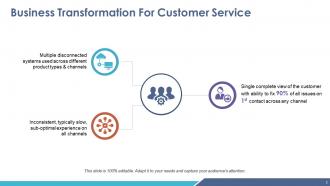
Slide 2: This slide showcases Business Transformation For Customer Service with the following three points- Multiple disconnected systems used across different product types & channels, Inconsistent, typically slow, sub-optimal experience on all channels, Single complete view of the customer with ability to fix 90% of all issues on 1st contact across any channel.
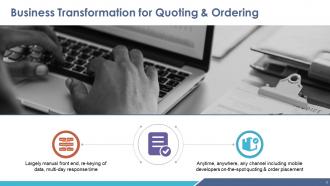
Slide 3: This slide displays Business Transformation for Quoting & Ordering. The context description is- Largely manual front end, re-keying of data, multi-day response time, Anytime-anywhere-any channel including mobile developers on-the-spot quoting & order placement.
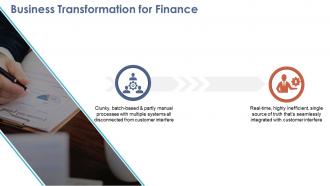
Slide 4: This slide showcases Business Transformation for Finance. The points described are- Clunky, batch-based & partly manual processes with multiple systems all disconnected from customer interference. Real-time, highly inefficient, single source of truth that’s seamlessly integrated with customer interfere
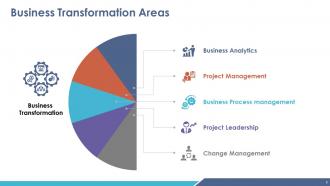
Slide 5: This slide shows Business Transformation Areas. The listed areas are- Business Analytics, Project Management, Business Process management, Project Leadership, Change Management.
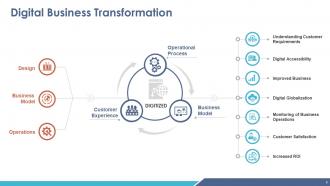
Slide 6: This slide shows Digital Business Transformation. It represents digitized cyclic process of Customer Experience, Business Model and Operational Process. The Customer Experience includes- Operations, Design and Business Model. The Business Model includes- Understanding Customer Requirements, Digital Accessibility, Improved Business, Digital Globalization, Monitoring of Business Operations, Customer Satisfaction, Increased ROI.
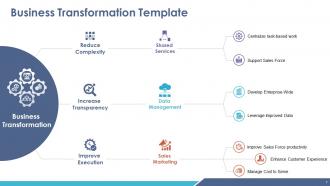
Slide 7: This slide represents detailed Business Transformation with three hierarchical headings- Reduce Complexity: Shared Services:: Centralize task-based work, Support Sales Force. Increase Transparency: Data Management:: Develop Enterprise Wide, Leverage Improved Data Improve Execution: Sales Marketing:: Improve Sales Force productivity, Manage Cost to Serve, Enhance Customer Experience
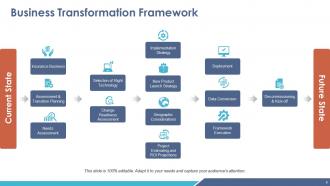
Slide 8: This slide showcases Business Transformation Framework for Current State and Future State. The headings in order of precedence are- Insurance Business : Assessment & Transition Planning : Needs Assessment: Change Readiness Assessment: Selection of Right Technology : New Product Launch Strategy : Implementation Strategy : Geographic Considerations : Project Estimating and ROI Projections : Deployment : Data Conversion : Framework Execution : Decommissioning & Kick-off.
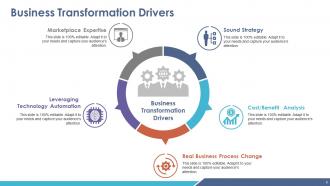
Slide 9: This slide displays Business Transformation Drivers.The main listed drivers are- Sound Strategy, Cost/Benefit Analysis, Real Business Process Change, Leveraging, Technology Automation, Marketplace Expertise.
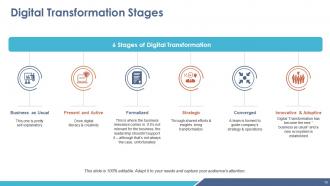
Slide 10: This slide displays 6 Stages of Digital Transformation Stages. The description of each stage is as follows- Business as Usual (This one is pretty self explanatory), Present and Active (Drive digital literacy & creativity), Formalized (This is where the business relevance comes in. If it’s not relevant for the business, the leadership shouldn’t support it – although that’s not always the case, unfortunately). Strategic (Through shared efforts & insights, bring transformation), Converged (A team is formed to guide company’s strategy & operations), Innovative & Adoptive (Digital Transformation has become the new “ business as usual” and a new ecosystem is established).
Slide 11: This slide is a Coffee Break image for a halt.
Slide 12: This slide forwards to Charts & Graphs.
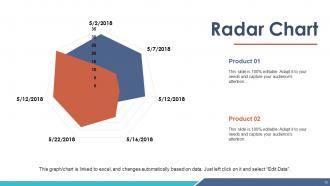
Slide 13: This slide presents a Radar Chart graph/chart. Compare Product 01, Product 02 and use as per required.
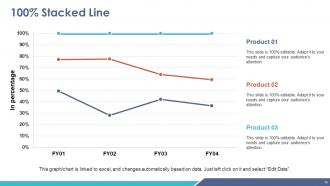
Slide 14: This slide shows a Stacked Line graph in terms of percentage and years for comparison of Product 01, Product 02, Product 03 etc.
Slide 15: This slide is titled Additional Slides.
Slide 16: This slide represents Our Mission. State your mission, goals etc.
Slide 17: This slide showcases Our Team with Name and Designation to fill.
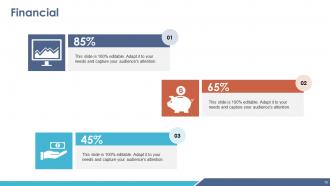
Slide 18: State your Financial score in this slide with relevant imagery and text.
Slide 19: This slide shows Comparison of Positive Factors v/s Negative Factors with thumbsup and thumb down imagery.
Slide 20: This slide displays Our Target with a background image.
Slide 21: This idea shows an image of Bulb Or Idea to state your facts, notes etc.
Slide 22: This is a Thank You slide with Address:# street number, city, state, Contact Numbers and Email Address.
Business Transformation Powerpoint Presentation Slides with all 22 slides:
Enable ease of flow with our Business Transformation Powerpoint Presentation Slides. Get an effective connection going.








FAQs for Business Transformation
Honestly, it comes down to three big things: getting people to actually use new tech, having employees who don't hate the changes, and focusing on what customers want. Leadership has to be genuinely committed - I've watched so many companies do these fake transformation initiatives that crash and burn. Your systems need to handle the changes, and if your team isn't buying in, you're screwed. Oh, and make decisions based on actual data, not gut feelings. Don't try changing everything at once though. Pick 2-3 things, grab some quick wins first, then expand. Go for whatever hits customers hardest.
Okay so first thing - get your baseline numbers locked down before you change anything. Revenue, productivity scores, how happy your customers and employees actually are. Some benefits won't show up for months though, which honestly sucks when you're trying to prove ROI. Track the quick wins too like how many people are actually using the new system or finished training. Don't just wait around for those big financial numbers to move. Survey your team regularly about how they're feeling - their mood matters more than you'd think. Oh and decide what success looks like upfront, otherwise you'll be measuring random stuff that doesn't matter.
Honestly, tech is what makes most business changes actually happen these days. Without it, you're kinda stuck doing things the old way. Cloud stuff, AI, data analytics - they automate boring manual work and give you way better insights into what's going on. Your customers get smoother experiences too. But here's the thing - don't just grab whatever everyone's talking about on LinkedIn. Figure out what's actually breaking in your business first, then find tech that fixes those specific problems. I've seen too many companies blow money on shiny tools they didn't really need.
Honestly, you've gotta be the example first - can't expect flexibility if you're stuck in your ways. Talk constantly about WHY stuff is changing, not just dumping new processes on people. I've watched so many managers mess this up then act shocked when everyone pushes back. Give people space to actually say what they're thinking without getting defensive. When someone tries something new and it flops? Celebrate that too - sounds weird but it works. Oh and don't expect people to just flip a switch overnight. Weekly check-ins help tons - just ask what's actually working vs what sucks during all the chaos.
Honestly, people are gonna hate you at first - nobody wants their routine messed with even if the current system sucks. Budget constraints will bite you too, and leadership never explains things clearly enough. You're basically trying to fix a plane while flying it, which is exhausting. Timelines? Ha, double whatever you initially think. Legacy tech is the worst - it's like trying to connect your iPhone to a computer from 2003. My advice is plan for everything to go wrong and spend serious time on getting people on board from the start.
Honestly, employee engagement makes or breaks the whole thing. Without it, you're just creating another eye-roll moment that'll get forgotten in six months. People need to feel like actual partners, not just told what to do - that's when they start problem-solving with you instead of against you. Get your key people involved from the beginning. Be real about why stuff needs to change. Nobody likes surprises, but they'll respect you for being straight with them. Oh, and don't expect miracles overnight - genuine buy-in takes time to build.
Honestly, data analytics just gives you real proof instead of guessing what's broken. You can see actual customer patterns and find the real bottlenecks - not just what Karen from accounting thinks is slow. Plus it shows if changes will hurt your bottom line before you make them. Here's the thing though - most people skip this part. Start tracking metrics *right now* before you change anything. Otherwise you'll never know if your transformation actually worked or if you just wasted a bunch of money. Oh, and you can spy on competitors too, which is always fun.
Honestly? Just talk to people constantly - even when there's nothing new to say. I learned this the hard way watching projects blow up because leadership disappeared during rough patches. Tell everyone your realistic timelines upfront, then actually stick to explaining why things change. Town halls, quick check-ins, those dashboard things everyone pretends to read - use whatever works. Short sentences hit different sometimes. When stuff goes sideways (and it will), just say so instead of sugar-coating it. People respect honesty way more than fake optimism. The whole "no surprises" thing isn't just corporate speak - your reputation literally depends on it.
Honestly, start by literally drawing lines between your transformation projects and your actual business goals. Sounds basic but most companies somehow miss this step completely. Set up regular check-ins with both your transformation team and strategy people - can't have them working in separate bubbles. The metrics you track should connect to both sides, not just random transformation KPIs that nobody cares about. Oh, and here's the thing that really matters: every time you make a transformation decision, explain how it ties back to your main strategy. People need to understand the "why" or they'll just go through the motions.
Honestly, customer feedback is like having a cheat sheet for what's actually broken vs what you *think* is broken. I've watched companies waste months fixing stuff nobody cared about because they never bothered asking customers first. Your customers see the whole picture - they'll catch problems your internal team totally misses. Here's the thing though: don't just collect feedback once at the start. You need regular check-ins throughout the whole process. Set up those pulse surveys so you can pivot when something's not working. Otherwise you're basically flying blind and hoping for the best.
Honestly, you've got a huge advantage over big companies - no endless meetings or approval chains slowing you down. When customers tell you something's not working, you can actually fix it that week instead of forming a committee about it. Plus you know your team personally, which makes change way less painful. The catch is obviously money - you can't afford to mess around with expensive experiments like Google can. My advice? Pick one thing to focus on first. Test it small, see what happens, then go bigger if it works. Don't try to transform everything at once or you'll burn out fast.
Okay so first thing - tell everyone WHY you're changing stuff. People hate being left in the dark. Hit them from all angles: meetings, emails, quick team chats, whatever works. Don't sugarcoat the messy parts either, that always bites you later. Set up ways for people to actually ask questions instead of just wondering what's happening. Your middle managers need to be saying the same thing you are (learned that one the hard way). Even when nothing's happening, send updates. Seriously - radio silence makes people think the worst.
Honestly, partnerships are a game-changer for transformation stuff. Why spend years building capabilities when you can just partner with someone who already nailed it? You get their expertise, tech, whole systems - without the crazy investment. I always tell people to map out what they desperately need versus what can wait. Then find partners who are actually good at those must-have areas. It's like... borrowing superpowers while you're still figuring things out. Way smarter than trying to do everything yourself, especially early on.
Look, you can't just transform once and call it done - that's like working out for a week then wondering why you're not ripped. Your team needs to keep learning new stuff or everything gets stale fast. I've seen companies nail their initial changes but then totally plateau because they stopped adapting. Set up regular check-ins to see what skills people actually need (not just what you think they need). Make learning part of how you operate, not some boring annual training thing. Otherwise you'll just slide back to where you started. Market keeps moving whether you do or not.
Think of it like a portfolio - don't pick one or the other, split your resources between both. I'd set aside a fixed chunk of budget and team time just for the long-term stuff that won't pay off right away. Here's what I learned the hard way: those transformation projects aren't gonna save your quarterly numbers, so don't fool yourself there. You'll need different success metrics for each timeline, otherwise you'll keep stealing from the future to hit this month's targets. Oh, and start with transformation work that doesn't mess with your current revenue streams - that's usually the safest bet.
-
Informative design.
-
Thanks for all your great templates they have saved me lots of time and accelerate my presentations. Great product, keep them up!