

Digital business transformation powerpoint templates






Try Before you Buy Download Free Sample Product
 Impress Your
 Audience
 100%
100% Editable
 Save Hours
 of Time


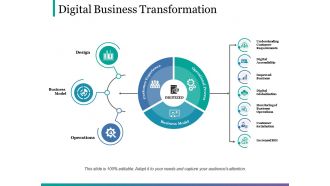
The digital transformation is a three-stage process which incorporates features like Design, Business Model, and Operations. Digital transformation is the integration of digital technology into all areas of business, fundamentally changing how you operate and deliver value to customers. It's also a cultural change that requires organizations to continually challenge the status quo, experiment, and get comfortable with failure. The Template shows an interlinked process with the components like the design, business models, and operations. The digital transformation Template is very beautiful and gives you the provision to change or add the texts in the Slide according to your need and requirement that will completely justify the motive and purpose of the Slide. You can gain public attention easily with the use of this Template as this will be completely understandable by the people which will, as a result, attract the customers. Save the digital convergence Template to present your motive and ideas clearly and with less time consumption. Identify the cause of inhibitions with our Digital Business Transformation Powerpoint Templates. Eliminate any gnawing doubts.
People who downloaded this PowerPoint presentation also viewed the following :
Digital business transformation powerpoint templates with all 5 slides:
Amend flaws before they cause harm with our Digital Business Transformation Powerpoint Templates. Fix them as they emerge.

FAQs for Digital business
Honestly, most companies mess this up because they obsess over the tech but ignore the people part. Get your executives on board first - without that you're dead in the water. Your data has to be clean and your new systems need to play nice with what you already have. I'd start with small pilot programs focused on customer experience since those show results fastest. Train your team properly and actually explain why you're changing things. Oh, and don't try to boil the ocean - pick one area, prove it works, then expand from there.
Track the hard numbers first - ROI, cost savings, how much faster processes are running, customer satisfaction scores. That stuff's obvious but necessary. The tricky part? Figuring out if people actually like the changes. Are your employees even using the new systems or just working around them? I've seen so many companies ignore that part and wonder why nothing improves. Customer engagement matters too - are they using your digital channels more? Pick maybe 4-5 metrics that actually matter to your business and check them every quarter. Don't overthink it with too many data points.
Honestly? Leadership makes or breaks the whole thing. If they're just going through the motions, everyone else will too. You need people at the top who actually get it - not just throwing money at shiny new tech but really understanding why you're doing this. They've gotta sell the vision to everyone else, which is harder than it sounds. Plus they need to walk the walk themselves. I've seen too many transformations crash because executives talked digital but still operated like it was 1995. Make sure your leadership team is genuinely all-in, not just checking boxes.
Oh man, where do I even start? Your biggest headaches will be people hating change and those ancient systems that refuse to play nice with anything new. Budget's gonna explode too - just accept it now. Data migration is always a disaster, and don't get me started on security stuff keeping everyone up at night. Training takes forever, like way longer than anyone thinks. Honestly, I'd run a small test first before diving into the deep end. Build in extra time and money from day one because something will definitely go sideways.
Honestly, data analytics is like having x-ray vision for your business decisions. Instead of guessing what customers want, you'll actually know. Track their behavior, see which digital stuff is bombing vs. crushing it, catch issues early. A/B testing becomes your best friend – you can try different approaches and let the numbers tell you what works. I'd probably start with just one area where you're flying blind right now and add some basic tracking. Way better than the old "spray and pray" method we used to rely on.
Honestly, start with cloud infrastructure since that's your base layer. Then hit data analytics hard - you can't make good calls without it. Automation tools are a lifesaver for cutting out tedious stuff your team shouldn't be doing manually anymore. Cybersecurity's obviously critical, especially once you're digitalizing everything. API management might sound boring but it's what actually connects your systems properly. Customer experience platforms help you turn all this tech into something customers actually benefit from. Mobile's just expected now. My advice? Audit what you've got first, then tackle your biggest headaches instead of doing some massive overhaul.
Look, digital transformation is basically like jumping from a flip phone straight to an iPhone - everything changes overnight. Your customers suddenly expect way more self-service stuff, plus they want experiences that actually feel personal based on their data. Response times need to be lightning fast now, and honestly, people get pretty annoyed when they can't track their orders in real-time. The cool part? You can start predicting what they want before they even know it. But here's the thing - all your touchpoints (app, website, stores) need to feel like one smooth experience, not some frankenstein monster of different systems.
Honestly, it's all over the map depending on your industry. Healthcare's going crazy for telemedicine and AI diagnostics right now. Retail? You've gotta nail that omnichannel thing - real-time personalization is basically table stakes at this point. Financial services are sprinting toward open banking and embedded finance (which is pretty cool actually). Manufacturing's doubling down on IoT and predictive maintenance to avoid those costly shutdowns. What I'm seeing everywhere though is this push for customer data platforms and cloud-first setups. Map these against whatever verticals you're in - that'll help you figure out which initiatives are actually worth pursuing.
Honestly, small businesses have a huge advantage here - no corporate red tape to deal with. Start with whatever eats up most of your time. Maybe that's setting up chatbots for customer questions or getting your inventory sorted digitally. Cloud stuff is perfect because it won't break the bank and grows with you. Here's the thing though - social media actually levels the playing field way more than people realize. You can connect with customers that big companies throw ridiculous money at trying to reach. Pick like 2-3 things that'll either make you money or give you back serious time each week, then build from there.
Honestly, psychological safety is everything - people won't take risks if they're scared of getting burned. Celebrate the smart failures, not just wins. Give teams some dedicated brainstorm time, even 10% helps. Some of my favorite innovations literally came from those random Friday afternoon sessions where people were half-checked out but somehow more creative? Leadership needs to experiment too, can't just talk about it. Cross-functional spaces work great. Different departments bump into each other and magic happens. Start with small pilots so failure doesn't hurt much.
Look, security can't be an afterthought - bake it right into your transformation plan. Encrypt literally everything: stored data, stuff moving around, all of it. Zero-trust is huge too - everyone proves who they are before getting access, even your own people. I know it sounds like a lot but you can't skip this part. Check what regulations hit you (GDPR, CCPA, whatever) and stay compliant. Oh, and train your team regularly since most breaches happen because someone clicked the wrong thing. If you don't have security experts already, definitely bring in outside help.
Honestly, data literacy is probably the biggest one - you've gotta be able to actually understand analytics, not just stare at dashboards. Get comfortable with digital collaboration tools too since that's just how work happens now. Automation and basic AI knowledge will save your butt later. The soft skills matter just as much though. Adaptability is huge because everything changes constantly (kind of exhausting tbh). Design thinking helps a lot with problem-solving. Emotional intelligence becomes super important when you're dealing with people who hate change. I'd say pick one new tool to really learn this quarter and go from there.
So basically, digital transformation turns your supply chain from a total guesswork nightmare into something that actually works. You'll get real-time tracking instead of calling vendors and hoping for updates. AI can predict when demand's gonna spike, IoT sensors watch your shipments, and blockchain keeps everything transparent - though honestly blockchain still feels overhyped to me. The best part? You can spot problems before they blow up and automatically reroute stuff. Don't try to fix everything at once though. Pick your biggest headache first - probably inventory tracking - then expand from there.
Dude, you can't build everything yourself anymore - that's just not realistic. Partnerships are huge for digital transformation. Map out your biggest gaps first, then find partners who actually complement what you're doing. Tech vendors for specialized stuff, consultants when you need expertise fast, strategic alliances for new markets. I mean, why reinvent the wheel every time? The trick is finding partners who'll scale with you long-term, not just solve today's problems. Make sure they align with your vision too - mismatched partnerships are honestly worse than going solo.
Run them side by side - don't try switching everything overnight. Keep your money-making stuff going while you test digital things separately. It's like fixing up your house while you're still living there (total pain but it works). Figure out which old processes you absolutely can't mess with first. Then slowly add digital bits that work WITH what you already have, not against it. Honestly, your customers will be way happier if things don't suddenly change on them. Oh, and track how both sides are doing so you know when to move more resources over to digital.
-
Visually stunning presentation, love the content.
-
Great product with effective design. Helped a lot in our corporate presentations. Easy to edit and stunning visuals.