


Digital Transformation Proposal Powerpoint Presentation Slides




Try Before you Buy Download Free Sample Product
 Impress Your
 Audience
 100%
100% Editable
 Save Hours
 of Time


Digital transformation is implementing technologies like artificial intelligence AI, machine learning ML, and cloud computing to improve efficiency and develop new business models. Grab our professionally designed Digital Transformation Proposal. It can assist any business in streamlining and automating business processes, improving customer experience, and enabling data driven decision making. Our Digital innovation deck helps to achieve Increased efficiency, greater business agility, and, ultimately, the unlocking of new value for employees, customers, and shareholders. The proposal begins with sections such as project context, need, services offered, and total investment required to avail of digital IT transformation services. Further, our Digital transformation consulting PPT exhibits detailed information about the roadmap, company overview, case study, and significant clients. Lastly, the Digitalization module includes slides related to social proof, terms, and conditions, etc. Customize this 100 percentsge editable template with assistance from our highly skilled research or design team. Get access now.
People who downloaded this PowerPoint presentation also viewed the following :
Content of this Powerpoint Presentation
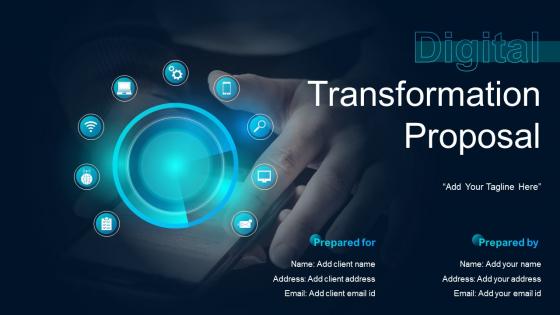
Slide 1: This slide introduces the Digital Transformation Proposal.
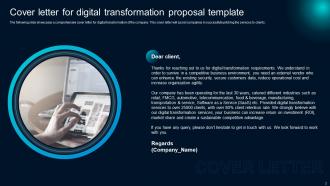
Slide 2: The following slide showcases a comprehensive cover letter for digital transformation of the company.
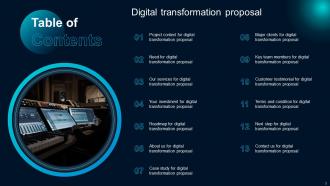
Slide 3: This slide incorporates the Table of Contents.
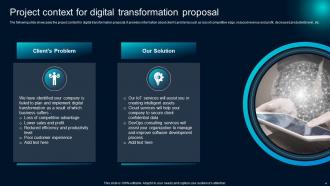
Slide 4: This slide presents the project context for digital transformation proposal.
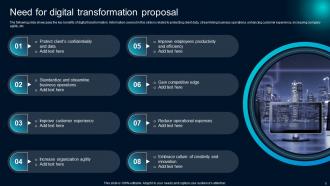
Slide 5: This slide exhibits the Need for digital transformation proposal.
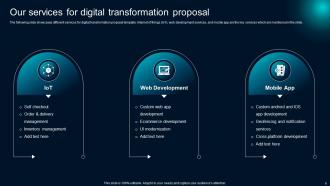
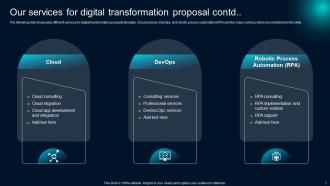
Slide 6: This slide states the different services for digital transformation proposal template.
Slide 7: The following slide elucidates the different services for digital transformation proposal template.
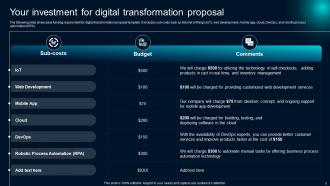
Slide 8: The following slide reveals funding requirement for digital transformation proposal template.
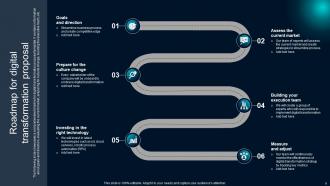
Slide 9: This slide displays the Roadmap for digital transformation proposal.
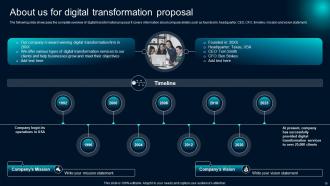
Slide 10: This is the About us slide for depicting the company-related information.
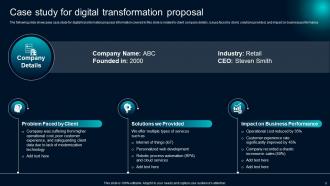
Slide 11: This slide highlights the Case study for digital transformation proposal.
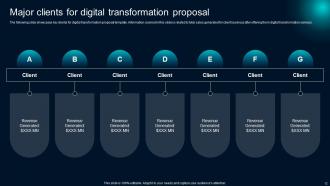
Slide 12: This slide represents the Major clients for digital transformation proposal.
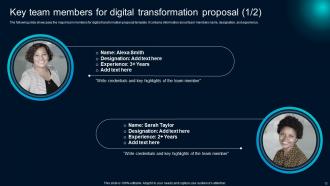
Slide 13: This slide provides information about the Key team members.
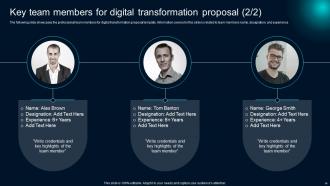
Slide 14: This is yet another slide continuing the The professional team members.
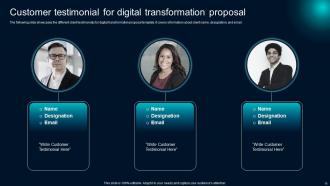
Slide 15: This slide highlights the Customer testimonial for digital transformation proposal.
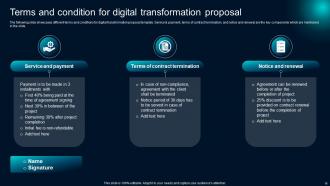
Slide 16: This slide outlines the Terms and condition for digital transformation proposal.
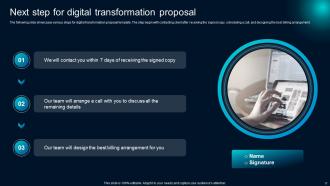
Slide 17: The following slide showcases various steps for digital transformation proposal template.
Slide 18: This slide is used for depicting the firm's conatact details.
Slide 19: This is the Icons slide containing all the Icons used in the plan.
Slide 20: This slide is used for stating the Additional information.
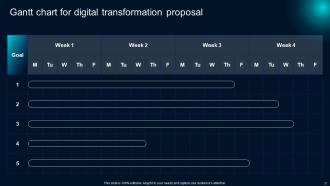
Slide 21: This slide illustrates the Gantt chart for digital transformation proposal.
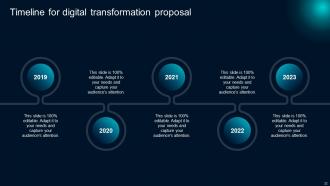
Slide 22: This slide presents the Timeline for digital transformation proposal.
Slide 23: This slide exhibits the 30 60 90 days plan for effective planning.
Slide 24: This slide elucidates the mission, vision, and goals of the organization.
Slide 25: This is the About us slide for revealing the organizational information.
Digital Transformation Proposal Powerpoint Presentation Slides with all 30 slides:
Use our Digital Transformation Proposal Powerpoint Presentation Slides to effectively help you save your valuable time. They are readymade to fit into any presentation structure.







FAQs for Digital Transformation Proposal
You'll need leadership backing, employee training, solid tech setup, and a data plan. But here's the thing - so many companies just focus on the shiny new tools and totally ignore getting their people ready. That's where everything falls apart. Pick your biggest headaches first instead of trying to fix everything at once. Set up clear ways to track if it's actually working. Oh, and definitely roll things out in phases - learned that one the hard way. Your team needs to understand not just the tech but how to actually use it day-to-day.
Mix hard numbers with the soft stuff to get the real story. Cost savings and revenue are obvious ones to track. But honestly? The qualitative signs tell you more - like whether people actually use the new systems or just complain about them. Employee feedback is huge here. Set up a dashboard combining financial metrics with adoption rates. Oh, and customer satisfaction scores too - almost forgot that one. Focus on metrics tied to your actual goals though, not just numbers that make pretty charts for leadership meetings.
Honestly, your leaders make or break the whole thing. Without them setting the vision and actually putting money behind it, you're toast. I've watched companies try to just throw new software at people and wonder why nothing changed - spoiler alert, it doesn't work. The key is getting leadership to visibly champion it and show teams why this matters. They need to communicate through the pushback (and there will be pushback). Plus they've got to experiment themselves and not freak out when stuff doesn't work immediately. No leadership buy-in? Your transformation's dead in the water.
Look, data analytics is like having GPS for going digital - shows you what's actually working vs. what's a total waste. Use it to figure out which processes to digitize first, see how customers are using your new tech stuff, and track if you're getting decent ROI. Honestly, I've watched way too many companies just throw money at digitizing random things without checking the numbers first (spoiler: doesn't end well). Analytics helps with personalizing experiences and spotting trends too. My advice? Don't go crazy - just pick one metric that actually matters to your business and build from there.
Honestly, the biggest pain points are always people hating change and lacking tech skills. Plus everyone tries cramming everything into one giant rollout - recipe for disaster IMO. Get your leadership bought in first, that's crucial. Then pour money into training because your team will be lost otherwise. Break it down into phases instead of some massive overhaul. Quick wins early on really help build trust. Oh and communication is huge - people need to know WHY you're doing this and what's in it for them personally. Otherwise they'll just resist the whole thing.
Dude, training your people is literally everything when it comes to digital transformation. I've watched so many companies blow ridiculous money on fancy software that just sits there collecting digital dust. You gotta teach your team the new tools AND help them actually want to use them - people hate change they don't get. Start by figuring out what skills are missing, then set up practice sessions where they can mess around without breaking anything. Find a few tech-savvy employees who can become your go-to helpers. Honestly, some executives think they can just buy solutions and magic happens. Train first, buy second.
Honestly, digital tools are a game-changer for customer experience. Chatbots give instant support, mobile apps make everything accessible, and data analytics show you what people actually want. AI can predict needs before customers even realize they have them - sounds crazy but it works. Map out where customers interact with you now and find the biggest headaches. Those are your priority fixes. The whole point is removing friction and meeting people where they already spend their time online. Oh, and don't try to fix everything at once - pick the most annoying problems first and tackle those with the right tech.
Honestly, start with cloud computing, AI/ML, and data analytics - that's your foundation right there. Mobile tech and IoT are massive too, especially for anything customer-facing. You'll also want solid API integrations because everything needs to connect these days (which is kind of annoying but whatever). Don't forget automation tools and cybersecurity stuff. My advice? Figure out what you've got first, then see where the gaps are. Oh, and prioritize based on what'll actually move the needle for your business instead of whatever tech blog is hyping this week.
Dude, pick ONE thing that's driving you crazy first - maybe invoicing or whatever eats most of your time. Don't go nuts trying to fix everything. Cloud stuff is usually cheaper since you're not buying expensive software upfront. Actually, Google Workspace handles way more than you'd think (and it's basically free). Once that first thing starts saving you money, use those savings for the next upgrade. Way better than dropping a fortune on some fancy system that might not even work for you. Baby steps beats going broke, you know?
Okay so digital transformation is basically a huge cultural shift. People either love the new tools and faster pace, or they freak out and resist everything - honestly depends on how leadership handles it. Don't just dump new tech on everyone and expect magic. Get people involved from the start. Training matters way more than you'd think, and explaining WHY you're changing things helps tons. Find your early adopters first - they'll do half the convincing for you. Most companies see better engagement once employees understand what's in it for them. It's really about bringing people along instead of dragging them.
Honestly, don't make security an afterthought - build it in from day one. Risk assessments before rolling out new tech will save you major headaches later. Encrypt everything, both when it's moving and sitting around. Zero-trust is clutch here - basically trust nothing until it proves itself. Your employees need solid training because, let's face it, they're usually how hackers get in (no offense to anyone reading this). Get some decent monitoring tools so you can catch weird stuff happening. Oh, and here's the thing - think of cybersecurity as helping your transformation, not slowing it down.
Okay so first thing - map out your data and figure out what APIs you're dealing with. The documentation on old systems is usually garbage, just warning you now. Use something like MuleSoft or Dell Boomi as middleware to connect everything. Don't try to replace everything at once - that's how disasters happen. Go gradual instead, keeps things running while you migrate. Test in isolated environments first, obviously. Oh and get security involved early because legacy stuff is basically Swiss cheese vulnerability-wise. Way less stressful than a big bang approach.
Honestly, these tools are total lifesavers when everything's changing constantly at work. Real-time document sharing means you're not dealing with version control nightmares anymore. Quick video calls fix confusion way faster than going back and forth over email - which, let's be real, nobody has time for. Your team can actually see what's happening with projects instead of guessing. The transparency thing is huge because when priorities flip (and they always do), everyone adapts quicker. My advice? Pick maybe two tools your team will genuinely use. Don't go overboard with like ten different platforms - that just creates more chaos.
Honestly, AI is like having a really smart assistant that never gets tired. It handles all the boring, repetitive stuff while you focus on the bigger picture. The data you're already collecting? AI actually makes sense of it and can even predict what customers want next. Pretty wild, right? But here's the thing - it doesn't just speed up what you're already doing. It completely changes how you can work. You get personalized customer experiences without the manual headache, plus everything runs smoother. My advice? Don't overthink it. Pick one small project to test it out first.
So basically, digital transformation lets you see everything happening in real-time - inventory levels, where shipments are, demand patterns, all of it. No more ancient spreadsheets! AI can actually predict when things might go wrong before they do, which is pretty wild. Automation takes over boring stuff like processing orders and warehouse tasks. You'll get constant data from IoT sensors (sometimes honestly feels like drinking from a fire hose). But here's the thing - you can fix problems in hours now instead of waiting days. I'd start by figuring out what's currently driving you crazy and which manual processes are eating all your time.
-
The PPTs are extremely simple to modify. Thank you for providing the slides that are ready to be used. They assist me in saving a lot of time.
-
Their designing team is so expert in making tailored templates. They craft the exact thing I have in my mind…..really happy.