


Digital transformation people process technologies powerpoint guide





Try Before you Buy Download Free Sample Product
 Impress Your
 Audience
 100%
100% Editable
 Save Hours
 of Time


Digital transformation is not just about technology, it's about people and process too. To truly transform your business, you need to consider all three aspects.Technology is obviously a key part of any digital transformation. You need to have the right infrastructure and platforms in place to enable change. But it's not just about the technology itself, it's about how you use it. People are a critical part of any transformation. They need to be involved in the process, and they need to be trained and empowered to use the new technologies.Process is also important. You need to have a clear plan for how you're going to implement the changes, and you need to make sure that the process is efficient and effective. SlideTeam has an extensive set of digital transformation PowerPoint templates to help you understand how people process technologies. Our templates are easy to use and customizable, so you can create a presentation that meets your specific needs. Download our templates today and start planning your next digital transformation project.
People who downloaded this PowerPoint presentation also viewed the following :
Content of this Powerpoint Presentation
Description:
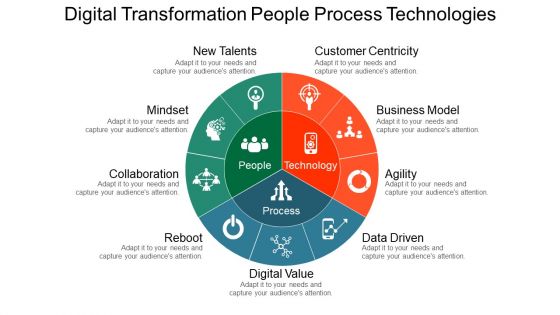
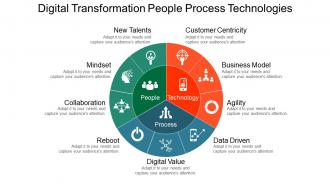
This image is a graphical representation of the key components involved in digital transformation, focusing on People, Process, and Technology. These three elements are presented in a Venn diagram highlighting the intersection of each area where Digital Value is created. Around this central graphic and within each section of the diagram, there are additional concepts important to successful digital transformation:
1. People:
Surrounded by "New Talents," "Mindset," "Collaboration," and "Reboot," indicating that a successful digital transformation requires not only skilled individuals but also the right attitude, collaborative efforts, and the ability to adapt and restart when necessary.
2. Process:
Emphasizes "Customer Centricity," "Business Model," "Agility," and "Data Driven," suggesting that processes should be designed with the customer at the core, supported by flexible business models, agile practices, and data-informed decision making.
3. Technology:
No specific subprocesses are listed under Technology, reflecting its role as an enabler and integrator in the transformation process.
Use Cases:
This slide can be applied across various industries as part of training sessions, strategy meetings, or workshops where digital transformation is a key topic. Here are seven industries and use cases:
1. Technology:
Use: To educate about integrating new digital tools.
Presenter: Chief Technology Officer
Audience: IT Department Staff
2. Healthcare:
Use: Discussing how to improve patient care with digital solutions.
Presenter: Healthcare Administrator
Audience: Medical professionals
3. Finance:
Use: Strategy for digital banking innovation.
Presenter: Innovation Manager
Audience: Bank Executives
4. Retail:
Use: Developing a customer-centric shopping experience online.
Presenter: E-commerce Strategist
Audience: Marketing and Sales Teams
5. Manufacturing:
Use: Implementing agile and data-driven processes in production.
Presenter: Operations Director
Audience: Factory Managers and Engineers
6. Education:
Use: Utilizing technology for enhancing learning experiences.
Presenter: Educational Consultant
Audience: Faculty and Administrators
7. Entertainment:
Use: Discussing the impact of digital technologies on consumer media consumption.
Presenter: Digital Media Specialist
Audience: Content Creators and Producers
Digital transformation people process technologies powerpoint guide with all 5 slides:
Avoid feeling helpless with our Digital Transformation People Process Technologies Powerpoint Guide. Always have the best assistance at hand.


FAQs for Digital transformation people process
Honestly, you gotta get leadership on board first or you're screwed from the start. Focus on what customers actually want - that should guide everything. Make sure your data systems can talk to each other instead of being a hot mess of disconnected tools. Your team will need proper training too, which people always underestimate. Oh, and don't try to do everything at once. Test stuff out with small pilot programs first. I've seen too many companies go big right away and crash hard. Change management sounds boring but it's what makes or breaks the whole thing.
Honestly, you've gotta get your baseline numbers first - otherwise you're just guessing later. Track the obvious stuff like cost savings and faster processing, but don't ignore the softer wins either. Customer satisfaction scores, how productive your team feels, decision-making speed... that stuff adds up. Here's what I'd do though - resist the urge to measure literally everything. Pick 3-5 metrics max and check them monthly. Maybe start with one big project and really figure out how to measure that properly first? Once you nail that approach, you can copy it for other initiatives. Trust me, a simple dashboard beats a complicated mess every time.
Honestly, leadership makes or breaks this stuff. Your executives can't just talk about it - they actually have to use the tools themselves. I've watched so many companies fail because the C-suite treated digital transformation like some IT side project instead of real business change. You need leaders who'll put money behind it (not pocket change) and explain why you're doing this. Break down those annoying department silos. Let teams try things and screw up quickly. Oh, and celebrate the wins when they happen - people need that motivation. If your CEO won't even log into the new system, you're already dead in the water.
So AI and IoT are kind of like having superpowers for your business transformation. With AI, you can automate the boring stuff and actually make sense of all that data you're collecting. IoT connects everything - and I mean everything - so you get real-time visibility into what's happening. It's honestly crazy how much clearer things become. You're not just digitizing the same old processes anymore, you're completely rethinking how things could work. My advice? Pick one small project first and show some wins before going all-in.
Honestly, the biggest pain points are usually people-related. Employees hate change, half your team doesn't have the digital skills they need, and if leadership isn't really committed? Game over. Then you've got all the technical headaches - old systems that fight with new ones, never enough budget, security freaking out about everything. Most companies also try to do way too much at once, which is just asking for disaster. My take? Pick one small thing to test first, spend serious money on training people (like, actually good training), and triple-check that your executives won't bail when things get messy.
Honestly, training is make-or-break for this stuff. People won't touch new tech if they're confused by it - I've watched so many rollouts crash because companies just dumped software on everyone and said "figure it out." Find your tech-savvy people first and turn them into cheerleaders. Don't just show the how, get them pumped about why it matters. Like, will this actually save them time or make work less boring? My old company did this terribly btw. Short training sessions work better than those marathon all-day things too.
Look at Walmart - they threw IoT sensors everywhere to track inventory better. Disney's MagicBands are actually brilliant, you just tap for everything from rides to buying overpriced churros. Mayo Clinic does AI diagnostics now. Oh and John Deere's tractors basically drive themselves with GPS tech. What's smart about all these? They didn't go crazy trying to digitize their entire business overnight. Each company picked one annoying problem and fixed that first. Way less overwhelming than some massive transformation project.
Honestly, customer experience is what should drive your whole digital transformation strategy. Map out where people get frustrated first - slow checkout, can't find products, whatever. Those pain points tell you exactly which tech to prioritize. I've seen companies throw money at random digital stuff that doesn't actually help anyone. Survey your customers about what bugs them most. That feedback becomes your roadmap for which solutions will actually make a difference. You're not digitizing just because it sounds cool - you're fixing real problems people face when they interact with your business.
Look, you can't just slap security on after everything's built - learned that the hard way at my last job. Start with zero-trust architecture and solid encryption from day one. Companies get way too excited about new cloud stuff and APIs without thinking through the risks first. Your attack surface is gonna grow fast. Do regular security checks, train your people on current threats, and have response plans ready. Oh, and identity management is huge - don't skimp there. Begin by auditing what you've got now, then build security controls into each new system as you roll them out.
Privacy needs to be baked in from the start - don't try adding it later, trust me on this. Do impact assessments for new systems and get solid data governance policies that people will actually follow. Encryption and access controls aren't optional anymore, they're basic requirements. Your teams need proper training because even the best tech is useless if nobody knows how to use it right. Oh, and get legal and IT talking to each other early - I've seen too many projects crash because they waited until the end to have that conversation.
Dude, the culture stuff will absolutely make or break your digital transformation. I'm talking more than the actual technology - which sounds crazy but it's true. Your team needs to be down for experimenting and learning new things together. Otherwise you get people dragging their feet or staying in their little departmental bubbles. Leadership has to walk the walk first, not just talk about change. Oh and definitely celebrate the small wins! People need to feel safe screwing up sometimes while they figure things out. Skip the training and you'll have half your team feeling totally lost and frustrated.
Honestly, start with a good project management tool - Asana or Monday.com work great. Slack or Teams for communication is a must because I've watched so many digital transformation projects crash and burn just from poor communication alone. Analytics dashboards like Tableau help track your progress. Oh, and don't skip change management stuff - even basic survey tools work to see if people are actually using what you're building. My advice? Pick one PM tool first, then add the rest as things grow. Otherwise you'll overwhelm everyone from day one.
Look, agility is just being able to pivot fast when stuff inevitably goes sideways - which it will, constantly. Test things quickly, fail without burning tons of cash, then adjust based on what actually works instead of clinging to some ancient strategic plan. I've seen too many companies get stuck that way. Stay responsive to new tech and what customers really want as it shifts. Build small teams that can actually make decisions without endless meetings and bureaucracy. Cross-functional works best. They'll iterate way faster than waiting around for everyone to agree on everything.
Honestly, AI and automation are taking over everything right now. Healthcare's going crazy with telemedicine and AI diagnostics. Retail's obsessed with personalized experiences and that whole omnichannel thing. Manufacturing? They're collecting insane amounts of data through IoT sensors - kinda scary how much they know tbh. Banks are pushing mobile-first everything plus blockchain stuff. The pattern I'm seeing is everyone wants to be more data-driven and customer-focused. My advice? Start with whatever makes your customers' lives easier first. That's usually where you'll see the biggest wins anyway.
Honestly, small businesses have a huge advantage here - you can move fast while big companies are stuck in committee hell. Pick 2-3 things that'll actually make you money, don't try to go crazy with everything at once. Cloud stuff is your friend since you won't blow your budget upfront. Think automated customer service, social media tools, basic analytics. The cool part? You can actually get to know your customers and switch directions when something's working. I'd start with whatever your customers see first - that's where you'll feel the impact fastest. Those big corporations take forever just to update their website!
-
Innovative and Colorful designs.
-
Great quality slides in rapid time.