

Change Management Powerpoint Presentation Slides




Try Before you Buy Download Free Sample Product
 Impress Your
 Audience
 100%
100% Editable
 Save Hours
 of Time


Every organization needs to adapt to the ever-changing business environment. Sensing this need, we have come up with these content-ready change management PowerPoint presentation slides. These change management PPT templates will help you deal with any kind of an organizational change. Be it with people, goals or processes. The business solutions incorporated here will help you identify the organizational structure, create vision for change, implement strategies, identify resistance and risk, manage cost of change, get feedback and evaluation, and much more. With the help of various change management tools and techniques illustrated in this presentation design, you can achieve the desired business outcomes. This business transition PowerPoint design also covers certain related topics such as change model, transformation strategy, change readiness, change control, project management and business process. By implementing the change control methods mentioned in the presentation, you will be able to have a smooth transition in an organization. So, without waiting much, download our extensively researched change management framework presentation. With our Change Management Presentation slides , understand the need for change and plan to go through it without any hassles.
People who downloaded this PowerPoint presentation also viewed the following :
Video for Change Management Powerpoint Presentation Slides
Content of this Powerpoint Presentation
Slide 1: This slide displays the heading Change Management with a creative gear image. State your company name below and introduce change management structure.
Slide 2: This slide covers Table of Content for the presentation. It includes the following sub headings- Identify the change, vision for change, change management agents and framework, resistance and risk, implementation strategies, cost of change, feedback and evaluation. It also shows an imagery of contents to go with the text.
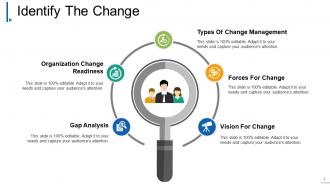
Slide 3: This slide expands the heading- Identify the Change. It showcases the type of change, forces, vision, organization change readiness, and Gap Analysis
for the change required.
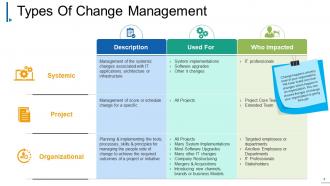
Slide 4: This slide shows Types of Change Management. The parameters displayed are- Systematic, Project and Organizational. State your Description, Used for and Impacted entities, by this slide.
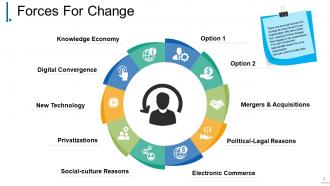
Slide 5: This slide covers the forces for change in the organization/company. The forces enlisted are- Knowledge economy, Digital convergence, New Technology, Privatisations, Socio-cultural & political-legal reasons, electronic commerce and mergers & acquisitions.
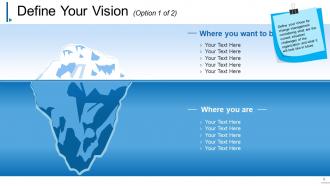
Slide 6: This slide covers imagery for defining your Vision. It also contains text boxes with a creative glacier image. State your vision in terms of- ‘Where you are’ v/s ‘Where you want to be’ with the help of the segmented glacier image.
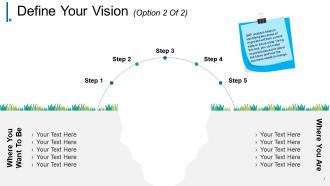
Slide 7: This slide displays Define your Vision with another variation. Showcase it in 5 steps your vision statement. State your vision in terms of ‘Where you are’ v/s ‘Where you want to be’ with accompanied steps.
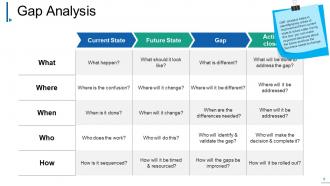
Slide 8: This slide covers Gap Analysis. Address current state, gap and future state on the parameters of what, when, where, who and how. Showcase your analysis with the help of this table in details.
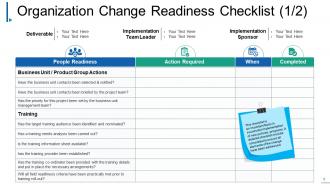
Slide 9: This slide displays the checklist for Organization Change Readiness. State Deliverables, Implementation Team leader and Sponsor with this slide. Display People readiness of the organization in terms of Business unit/Product Group Actions and Training with Action required for the particular parameter. You can also show the time and duration of the change under the headings- ‘When’, ‘Completed’.
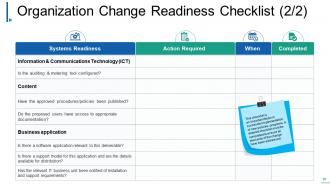
Slide 10: This slide displays the checklist for Organization Change Readiness. Showcase System Readiness in terms of ICT, Content and Business Application as parameters for tracking. State the Action required, and time duration of start and finish under the headings- ‘When’, ‘Completed’.
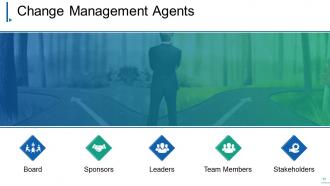
Slide 11: This slide covers Change Management Agents with a backdrop image of a businessman. The points included for agents are- Board, Sponsor, Leader, Team members and Stakeholders.
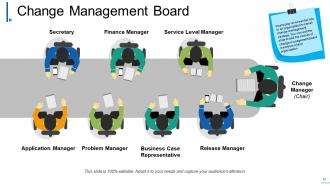
Slide 12: This slide displays Change Management Board with the following subheading members- Secretary, Finance manager, Service level manager, Change manager, Application manager, Problem manager, Business case representative and Release manager. It is shown in the form of a team table with manager imagery to go with each designation.
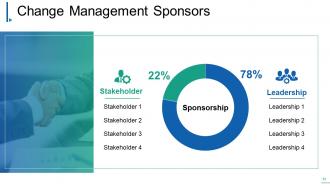
Slide 13: This slide showcases Change management sponsors with stakeholder and leadership as subheadings. State the stakeholder and leadership share in percentages with this slide.
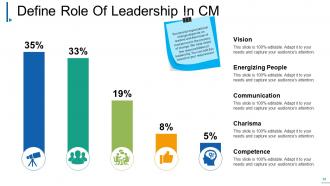
Slide 14: This slide shows Role of Leadership in Change management. Accompanied with a bar graph, state contribution/role importance in terms of percentage. The subheadings included to show the percent count are- Vision, Energizing people, Communication, Charisma and Competence. It displays icon imagery for each of the sub headings included.
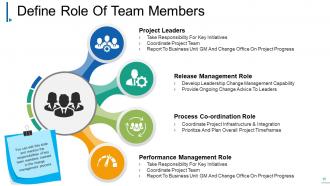
Slide 15: This slide shows the Role of team members. The subheadings that make it explicit are- Project Leaders, Release management role, Press co-ordination role, and Performance management role. It also includes imagery for each of the respective sub headings.
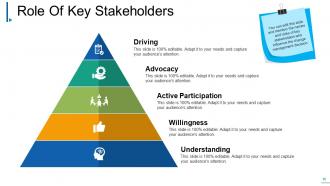
Slide 16: This slide covers Role of Key stakeholders. With a pyramidal image it displays the factors of- Driving, Advocacy, Active participation, Willingness, and Understanding. It also showcases imagery for each sub heading shown.
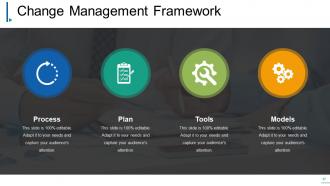
Slide 17: This slide shows Change Management Framework. With apt imagery to go with, it showcases Process, Plan, Tools and Models to fill the text for.
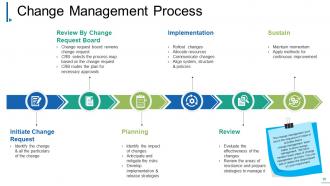
Slide 18: This slide shows Change management process. The process shown covers – Initiate the change request (Identify the change & all the particulars of the change), Planning (Identify the impact of changes, Anticipate and mitigate the risks Develop implementation & release strategies), Review by Change Request Board (Change request board reviews change request, CRB selects the process map based on the change request, CRB routes the plan for necessary approvals), Implementation (Rollout changes, Allocate resources, Communicate changes, Align system, structure & policies), Review (Evaluate the effectiveness of the changes ,Review the areas of resistance, and prepare strategies to manage it), Sustain Maintain momentum, Apply methods for continuous improvement). The change management process is the sequence of steps or activities that a change management team follow to drive change management.
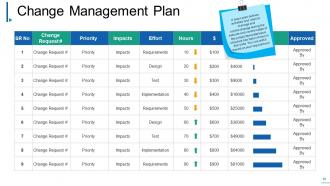
Slide 19: This slide showcases a Change Management Plan. A basic plan defines activities and roles to manage and control change during ‘execution’ and ‘control stage’ of the project. Basic structure has been shown in this slide.
Slide 20: This slide shows Change Management Tools such as- Job Impact Assessment, (Ascertain the impact of change on roles & people), Stakeholder Analysis, (Identify stakeholder engagement levels for mutual solutions), Change Impact Assessment, (Identify potential impact of change on the organization), Change Effectiveness Assessment, (Determine the need to re-evaluate the current approaches to ensure sustainability of change), Change Readiness Assessment, (Diagnose AS-IS situation & evaluate the employee readiness towards the change).
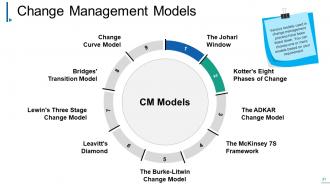
Slide 21: This slide showcases Change management Models. Various models used in change management process have been listed down. You can choose one or more models based on your requirement- The Burke-Litwin Change Model, The Johari Window, Kotter's Eight Phases of Change, The ADKAR Change Model, The McKinsey 7S Framework, Leavitt's Diamond, Lewin's Three Stage Change Model, Bridges' Transition Model, Change Curve Model.
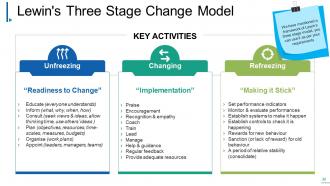
Slide 22: This slide shows Lewin's Three Stage Change Model. We have mentioned a framework of Lewin’s three stage model. Unfreezing- Readiness to change Educate (everyone understands) Inform (what, why, when, how) Consult (seek views & ideas, allow thinking time, use others’ ideas), Plan (objectives, resources, time-scales, measures, budgets) Organise (work plans) Appoint (leaders, managers, teams) Changing- “Implementation” Praise, Encouragement, Recognition & empathy Coach, Train, Lead Manage Help & guidance, Regular feedback, Provide adequate resources. Refreezing- “Making it Stick” Set performance indicators Monitor & evaluate performances, Establish systems to make it happen, Establish controls to check it is happening, Rewards for new behaviour Sanction (or lack of reward) for old behaviour, A period of relative stability (consolidate).
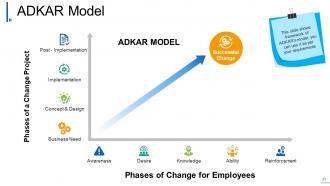
Slide 23: This slide shows ADKAR MODEL. The headings showcases- Phases of a Change Project, Phases of Change for Employees, Awareness, Desire, Knowledge, Ability, Reinforcement, Implementation, Post - Implementation, Concept & Design, Business Need.
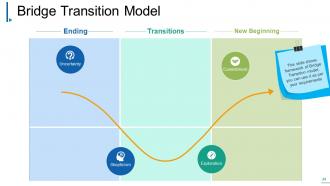
Slide 24: This slide shows framework of Bridge Transition model. Bridge Transition Model covers- Ending, Transitions, New Beginning, Uncertainty, Exploration, Skepticism, Commitment.
Slide 25: This slide showcases Szpekman's Communication Framework. The headings covered are- Communication (Communication Plans, Print & Electronic Media, Face-to-Face Communication), Leadership, (Vision & Strategy Agenda, Items Questions, Praise, Resources, Assignments, Symbolic Behavior) Structure / Process, (Organization Structure, Career Paths, Policies & Procedures, Roles & Responsibilities, Tools & Support) Rewards, (Compensation Plans, Benefits, Recognition Programs, Promotions) Measures, (Performance Management, 360 degree Feedback, Employee Surveys Performance Metrics & Benchmarks) Knowledge / Skill Emphasis, (Competency Models, Hiring Processes, Orientation Programs, Training & Development, Feedback & Coaching, Talent Planning)
Slide 26: This slide showcases Roger's Technology Adoption Curve. The main headings constitute of- Innovators, Early Adopters, Early Majority, Late Majority, Laggards to be shown with respective percentages.
Slide 27: This slide covers Risks and Barriers. The subheadings include- Risk Assessment, Resistance to Change, Resistance Management Plan
Slide 28: This slide covers Risk Assessment
in details. Identify the risk and assess the significance and likelihood of it occurring and plan the contingency. For effectively change management process, it is important to identify all the possible risk elements associated with it. Date of risk occurring and Brief Description of Risk, Mitigation Action, Approval of Commencement, Date of Commencement, Risk No. can be shown by with respective High medium low parameters.
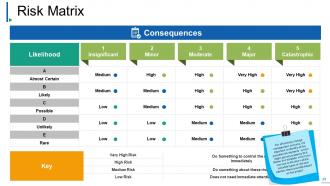
Slide 29: This slide displays Risk Matrix. It is a detailed variation of Risk associated in Change management. Consequences in the order of Insignificant, Minor, Moderate, Major, Catastrophic factors for any Likelihood to happen can be shown by this matrix.
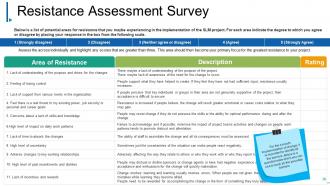
Slide 30: This slide covers Resistance Assessment Survey. For the smooth implementation of change, it is important to identify all the barriers. The Areas, Description and Rating can be shown in terms of list of potential areas for resistance that you may be experiencing in the implementation of the SLM project. For each area indicate the degree to which you agree or disagree by placing your response in the box from the following scale. Assess the across individually and highlight any scores that are greater than three. This area should then become your primary focus for the greatest resistance to your project are- Area of Resistance, Description, Rating.
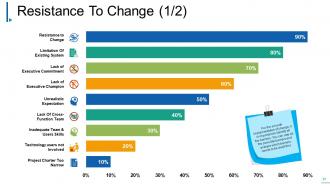
Slide 31: This slide shows Resistance to Change faced. For the smooth implementation of change, it is important to identify all the barriers. You can rate all the possible barriers and analyse which barriers needs to be dealt first. The following factors can be gauged on the parameters of High medium low- Inadequate Team & Users Skills, Technology users not involved, Resistance to Change, Limitation of Existing System, Lack of Executive Commitment, Lack of Executive Champion, Unrealistic Expectation, Lack of Cross-Function Team, Project Charter Too Narrow.
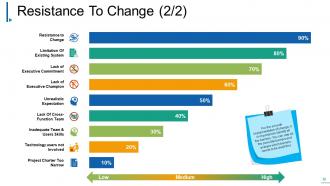
Slide 32: This slide is another variation of Resistance to change faced. These factors can be gauged on the parameters of High medium low.
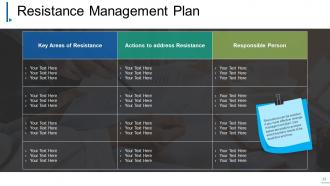
Slide 33: This slide covers Resistance management plan in brief. It shows Resistance management plan which includes Key areas, Actions and persons responsible.
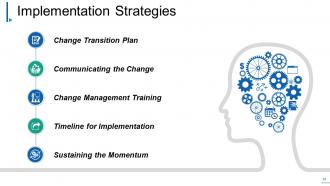
Slide 34: This slide displays Implementation Strategies. The sub headings include- Change Transition Plan, Communicating the Change, Change, Management Training, Sustaining the Momentum, Timeline for Implementation.
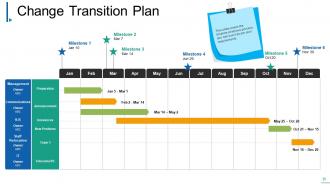
Slide 35: This slide showcases Change Transition plan for milestones covered in a span of twelve months. Management Owner (Preparation), Communications Owner (Announcement), H.R Owner (Grievances, New Positions) Staff Relocation Owner (Team 1) IT Owner (Telecoms/PC)
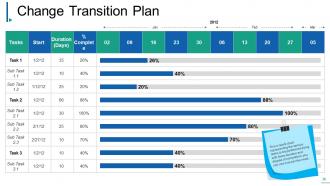
Slide 36: This slide shows Change Transitions plan. This a Gantt chart representing various tasks to be performed along with their duration and degree of completion.
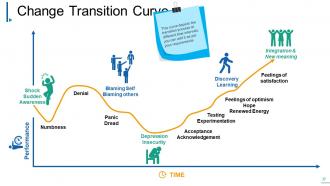
Slide 37: This slide covers Change Transition Curve. This curve depicts the transition process at different time intervals. Numbness, Denial, Panic Dread, Acceptance Acknowledgement, Testing & Experimentation, Feelings of optimism Hope Renewed Energy, Feelings of satisfaction, Shock Sudden Awareness, Blaming Self Blaming others, Depression Insecurity, Discovery & Learning, Integration & New meaning, These aspects are covered in terms of Time and Performance.
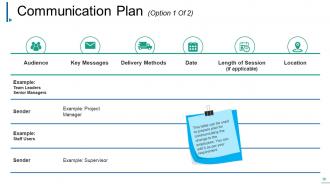
Slide 38: This slide displays Communication Plan. The table can be used to prepare plan for communicating the change to the employees. Audience, Key Messages, Delivery Methods, Date, Length of Session (if applicable), and Location are the major factors covered which can be presented.
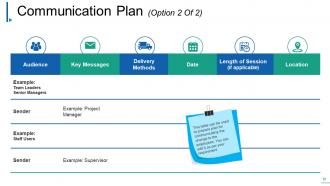
Slide 39: This slide presents a table which can be used to prepare plan for communicating the change to the employees. Communication Plan (Option 2 Of 2) contains the same parameters in a different colour variation.
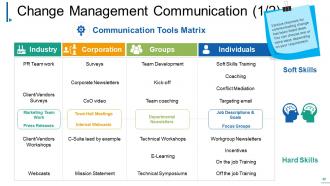
Slide 40: This slide represents Communication Tools Matrix. The main sub headings included are- Industry, Corporation, Groups,Individuals All the above mentioned points are divided on the basis of Soft skills and Hard skills respectively.
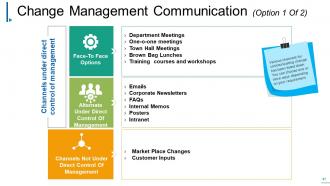
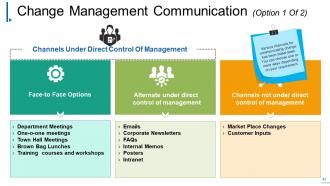
Slide 41: This slide shows Change Management Communication. Various channels for communicating change has been listed down. Channels under direct control of management are sub divided into- Face to face Options, Department Meetings One-o-one meetings, Town Hall Meetings, Brown Bag Lunches, Training courses and workshops Alternate under direct control of management Emails Corporate Newsletters FAQs Internal Memos Posters Intranet Channels Not Under Direct Control of Management Market Place Changes Customer Inputs
Slide 42: This slide is another variation of Change management communication.
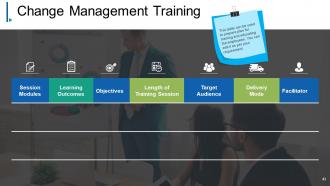
Slide 43: This slide consisting of a Change Management Training table can be used to prepare plan for training and educating the employees.
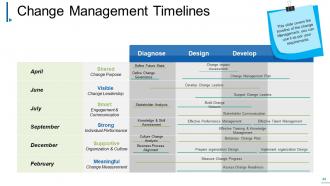
Slide 44: This slide shows Change Management timelines for 6 months. Its sub headings are- Shared (Change Purpose), Visible (Change Leadership), Smart (Engagement & Communication), Strong (Individual Performance), Supportive (Organization & Culture), Meaningful (Change Measurement). These sub headings can be categorised as Diagnosed, Design and Develop. The Diagnose section includes- Define Future State, Define Change Governance, Stakeholder Analysis, Knowledge & Skill Assessment, Culture Change Analysis, Business process Alignment. The Design and Develop section includes- Change Impact Assessment, Change Management Plan, Develop Change Leaders, Support Change Leaders, Build Change Network, Stakeholder Communication Effective, Performance Management, Effective Talent Management, Effective Training & Knowledge Management, Measure Change Progress, Assess Change, Readiness Behaviour Change Plan Prepare organization Design, Implement organization Design.
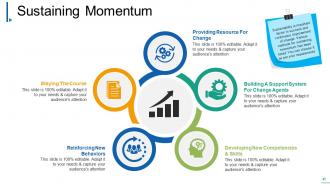
Slide 45: This slide is on Sustainability- an important factor in success and continuous improvement of change. Various methods for sustaining momentum has been listed. Sustaining Momentum slide includes - Building a Support System for Change Agents, Staying the Course, Developing new competencies & Skills, Reinforcing new behaviors, Providing Resource for change.
Slide 46: This slide displays Cost of Change Management as the main title.
Slide 47: This slide displaying Change Management Cost table helps you in ascertaining the cost incurred in executing various steps of change management process. It displays a quarterly cost table with the following headings and content- Task name and Cost to be covered under four quarters. Task name with its subheadings are- Top Down Plan, Strategy, Change Readiness Assessment, Execute Change, Long Term Sustainment. Put the cost involved in front of these sub headings as deemed fit.
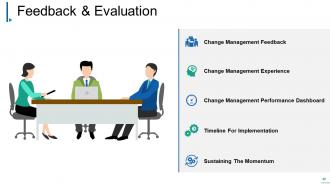
Slide 48: This slide covers Feedback and Evaluation. The subheadings included are- Change Management Feedback Sustaining the Momentum Timeline for Implementation Change Management Experience Change Management Performance Dashboard
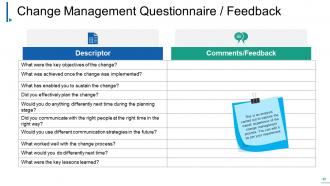
Slide 49: This slide shows Change Management Questionnaire / Feedback. This is an analysis carried out to capture the overall experience of the change management process. It is divided into Descriptor Section and Comments/Feedback section.
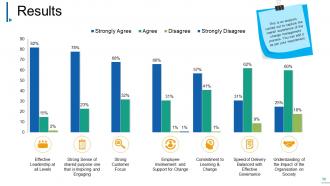
Slide 50: This slide shows the overall Results found out. The factors included are- Effective Leadership at all Levels, Strong Sense of shared purpose one that is Inspiring and Engaging, Strong Customer Focus, Employee Involvement and Support for Change, Commitment to Learning & Change, Speed of Delivery Balanced with Effective Governance, Understanding of the Impact of the Organization on Society.
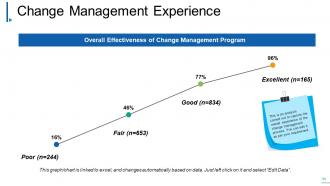
Slide 51: This slide represents a graph for Change Management Experience. Overall Effectiveness of Change Management Program Poor -Fair -Good- Excellent. This is the parameter for the experience.
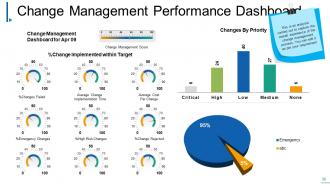
Slide 52: This slide displays Change Management Performance Dashboard. The factors calculated are- %Change Implemented within Target, %Changes Failed, %Emergency Changes, Average Change Implementation Time, %High Risk Changes, Average Cost per Change, %Change Rejected, for the entire Change Management Score.
Slide 53: This slide displays Change Management Icons.
Slide 54: This is another Change Management Icon Slide.
Slide 55: This slide shows Coffee Break image.
Slide 56: This slide displays the title Charts & Graphs.
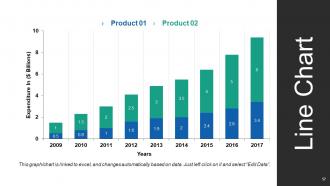
Slide 57: This slide shows a Line Chart for two product comparison.
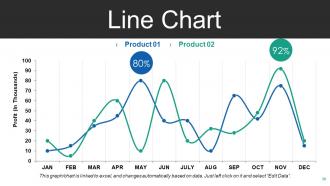
Slide 58: This slide shows a Line Chart for two product comparison.
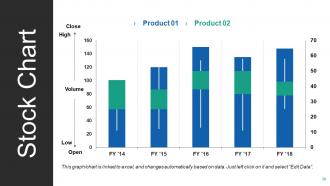
Slide 59: This slide displays a Stock Chart with volume as parameter in terms of high and low, open and close.
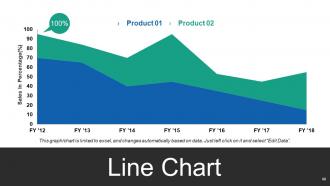
Slide 60: This slide contains a Line Chart. Product 01Product 02 can be shown in comparison.
Slide 61: This slide is titled Additional slides.
Slide 62: This slide contains Our Mission with text boxes.
Slide 63: This slide helps depict Our Team with text boxes.
Slide 64: This slide helps show- About Our Company. The sub headings include- Creative Design, Customer Care, Expand Company
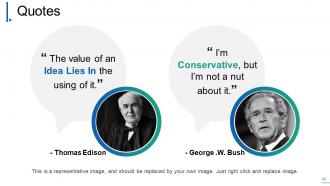
Slide 65: This is a representative image for using a QUOTE.
Slide 66: This slide is titled as Financials. Show finance related stuff here.
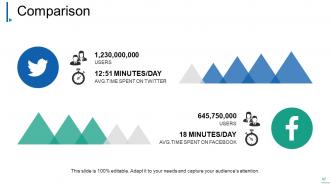
Slide 67: This slide shows Comparison of number of users and Time.
Slide 68: This slide shows Our Goals for your company.
Slide 69: This slide showcases a Puzzle with imagery.
Slide 70: This slide displays a Venn diagram image.
Slide 71: This slide shows Target image with text boxes.
Slide 72: This slide shows a Mindmap for representing entities.
Slide 73: This slide displays a Bulb or idea image.
Slide 74: This is a Thank You image slide with Address, Email and Contact number.
Change Management Powerpoint Presentation Slides with all 74 slides:
Your thoughts are adequately cared for by our Change Management Powerpoint Presentation Slides. They are excellent custodians.
-
Change Management
-
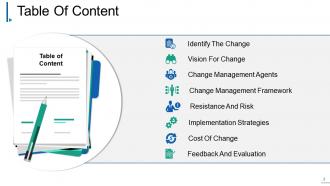
Table Of Content
-
Identify The Change
-
Types Of Change Management
-
Forces For Change
-
Define Your Vision Option 1 of 2
-
Define Your Vision Option 2 Of 2
-
Gap Analysis
-
Organization Change Readiness Checklist 1 2
-
Organization Change Readiness Checklist 2 2
-
Change Management Agents
-
Change Management Board
-
Change Management Sponsors
-
Define Role Of Leadership In CM
-
Define Role Of Team Members
-
Role Of Key Stakeholders
-
Change Management Framework
-
Change Management Process
-
Change Management Plan
-

Change Management Tools
-
Change Management Models
-
Lewin s Three Stage Change Model
-
ADKAR Model
-
Bridge Transition Model
-
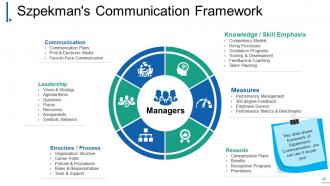
Szpekman s Communication Framework
-
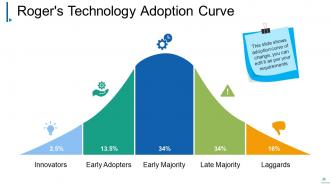
Roger s Technology Adoption Curve
-
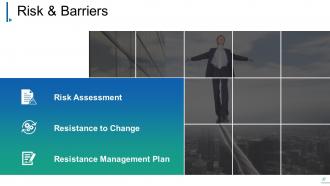
Risk Barriers
-
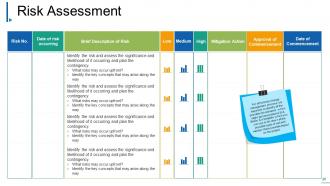
Risk Assessment
-
Risk Matrix
-
Resistance Assessment Survey
-
Resistance To Change 1 2
-
Resistance To Change 2 2
-
Resistance Management Plan
-
Implementation Strategies
-
Change Transition Plan
-
Change Transition Plan
-
Change Transition Curve
-
Communication Plan Option 1 Of 2
-
Communication Plan Option 2 Of 2
-
Change Management Communication 1 2
-
Change Management Communication Option 1 Of 2
-
Change Management Communication Option 1 Of 2
-
Change Management Training
-
Change Management Timelines
-
Sustaining Momentum
-

Cost of Change Management
-

Change Management Cost
-
Feedback Evaluation
-
Change Management Questionnaire Feedback
-
Results
-
Change Management Experience
-
Change Management Performance Dashboard
-
Change Management Icon Slide
-
Change Management Icon Slide
-

Coffee Break
-

Charts Graphs
-
Line Chart
-
Line Chart
-
Stock Chart
-
Line Chart
-
Additional Slides
-
Our Mission
-
Our Team
-
About Our Company
-
Quotes
-
Financial
-
Comparison
-
Our Goal
-
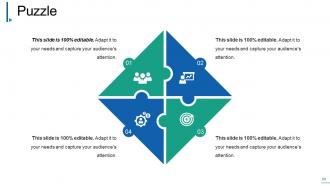
Puzzle
-
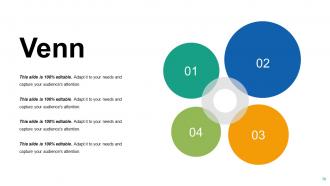
Venn
-
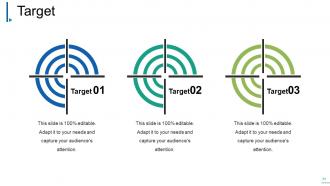
Target
-
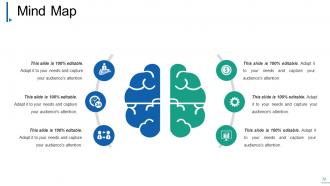
Mind Map
-
Bulb Or Idea
-

Thank You
FAQs for Change Management
So you gotta start by making people feel like something actually needs to change - create that urgency. Build up your crew of supporters first. Then figure out your vision and strategy (honestly, don't get stuck overthinking this part forever). Communicate it everywhere, let people run with it, and grab some early wins to keep momentum going. The tricky part? You'll need to bake it into how things actually work day-to-day or it won't stick. Most people mess up by skipping that first urgency step and jumping straight to "here's the solution!" Big mistake.
Okay so first thing - tell people WHY you're making changes. Nobody likes being kept in the dark, and honestly? The gossip network is way faster than any official email you'll send. Get out there early with town halls, team meetings, whatever works. Different people need to hear things different ways. Don't ignore the pushback either - address it head on. Here's what really works though: get them involved in planning it. When someone helps design the solution, they're not gonna fight you on it later. Trust me on this one.
Honestly, leadership makes or breaks the whole thing. They've got to explain why the change matters - not just what's happening, but actually why. If they're not modeling the new stuff themselves, forget it. I've watched so many initiatives just die because leaders weren't really committed. People can tell when someone's faking it, you know? The good leaders tackle pushback directly instead of hoping it'll go away. They also make a big deal about early wins, which helps everyone stay motivated. Bottom line: if your leadership isn't visibly and consistently behind it, you're probably wasting your time.
Honestly, you need both the hard numbers and the people stuff to really know what's going on. Start with adoption rates, cost savings, timeline metrics - that's your foundation. But here's the thing - surveys and casual conversations tell you way more than spreadsheets sometimes. Like, are people actually buying into this change or just pretending? I'd set up regular check-ins throughout (not just at the end) so you can pivot if things start going south. Watch for resistance patterns and how fast teams bounce back to being productive. The hallway chatter is probably your best early warning system tbh.
Honestly, the worst thing you can do is spring changes on people out of nowhere - they'll revolt every time. Communication breakdowns kill these things. Also don't rush it! People need time to wrap their heads around new stuff. Get your boss and other higher-ups on board first, because without them you're screwed. Resistance is gonna be way worse than you think (learned this the hard way lol). Start talking about WHY you're changing things super early. Bring important people into the planning process. Give everyone extra time to adjust - seriously, more than feels reasonable. Oh, and celebrate the little victories! Keeps people motivated when everything feels chaotic.
Start with three main things: leadership buy-in, how your team actually feels about change, and whether you've got the capacity to pull it off. Survey people honestly - some will hate this idea, and you need to know who. Check if your leaders are really committed or just pretending to be (you can usually tell). Also look at your resources and bandwidth. Oh, and definitely dig into what's worked before versus what crashed and burned. I'd make a quick scorecard to track all this stuff so you can spot the gaps early. Trust me, finding problems now beats discovering them halfway through.
Honestly, you've got to tackle that resistance straight up with good communication. Explain why this change matters - nobody likes being kept in the dark about stuff that affects them. Bring your key people into the planning process so they feel like partners instead of just getting things dumped on them. Actually listen when people complain too (I mean, sometimes they spot real issues you totally missed). Training helps a ton during transitions. Celebrate the small wins - builds momentum. Oh, and find your cheerleaders early. Those people will do half your convincing for you.
Look, culture is everything when it comes to change - and I mean *everything*. Some workplaces are all about trying new stuff, so people roll with changes pretty easily. Others? Total bureaucratic nightmares where everyone's scared to rock the boat. The thing is, culture determines whether your team trusts leadership and actually wants to adapt their day-to-day work. You can't just bulldoze through it either - that never works. Figure out what kind of culture you're dealing with first, then work with those existing attitudes instead of fighting them. Way less painful that way.
Honestly, tech makes change management so much easier - you can automate all that tedious communication stuff and track how things are going without constantly bugging people. I'd start with one good platform that handles both messaging and progress tracking (trust me, juggling multiple tools gets messy fast). Survey tools are great for catching pushback early, and the analytics actually show you where things are getting stuck. Way better than drowning in spreadsheets and email chains. Just don't go overboard picking complicated systems - your team will hate you for it. Pick something simple first, then add more tools if you need them.
Start by figuring out who you're dealing with - map out all your stakeholders first. Seriously, kick this off way sooner than feels necessary because nobody likes getting blindsided by change. Mix up how you communicate too. Town halls work, but so do smaller group chats and grabbing coffee with the people who actually influence others. Don't just tell them what's happening - explain why it matters. When they push back (and they will), actually listen instead of just waiting for your turn to talk. Oh, and find your cheerleaders early. Give them the right info so they can help sell this thing naturally.
Honestly, start gathering feedback from day one - don't wait. Quick surveys, casual coffee chats, whatever works. People always surprise you with stuff you'd never think of (seriously, it's wild what comes up). Make it super safe to complain or voice concerns without anyone getting in trouble for it. Then actually USE what they tell you to tweak your timeline or approach instead of just... collecting it and doing nothing. I mean, what's the point otherwise? Even if you're already knee-deep in changes, start this week. Better late than never, right?
Honestly, people freak out about change because our brains think uncertainty = danger. So when you see folks getting defensive or shutting down, don't take it personally - it's just how we're wired. What works? Tell them WHY you're making changes, and do it early. Let people ask questions and actually process what's happening. If you can get them involved in planning stuff, even better - makes them feel less like things are happening TO them. Oh, and don't pretend change is always awesome. Sometimes it just sucks and that's okay to admit. Keep talking to people throughout the whole mess though.
So you take the basic framework structure but swap in stuff that actually matters to your industry. Healthcare's "Awareness" phase? Talk about patient safety. Tech company? Make it about staying competitive. Kotter's urgency step works totally different across industries too - like compliance deadlines in pharma create real urgency, but retail's seasonal pressure is a whole other thing. Manufacturing needs tons more safety training during changes than some creative agency would. Keep the framework's skeleton but fill it with examples, stakeholders, and timelines that make sense for your world. Map out what drives your industry first, then match it to each step.
Dude, you literally can't just announce change and expect people to roll with it. Training fills that gap between "we're doing this now" and people actually doing it. I've seen this fail so many times when companies skip the learning part. People need specific skills for whatever new thing you're throwing at them. Short bursts work better than those marathon training sessions nobody remembers anyway. The key is figuring out exactly what skills they're missing first, then building something that actually addresses those gaps. Otherwise they'll just slide back to old habits within a week.
Honestly, the biggest mistake I see is leaders announcing changes then just... moving on to whatever's next. You've got to bake it into everything - your processes, how you train people, what you actually measure. Find some champions who'll keep pushing it when you're not around (trust me, you'll get distracted). Celebrate the small wins along the way. Regular check-ins are huge too - catch people slipping back into old habits before it becomes this whole thing. The culture piece takes forever, but that's where the real sticking power comes from.
-
very good ,well done
-
good
-
good
-
kcool
-
Thanks for all your great templates they have saved me lots of time and accelerate my presentations. Great product, keep them up!
-
Understandable and informative presentation.
-
good
-
Great
-
Great slides