


Risk Assessment Strategies Powerpoint Presentation Slides





Try Before you Buy Download Free Sample Product
 Impress Your
 Audience
 100%
100% Editable
 Save Hours
 of Time


If you are looking for a perfect template to showcase your business approach towards identifying and managing risk, download our risk assessment strategies PowerPoint presentation slides. This Risk Assessment Strategies PPT template of risk assessment strategies allows you to review risk strategies, risk management plans and process, evaluate and judge risks based on tactics and developments. With the help if these PowerPoint slides, you can make your plans to manage risk. Use risk response matrix and charts to showcase how your business will mitigate risks and its response strategies. This risk estimation plan presentation slide permits you to implement risk assessment strategy at organizational level and enables its employees to discuss overall risks faced by an organization. This Risk Assessment Strategies presentation template will help you conduct risk evaluations in systematic method and you will be able to review your risks on regular basis. Effective risk management template has been crafted by our team of professionals so that you can prioritize risks, assign risk and make accountable business line for decision making. Establish brand consistency with our Risk Assessment Strategies Powerpoint Presentation Slides. Give an account of enduring achievements.
People who downloaded this PowerPoint presentation also viewed the following :
Content of this Powerpoint Presentation
Slide 1: This slide introduces Risk Assessment Strategies. State your company name and begin.
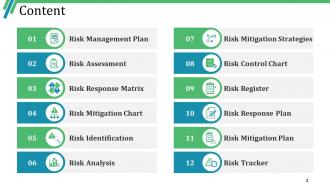
Slide 2: This slide shows Content with the following points- Risk Management Plan, Risk Assessment, Risk Response Matrix, Risk Mitigation Chart, Risk Identification, Risk Analysis, Risk Mitigation Strategies, Risk Control Chart, Risk Register, Risk Response Plan, Risk Mitigation Plan, Risk Tracker.
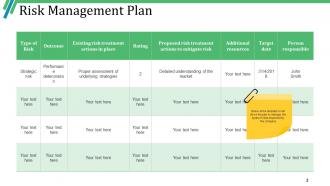
Slide 3: This slide shows Risk Management Plan. List down the plan here to manage the types of risks expected by the company.
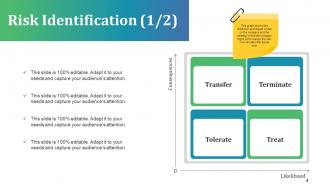
Slide 4: This slide displays Risk Identification graph. This graph shows the likelihood and impact of risk on the company and the strategy which the company might opt to manage the risk. You can alter this as per your need.
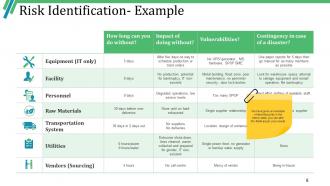
Slide 5: This slide explain Risk Identification with an Example. You can alter the fields as per your needs.
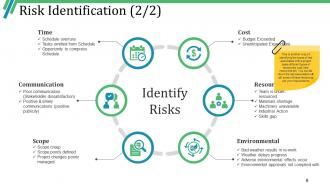
Slide 6: This slide shows another way of Risk Identification with several factors like cost, time, resources etc. You can list down the risk associated with all/ some of these factors as per your requirements.
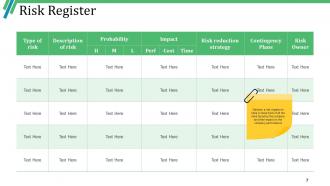
Slide 7: This slide shows Risk Register.Maintain a risk register to keep a close track of all the risks faced by the company and their impact on the company performance.
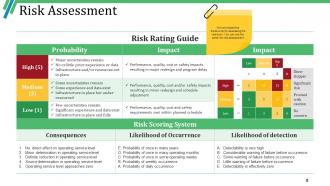
Slide 8: This slide shows Risk Assessment with Risk Rating Guide.We have listed the framework for assessing the risk level in this slide which you can alter as per your need.
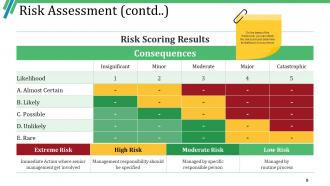
Slide 9: This slide also shows Risk Assessment with Risk Scoring Results.
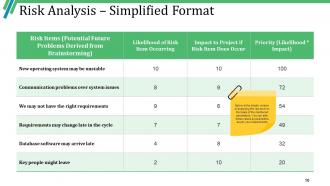
Slide 10: This slide shows Risk Analysis in a Simplified Format. We have also mentioned a few parameters and values of risk analysis which you can alter as per your requirement.
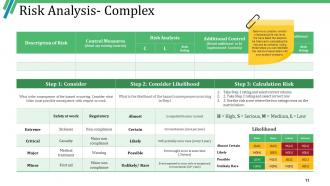
Slide 11: This slide also shows Risk Analysis but its Complex format. We have also listed the steps to be followed in calculating the risk and its certainty. Using these steps you can estimate the risk level associated with your project/ company.
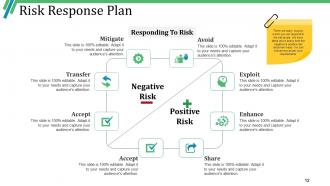
Slide 12: This slide shows the Risk Response Plan. There are many ways in which you can respond to the risk levels. We have listed down both the negative & positive risk response ways here from which you can choose as per your requirements.
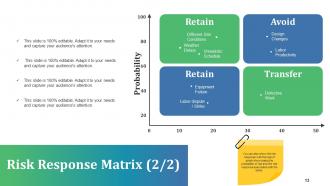
Slide 13: This slide shows the Risk Response Matrix. You can also show the risk response with the help of graph showcasing the probability of risk and the risk response associated with the same.
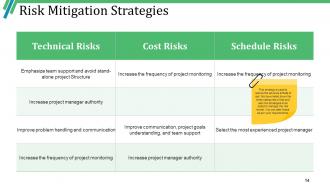
Slide 14: This slide shows Risk Mitigation Strategies. This strategy is used to reduce the adverse effects of risk. We have listed down the three categories of risk and also the strategies to be opted to manage the risk levels. You can alter these as per your requirements.
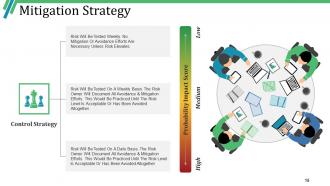
Slide 15: This slide shows Mitigation Strategy with High, Medium and Low parameters.
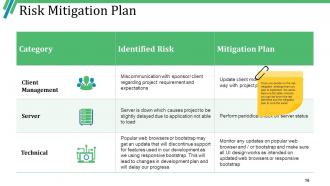
Slide 16: This slide shows Risk Mitigation Plan. Once you decide on the risk mitigation strategy then you plan to implement the same. Here is the table wherein you can list down the risk identified and the mitigation plan to curb the same.
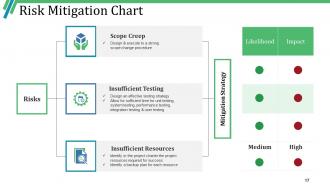
Slide 17: This slide shows Risk Mitigation Chart showing three types of risks: Scope Creep, Insufficient Testing, Insufficient Resources along with Mitigation Strategy.
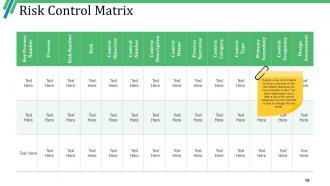
Slide 18: This slide shows Risk Control Matrix. Prepare a risk control matrix to have a close tap on the risk related measures you have intended to take. The table showcased will help you to keep a log of the control measures which you have decided to take to manage the risk levels.
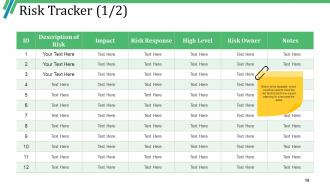
Slide 19: This slide shows Risk Tracker which could be used to track the risk factors and how you are planning to overcome the same.
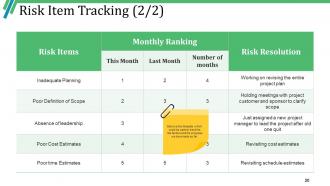
Slide 20: This is Risk Item Tracking slide. Use this to rack the risk factors and the progress made so far.
Slide 21: This is a Risk Assessment Strategy Icon Slide. Alter/ modify icons as per your need.
Slide 22: This slide shows Coffee Break image. You can alter the content as per need.
Slide 23: This slide shows the next section of Charts and Graphs.
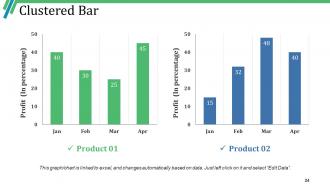
Slide 24: This is a Clustered Bar graph slide to show product/ entity comparison, specifications etc.
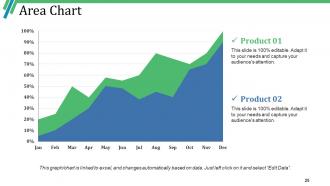
Slide 25: This is an Area Chart slide to show product/ entity growth, comparison, specifications etc.
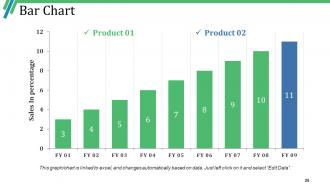
Slide 26: This is a Bar Chart slide to show product/ entity growth, comparison, specifications etc.
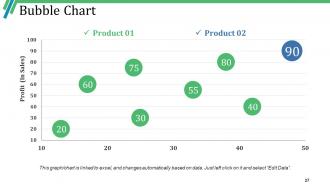
Slide 27: This is a Bubble Chart slide to show product/ entity comparison, specifications etc.
Slide 28: This slide is titled Additional Slides to move forward. You can change the slide content as per need.
Slide 29: This is Our Mission slide. Show your company mission and goals here.
Slide 30: This slide showcases Our Team with designation, text boxes and image to fit.
Slide 31: This is an About Us slide showing Premium Services, Valued Clients, and Preferred by Many as examples.
Slide 32: This is an Our Goal slide. State them here.
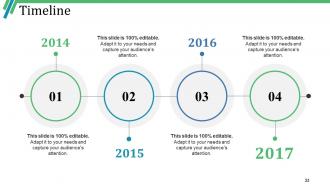
Slide 33: This is a Timeline slide to show milestones, growth or highlighting factors.
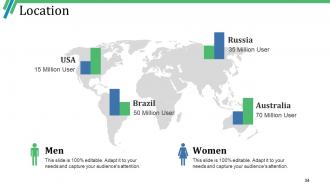
Slide 34: This is a Location slide in terms of men and women to show segregation globally.
Slide 35: This is a Post It slide. Pin your important text here.
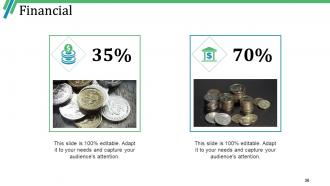
Slide 36: State your Financial score in this slide with relevant imagery and text.
Slide 37: This is a Target slide. State your targets here.
Slide 38: This is a Puzzle image slide to show information, specifications etc.
Slide 39: This is a Magnifying glass image slide to show information, scoping aspects etc.
Slide 40: This is a Bulb Or Idea image slide to show information, innovative aspects etc.
Slide 41: This is a Thank You slide with Address# street number, city, state, Contact Number, Email Address.
Risk Assessment Strategies Powerpoint Presentation Slides with all 41 slides:
Encourage growth of affection with our Risk Assessment Strategies Powerpoint Presentation Slides. Don't allow hatred to build.









FAQs for Risk Assessment Strategies
You'll need four main pieces: risk identification, probability assessment, impact analysis, and mitigation planning. Map out what could go wrong in your situation first - seriously, don't just steal from some template online. How likely is each risk? What's the potential damage? Prioritize using both factors, not just how bad things could get. Then create actual response strategies for the big ones. Oh, and set up quarterly reviews to keep everything current. That's honestly where most people mess up - they build it once and forget about it.
Start with stakeholder interviews - seriously, people will tell you stuff you'd never think of on your own. Go through each project stage and ask "what breaks here?" SWOT analysis helps too, even though it feels kinda dated. Past projects are treasure troves for spotting patterns you missed. Your assumptions? That's where things usually go sideways. Don't skip external factors like market shifts or new regulations either. Better to identify too many risks upfront than scramble later when something blindsides you. It's way easier to cross things off a list than recover from what you didn't see coming.
You really need those stakeholders involved from the start. They'll catch blind spots you'd never see and bring expertise from angles you hadn't considered. Map out who actually cares about the outcome early on - don't just loop them in when you're done. People are way more likely to support your strategies if they helped build them, honestly. Your internal folks especially know the day-to-day realities better than anyone. Keep them engaged throughout the whole process, not just for some final presentation. Oh, and their different concerns will help you figure out what risks actually matter most.
Start with the hard numbers - probabilities, financial impacts, all that quantitative stuff. But honestly, don't stop there because you'll miss the messy human stuff that matters. Like yeah, the math might say a risk is low-impact, but if it pisses off your biggest client? That's huge. I always run qualitative assessments after to catch things like reputation damage or stakeholder drama. The qualitative insights actually help me figure out which scenarios are worth diving deeper into with more complex models. Try both approaches on the same risk - where they don't match up is usually where you're missing something important.
Oh man, so many routes you can go! Big companies usually grab GRC platforms like Archer or ServiceNow. But honestly? Don't sleep on Airtable or even basic Excel templates - I've watched teams crush it with simple spreadsheets. For the quantitative stuff, @RISK and Crystal Ball are solid Monte Carlo tools, though they're kinda overkill unless you're really diving deep into analysis. Here's the thing though - pick whatever your team will actually stick with. I can't tell you how many fancy tools I've seen teams buy and then abandon after like two weeks.
Look, quarterly is the bare minimum but honestly that's pretty slow for most places. Monthly makes way more sense if you're in anything fast-moving or dealing with regulatory changes. I'd set up quick monthly check-ins on your biggest 5 risks - takes like 30 minutes but saves you from getting blindsided later. The whole point is making it ongoing, not some annual thing you dread. Oh and definitely do emergency reviews when major stuff hits - new tech rollouts, market crashes, whatever. Don't wait for the scheduled review if something's clearly going wrong.
So the big one is scope - people get way too narrow and miss how risks connect to each other. Historical data's useful but it won't show you new threats emerging. Honestly, I've watched teams completely rush the stakeholder interviews (or skip them), which is just asking for blind spots. Make it ongoing, not some annual checkbox exercise. Oh and don't let the same person who manages a risk also assess it - that's like grading your own homework. Get different viewpoints involved. Question everything, especially your own assumptions.
Honestly, just make a simple grid - likelihood on one side, impact on the other. Plot your risks and boom, the high-high corner shows what needs fixing first. Sounds stupidly simple but it actually works way better than keeping it all in your head. The medium stuff? Maybe monitor those or do quick patches. Low-low risks can sit there forever, whatever. Here's the thing though - don't let office politics mess with your scoring. If something's likely to happen, mark it likely even if your boss doesn't want to hear it. Focus on your top 3-5 nightmare scenarios first.
Scenario analysis is like running "what if" games on your risk models - super helpful for stress-testing different situations. You get to see how variables actually interact instead of just staring at old data. Honestly, it's way better than those single-point estimates everyone relies on. The cool part? You'll catch tail risks and weird interdependencies that normal methods totally miss. Think of it as exploring potential futures and watching how effects ripple through your system. Try mapping out maybe 3-5 realistic scenarios for your next assessment - doesn't have to be fancy, but you'll definitely spot blind spots you'd otherwise miss.
Look, you gotta weave compliance into your risk framework right from day one. Figure out what regs hit your industry first - HIPAA if you're healthcare, SOX for public companies, whatever. Then build your assessment criteria around those specific requirements. Trust me, I've watched teams try to slap compliance on later and it's always a disaster. Schedule regular regulatory check-ins and get someone who actually understands the rules to validate everything. Oh, and treat compliance like any other major risk category instead of some side project. You'll thank yourself later when you're not scrambling to fix everything.
Honestly, just skip all the tech speak and talk money/reputation damage instead. Stakeholders eat up those color-coded risk matrices - makes them feel like they actually understand what's going on. Tell them stories they can visualize happening to their business. Keep it to your top 3-5 risks max because attention spans are terrible in these meetings. Charts and heat maps work way better than bullet points. Oh, and never present a problem without suggesting what to do about it and when. That's like... presenting 101. They want solutions, not just a list of things that could go wrong.
Market trends are literally the worst because they flip your whole risk picture without warning. One day you're golden, next day everything's chaos. Your financial exposure changes, regulations shift, customers act totally different - honestly feels impossible to keep up with sometimes. But here's what actually works: build those external variables right into your risk models as live data, not frozen assumptions. Set up alerts that ping you when key conditions hit danger zones. Figure out which outside factors mess with your business most, then watch those like a hawk. Way better than getting blindsided again.
Look, risks change constantly - your business isn't the same today as it was six months ago, right? You can't just do one risk check and call it good. New threats pop up, old ones get worse or better, and honestly, sometimes you'll change what you're willing to risk based on how things are going. It's like... you wouldn't drive cross-country checking your gas gauge only at the start. Set up monthly reviews (or quarterly if you're not in a crazy volatile industry) and create some kind of alert system for the big stuff so you're not scrambling when something hits.
Honestly, your old data is probably way more useful than you think. Dig into past incidents and near-misses - that's where the real patterns hide. Insurance claims are great for this too, plus any operational reports you've got lying around. Don't just look at single events though, track frequency and impact over months or years. Even messy records are better than nothing, so start there. Build yourself a basic tracking system going forward. Industry benchmarks help if you can get them, but your own historical stuff will show you where your predictions actually matched reality vs where you were totally off.
Start with the basics - risk identification methods, probability assessment, impact analysis. Your industry's compliance stuff is crucial too. Communication skills matter way more than people think, especially for stakeholder interviews to get good data. Don't sleep on the soft skills training! Get them certified through something like PMI-RMP first. Then set up internal workshops using your real projects - way better than generic examples. Risk management software training is a must, plus give them access to industry databases and regulatory updates. Build from formal cert programs, then customize around what you actually do.
-
Commendable slides with attractive designs. Extremely pleased with the fact that they are easy to modify. Great work!
-
The Designed Graphic are very professional and classic.