


Risk Assessment Step Powerpoint Presentation Slides





Try Before you Buy Download Free Sample Product
 Impress Your
 Audience
 100%
100% Editable
 Save Hours
 of Time


Here is our professional-looking Risk Assessment Step Powerpoint Presentation Slides for risk identification and prioritization. Evaluate the risk and decide on precaution with this easy to understand risk management process steps presentation deck. The risk process steps PowerPoint complete deck has forty five content ready slides like risk management introduction, types of risks, risk categories, stakeholder’s management and engagement, risk appetite and tolerance, procedure, risk management plan, risk identification, risk register, risk assessment, risk analysis, risk response plan, risk response matrix, risk control matrix, risk items tracking, tools and practices, risk impact & profitability analysis, risk mitigations strategies, plans, qualitative and quantitative risk analysis, etc. All PowerPoint templates of risk identification process presentation are easy to customize, edit them as per your specific project needs. Download easy to use risk mitigation plan PPT slides to make your business presentation more effective. Get to grapple with the actual facts due to our Risk Assessment Step Powerpoint Presentation Slides. Be able to figure out the ballgame.
People who downloaded this PowerPoint presentation also viewed the following :
Content of this Powerpoint Presentation
Slide 1: This slide introduces Risk Assessment Steps. State Your Company Name and begin.
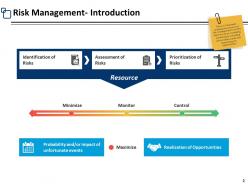
Slide 2: This slide presents Risk Management Introduction describing- Identification of Risks, Assessment of Risks, Prioritization of Risks.
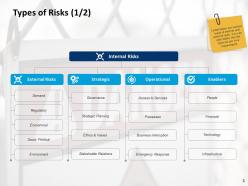
Slide 3: This slide shows Types of Risks describing Internal and External risks.
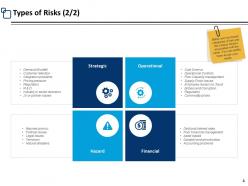
Slide 4: This is another slide on Types of Risks describing- Strategic, Operational, Hazard and Financial risks.
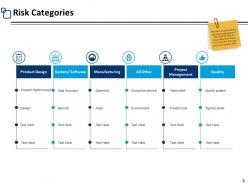
Slide 5: This slide showcases Risk Categories which includes- Product Design, System/ Software, Manufacturing, Project Management, Quality and all other.
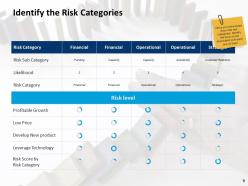
Slide 6: This slide represents Identify the Risk Categories with risk level and other sub categories.
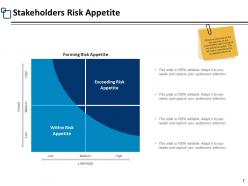
Slide 7: This slide displays Stakeholders Risk Appetite describing risk appetite with the help of bar graph.
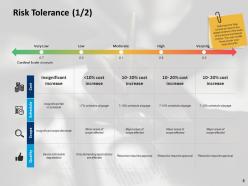
Slide 8: This slide shows Risk Tolerance on a scale describing risk from very low to very high.
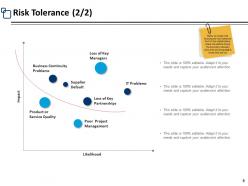
Slide 9: This is another slide on Risk Tolerance describing risk tolerance limit of stakeholders.
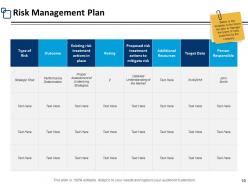
Slide 10: This slide presents Risk Management Plan describing- Type of Risk, Outcome, Existing Risk Treatment Actions in Place, Rating, Proposed Risk Treatment Actions to Mitigate risk, Additional Resources, Target Date and Person Responsible.
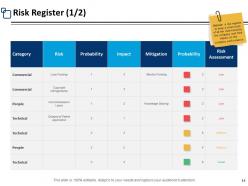
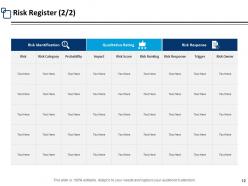
Slide 11: This slide displays Risk Register with- Category, Risk, Probability, Impact, Mitigation and Risk assessment.
Slide 12: This is another slide displaying Risk Register with related text boxes.
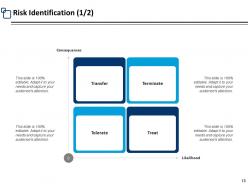
Slide 13: This slide represents Risk Identification with a graph that shows the likelihood and impact of risk on the company and the strategy which the company might opt to mange the risk.
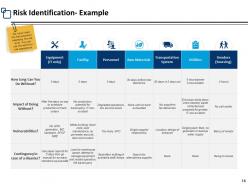
Slide 14: This slide showcases Risk Identification- Example describing Time period, Impact of Doing, Vulnerabilities and Contingency in case of a disaster.
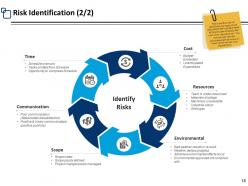
Slide 15: This is another slide on Risk Identification describing factors like cost, time, resources etc.
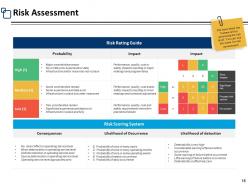
Slide 16: This slide shows Risk Assessment describing Risk Rating Guide with probability and impact along with Risk scoring system describing Consequences, Likelihood of Occurrence and Likelihood of detection.
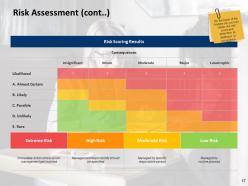
Slide 17: This is another slide continuing Risk Assessment, with this you can obtain the risk score and determine its likelihood of occurrence.
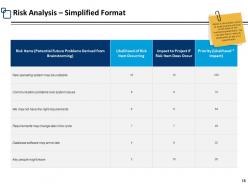
Slide 18: This slide presents Risk Analysis – Simplified Format with related table and text boxes. You can alter these values & parameters as per your requirements.
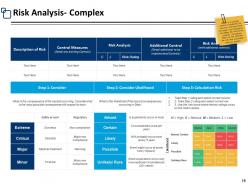
Slide 19: This slide displays Risk Analysis- Complex. This is a complex version of analysing the risk level. Follow the described steps to calculate risk.
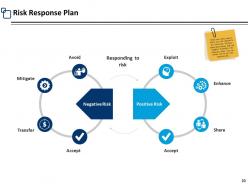
Slide 20: This slide represents Risk Response plan describing positive and negative ways of responding to the risk levels.
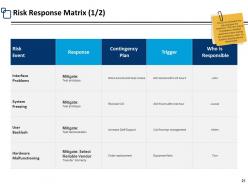
Slide 21: This slide showcases Risk Response Matrix stating the contingency plan, its duration and the person responsible.
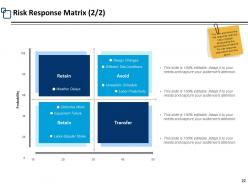
Slide 22: This is another slide showcasing Risk Response Matrix with the help of graph describing the probability of risk and the risk response associated with it.
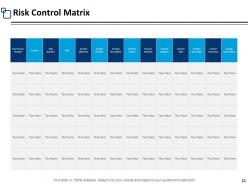
Slide 23: This slide shows Risk Control Matrix. This matrix helps you to keep a log of the control measures you have decided to take to manage the risk levels.
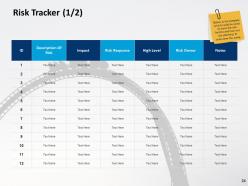
Slide 24: This slide presents Risk Tracker which could be used to track the risk factors and how we are planning to overcome the same.
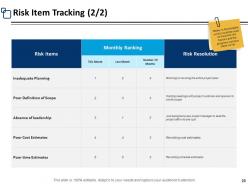
Slide 25: This is another slide presenting Risk Item Tracking which could be used to track the risk factors and the progress we have made so far.
Slide 26: This slide displays Risk Assessment Icons.
Slide 27: This slide reminds about a 15 minutes coffee break.
Slide 28: This slide is titled Additional slides for moving forward.
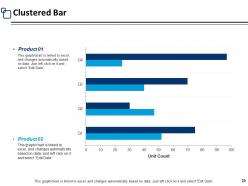
Slide 29: This slide shows Clustered Bar graph with two products comparison.
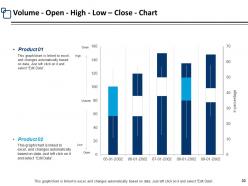
Slide 30: This slide showcases Volume - Open - High - Low – Close - Chart of two different products.
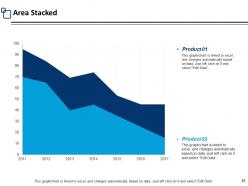
Slide 31: This slide presents Area Stacked chart with two products comparison.
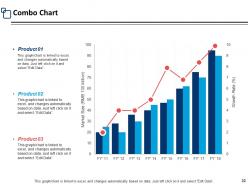
Slide 32: This slide displays Combo Chart with three products comparison.
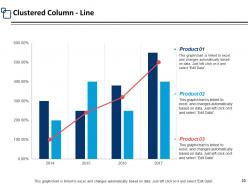
Slide 33: This slide represents Clustered Column - Line chart with three products comparison.
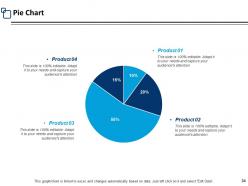
Slide 34: This slide represents Pie chart with four products comparison.
Slide 35: This is Our Goal slide. Show your goals here.
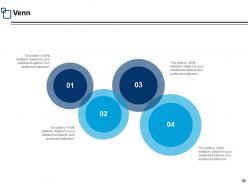
Slide 36: This is a Venn slide with text boxes to show information.
Slide 37: This slide is titled as Important Notes. Post your important notes here.
Slide 38: This is a Bulb or Idea slide to state a new idea or highlight specifications/information etc.
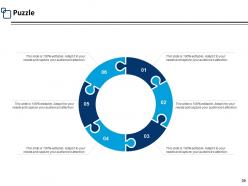
Slide 39: This slide shows a Puzzle with text boxes.
Slide 40: This is a Target slide. State your targets here.
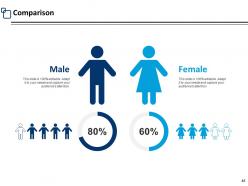
Slide 41: This is a Comparison slide to state comparison between commodities, entities etc.
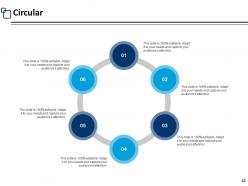
Slide 42: This slide shows Circular diagram with text boxes.
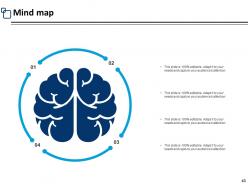
Slide 43: This slide shows Mind Map with related icons and text boxes to go with.
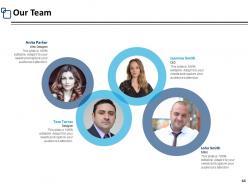
Slide 44: This is Our team slide with names and designation.
Slide 45: This is a Thank You slide with Address# street number, city, state, Contact Number, Email Address.
Risk Assessment Step Powerpoint Presentation Slides with all 45 slides:
Use our Risk Assessment Step Powerpoint Presentation Slides to effectively help you save your valuable time. They are readymade to fit into any presentation structure.





FAQs for Risk Assessment Step
So there's basically four things you gotta cover for a decent risk assessment. First, figure out what could potentially blow up - and yeah, this part's kind of a downer when you really get into it. Then you'll want to rank everything by how likely it is and how bad the damage would be. Check what protections you've already got and whether they actually work (spoiler: they usually don't work as well as you think). Finally, decide if you're gonna accept the risk, avoid it completely, reduce it somehow, or just pass it off to someone else. Oh, and write it all down so you can update it later when things inevitably change.
Honestly, you've gotta look at this from every angle - money stuff, operations, regulations, reputation, the whole deal. Map out your main processes first, then ask "what could screw us over here?" at each point. Different teams will catch things you'd never think of, so get them involved. Check your old disasters too - problems love making comebacks. We do these quarterly brainstorming sessions where people can throw out wild scenarios without getting shot down. Way better than those annual risk assessments that everyone just phones in. Keep updating your list regularly or it becomes useless pretty fast.
Honestly, it totally depends on what industry you're in, but I'd start simple with a risk matrix - just plot probability against impact. Super basic but it actually works really well. Monte Carlo simulations are solid if you've got good data to work with. SWOT analysis feels ancient but still gets the job done for bigger picture stuff. Here's the thing though - I've watched teams spend tons on fancy software that just sits there unused because nobody bought into it. Way better to pick something your people will actually stick with. Start small with whatever doesn't overwhelm your team, then you can always add more complex stuff later once everyone's comfortable.
Look, different industries worry about totally different stuff when it comes to risk. Healthcare? They're sweating patient safety and avoiding lawsuits - like preventing med errors or hospital infections. Finance is all about market crashes and credit defaults instead. The timelines are weird too - doctors deal with life-or-death moments while bankers might stress about what happens next quarter. It's honestly pretty fascinating how different they are. But here's the thing - everyone follows the same basic playbook: figure out what could blow up, estimate how likely it is, then tackle the scary stuff first. Just start by learning what risks actually matter in your field.
Honestly, data analytics is a game-changer for risk stuff. Instead of just guessing, you get actual numbers and percentages. The cool thing is it spots patterns in old data that you'd never catch yourself - like weird customer behaviors or market shifts. Real-time monitoring helps too since you'll catch problems way earlier. I mean, these algorithms can juggle tons of variables at once while your brain would just explode trying. Way better than those useless "high/medium/low" ratings everyone loves. Just start by looking at your biggest data sources and see what patterns pop up from past incidents.
Honestly, just use that impact vs likelihood grid thing - plot each risk by damage potential and how likely it actually is. Go after the high-impact, high-probability stuff first (duh). But here's what trips people up: those crazy high-impact, low-probability events that everyone ignores until they're totally screwed. Don't wing it with gut feelings. Look at real data and what's happened before if you can. Your company's risk tolerance matters too, obviously. Pick your top 3-5 risks and make actual plans instead of trying to fix everything at once.
You've gotta match your message to who you're talking to. Executives just want the bottom line impact. Tech teams need all the detailed stuff. Put your main findings first - nobody has time to dig for the point. Visuals are clutch here, like heat maps or basic charts. Honestly, walls of text kill presentations every time. Be crystal clear about what you want people to actually DO and when. Ditch the jargon completely. Explain techy stuff like you're talking to your mom. Oh, and block time for questions after - trust me, there will be tons. Follow up with a short email summary so nothing gets lost.
Honestly, tech makes this stuff so much easier. You can automate all that data collection instead of bugging different departments for weeks. Real-time dashboards pull everything together in one place - way better than those endless spreadsheets we all hate. The predictive modeling is pretty wild too, catches patterns you'd never spot manually. I'd start with whatever's driving you crazy first, like if you're constantly checking alerts or something. Oh, and the automated notifications are clutch so you're not babysitting everything 24/7. Once you get past the initial setup headache, it's honestly night and day.
Yeah, most places technically just need annual assessments - bare minimum stuff. But you'll want to do them way more often than that. Any time you change systems or processes, do another one. Finance and healthcare folks? They're doing quarterly reviews because they have to. Document absolutely everything though - auditors are obsessed with paperwork trails. I always tell people to just set a calendar reminder and stay ahead of it. Waiting around for problems is such a bad move. Oh, and critical systems definitely need more attention than your basic stuff.
The biggest mistake? Going too narrow and missing how risks connect to each other. Seriously, I've watched companies get blindsided by stuff they never saw coming because they only focused on the obvious threats. Don't just recycle last year's assessment either - that's lazy and usually wrong. Get out of the conference room! Talk to people actually doing the work instead of guessing from your desk. Oh, and when leadership pressures you to rush the likelihood vs impact part, push back a little. You need real data and different viewpoints to make it worth anything.
Don't let those risk assessments just collect dust after you finish them. Build the results straight into your approval process - like making high-risk stuff automatically go to the C-suite for sign-off. Most teams I've seen do the assessment then completely ignore it, which drives me crazy because what's the point? Your project teams should be referencing those specific risk findings when they're asking for budgets and timelines. Create templates that force people to actually address the risks before moving forward. Otherwise you're just checking a box. The whole thing only works if decision-makers can't proceed without dealing with what you found.
Honestly, bias is probably your biggest trap here - don't let assumptions about certain groups creep into your data analysis. Be upfront about what methods you're using and where they fall short. Privacy matters too, obviously. The tricky part? Your assessment could seriously impact vulnerable people depending on how it gets used. I'd bring in different perspectives early since you'll miss stuff working solo. Short sentences work. Document why you made ethical choices, not just the technical stuff. Oh, and stakeholders need to actually understand your conclusions - can't just dump jargon on them.
Honestly, it's all about what you can actually handle. Small companies should stick to basic stuff - simple risk matrices, maybe quarterly check-ins. Don't try copying what big corporations do (I've watched startups burn weeks on this mistake). Larger orgs can go wild with fancy metrics and dedicated teams since they've got the budget. But here's the thing - your framework needs to match your reality, not some textbook example. Start simple and build up as you grow. Way better than forcing some elaborate system that nobody will actually use because it's too much work.
Honestly, training your people is huge for risk management. Most problems get stopped before they start when everyone knows what to look for. Your fancy risk plans don't mean much if nobody actually follows them, you know? Good training teaches people to spot red flags, stick to protocols, and think clearly when things get crazy. Just don't make it one of those boring annual things everyone forgets about. Keep updating it with real scenarios they'll actually face. Make risk awareness part of how you operate day-to-day - way more effective that way.
AI's pretty wild for risk stuff - it can crunch through tons of data and catch patterns we'd totally miss. Instead of just looking backwards at what happened, you get real-time insights. The way these algorithms connect thousands of variables at once is honestly mind-blowing when you see it work. Don't go all-in right away though. These systems aren't perfect and can inherit weird biases from their training data. Humans still gotta keep an eye on things. I'd say test it out on one specific risk area first, see how it goes, then expand from there if it's working well.
-
Easy to edit slides with easy to understand instructions.
-
Great product with highly impressive and engaging designs.
-
Awesome use of colors and designs in product templates.
-
Topic best represented with attractive design.
-
Easy to edit slides with easy to understand instructions.