


Risk assessment and mitigation plan powerpoint presentation slides




Try Before you Buy Download Free Sample Product
 Impress Your
 Audience
 100%
100% Editable
 Save Hours
 of Time


Eradicate numerous uncertainties using this Risk Assessment and Mitigation Plan PowerPoint Presentation Slides PPT. Take advantage of these risk analysis PPT template to depict risk mitigation techniques, risk identification, risk tracking, risk response matrix, risk assessment, etc. Take the assistance of these uncertainty analysis PPT slides to reveal the constituents of a risk management plan including risk type, outcome, risk treatment, etc. Moreover, you can also represent the parameters that should be included in the risk register such as risk description, contingency plan, etc. Further, these risk reduction PPT infographics will assist your team to illustrate risk response graphically. Also, ensure that workers at safe from all kinds of bodily injury and hazards using these risk PPT layouts. Demonstrate the risk alleviation strategies that will eventually help your organization in mitigating technical, cost, and schedule risks. Download these risk management PPT visuals to increase workplace safety.
People who downloaded this PowerPoint presentation also viewed the following :
Content of this Powerpoint Presentation
Slide 1: This slide introduces Risk Assessment & Mitigation Plan. State Your Company Name and begin.
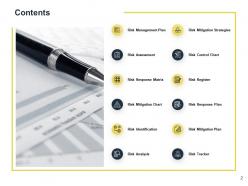
Slide 2: This slide shows content of the presentation.
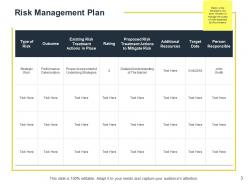
Slide 3: This slide presents Risk Management Plan describing- Type of Risk, Outcome, Existing Risk Treatment Actions in Place, Rating, Proposed Risk Treatment Actions to Mitigate risk, Additional Resources, Target Date and Person Responsible.
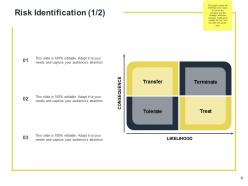
Slide 4: This slide represents Risk Identification with a graph that shows the likelihood and impact of risk on the company and the strategy which the company might opt to mange the risk.
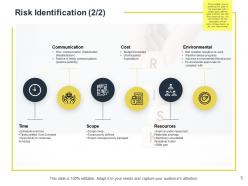
Slide 5: This is another slide on Risk Identification describing factors like cost, time, resources etc.
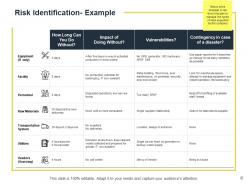
Slide 6: This slide showcases Risk Identification- Example describing Time period, Impact of Doing, Vulnerabilities and Contingency in case of a disaster.
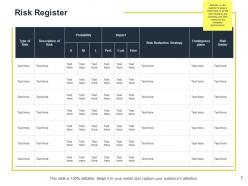
Slide 7: This slide shows Risk register to keep a close track of all the risks faced by the company and their impact on the company performance.
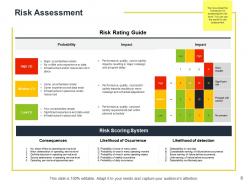
Slide 8: This slide shows Risk Assessment describing Risk Rating Guide with probability and impact along with Risk scoring system describing Consequences, Likelihood of Occurrence and Likelihood of detection.
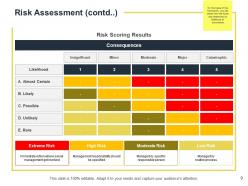
Slide 9: This is another slide continuing Risk Assessment, with this you can obtain the risk score and determine its likelihood of occurrence.
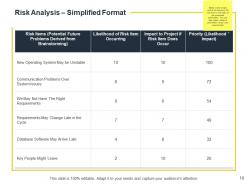
Slide 10: This slide presents Risk Analysis – Simplified Format with related table and text boxes. You can alter these values & parameters as per your requirements.
Slide 11: This slide displays Risk Analysis- Complex. This is a complex version of analysing the risk level. Follow the described steps to calculate risk.
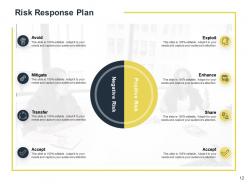
Slide 12: This slide represents Risk Response plan describing positive and negative ways of responding to the risk levels.
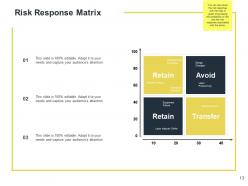
Slide 13: This slide showcases Risk Response Matrix with the help of graph describing the probability of risk and the risk response associated with it.
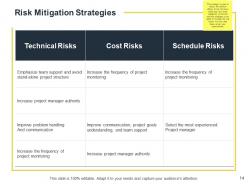
Slide 14: This slide presents Risk Mitigation Strategies describing Technical, cost and scheduled risks.
Slide 15: This slide shows Mitigation Strategy with related imagery and text.
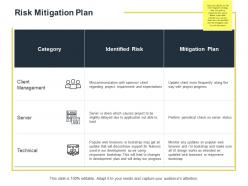
Slide 16: This slide displays Risk Mitigation Plan in a tabular form.
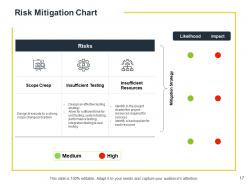
Slide 17: This slide showcases Risk Mitigation Chart with likelihood and impact of risk.
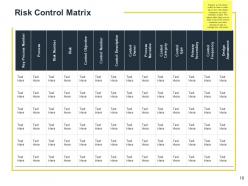
Slide 18: This slide shows Risk Control Matrix. This matrix helps you to keep a log of the control measures you have decided to take to manage the risk levels.
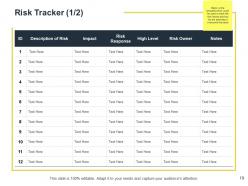
Slide 19: This slide presents Risk Tracker which could be used to track the risk factors and how we are planning to overcome the same.
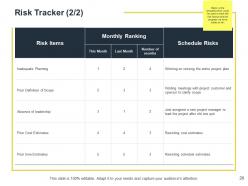
Slide 20: This is another slide presenting Risk Tracker which could be used to track the risk factors and the progress we have made so far.
Slide 21: This slide displays Risk Assessment & Mitigation Plan Icons.
Slide 22: This slide reminds about a 15 minutes coffee break.
Slide 23: This slide is titled as Additional slides for moving forward.
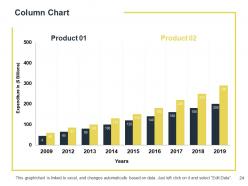
Slide 24: This slide shows Column Chart with two products comparison.
Slide 25: This is Our Mission slide with related imagery and text.
Slide 26: This is Meet Our Team slide with names and designation.
Slide 27: This is About us slide to show company specifications etc.
Slide 28: This is Our Goal slide. Show your firm's goals here.
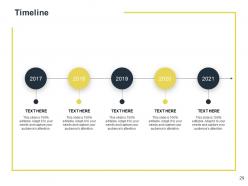
Slide 29: This is a Timeline slide to show information related with time period.
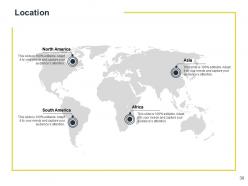
Slide 30: This is a Location slide with maps to show information related with different locations.
Slide 31: This slide is titled as Post It. Post your important notes here.
Slide 32: This is an Idea Generation slide to state a new idea or highlight information, specifications etc.
Slide 33: This is a Thank You slide with address, contact numbers and email address.
Risk assessment and mitigation plan powerpoint presentation slides with all 33 slides:
Use our Risk Assessment And Mitigation Plan Powerpoint Presentation Slides to effectively help you save your valuable time. They are readymade to fit into any presentation structure.







FAQs for Risk assessment and mitigation plan
Okay so basically you need four things: spot the risks, figure out how bad they could be, decide what's worth worrying about, then make a plan. Start by listing everything that could go sideways - I know it sounds obvious but people skip this step all the time. Don't get too hung up on the analysis part, just ballpark the likelihood and impact. Some risks you can live with, others need action. For those, you've got options: avoid them completely, reduce the damage, pass them off to someone else, or just accept them. Oh and definitely write this stuff down - risks have a way of sneaking up on you later. Grab a simple template online to start.
Honestly, just start by listing out everything that could go wrong - cyber attacks, compliance stuff, operations breaking down, money problems, whatever. Plot each risk on how likely it is vs how bad it'd be if it happened. I always make a little chart because I'm visual like that. Hit the high-probability, high-damage ones first obviously. But here's the thing - get other departments involved early. They'll catch blind spots you totally missed. Finance sees different risks than IT does, you know? Oh and don't make this a one-time thing. Risks change constantly so you gotta keep updating.
Monte Carlo simulation is your best bet - runs thousands of scenarios and handles uncertainty really well. Decision trees work great for structured stuff, and fault tree analysis is perfect when you're looking at system failures. Bow-tie analysis gives you the full picture, honestly. Event trees are solid for sequential events too. The math gets pretty gnarly with some of these methods, not gonna lie. @RISK and Crystal Ball are lifesavers, though Excel can handle most of it if you're on a budget. I'd start with Monte Carlo - it's flexible and gives you confidence intervals that won't make your boss's eyes glaze over.
Honestly, I'd go with probability/impact matrices first - they're dead simple and everyone gets it right away. Just map your risks on a grid showing how likely they are vs how bad they'd be. Expert judgment workshops are solid too because your team probably has tons of experience to draw from (and people always have good horror stories). SWOT analysis works if you want to be really systematic about strengths, weaknesses, opportunities, threats. The matrix thing is probably your best bet though since it gives you clear priorities without overthinking it.
Honestly, most teams mess this up by treating risk assessment like a one-and-done thing. Build it into every phase instead - initiation, planning, execution, the works. When you're planning, spot the potential disasters and figure out how to dodge them. Track everything at milestone reviews (this is where everyone usually falls off). Keep that risk register fresh and connect your responses to actual tasks and deadlines. Oh, and here's a super easy start - just tack on a quick 10-minute risk check to whatever status meetings you're already doing. Makes it way less painful than overhauling everything at once.
Tech is a game-changer for risk assessments, honestly. AI can crunch through tons of data and catch patterns you'd miss completely - I'm always amazed by what it finds. Instead of waiting for quarterly reports, real-time monitoring keeps you updated constantly. Predictive analytics let you see problems coming before they actually hit. The automated reporting alone saves hours of tedious work (trust me on that one). Cloud platforms are great too since everyone can work on assessments together. I'd start small with automated data collection - once you see those time savings, you'll want to expand everywhere else.
Honestly, you can't do a decent risk assessment without getting other people involved. Different departments see totally different problems - finance spots budget issues, operations knows where stuff breaks, and the people actually doing the work? They usually have the best sense of what goes wrong day-to-day. I learned this the hard way on a project last year. Map out everyone who's connected to what you're assessing first. Then just grab 15 minutes with someone from each group. It's way easier than formal meetings, and they'll actually buy into your solutions later since they helped create them.
At minimum, once a year - but that's honestly cutting it close. Major changes like new processes, suppliers, or regulatory stuff? Update it right away. Most teams just set it once and never touch it again, which is basically useless. I'd do quick quarterly check-ins to catch small issues early. Actually, funny thing - I always forget unless I put it in my calendar immediately, and I bet you will too once work gets crazy. Those reminders are a lifesaver. The whole point is staying on top of changes before they bite you.
Don't be overly optimistic when brainstorming what could go wrong - you'll miss the big stuff. Teams always rush this part because it feels pointless, but honestly? That's when you get blindsided. Also think about how risks connect to each other, not just individual threats. Get different people involved too - your devs will catch things management won't see coming. Oh, and actually put numbers on impact and probability instead of those useless "medium risk" labels that don't mean anything. I've seen too many projects crash because someone thought "it probably won't happen" was good enough analysis.
Track how often bad stuff actually happens and how severe the damage is when it does. Your response time matters too - nobody wants to be scrambling for hours during a crisis. I'd also watch your risk scores over time to see if they're trending down. Employee compliance is huge (people are usually the weakest link, honestly). Compare your actual losses to what you predicted - that's where you'll really see if your strategies work. Don't forget to refresh your risk assessments regularly because outdated data is basically useless. Short answer: regular reviews will show you what's working.
Start with the big ones - OSHA if you've got workplace stuff, EPA for environmental risks, SOX if you're dealing with financial controls. State and local regs can bite you too, so don't skip those. International standards are honestly a pain but you can't ignore them if you're going global. Here's what actually works though - figure out your main risk areas first, then trace back to see which regulations hit each one. Way better than drowning yourself trying to research every rule that exists. I learned this the hard way on a project last year.
Risk assessment shows you exactly where your biggest threats are so you can spend smart. Instead of throwing money at random stuff, you're focusing on what'll actually bite you. Honestly, I've seen companies waste tons on low-probability disasters while ignoring obvious cybersecurity gaps. Map out your top 5 risks with real dollar amounts attached - that's your roadmap right there. When you can show leadership that a data breach costs way more than better security software, suddenly budgets shift. It's pretty satisfying actually. No more guessing games with your resources.
Honestly, it depends what industry you're in because the risks are completely different. Healthcare worries about patient safety and data breaches - that's literally life or death sometimes. Finance? They're sweating market crashes, fraud, and credit risks that could destroy their reputation overnight. The approaches are totally different too. Hospitals use clinical safety protocols while banks run these crazy complex quantitative models and stress tests. Both industries are heavily regulated but the rules are night and day different. My advice? Figure out what your industry's biggest nightmares are first, then build from there.
Look, external stuff can totally wreck your plans these days. Geopolitical drama, supply chain breakdowns, cyber attacks - any of it can hit you out of nowhere. A factory closes in Asia and suddenly your whole operation feels it. Trade wars start and boom, your costs double. Weather's getting crazy too (I swear every storm is "historic" now). Climate disasters happen monthly it seems. You can't just do those boring annual risk reviews anymore. Monitor this stuff constantly. Stress-test your assumptions because honestly? The world's too connected for old-school planning.
Honestly, critical thinking is huge - you're always questioning why things are done a certain way. Pattern recognition matters too, catching stuff others miss. Communication though? That's where people struggle. Executives just want the headline while your tech team needs all the messy details. Oh, and attention to detail obviously. Industry knowledge helps but isn't everything - I've seen people obsess over certifications when they can't explain risk to save their lives. Practice presenting to different crowds. That'll get you further than most technical skills, which sounds backwards but it's true.
-
Very well designed and informative templates.
-
Designs have enough space to add content.
-
Commendable slides with attractive designs. Extremely pleased with the fact that they are easy to modify. Great work!