


Risk assessment ppt infographics





Try Before you Buy Download Free Sample Product
 Impress Your
 Audience
 100%
100% Editable
 Save Hours
 of Time


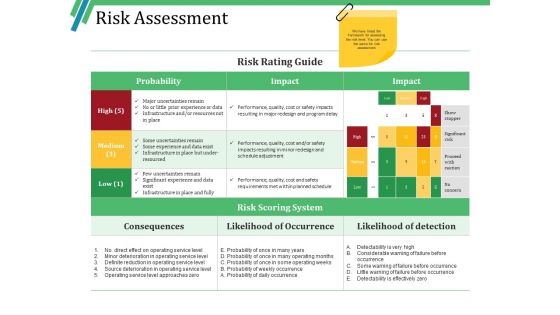
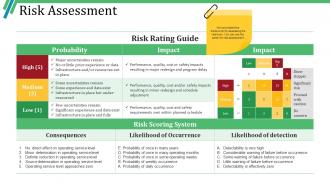
Risk management is recognized as an integral component of good management and governance. So, use our risk assessment PPT infographics PowerPoint slide and identify potential risks related to your business organization. Our risk assessment Presentation slideshow includes a tabular format with editable text and can help a business determine what their risks are in order to reduce their likelihood and provide a means for better decision-making in order to avoid future risk. When a business is aware of the potential risks that are associated with their business, it is easier to take steps to avoid them. Knowing the risks makes it possible for the managers of the business to formulate a plan for lessening the negative impact of them. Apart from this, our risk assessment PPT visual is designed by keeping in mind the need for every organization. Moreover, it has time-saving capabilities and is extremely spacious to include vast content under single screen view. Our Risk Assessment Ppt Infographics allow for accurate judgements. Each input is investigated for authenticity.
People who downloaded this PowerPoint presentation also viewed the following :
Risk assessment ppt infographics with all 5 slides:
You want to demonstrate your delicate touch. Our Risk Assessment Ppt Infographics possess that sensitivity.

FAQs for Risk
Start with the basics: risk identification, analysis, evaluation, and how you'll actually deal with them. Documentation matters too, plus ongoing monitoring. Stakeholder buy-in is huge - I've seen frameworks die because leadership didn't care. Define your risk appetite upfront and create consistent scoring so everyone's on the same page. Also build in escalation paths for the serious stuff. Honestly, half the battle is making it simple enough that people will actually use it instead of letting it collect dust. Begin basic and add layers once your team gets the hang of it.
First thing - map out what regulations actually hit your industry and the risks that keep your competitors up at night. Tech companies worry about data breaches, manufacturing deals with supply chain chaos, you know? Generic frameworks are pretty useless tbh. Build your own risk categories and scales around what matters for your specific sector. A hospital tracking patient safety looks nothing like how banks measure credit risk. I'd start small - grab a few people, test your approach on one area first. Also worth chatting with other companies in your space to see what's working for them.
Honestly, the automation piece is huge - no more manual data entry mistakes screwing up your numbers. Machine learning catches patterns we'd totally miss, and you can crunch datasets that would take your team forever. Real-time processing is a lifesaver too. Instead of looking backwards, predictive models actually show you what's coming. The coolest part? Everything integrates now - you're not juggling five different spreadsheets anymore. I'd start by figuring out which parts of your current process eat up the most time. Those are probably where you'll see the biggest wins from upgrading.
So basically, qualitative risk assessment is just using words like "high" or "low risk" instead of actual numbers. Way easier to explain to your boss - trust me, they glaze over when you start throwing around statistics. Quantitative is the opposite - you're crunching real data and probabilities. I'd go qualitative first when you don't have much data yet or need people to quickly grasp what's going on. Save the number-heavy approach for when you've got solid historical info and you're dealing with stuff where precision actually matters, like budget decisions or safety issues. Start simple, then get fancy with the math on your biggest threats.
Honestly, most people screw up by being way too narrow - they only look at the obvious stuff and totally miss how risks connect to each other. That's what really gets you. Also, don't just invite the usual suspects to these meetings. You need different perspectives or you'll have massive blind spots. Oh, and here's the thing - so many teams do this once, check the box, then never touch it again. Huge mistake. Risks shift constantly, especially these days. Keep updating your assessments and actually use them to make decisions instead of letting them collect dust.
Dude, regulatory requirements basically dictate your entire risk assessment approach. Healthcare means FDA validation hoops to jump through. Financial services? You're stuck with SOX compliance and stress testing. Manufacturing gets ISO standards and safety protocols - honestly the variety is crazy across industries. Here's the thing though - regulators want more than just risk identification. They need documented proof you're handling everything systematically. My advice? Map out your specific industry regs first, then structure your risk framework around those. It's way less chaotic that way, trust me.
Honestly, getting stakeholders involved early is everything. Map out who actually cares about the outcome first - that's your starting point. Then drag them into workshops or interviews where they can vent about what scares them most. People eat this stuff up when you genuinely ask for their take! Surveys work great for casting a wider net. Just ditch the fancy risk jargon - nobody wants to decode that mess. Show them how these risks will mess with their specific goals. Oh, and cross-functional teams are clutch for this. Run a stakeholder analysis upfront so you're not wasting time on the wrong people.
Historical data is your best friend here - dig into past incidents and near-misses from the last 2-3 years. Map out what usually goes wrong and why. The thing is, you've gotta make sure that old data still applies to your current situation. Business moves so fast now that last year's patterns might be totally irrelevant. Build some basic probability models from what you find, then tweak them for today's reality. Oh, and definitely track those early warning signs that showed up before things went sideways historically. Honestly, most people skip this step but it's where the real insights are hiding.
Watch out for bias first - don't let historical data perpetuate old discrimination patterns. Transparency matters too, people should understand how you're making decisions that affect them. Privacy and consent when collecting data, obviously. Short sentences feel choppy but whatever. Look, it's super easy to get lost in the technical weeds and forget about the human side. That's honestly where most teams screw up. Having an outside person review your approach before you lock it in is clutch - they'll catch blind spots you've missed.
Yeah, do it yearly at minimum but don't just stick to that schedule religiously. Whenever something big changes - new regulations, incidents, major operational shifts - update it right away. I've watched companies get burned because they waited for their "annual review" while new risks were sitting right there. Makes no sense to me. Build in trigger points for updates throughout the year, not just your yearly date. Quick question though - when did you last update yours and what's different now?
So risk assessments basically show you what could go wrong before it actually does - super helpful for making better decisions. You can figure out which projects are actually worth your time based on how risky they are versus the payoff. Plus you'll know where to put your resources and have backup plans ready. Honestly, most people just do them for compliance which is such a waste. The trick is mapping out risks against your actual goals so you can tell what might really mess things up versus stuff that doesn't matter. It's like having a heads up on problems before they become disasters.
Depends what you're trying to do and how much you want to spend, really. Basic spreadsheet templates work fine for most stuff. RiskWatch and Resolver are solid if you need something more comprehensive. For IT risks specifically, Nessus or Qualys are great for vulnerability scanning. I've honestly watched so many people jump straight to crazy expensive enterprise tools when a decent Excel template would've been perfect for their small project. Match the tool to what you actually need. Start with whatever you have - probably Excel - then upgrade later if you need better automation or fancy reports.
Start monitoring tech trends that could hit your industry - AI, quantum computing, biotech, whatever applies to you. Cross-functional teams work best here, mixing tech people with risk experts since each group misses different things. Academic research and industry reports are goldmines for this stuff. Honestly, most companies wait until they're blindsided instead of getting ahead of it. Don't be those guys. Quarterly reviews help you figure out which emerging tech might mess with your business or create new opportunities. The whole point is catching disruption before it catches you.
So scenario analysis is basically stress-testing your risk models with "what if" situations. You run different conditions through them - economic crashes, supply chain mess-ups, new regulations, whatever. It's super practical because risks don't happen alone like your basic models pretend they do. You get to see how problems cascade and mess with each other. Don't just do best/worst case though - that's amateur hour. Run 3-5 realistic scenarios that hit your biggest weak spots. Way more useful than just spotting potential issues.
Honestly, just pick 3-4 things to track and stick with them. I'd go with how often bad stuff happens, how bad it gets when it does, and maybe compliance scores. Insurance premiums dropping is a nice surprise bonus. Grab your baseline numbers now - even if your system's messy, you need something to compare against later. Check in every quarter or so to see if things are actually improving. Oh, and ask people if they feel more confident about risk stuff. Sometimes the numbers look good but everyone's still stressed out, you know? Don't overcomplicate it with fancy dashboards initially.
-
Great designs, Easily Editable.
-
Appreciate the research and its presentable format.