

Risk Mitigation Strategy Powerpoint Presentation Slides





Try Before you Buy Download Free Sample Product
 Impress Your
 Audience
 100%
100% Editable
 Save Hours
 of Time


A plan to mitigate or eliminate risk is handled well with the use of Risk Mitigation Strategy PowerPoint Presentation Slides. All the steps planned well in advance for enhancing the opportunities and reducing threats needs a professionally crafted PPT layout. Each and every fundamental area of concern and disaster recovery plan needs time to compile the data in a sequential presentation graphic thus making life much more easy and manageable. Not only there is financial and strategic impact of risk but also the execution of plans becomes difficult therefore it’s always important to keep a record of market trends in PowerPoint template. Operations can be made more effective with classic risk management presentation slides as it addresses important and functional areas like avoiding, reducing, transferring and retaining or accepting. Contingent risks can also be avoided and still if they happen can be addressed with ease as all the data and growth trend is just a click away on the PPT slide Our Risk Mitigation Strategy Powerpoint Presentation Slides are ideal for any job. It even caters for impulsive ideas.
People who downloaded this PowerPoint presentation also viewed the following :
Content of this Powerpoint Presentation
Slide 1: This slide introduces Risk Mitigation Strategy with a relevant imagery. State Your Company Name and get started.
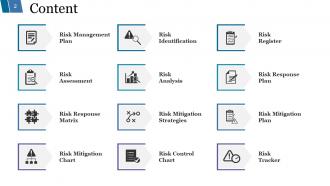
Slide 2: This slide showcases Content with the following points- Risk Assessment, Risk Management Plan, Risk Response Matrix, Risk Mitigation Chart, Risk Mitigation Strategies, Risk Analysis, Risk Control Chart, Risk Identification, Risk Mitigation Plan, Risk Tracker, Risk Response Plan, Risk Register.
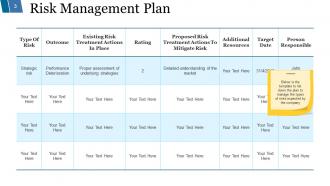
Slide 3: This slide showcases a Risk Management Plan. This slide template to list down the plan to manage the types of risks expected by the company.
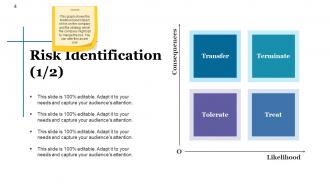
Slide 4: This sldie showcases Risk Identification (1/2) displaying- Terminate, Treat, Transfer, Tolerate, Consequences, Likelihood. This graph shows the likelihood and impact of risk on the company and the strategy which the company might opt to mange the risk. You can alter this as per your
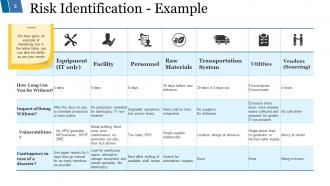
Slide 5: This slide shows Risk Identification - Example in tabular form. We have given an example of identifying risk in the below table, you can alter the fields as per your needs.
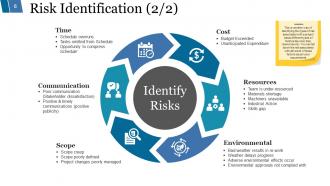
Slide 6: This slide shows Risk Identification (2/2) displaying- Cost: Budget Exceeded, Unanticipated Expenditure. Resources: Team is under-resourced, Materials shortage, Machinery unavailable, Industrial Action, Skills gap. Environmental: Bad weather results in re-work, Weather delays progress, Adverse environmental effects occur, Environmental approvals not complied with. Communication: Poor communication (Stakeholder dissatisfaction), Positive & timely communications (positive publicity). Time: Schedule overruns, Tasks omitted from Schedule, Opportunity to compress Schedule’. Scope: Scope creep, Scope poorly defined, Project changes poorly managed. This is another way of identifying the types of risk associated with a project basis different types of factors like cost, time, resources etc. You can list down the risk associated with all/ some of these factors as per your requirements
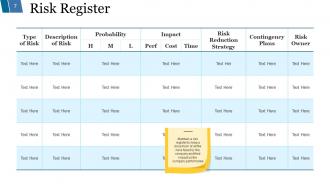
Slide 7: This is a Risk Register slide in tabular form. Maintain a risk register to keep a close track of all the risks faced by the company and their impact on the company performance.
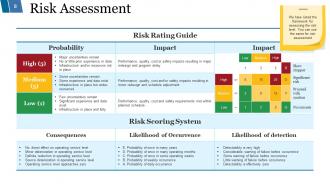
Slide 8: This slide shows Risk Assessment with Risk Rating Guide. We have listed the framework for assessing the risk level. You can use the same for risk assessment.
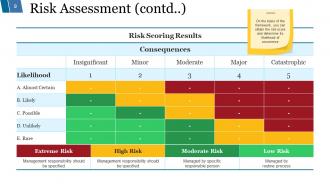
Slide 9: This slide shows Risk Assessment with Risk Scoring Results table in terms of- Insignificant, Minor, Moderate, Major, Catastrophic, Consequences, Likelihood. A. Almost Certain, B. Likely, C. Possible, D. Unlikely, E. Rare.
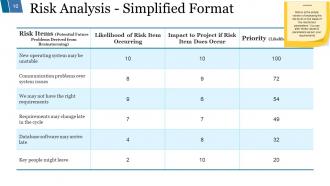
Slide 10: This slide presents Risk Analysis – Simplified Format in tabular form showing- New operating system may be unstable, Communication problems over system issues, We may not have the right requirements, Requirements may change late in the cycle, Database software may arrive late, Key people might leave, Likelihood of Risk Item Occurring, Impact to Project if Risk Item Does Occur, Priority (Likelihood * Impact) as Risk Items (Potential Future Problems Derived from Brainstorming).
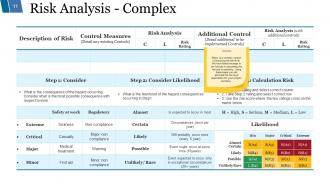
Slide 11: This slide Risk Analysis- Complex showcasing- Description of Risk, Risk Analysis, Risk Rating, Control Measures, (Detail any existing Controls), Risk Rating, Risk Analysis(with additional controls), Additional Control, (Detail additional to be implemented Controls).
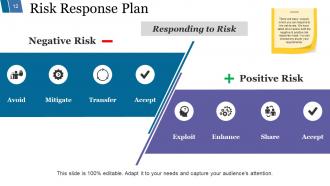
Slide 12: This slide shows Risk Response Plan showcasing- Responding to Risk consisting of- Mitigate, Avoid, Transfer, Accept, Exploit, Enhance, Share, Accept, Negative Risk, Positive Risk.
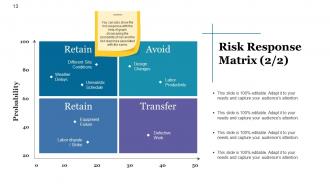
Slide 13: This slide shows a Risk Response Matrix displaying- Avoid: Design Changes Different Site Conditions Labor Productivity Unrealistic Schedule Transfer, Retain: Weather Delays, Defective Work, Equipment Failure, Labor dispute / Strike.
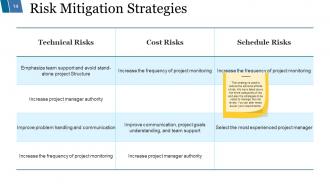
Slide 14: This slide shows Risk Mitigation Strategies showcasing- Technical Risks, Cost Risks, Schedule Risks.
Slide 15: This slide showcases Mitigation Strategy as- Control Strategy stated in terms of- High, Medium, Low on Probability Impact Score.
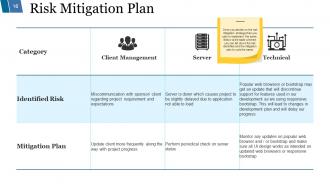
Slide 16: This slide presents Risk Mitigation Plan with- Category, Identified Risk, Mitigation Plan.
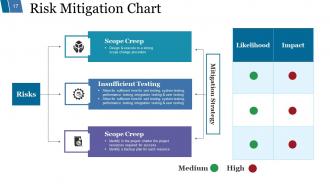
Slide 17: This slide shows Risk Mitigation Chart displaying- Scope Creep, Insufficient Testing, and Scope Creep as Risks with Mitigation Strategy stated in terms of- Medium, High.
Slide 18: This slide presents a Risk Control Matrix. Prepare a risk control matrix to have a close tap on the risk related measures you have intended to take. The below table helps you to keep a log of the control measures you have decided to take to manage the risk levels.
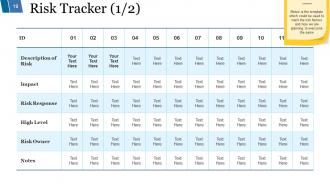
Slide 19: This slide shows Risk Tracker in tabular form.
Slide 20: This slide shows Risk Item Tracking with- Risk Items, Risk Resolution, Monthly Ranking.
Slide 21: This is a Coffee break image slide to halt. You can change the slide content as per need.
Slide 22: This slide displays Risk Mitigation Strategy icons. Use them as per need.
Slide 23: This slide is titled Charts & Graphs to move forward. You can change the slide content as per need.
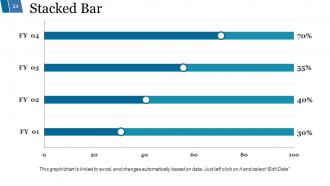
Slide 24: This is a Stacked Bar chart slide to show product/entity comparison, specifications etc.
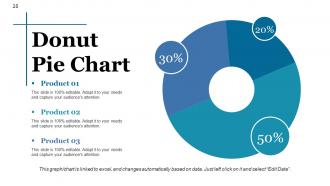
Slide 25: This is a Donut Pie chart slide to show product/entity comparison, specifications etc.
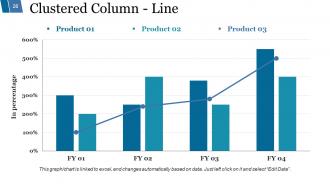
Slide 26: This is a Clustered Column chart slide to show product/entity comparison, specifications etc.
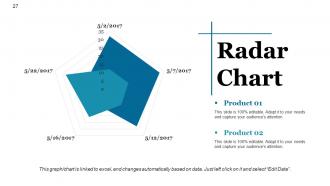
Slide 27: This is a Radar chart slide. State specifications, comparison of products/entities here.
Slide 28: This slide is titled Additional Slides to move forward. You can alter the slide content as per need.
Slide 29: This is Our Mission slide. State it here.
Slide 30: This is Our Team slide to state team specifications, information, structure etc. \
Slide 31: This is an About Company slide. State company specifications here.
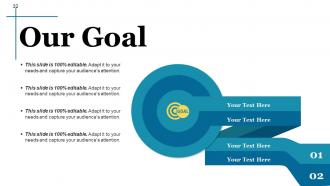
Slide 32: This is Our Goal slide. State goals, targets etc. here.
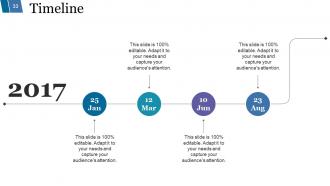
Slide 33: This is a Timeline slide to show milestones, evolution, growth highlights etc.
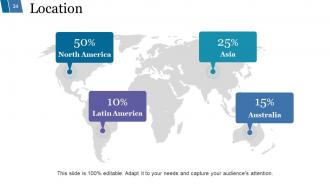
Slide 34: This is a Location slide of world map top show global marketing, growth, presence etc.
Slide 35: This is a Post It Notes slide to mark reminders, events or anything important.
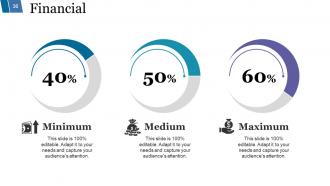
Slide 36: This is a Financial score slide. State financial aspects, information etc. here.
Slide 37: This is Our Target image slide. State targets, information, specifications etc. here.
Slide 38: This is a Puzzle image slide. State information, specifications etc. here.
Slide 39: This is a Magnifying Glass image slide to show information, specifications etc.
Slide 40: This is a Bulb or Idea slide to state a new idea or highlight innovative specifications/information etc.
Slide 41: This is a Thank You slide with Address# street number, city, state, Contact Number, Email Address.
Risk Mitigation Strategy Powerpoint Presentation Slides with all 41 slides:
Clothe your thoughts with our Risk Mitigation Strategy Powerpoint Presentation Slides. Fashion your views to be the talk of the day.
-
Risk Mitigation Strategy
-
Content
-
Risk Management Plan
-
Risk Identification 1 2
-
Risk Identification Example
-
Risk Identification 2 2
-
Risk Register
-
Risk Assessment
-
Risk Assessment contd
-
Risk Analysis Simplified Format
-
Risk Analysis Complex
-
Risk Response Plan
-
Risk Response Matrix 2 2
-
Risk Mitigation Strategies
-

Mitigation Strategy
-
Risk Mitigation Plan
-
Risk Mitigation Chart
-

Risk Control Matrix
-
Risk Tracker 1 2
-

Risk Item Tracking 2 2
-
Coffee Break
-
Risk Mitigation Strategy
-

Charts Graphs
-
Stacked Bar
-
Donut Pie Chart
-
Clustered Column Line
-
Radar Chart
-

Additional Slides
-
Our Mission
-

Our Team
-
About Company
-
Our Goal
-
Timeline
-
Location
-
Post It
-
Financial
-
Our Target
-

Puzzle
-
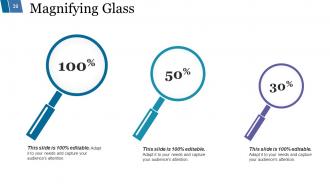
Magnifying Glass
-

Bulb Or Idea
-
Thank You
FAQs for Risk Mitigation Strategy
Okay so basically you need four things: figuring out what could go wrong, ranking those risks, planning your response, and then actually monitoring everything. Start by brainstorming all the ways your project might tank - not just the obvious ones either. Rank them by how likely they are and how badly they'd hurt. Then decide if you'll avoid each risk, reduce it, pass it off to someone else, or just accept it. The monitoring part is honestly where most people drop the ball. Set up regular check-ins so you're not flying blind. Don't let it become another useless document nobody looks at.
So risk assessment is like being a detective - you're hunting down everything that could go sideways and ranking how bad/likely each one is. After that comes mitigation, which is actually *doing* something about those risks. Assessment = your "what if" brainstorming where you analyze odds and damage. Mitigation = rolling up sleeves and making your game plan. You might avoid the risk completely, shrink it down, pass it off to someone else, or just live with it. Honestly, jumping straight to solutions without assessing first is pretty much pointless. Gotta understand what you're dealing with before you can fix it.
Dude, you really can't do risk management alone - it's like trying to diagnose yourself on WebMD. Getting stakeholders involved early gives you different viewpoints that'll catch stuff you'd totally miss otherwise. People actually follow through on plans they helped build, versus when you just dump strategies on them from corporate. Different groups care about different risks too, so you need their input on what's realistic to fix. I'd start by figuring out who the key players are, then get them in workshops or just chat with them individually. Way better than guessing what matters to people.
Honestly, you've gotta measure the boring stuff - how often incidents happen, money lost, downtime, compliance issues. Get your baseline numbers first or you're just guessing later. Skip the metrics that make you feel good but don't actually mean anything (learned that the hard way). Check in quarterly to see if risk levels are dropping and your controls work. Oh, and survey people too - sometimes their gut feeling about risk matters as much as spreadsheets. The whole point is seeing real improvement, not just pretty dashboards.
Ugh, the worst part is honestly getting people to care about stuff that hasn't happened yet. You know how it is - everyone's like "we'll be fine" until they're not. Money's always tight too, so good luck convincing anyone to spend on prevention. Then there's figuring out what to fix first when literally everything seems urgent. Keeping track of new risks while updating old plans? Total headache. And don't get me started on trying to coordinate between teams - it's like herding cats. But seriously, just pick some easy wins first. Once people see it actually working, they'll start buying into the bigger changes.
So here's the thing - tech can totally transform how you handle risk stuff. Automated monitoring catches problems way earlier than doing it manually. Predictive analytics finds patterns your brain would never spot, and AI crunches insane amounts of data. Honestly, dashboards are kind of a game-changer because bosses eat up those visual reports. Just don't go crazy buying tools that don't talk to each other - that's how you end up with a mess. My advice? Pick one area where you're already tracking data and start there. You'll see results faster and can build from there.
So basically you wanna look at two things: how likely is this crap gonna happen, and how bad will it mess you up if it does. High chance + major damage = deal with it first, obviously. Then think about what you can actually do about it - some risks you just can't control anyway, so why stress? Timing matters too. Something that might hit next month beats worrying about stuff years away. Honestly, just throw everything on a simple grid with probability on one side and impact on the other. Makes it way easier to see what deserves your attention first.
Oh totally, it changes big time depending on your industry. Healthcare is all about patient safety and HIPAA stuff - you're basically trying not to kill anyone or leak their medical records. Finance though? That's market crashes, fraud, Basel III regulations... completely different headache. Healthcare prevents individual disasters while finance worries about taking down entire markets (which honestly sounds more terrifying to me). My advice? Figure out your top 3 regulatory bodies first. I know it sounds boring but they'll basically dictate your whole approach anyway.
First thing - create a basic template with risk details, impact ratings, who's handling what, and deadlines. Nothing fancy. Update it constantly because stale risk docs are basically useless (learned that the hard way). Store everything where people can actually access it, not buried in some random folder. Write like a normal person - skip the corporate speak nonsense. Monthly check-ins work great for keeping everything current. Oh, and track your progress religiously. Can't tell you how many times I've seen good mitigation plans fall apart because nobody followed through on the actual actions.
Honestly, you've gotta weave risk thinking into everyone's normal routine instead of burying it in some manual nobody reads. Get your leaders to actually voice concerns during meetings - like when discussing new projects, have them openly mention what might go sideways. Train people to naturally ask "what could go wrong?" alongside budget questions. I swear, once teams start doing this regularly it clicks pretty fast. Simple risk check-ins during normal meetings work great. Celebrate when someone catches potential problems early. The whole thing needs to feel collaborative though, not like you're hunting for mistakes. Otherwise people just clam up.
So basically, if you don't handle risk properly, you're setting yourself up for lawsuits - negligence, regulatory fines, breach of duty, the whole mess. Directors can even face personal liability. Courts expect you to spot obvious risks and deal with them reasonably. When things blow up and you weren't prepared, lawyers will make you look like an idiot showing how "predictable" it all was. Regulatory bodies love hitting companies with massive penalties too. Honestly, the paperwork part sucks but document everything about your risk process and keep updating it. It's literally your only solid defense when things go sideways.
Look, training your team is honestly one of the smartest moves you can make. It helps people catch problems early instead of dealing with disasters later. More trained employees means better decision-making when stuff hits the fan - and trust me, it will at some point. Communication during crises gets way smoother too, which is huge. Don't make it a one-and-done workshop though. Keep it regular and focus on your actual risk areas. Like, if data breaches are your nightmare, train specifically for that. It's basically building your human firewall.
Honestly, predictive analytics is where it's at right now - you can spot problems coming instead of scrambling after they happen. Digital twins are pretty cool too, basically letting you test scenarios without breaking anything real. IoT sensors give you those instant "oh crap" alerts for equipment or security issues. Blockchain's actually useful now for tracking supply chains (took long enough, right?). The best part? This stuff isn't just for huge companies anymore - smaller ops can afford it. I'd probably start with predictive stuff for whatever keeps you up at night.
Look, external stuff will totally mess with your risk plans. Economic changes or new regulations? Yesterday's big concerns become pointless overnight. Meanwhile, threats you never saw coming suddenly matter. Honestly drives me crazy how unpredictable it gets. Your mitigation strategy can't be some rigid checklist you wrote once and forgot about. Build in regular check-ins - maybe quarterly reviews or whatever works. That way when things shift (and they will), you're not scrambling to figure out what changed. Flexibility beats perfection here.
Honestly, data analytics is like having a crystal ball for catching problems before they blow up. Look at your historical data to spot weird patterns - financial fraud, supply chain issues, whatever keeps you up at night. Most companies aren't even scratching the surface with this stuff, which is crazy to me. Set up some dashboards that ping you when something's off instead of just scrambling when disaster hits. I'd start small though - pick your top 3 nightmare scenarios and see what data you've already got sitting around. You'll be surprised how much insight is just hiding in plain sight.
-
Colors used are bright and distinctive.
-
Innovative and Colorful designs.