

Risk Management Tools And Techniques Powerpoint Presentation Slides




Try Before you Buy Download Free Sample Product
 Impress Your
 Audience
 100%
100% Editable
 Save Hours
 of Time


Trace the risks involved in your business project by using our Risk Management Tools And Techniques PowerPoint Presentation Slides. With the help of business risk methods PPT template, you can identify and analyze the risk present in your management life-cycle. There is quantitative and qualitative analysis included in our risk management plan PowerPoint slides which help in recognizing the risks involved in the productivity and economy of the project. You can rate the risk tolerance on the basis of its cost, schedule, scope, and quality with the help of the project risk management presentation complete deck. The risk assessment PPT slides showcase the categories like project performance, data accuracy, consumer service, assembly, quality system, designing, etc. which involves risk. This risk management tools PowerPoint presentation template helps to generate, controls, prioritize, develop solutions, and track the risk. Therefore, download this professionally designed business risk methods PPT deck and monitor the impact of risk adequately.
People who downloaded this PowerPoint presentation also viewed the following :
Content of this Powerpoint Presentation
Slide 1: This slide introduces Management Tools & Techniques. State your Company Name and begin.
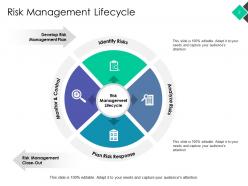
Slide 2: This slide presents Risk Management Lifecycle with related diagram.
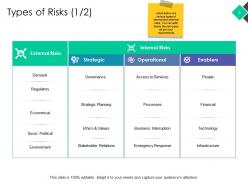
Slide 3: This slide shows Types of Risks describing External, Strategic, operational and enables risks.
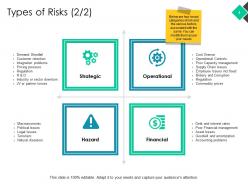
Slide 4: This is another slide on Types of Risks describing- Strategic, Operational, Hazard and Financial risks.
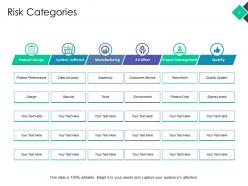
Slide 5: This slide showcases Risk Categories which includes- Product Design, System/ Software, Manufacturing, Project Management, Quality and all other.
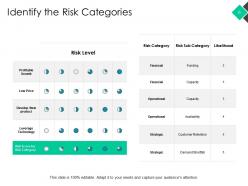
Slide 6: This slide represents Identify the Risk Categories with risk level and other sub categories.
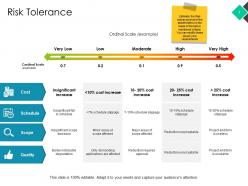
Slide 7: This slide shows Risk Tolerance on a scale describing risk from very low to very high.
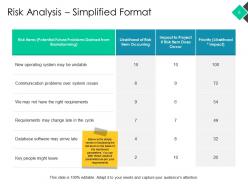
Slide 8: This slide presents Risk Analysis – Simplified Format with related table and text boxes. You can alter these values & parameters as per your requirements.
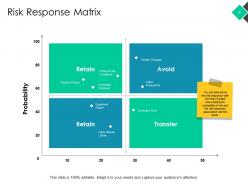
Slide 9: This slide showcases Risk Response Matrix with the help of graph describing the probability of risk and the risk response associated with it.
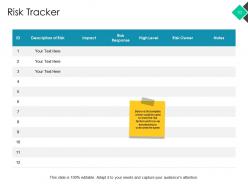
Slide 10: This slide presents Risk Tracker which could be used to track the risk factors and how we are planning to overcome the same.
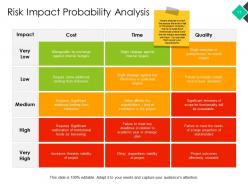
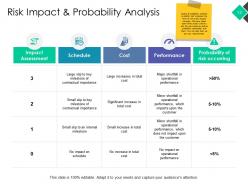
Slide 11: This slide shows Risk Impact and Probability Analysis.
Slide 12: This is another slide on Risk Impact & Probability Analysis.
Slide 13: This slide presents Risk Mitigation Strategies describing Technical, cost and scheduled risks.
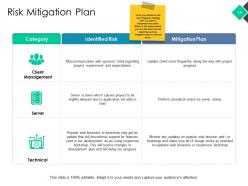
Slide 14: This slide displays Risk Mitigation Plan in a tabular form.
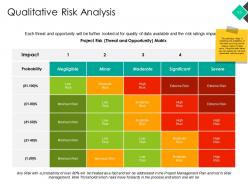
Slide 15: This slide represents Qualitative Risk Analysis for assessing the probability of risk event occurring and its relative impact if it does occur.
Slide 16: This slide showcases Quantitative Risk Analysis in a tabular form.
Slide 17: This slide displays Risk Management Tools & Techniques Icons.
Slide 18: This slide is titled Additional slides for moving forward.
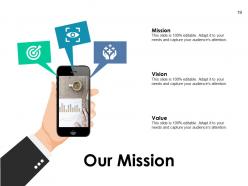
Slide 19: This is Our Mission slide with related imagery and text.
Slide 20: This is Our team slide with names and designation.
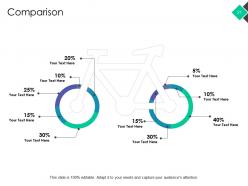
Slide 21: This is a Comparison slide to state comparison between commodities, entities etc.
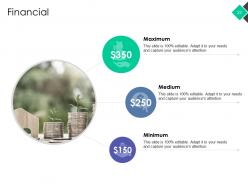
Slide 22: This is a Financial slide. Show your finance related stuff here.
Slide 23: This is About Us slide to show company specifications etc.
Slide 24: This is Our Goal slide. Show your goals here.
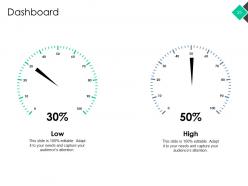
Slide 25: This slide shows Dashboard with additional text boxes to show information.
Slide 26: This is a Quotes slide to convey message, beliefs etc.
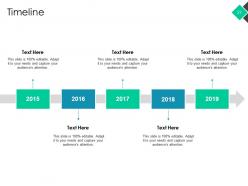
Slide 27: This is a Timeline slide to show information related with time period.
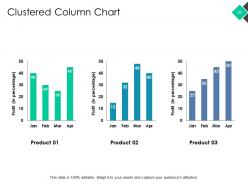
Slide 28: This slide represents Clustered Column chart with three products comparison.
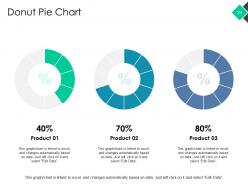
Slide 29: This slide displays Donut Pie Chart with data in percentage.
Slide 30: This is a Thank You slide with Address# street number, city, state, Contact Number, Email Address.
Risk Management Tools And Techniques Powerpoint Presentation Slides with all 30 slides:
Use our Risk Management Tools And Techniques Powerpoint Presentation Slides to effectively help you save your valuable time. They are readymade to fit into any presentation structure.






FAQs for Risk Management Tools And Techniques
Honestly, it's all about spotting problems before they bite you. Look for risks constantly, figure out how likely they are and what damage they'd do. I can't tell you how many projects I've watched blow up because people just crossed their fingers and hoped for the best. Keep updating that risk list throughout - not just week one then forget about it. Give each risk to someone specific so there's actual accountability. Oh, and tell stakeholders about potential issues upfront! Trust me, they'll forgive you way faster than if you surprise them later with "oops, everything's on fire."
Start by mapping out your processes - just walk through everything step by step and think "what goes wrong here?" Your team's probably your best resource though, they see stuff you don't. Regular brainstorming sessions work great for this. Also dig into your historical data - past problems, complaints, close calls. That stuff's gold. Don't ignore outside factors either like new regulations or sketchy suppliers. Honestly, the biggest mistake is treating this like a once-a-year thing. Monthly team check-ins where people can raise new risks they're spotting - that's where the real value is.
Honestly, tech has become a game-changer for managing risk. AI can crunch through tons of data way faster than we ever could and catch patterns we'd totally miss. Real-time alerts are clutch too - you'll know immediately when things start going wrong. I've seen people get overwhelmed trying to set up everything at once though, which never works. Start simple with one solid dashboard tool first. The automation side is probably my favorite part since it cuts out those dumb human mistakes we all make during routine checks. Oh, and the scenario modeling helps you think through "what if" situations before they actually bite you.
So it really depends on what you're trying to protect, right? Healthcare is obsessed with patient safety and HIPAA stuff - their whole thing revolves around clinical protocols and not accidentally killing someone. Finance though? They're sweating over market crashes, credit defaults, and staying compliant with SOX or Basel III regulations. Honestly, healthcare feels more "don't hurt people" while finance is pure "don't lose money." But here's what's weird - they both use pretty similar risk assessment methods, just pointed at completely different disasters. I'd say figure out what would absolutely destroy your industry first, then build backwards from that nightmare.
Honestly, leadership needs to talk about risks openly in meetings first - when the boss discusses what went wrong, everyone else feels safer doing it too. Set up reporting systems where people won't get blamed for flagging issues. The real trick though? Celebrate whoever speaks up about problems before they blow up. I've seen this work way better than boring training sessions. Make it part of reviews and regular team talks. People will actually care about risk management when they see their concerns lead to real changes, not just paperwork.
Honestly, you need both. Start with qualitative stuff to figure out what risks you're even dealing with - way easier than jumping straight into numbers. Then for the big scary ones, break out the spreadsheets and do proper quantitative analysis. Financial risks? Perfect for hard data and models. But good luck putting exact numbers on something like "our CEO might say something stupid on Twitter" - that's where risk matrices actually work better. I've watched teams waste weeks trying to quantify everything when sometimes you just gotta say "this is medium-high risk, let's monitor it."
Honestly, the worst part is when teams don't talk to each other about risks - like marketing launches something without telling operations about potential issues. You'll also deal with outdated risk assessments gathering dust and incomplete identification of problems. Get your frontline people involved since they see stuff management totally misses. Set up regular cross-team reviews and actually maintain a central risk tracker (I know, easier said than done). Oh and weave risk talks into normal meetings instead of making it this dreaded separate thing nobody wants to attend.
Honestly, compliance and risk management are basically joined at the hip - you can't really do one without the other. Banks have Basel III telling them exactly how to handle credit risks. Healthcare? HIPAA completely drives their data protection game. Manufacturing gets hit with environmental regs that flip their whole operational risk approach upside down. Sometimes it feels backwards though - like you're designing a house around pipes that are already there. Each industry's rules create totally different priorities. My advice? Map out your specific regulations first, then build risk controls that actually work for your business while keeping the regulators happy. Way easier than trying to retrofit everything later.
So many good options out there! ServiceNow GRC, MetricStream, and RSA Archer are the big comprehensive ones that do everything. Smaller teams might like Resolver for incidents or LogicGate for workflows - oh, and RiskLens if you're into the numbers side of things. Honestly though, don't just go for the shiniest tool. Map out what you're actually doing now, then demo maybe 2-3 that fix your worst headaches. Most have free trials anyway, so you can mess around before spending money. I'd probably start there vs overthinking it.
Honestly, scenario planning is a game changer for catching risks before they blindside you. Pick like 3-4 "what if" situations for your biggest project - economic crashes, supply chain mess, new regulations, whatever. Then work backwards from each scenario to see where your current plan would fall apart. Getting different teams involved is clutch because they'll spot stuff you'd never think of. I've seen this save companies so much headache when things actually went sideways. Don't overthink it though - just start with realistic scenarios that could actually happen, not zombie apocalypse stuff. You'll be shocked how many vulnerabilities pop up.
Dude, communication is honestly everything when it comes to risk management. Your plan can be perfect on paper, but if people don't get what they're supposed to do? Total disaster. I've watched solid strategies completely bomb because the messaging was garbage. You need simple language that everyone understands - not corporate speak that confuses people. Set up clear ways for teams to report problems and share updates regularly. Oh, and make sure leadership actually buys into what you're doing, otherwise good luck getting resources when things go sideways. Basically spend as much time planning how you'll talk about risks as you do identifying them.
Honestly, you gotta track both the predictive stuff and what actually happens after. I'd focus on how many risks you're catching and fixing, plus incident rates and response times. Near-misses are huge - most people ignore them but they're super valuable for spotting patterns. Cost of incidents vs what you spend on prevention is key too. Oh, and track if your risk predictions are actually accurate by comparing them to real outcomes later. Employee training completion gives you a decent pulse on awareness. Don't go crazy with metrics though - maybe 3-5 that you actually review monthly. Pick what makes sense for your situation.
Set up buckets for your risks - compliance/safety stuff is totally off-limits, but market experiments? Go for it. Run tiny pilots instead of going all-in from the start. Build in checkpoints where you actually review what could go wrong (I swear, most teams skip this part). Having someone play devil's advocate saves you from expensive mistakes later. The whole point is failing small and cheap while your main business stays stable. Honestly, it's way less stressful than you'd think once you get the framework down.
AI-powered risk analytics are pretty much everywhere now, plus ESG integration and cyber resilience stuff. Climate risk is getting massive - regulators want way more disclosure about environmental impacts and scenario planning. Honestly, third-party risk management is blowing up because supply chains are insanely complex and one bad vendor can wreck everything. Those monthly reports nobody actually reads? They're getting replaced by real-time dashboards. The whole industry's shifting from reactive to predictive approaches - that's probably the biggest change I'm seeing. Start by looking at what tools you've got now and see where you can automate the boring repetitive assessments.
Think of crisis management as your "oh shit" backup plan sitting on top of regular risk stuff. When you're doing risk assessment, spot the potential disasters and build specific game plans for each one. It's basically like keeping a fire extinguisher around - probably won't need it, but you'll be glad it's there when your prevention stuff fails. The trick is connecting your crisis plans to the risks you've already mapped instead of having random documents nobody looks at. Oh, and update them together so you're not totally lost when things actually go sideways.
-
The content is very helpful from business point of view.
-
Informative design.
-
Very well designed and informative templates.
-
Unique and attractive product design.
-
Good research work and creative work done on every template.