


Risk Management Workshop Agenda Powerpoint Layout




Try Before you Buy Download Free Sample Product
 Impress Your
 Audience
 100%
100% Editable
 Save Hours
 of Time


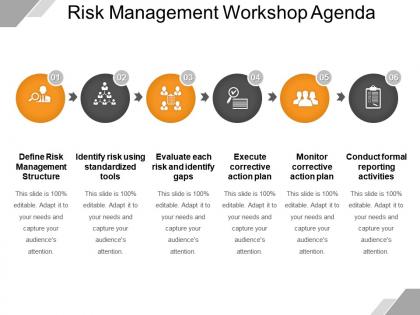
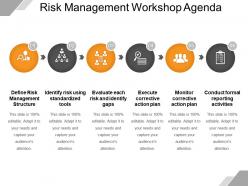
Are you the one going to deliver a presentation during the course of risk management workshop? If yes, then this risk management workshop agenda PowerPoint layout is exactly what is needed by you. The provided workshop agenda PowerPoint model is crafted to meet the needs of every professional belonging to the firm of any size. A well documented and streamlined risk management PPT visual can never miss grabbing the attention of the audience. Moreover, a well streamlined visual diagram is a treat for those who are going to deliver the presentation as well as those who are going to comprehend it. Define risk management structure, identify risk using standardized tools, evaluate each risk and identify gaps, execute a corrective action plan, monitor the corrective action plan and conduct formal reporting activities are the points covered in this risk management workshop contents presentation diagram. Your ideas will dart across. Play them with our Risk Management Workshop Agenda Powerpoint Layout.
People who downloaded this PowerPoint presentation also viewed the following :
Risk Management Workshop Agenda Powerpoint Layout with all 5 slides:
Hammer it in with our Risk Management Workshop Agenda Powerpoint Layout. Ensure your thoughts get embedded in their brains.

FAQs for Risk Management Workshop
So you need four main things: spotting risks before they hit, figuring out how bad/likely they are, having actual plans to deal with them, and - this is where everyone screws up - actually checking back on everything regularly. Most people just set it and forget it, which is dumb. You'll want someone clearly in charge of each risk too, because when shit hits the fan, you don't want people pointing fingers about whose job it was. Start with your worst-case scenarios first instead of trying to plan for every tiny thing that could go wrong.
Brainstorm with your whole team first - they'll catch stuff you totally missed. Past project disasters are actually super helpful for spotting patterns, weirdly enough. Do regular risk assessments using SWOT or risk registers. Industry reports are worth checking out too. Talk to stakeholders about what keeps them up at night. Don't ignore outside factors like new regulations or market changes - those can blindside you fast. Monthly risk meetings work better than doing this once and forgetting about it. Your team probably has way more insight than you think they do.
Tech makes risk management way smarter - you get better data and can catch problems faster. AI spots patterns you'd totally miss doing it manually. Automated systems watch everything 24/7 so you don't have to stare at screens all day. Real-time reporting is huge because you're dealing with current issues, not old ones. Though honestly, some tools spam you with alerts if you don't set them up right. The best part? You can actually predict problems before they blow up instead of scrambling afterward. Figure out where you're blind first, then grab specific tools for those gaps. Don't go crazy buying everything upfront.
Look, you gotta measure risks with real numbers first - potential losses, revenue hits, extra costs, whatever applies to your situation. The math gets messy though, don't stress if it's not perfect. Track non-financial stuff too like project delays or how badly it'll hurt your reputation. Customer satisfaction scores work great for some companies. Honestly, the scoring system matters way more than getting every number exact - you need to compare apples to apples somehow. Set up monthly check-ins to see how things are shifting. That way you can tweak your game plan before small problems become expensive ones.
First thing - map out everything that could go sideways. Financial stuff, operations, compliance, reputation damage, you name it. Rate each risk on how likely it is and how bad it'd hurt if it happened. Honestly, a simple grid works better than getting fancy with it. Pull in folks from other teams too since they'll catch blind spots you totally missed. Write it all down somewhere (including who's handling what and how you'll deal with each risk). Oh, and don't just file this away - actually revisit it regularly or it's pretty much useless.
So regulatory requirements are basically your starting point for risk management - the bare minimum to stay legal. Finance has Basel III for capital stuff, healthcare deals with HIPAA for data protection. Honestly, regulations change so much it's kind of annoying to track sometimes. But here's what I've noticed - the companies that actually do well don't just hit those minimums and call it a day. They figure out which rules apply to them specifically, then build their risk controls to go beyond what's required. Makes way more sense than just barely scraping by.
Write down your main processes so everyone's on the same page - honestly, this alone prevents so many stupid mistakes. Track your key metrics regularly to catch problems early. Cross-train people because when Dave's the only one who knows the system and he gets sick, you're screwed. Also make backup plans for your worst-case scenarios and actually practice them. Oh, and audit things periodically. I learned this the hard way - being reactive sucks way more than putting in the upfront work to stay ahead of issues.
Make it part of regular team chats, not just some dusty policy manual. Train people to flag risks without getting blamed - honestly, I've worked places where everyone just kept their mouth shut because they were scared of getting fired! Celebrate when someone catches a problem early. Leadership has to walk the walk too, your team copies what you do. Brief risk check-ins during meetings make it feel normal. Share examples of good catches so people know what to look for. Oh, and actually reward the people who speak up.
So qualitative risk analysis is basically the "high/medium/low" approach - you're rating stuff on descriptive scales instead of crunching actual numbers. Quantitative gets into the real data though. Dollar amounts, percentages, timelines. Way more precise but honestly takes forever to pull together. I'd go qualitative first when you're just trying to get a quick read on things or don't have solid data yet. Gets everyone aligned on what matters most. Save quantitative for when you need to justify spending or build a business case - that's where those concrete figures actually matter. Most people I know start broad then zoom in on the big risks.
Just make a simple grid - impact on one side, likelihood on the other. 3x3 works fine, or go 5x5 if you're feeling fancy. Plot "how bad would this mess us up" against "what are the actual odds." Focus on high-impact, high-probability stuff first since that's where the real danger lives. Honestly, I've seen too many teams waste time on dramatic but unlikely disasters while ignoring boring risks that'll actually bite them. Don't let politics drive the conversation either - Sarah's favorite initiative getting delayed isn't the same risk level as losing your biggest client. Start with the worst-case, likely scenarios and work down from there.
Oh man, the worst part is always getting leadership on board - they think risk management is just red tape slowing things down. Teams push back hard when they're already drowning in work. Data's a nightmare too because every department hoards info differently (seriously, why does marketing use different metrics than ops?). Then you're stuck trying to be thorough while everything moves at breakneck speed. Honestly though? Pick one critical process first. Get some quick wins to show it actually works, then slowly expand. Way less painful that route.
Honestly, templates are lifesavers. You get all the categories and rating scales already built in, so no more staring at blank spreadsheets wondering where to start. Time-wise it's a game changer – I used to waste hours setting up the same basic structure over and over. Everything stays consistent too, which your team will actually appreciate since everyone's using the same format. The best part? You won't forget to check important stuff because it's all laid out already. Oh, and definitely start simple – you can always add more sections later once you figure out what you actually need.
Honestly, communication can make or break the whole thing. If people don't get what the risks are or what they're supposed to do about them, your fancy strategy just becomes another dusty binder on someone's shelf. Regular updates help, but the real trick is making it two-way. Your team sees stuff you don't - they're in the trenches daily while you're looking at spreadsheets. Training sessions are obviously important, but so are those casual check-ins where people actually feel comfortable bringing up concerns. Oh, and keep the messaging consistent across departments. Nothing kills momentum like mixed signals from leadership.
Look, you gotta bake flexibility right into your risk setup from day one. Skip the annual checkbox BS - do real threat assessments that dig into what's actually shifting in your space. Most companies are still prepping for old problems while new stuff's already hitting. Cross-functional teams help you pivot fast when weird risks pop up. Oh, and continuous monitoring beats periodic check-ins every time. Map where you're blind right now. Then build some early warning systems. Risk management can't be this static thing you set and forget - it's gotta move with everything else.
Honestly? Stop ignoring the red flags and actually listen when people raise concerns. Enron, Wells Fargo, 2008 crisis - same pattern every time where leadership just dismissed warning signs. Risk management can't be dumped on one department either. Everyone needs skin in the game, especially executives. Stress testing worst-case scenarios might feel like overkill, but it's not paranoia when shit actually hits the fan. Here's a quick test: would anyone in your company feel safe challenging a big decision right now? If the answer's no, you've got bigger problems than you think.
-
Easy to edit slides with easy to understand instructions.
-
Very well designed and informative templates.