


Business Risk Management Overview Powerpoint Presentation Slides




Try Before you Buy Download Free Sample Product
 Impress Your
 Audience
 100%
100% Editable
 Save Hours
 of Time


Showcase the steps to ascertain the risk levels with the aid of our content ready Business Risk Management Overview PowerPoint Presentation Slides. By using this engaging disaster management PPT theme, you can explain how to identify and analyze the factors that cause problems during the execution of business projects. Use a business emergency planning presentation template and highlight the ways to avoid potential losses from various issues. With the help of this visually appealing disaster risk reduction plan PowerPoint graphics, you can list out the benefits to reduce the financial risk of an organization. Take the assistance of the business emergency preparedness PPT visuals and showcase the features that ensure the safety and security of your staff. Employ this professionally designed business crisis management PowerPoint layout and prepare an effective risk management plan. Hence, download our ready-to-use emergency management in the business PPT deck and illustrate the business-activities to reduce the risk.
People who downloaded this PowerPoint presentation also viewed the following :
Content of this Powerpoint Presentation
Slide 1: This slide introduces Business Risk Management Overview. State your company name here.
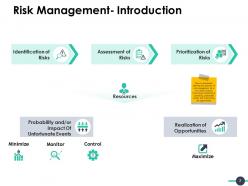
Slide 2: This is introduction to Risk Management slide.
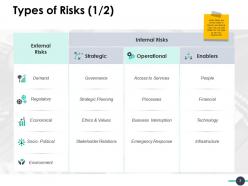
Slide 3: This slide showcases Types of internal and external Risks such as- Governance, Strategic Planning, Ethics & Values, Stakeholder Relations, Demand, Regulatory, Economical etc.
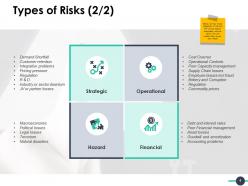
Slide 4: This is another slide showcasing Types of Risks.
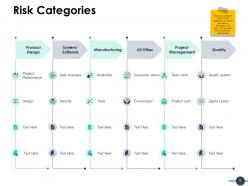
Slide 5: This slide showcases Risk Categories.
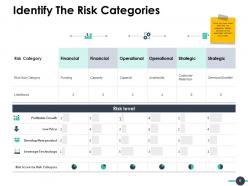
Slide 6: This slide showcases the category of risk identified and level of risk associated with each one of them.
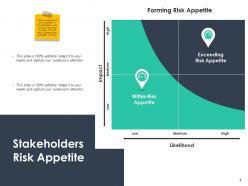
Slide 7: This is Stakeholders Risk Appetite slide showcasing forming risk appetite graph.
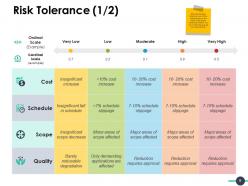
Slide 8: This slide showcases Risk Tolerance.
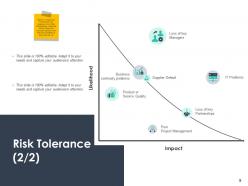
Slide 9: This slide also shows Risk Tolerance.
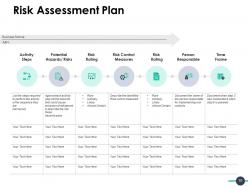
Slide 10: This slide showcases Risk Assessment Plan with Activity, Steps, Potential Hazards/ Risks, Risk Rating, Risk Control Measures, Person Responsible, Time Frame.
Slide 11: This is Business Risk Management Overview Icons Slide.
Slide 12: This slide shows time for Coffee Break.
Slide 13: This slide is titled as Additional Slides for moving forward.
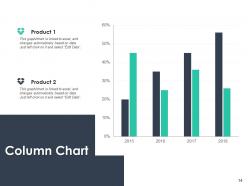
Slide 14: This slide depicts Column Chart for different products.
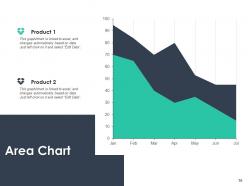
Slide 15: This slide displays Area Chart.
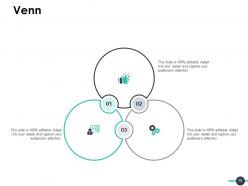
Slide 16: This is Venn slide.
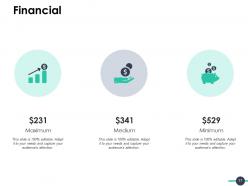
Slide 17: This is Financial slide.
Slide 18: This is About Us slide to show company specifications.
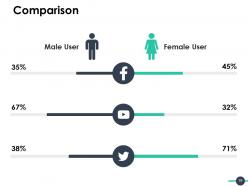
Slide 19: This slide showcases Comparison.
Slide 20: This is Our Goal slide. Showcase your important goals.
Slide 21: This slide showcases Magnifying Glass. Highlight your important content.
Slide 22: This is Puzzle slide with text boxes.
Slide 23: This is Our Team slide with names and designation.
Slide 24: This is Thank you slide with Email address, address and contact number.
Business Risk Management Overview Powerpoint Presentation Slides with all 24 slides:
Use our Business Risk Management Overview Powerpoint Presentation Slides to effectively help you save your valuable time. They are readymade to fit into any presentation structure.






FAQs for Business Risk Management Overview
Start with identifying all the ways your business could get screwed - financial hits, operational mess-ups, regulatory stuff, you name it. Then figure out which ones are most likely and would hurt the worst. That prioritization step is honestly where most people get stuck, but just pick the obvious big ones first. Create actual response plans for those top risks and make someone own each one. Oh, and you'll need regular check-ins to see if anything's changed - maybe monthly? The whole thing falls apart if you just build it once and forget about it. Has to become part of how you actually run things.
Honestly, start by getting your team in a room and just brainstorm everything that could possibly go wrong - like, really go deep on this. Walk through your actual processes physically too, not just on paper. You'll catch weird stuff you'd never think of otherwise. Check out what screwed you over before - old incidents, complaints, close calls. That patterns thing is huge. Oh and peek at what your competitors are dealing with, that's usually a goldmine. The trick is doing this monthly or whatever works, not just once and forgetting about it. New problems pop up constantly.
Look, risk assessment is like having a GPS for your business strategy - you'll spot the potholes before hitting them face-first. Think about what could mess up your plans: market changes, new regulations, internal stuff breaking down. Honestly, I've watched so many companies get totally caught off guard by obvious risks they just ignored. The whole process makes you actually think through different scenarios and build backup plans upfront. Oh, and start small - grab your top 5 risks and figure out what you'd do if they happened. Way easier than scrambling later.
Honestly, tech is like having X-ray vision for problems before they hit. Predictive analytics can catch patterns we'd never see - stuff like supply chain issues or customers about to bail. Real-time dashboards keep you watching the important metrics around the clock, and AI flags weird stuff automatically. You can also run "what if" scenarios to see how screwed you'd be in different situations (which is oddly fun). My advice? Don't go crazy at first. Just pick one major risk area and throw some basic analytics at it to start.
Honestly, you're looking at a bunch of different headaches here. Operational stuff hits first - supply chains breaking down, systems crashing when you need them most. Financial risks are brutal too: cash flow drying up, markets going crazy. Cybersecurity's gotten insane lately, feels like there's a new threat every week. Don't forget regulatory changes that come out of nowhere. Your reputation can tank from one bad product launch or PR mess. The scariest ones? Strategic risks where competitors or new tech basically make you irrelevant overnight. Natural disasters happen too, obviously. Figure out what usually destroys companies in your space first, then work backwards from there.
Risk matrices are your best friend here - just plot probability vs impact and you'll see what to tackle first. High probability + high impact = your nightmare scenarios, so start there. Get people from different teams involved because they catch stuff you'd never think of. Don't overthink the scoring system though, ballpark numbers work fine initially. Honestly, I'd knock out some easy wins first to get people bought in, then go after those big risks that could actually sink you. Works way better than trying to be perfectly systematic about everything from day one.
Honestly, just bake risk talks into your regular meetings instead of waiting for disasters. People need to know they won't get crucified for speaking up. Your leadership team has to go first though - I've watched too many execs claim they want honesty then absolutely murder whoever brings bad news. Train everyone to spot problems early and actually reward the people who catch stuff before it blows up. Oh, and make it crystal clear that burying issues is infinitely worse than just saying something. The whole "don't shoot the messenger" thing? It's real.
Ugh, regulatory changes are such a pain - they basically flip your entire risk setup upside down. What used to be fine? Now it's suddenly non-compliant. You'll probably need gap analyses, staff retraining, maybe even new systems depending on what changed. The reporting requirements alone can be a nightmare. Best thing you can do is try to stay on top of what's coming down the pipeline in your industry. Oh, and build some flexibility into your processes from day one - trust me on that one. Makes the whole mess way less stressful when changes hit.
Honestly depends what kind of risks you're dealing with. ServiceNow and MetricStream are solid if you need the full GRC suite, but they're pricey. LogicGate's pretty user-friendly too. For cyber stuff, RiskLens is decent. But real talk? Excel still handles basic risk registers better than people give it credit for - I use it all the time. SAS handles financial risk well if that's your thing. My buddy swears by Resolver for operational stuff. I'd figure out your specific needs first, then demo maybe 2-3 options. Don't overcomplicate it if you don't need to.
Just weave risk conversations into the meetings you're already having - don't make it some separate thing. During budget talks or project kickoffs, throw in "what could go wrong here?" and "got a backup plan?" Most places wait until they're on fire to think about this stuff, which is pretty dumb honestly. Create something dead simple your team can actually use without getting buried in Excel hell. Oh, and try adding like 10 minutes of risk chat to meetings you're doing anyway. Way better than treating it like some boring compliance box to check.
Honestly? Most people think risk management is boring as hell, so you're already fighting for attention. Employees see policies as red tape instead of protection. Breaking down complex stuff like cyber threats for your sales team or accounting folks - that's rough. Different departments need different approaches too, which makes everything harder. I'd focus on real examples from companies like yours (maybe ones that got burned). Oh, and definitely chunk everything into small, department-specific bits. Nobody's reading a 20-page manual anyway.
Look, first thing - you gotta do a brutally honest assessment of what actually went wrong. Don't sugarcoat it. Stabilize whatever's on fire, then be straight with people about what you learned and what's changing. This is where leaders either earn trust or lose it completely. After that, rebuild your whole risk setup - new policies, better monitoring, proper training. I mean, you can't just slap a band-aid on it and call it good. The trick is showing everyone you're not just fixing today's mess but actually getting stronger. Oh, and document everything because you'll want that playbook when (not if) something else hits.
Track both the hard numbers and the fuzzy stuff if you want the real story. Incident counts, financial hits, response times - that's your baseline. But honestly, risk assessment accuracy is where most people mess up. Are your "high risk" flags actually turning into problems? Also measure employee awareness and whether departments are actually following your controls (spoiler: they're probably not). Oh, and don't go crazy with metrics at first. Pick 3-5 that actually matter to your business and expand later.
Honestly, global events are like dominoes - they knock everything over at once. A pandemic hits and suddenly you've got supply chain chaos, half your team out sick, customers buying weird stuff, and cash flow issues all happening together. Normally these problems would be spread out, right? Geopolitical drama screws with trade routes and currencies in ways nobody sees coming. The worst part is discovering how connected everything really is when it's too late. My advice? Run through some "what if this goes sideways" scenarios now and build wiggle room into your operations. Way easier than scrambling later.
Honestly, the best thing you can do is catch problems before they blow up. Google Alerts are your friend here - way better than having angry customers tell you what's happening. Build good relationships with reporters and key people now, not when you're in crisis mode. Your team needs to know who handles what when stuff hits the fan, so write that down somewhere. Oh and here's the thing - just be real with people. They'll forgive screw-ups but they hate being lied to. Start by checking what people are already saying about you online.
-
Illustrative design with editable content. Exceptional value for money. Highly pleased with the product.
-
Thanks for all your great templates they have saved me lots of time and accelerate my presentations. Great product, keep them up!
-
Excellent design and quick turnaround.