


Risk Management Lifecycle Powerpoint Presentation Slides





Try Before you Buy Download Free Sample Product
 Impress Your
 Audience
 100%
100% Editable
 Save Hours
 of Time


Add your company’s name and make all the PPT layout slides yours. All sections like risk management lifecycle, introduction, and analysis or report can be rightly addressed with the effective use of Risk Management Lifecycle PowerPoint Presentation Slides. Monitoring and managing the risk potential serve as the lifeline of any business activity, thus it becomes important to make a record of all the available stats in the form of PowerPoint layout. The effective and efficient use of graphs, charts and pie diagrams bring text to life in the board room while you are delivering the information. Potential risk factors that hinder the growth of business activity which can be included in presentation template include cyber threats, system failure, natural disaster and much more. An easy track record can be maintained for the same in PPT slide so that they don’t impact the business to a greater extent or have a negative impact on a very vast scale. The right use of presentation layout brings life to your text and stats. Act impeccably with our risk management ppt. Flaws don't get a chance to emerge.
People who downloaded this PowerPoint presentation also viewed the following :
Content of this Powerpoint Presentation
Slide 1: This slide introduces Risk Management Lifecycle. State your company name to get started.
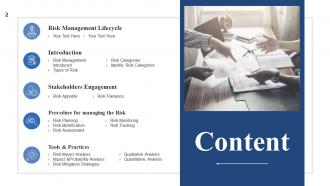
Slide 2: This slide showcases Content with the following points- Risk Management Lifecycle, Introduction, Stakeholders Engagement, Procedure for managing the Risk, Tools & Practices.
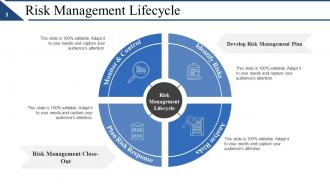
Slide 3: This slide showcases Risk Management Lifecycle in a circular image form. It consists of the following- Identify Risks, Analyze Risks, Monitor & Control, Plan Risk Response.
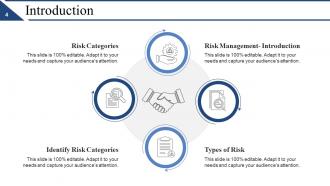
Slide 4: This is an Introduction slide with- Risk Management- Introduction, Types of Risk, Risk Categories, Identify Risk Categories.
Slide 5: This is Risk Management- Introduction slide showing- Assessment of Risks, Prioritization of Risks, Identification of Risks.
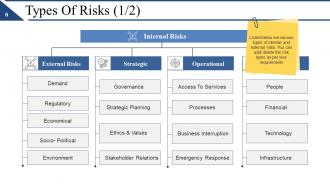
Slide 6: This slide states the Types Of Risks with respect to internal and external risks. You can add/ delete the risk types as per your requirements.
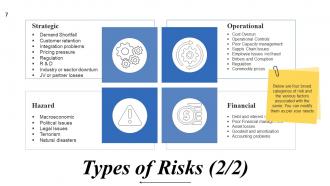
Slide 7: This slide also states Types of Risks. Below are four broad categories of risk and the various factors associated with the same- Financial, Hazard, Strategic, Operational. You can modify them as per your needs.
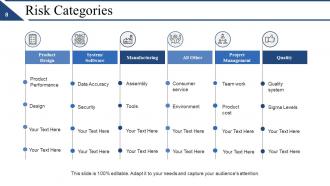
Slide 8: This slide states Risk Categories in terms of- Quality, Project Management, All Other, Manufacturing, System/ Software, Product Design.
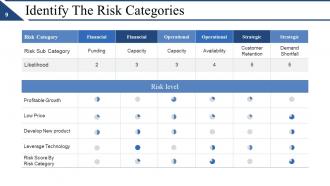
Slide 9: This is Identify The Risk Categories slide.
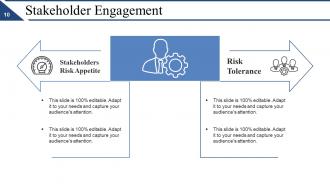
Slide 10: This slide showcases Stakeholder Engagement with arrow imagery. Its two important factors are- Stakeholders Risk Appetite, Risk Tolerance.
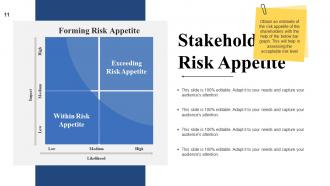
Slide 11: This is Stakeholders Risk Appetite in a matrix form. Obtain an estimate of the risk appetite of the shareholders with the help of the below bar graph. This will help in assessing the acceptable risk level.
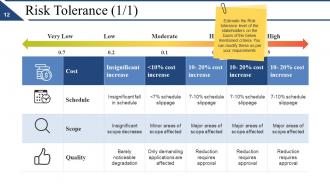
Slide 12: This slide shows Risk Tolerance with High, Low, Moderate, Very High and Very Low parameters. Estimate the Risk tolerance level of the stakeholders on the basis of this criteria. You can also modify these as per your requirements.
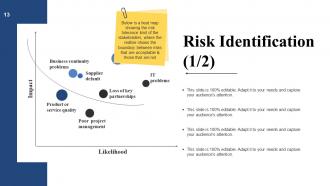
Slide 13: This slide also shows Risk Identification in a heat map. This is a heat map showing the risk tolerance limit of the stakeholders, where the redline shows the boundary between risks that are acceptable & those that are not. Use it as per need.
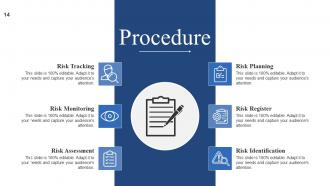
Slide 14: This slide showcases the Procedure with the following steps- Risk Planning, Risk Register, Risk Identification, Risk Assessment, Risk Monitoring, Risk Tracking.
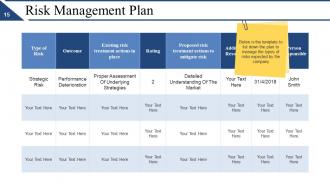
Slide 15: This slide showcases Risk Management Plan. This is a template to list down the plan to manage the types of risks expected by the company. You can chagnge/ alter it as per need.
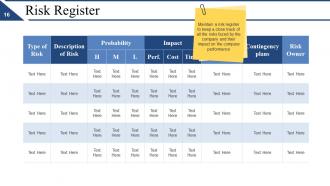
Slide 16: This slide shows a Risk Register. Maintain a risk register to keep a close track of all the risks faced by the company and their impact on the company performance.
Slide 17: This is a quadrant showing Risk Identification (1/2) with Likelihood and Consequences as its parameters.
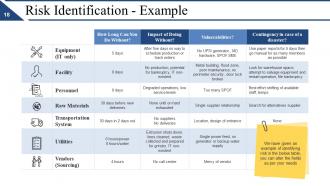
Slide 18: This slide states Risk Identification with an example. You can alter the fields as per your needs.
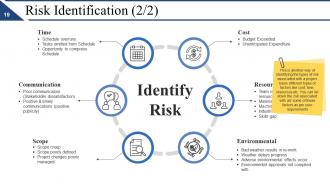
Slide 19: This slide also shows Risk Identification (2/2). This is another way of identifying the types of risk associated with a project basis different types of factors like cost, time, resources etc. You can list down the risk associated with all/ some of these factors as per your requirements.
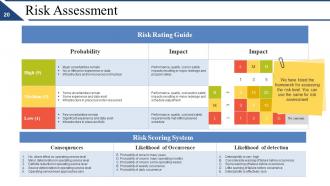
Slide 20: This slide presents a framework of Risk Assessment . We have listed the framework for assessing the risk level which you can use for risk assessment. You can also change it as per your need.
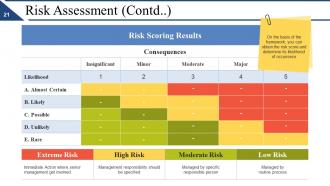
Slide 21: This slide also presents Risk Assessment framework. On the basis of this framework, you can obtain the risk score and determine its likelihood of occurrence.
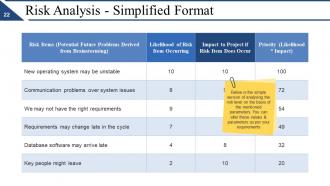
Slide 22: This slide showcases Risk Analysis - Simplified Format in a tabular form. This is a simple version of analysing the risk level on the basis of the mentioned parameters. You can alter these values & parameters as per your requirements.
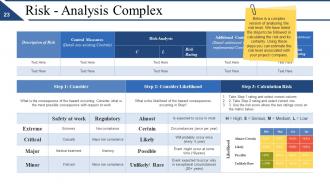
Slide 23: This slide shows Risk - Analysis Complex. It shows a complex version of analysing the risk level. We have listed the steps to be followed in calculating the risk and its certainty. Using these steps you can estimate the risk level associated with your project/ company.
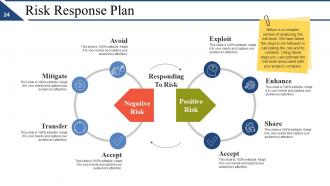
Slide 24: This slide showcases Risk Response Plan in a circular form.
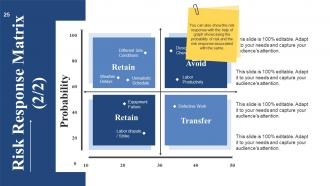
Slide 25: This slide showcases Risk Response Matrix. You can also show the risk response with the help of graph showcasing the probability of risk and the risk response associated with the same.
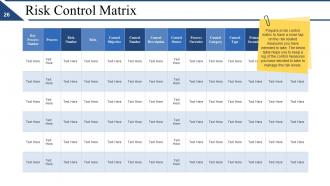
Slide 26: This is Risk Control Matrix slide in a tabular form. Prepare a risk control matrix to have a close tap on the risk related measures you have intended to take. The table helps you to keep a log of the control measures you have decided to take to manage the risk levels.
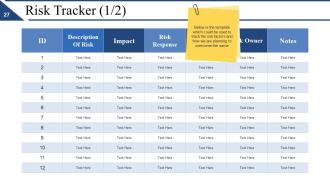
Slide 27: This slide showcases Risk Tracker . It consists of a template which could be used to track the risk factors and how we are planning to overcome the same. Change/ alter the content as per need.
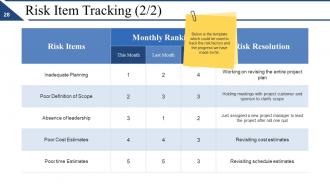
Slide 28: This slide showcases Risk Item Tracking template. This template could be used to track the risk factors and the progress we have made so far.
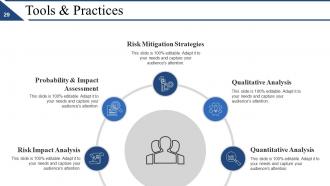
Slide 29: This slde states various Tools & Practices in a circular image form. These are- Risk Mitigation Strategies, Qualitative Analysis, Quantitative Analysis, Probability & Impact Assessment, Risk Impact Analysis
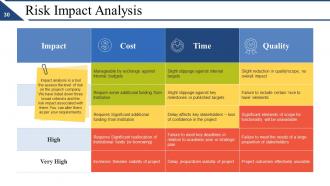
Slide 30: This slide presents Risk Impact Analysis with the following sub headings- Impact, Cost, Time, Quality.
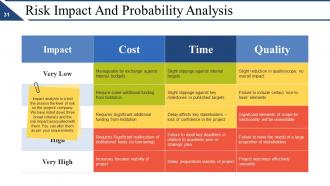
Slide 31: This slide presents Risk Impact And Probability Analysis in a tabular form.
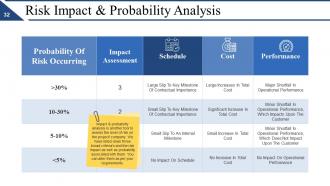
Slide 32: This slide also presents Risk Impact & Probability Analysis with the following- Probability Of Risk Occurring, Impact Assessment, Schedule, Cost, Performance.
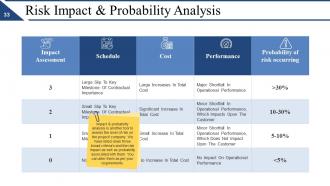
Slide 33: This too is a slide showing Risk Impact & Probability Analysis.
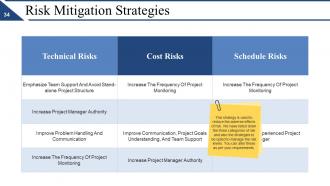
Slide 34: This slide states Risk Mitigation Strategies. This strategy is used to reduce the adverse effects of risk. We have listed the three categories of risk and also the strategies to be opted to manage the risk levels. You can alter these as per your requirements.
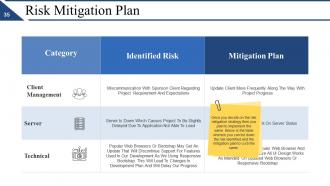
Slide 35: This slide states Risk Mitigation Plan. Once you decide on the risk mitigation strategy then you plan to implement the same. Here is a table wherein you can list down the risk identified and the mitigation plan to curb the same.
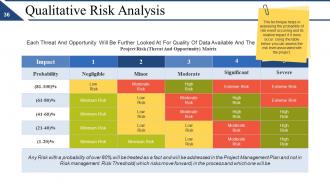
Slide 36: This slide showcases Qualitative Risk Analysis technique. This technique helps in assessing the probability of risk event occurring and its relative impact if it does occur. Using the table you can assess the risk level associated with the project.
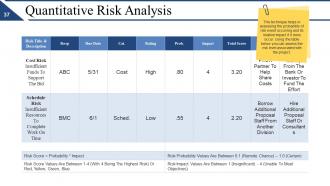
Slide 37: This slide also showcases Quantitative Risk Analysis in a tabular form.
Slide 38: This is a Coffee Time image slide to halt. You may change it as per requirement.
Slide 39: This is Enterprise Risk Management for Icon Slide. Use/ alter icons on the basis of your requirement.
Slide 40: This slide is titled Charts & Graphs to move forward. You can change/ alter the content as per need.
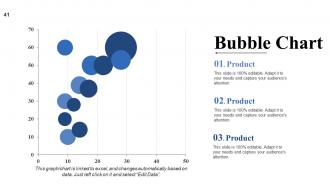
Slide 41: This is a Bubble Chart slide to present product/entity comparison, specifications etc.
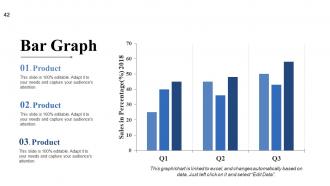
Slide 42: This is a Bar Graph slide to present product/entity comparison, specifications etc.
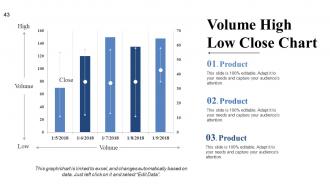
Slide 43: This is Volume High Low Close Chart to state product/ entity comparison, information etc.
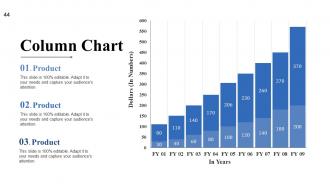
Slide 44: This is Column Chart slide to showcase product/ entity comparison, information, specifications etc.
Slide 45: This is titled Additional Slides to move further. You may change/ alter it as per need.
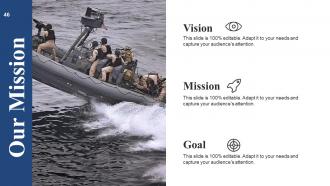
Slide 46: This is Our Mission slide. State your vision, goals and mission here.
Slide 47: This is an About Us slide. State about your company team, company essentials, highlights etc. here.
Slide 48: This slide showcases Meet Our Team with name and designation to fill.
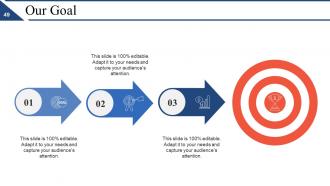
Slide 49: This is an Our Goal slide. State your important goals here.
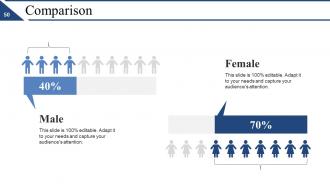
Slide 50: This slide shows Comparison of two entities/ products etc.
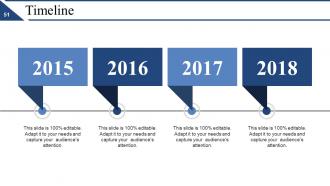
Slide 51: This is a Timeline slide to show milestones, growth or highlighting factors.
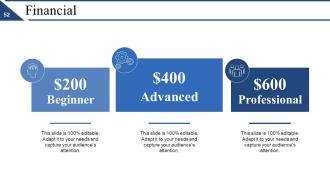
Slide 52: This is a Financial score slide. State financial aspects etc. here.
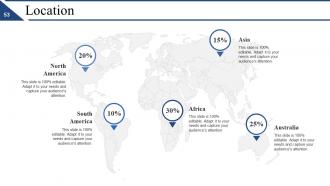
Slide 53: This is a Location slide of World map to show global presence, growth etc.
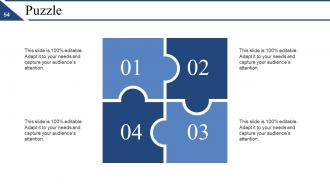
Slide 54: This is a Puzzle image slide to show information, specification etc.
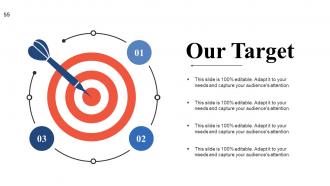
Slide 55: This is Our Target slide with imagery. State your targets, goals etc. here.
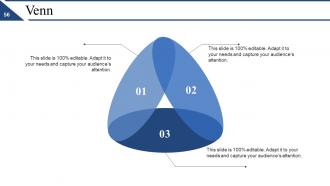
Slide 56: This is a Venn slide to show information, specifications etc.
Slide 57: This is a Mind Map image slide to show information, specifications etc.
Slide 58: This is a Lego blocks creative slide to present information, specifications etc.
Slide 59: This is an Important Notes slide to post important information, highlights etc.
Slide 60: This is Circular image slide to show information, product/ entity etc.
Slide 61: This slide presents a Hierarchy to showcase team information, specification etc.
Slide 62: This is a Silhouettes image slide to present people specific information, specifications etc.
Slide 63: This slide presents a Magnifying Glass image to showcase sales, information, specifications etc.
Slide 64: This is a Bulb Or Idea image slide to show information, innovative aspects etc.
Slide 65: This is a Thank You slide with Address# street number, city, state, Contact Numbers, Email Address.
Risk Management Lifecycle Powerpoint Presentation Slides with all 65 slides:
Avoid waste with our Risk Management Lifecycle Powerpoint Presentation Slides. You will never act in haste.





FAQs for Risk Management Lifecycle
The Risk Management Lifecycle includes risk identification, assessment, analysis, treatment planning, implementation, and continuous monitoring phases. These phases work systematically by establishing comprehensive risk registers, prioritizing threats based on impact probability, developing targeted mitigation strategies, and maintaining ongoing surveillance, with many organizations finding that this structured approach delivers enhanced operational resilience and strategic decision-making capabilities.
Risk identification varies significantly across industries based on regulatory requirements, operational complexities, and stakeholder expectations. While financial services focus on credit and market risks, healthcare emphasizes patient safety and compliance risks, manufacturing prioritizes operational and supply chain vulnerabilities, and technology companies concentrate on cybersecurity and data privacy threats, ultimately enabling targeted risk strategies.
Common risk assessment tools include risk matrices, Monte Carlo simulations, sensitivity analysis, scenario planning, SWOT analysis, and fault tree analysis. These techniques enhance decision-making by quantifying uncertainties, modeling potential outcomes, and prioritizing threats, with many financial institutions and manufacturing companies finding that combining multiple assessment methods delivers more comprehensive risk visibility and strategic advantage.
Organizations effectively prioritize risks through comprehensive risk assessment matrices, stakeholder impact analysis, regulatory compliance requirements, business continuity evaluations, and strategic objective alignment. This systematic approach enables companies across sectors like financial services, healthcare, and manufacturing to allocate resources strategically, address critical vulnerabilities first, and maintain operational resilience while ultimately delivering enhanced competitive advantage.
Stakeholder engagement ensures comprehensive risk identification, assessment, and mitigation by incorporating diverse perspectives, expertise, and concerns from employees, customers, suppliers, and regulatory bodies. Through collaborative communication and feedback mechanisms, organizations enhance risk visibility, improve decision-making accuracy, and build broader support for risk management initiatives, ultimately delivering more effective risk strategies and organizational resilience.
Effectiveness of risk mitigation strategies can be measured through key risk indicators, residual risk assessments, cost-benefit analyses, incident frequency tracking, and compliance audit results. Organizations across sectors like banking, healthcare, and manufacturing increasingly use quantitative metrics and qualitative reviews to evaluate strategy performance, ultimately ensuring reduced exposure, improved operational resilience, and enhanced stakeholder confidence.
Common challenges during risk monitoring include inadequate real-time data systems, inconsistent reporting frameworks, resource constraints, and difficulty tracking dynamic risk environments across multiple business units. Organizations often struggle with alert fatigue from excessive notifications, outdated monitoring tools, and lack of integrated dashboards, with many finding that fragmented systems ultimately hinder timely decision-making and effective risk response.
The Risk Management Lifecycle integrates seamlessly with project management frameworks by embedding risk identification, assessment, mitigation, and monitoring into each project phase, from initiation through closure. This strategic alignment enables project managers to anticipate potential disruptions, allocate resources more effectively, and maintain project timelines, with many organizations finding that integrated risk-project frameworks deliver significantly improved project success rates and stakeholder confidence.
**INPUT**: What strategies can be employed for continuous risk improvement? **OUTPUT**: Continuous risk improvement strategies include regular risk assessments, automated monitoring systems, stakeholder feedback integration, performance benchmarking, and predictive analytics implementation. These approaches streamline risk identification, enhance response capabilities, and minimize operational disruptions, with many financial institutions and healthcare organizations finding that proactive risk refinement ultimately delivers competitive advantage and sustained resilience. **Word count: 54 words**
Technology enhances the Risk Management Lifecycle by automating risk identification, enabling real-time monitoring, and streamlining compliance reporting through advanced analytics and AI-powered tools. These solutions help organizations minimize human error, accelerate response times, and improve decision-making accuracy, with many financial institutions and healthcare providers finding that integrated platforms deliver comprehensive visibility and significantly reduced operational risks.
Key risk management performance metrics include risk-adjusted return on capital, value at risk, risk appetite adherence, incident frequency rates, and mean time to resolution. These metrics enable organizations to measure financial impact, operational efficiency, and strategic alignment, with many financial institutions and healthcare systems finding that comprehensive dashboards combining quantitative and qualitative indicators deliver enhanced decision-making and competitive advantage.
Regulatory compliance significantly shapes risk management by mandating specific frameworks, reporting requirements, documentation standards, and audit protocols that organizations must integrate into their processes. This strategic combination enhances transparency, accountability, and systematic risk identification, with many financial institutions and healthcare organizations finding that compliance-driven frameworks ultimately streamline operations while delivering competitive advantage through robust governance structures.
Organizations can foster a risk-aware culture through comprehensive training programs, transparent communication channels, leadership modeling, clear accountability structures, and regular risk assessments integrated into daily operations. By implementing structured workshops, establishing cross-departmental risk committees, and incentivizing proactive risk identification, companies ultimately create environments where employees actively contribute to strategic risk mitigation and organizational resilience.
Not adhering to a structured risk management process leads to increased financial losses, regulatory penalties, operational disruptions, and compromised strategic decision-making across organizations. Without systematic risk identification and mitigation, companies face greater vulnerability to market volatility, compliance failures, and reputational damage, ultimately undermining competitive advantage and long-term sustainability.
External factors significantly influence risk management by introducing new vulnerabilities, shifting probability assessments, and altering business environments that require adaptive strategies. Market volatility, regulatory changes, and economic shifts compel organizations across sectors like banking, healthcare, and manufacturing to continuously recalibrate their risk frameworks, ultimately enhancing resilience and competitive positioning.
-
Attractive design and informative presentation.
-
Excellent design and quick turnaround.