


Risk Mitigation Plan Powerpoint Presentation Slides





Try Before you Buy Download Free Sample Product
 Impress Your
 Audience
 100%
100% Editable
 Save Hours
 of Time


Introducing Risk Mitigation Plan PowerPoint Presentation Slides to predict risk and estimate the impacts of any unfortunate event on your enterprise. The different ways of managing the threats can be showcased using this self-explanatory risk management PPT template. This threat mitigation PowerPoint complete deck comprise of ready-to-use templates such as risk management plan, risk identification, registration, assessment, analysis and risk response plan. Also, the risk minimization planning and strategy, risk control chart and risk tracker can be illustrated with this professionally designed contingency plan PPT layout. To lessen the effects of threats you can develop an action plan to identify, assess and control risk for your organization. The identification of risk and the correlation between consequences and likelihood can be highlighted by utilizing the risk evaluation PowerPoint theme. Furthermore, the risk response matrix PowerPoint slideshow can be incorporated to categorize the risks and take action accordingly. Download this high-quality risk management plan PowerPoint presentation to control or minimize risk and increase safety.
People who downloaded this PowerPoint presentation also viewed the following :
Content of this Powerpoint Presentation
Slide 1: This slide introduces Risk Mitigation Plan. State Your Company Name and begin.
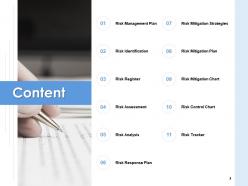
Slide 2: This slide shows content of the presentation.
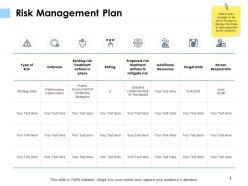
Slide 3: This slide presents Risk Management Plan describing- Type of Risk, Outcome, Existing Risk Treatment Actions in Place, Rating, Proposed Risk Treatment Actions to Mitigate risk, Additional Resources, Target Date and Person Responsible.
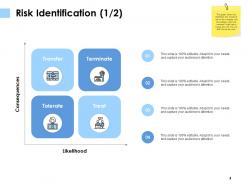
Slide 4: This slide represents Risk Identification with a graph that shows the likelihood and impact of risk on the company and the strategy which the company might opt to mange the risk.
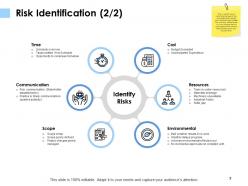
Slide 5: This is another slide on Risk Identification describing factors like cost, time, resources etc.
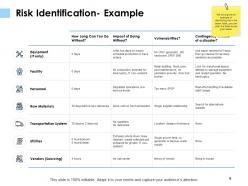
Slide 6: This slide showcases Risk Identification- Example describing Time period, Impact of Doing, Vulnerabilities and Contingency in case of a disaster.
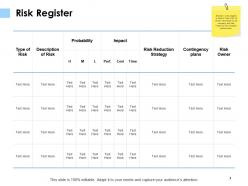
Slide 7: This slide shows Risk register to keep a close track of all the risks faced by the company and their impact on the company performance.
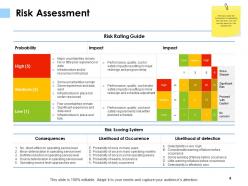
Slide 8: This slide shows Risk Assessment describing Risk Rating Guide with probability and impact along with Risk scoring system describing Consequences, Likelihood of Occurrence and Likelihood of detection.
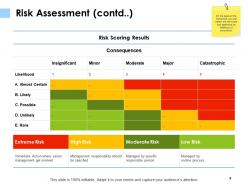
Slide 9: This is another slide continuing Risk Assessment, with this you can obtain the risk score and determine its likelihood of occurrence.
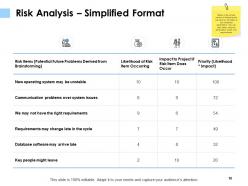
Slide 10: This slide presents Risk Analysis – Simplified Format with related table and text boxes. You can alter these values & parameters as per your requirements.
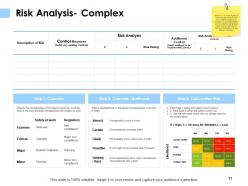
Slide 11: This slide displays Risk Analysis- Complex. This is a complex version of analysing the risk level. Follow the described steps to calculate risk.
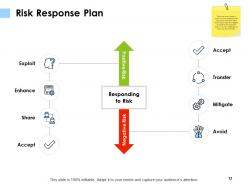
Slide 12: This slide represents Risk Response plan describing positive and negative ways of responding to the risk levels.
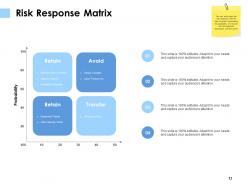
Slide 13: This slide showcases Risk Response Matrix with the help of graph describing the probability of risk and the risk response associated with it.
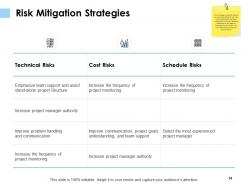
Slide 14: This slide presents Risk Mitigation Strategies describing Technical, cost and scheduled risks.
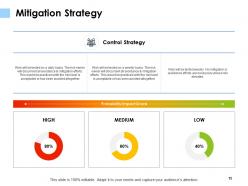
Slide 15: This slide shows Mitigation Strategy with related imagery and text.
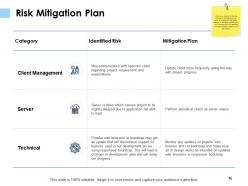
Slide 16: This slide displays Risk Mitigation Plan in a tabular form.
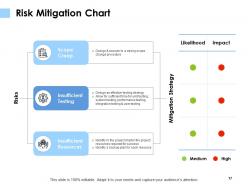
Slide 17: This slide showcases Risk Mitigation Chart with likelihood and impact of risk.
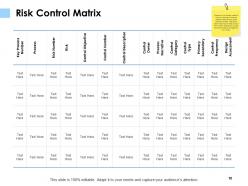
Slide 18: This slide shows Risk Control Matrix. This matrix helps you to keep a log of the control measures you have decided to take to manage the risk levels.
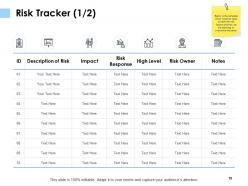
Slide 19: This slide presents Risk Tracker which could be used to track the risk factors and how we are planning to overcome the same.
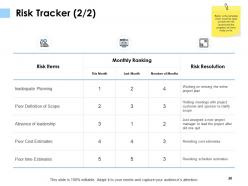
Slide 20: This is another slide presenting Risk Tracker which could be used to track the risk factors and the progress we have made so far.
Slide 21: This slide displays Risk Mitigation Plan icons.
Slide 22: This slide is titled as Additional slides for moving forward.
Slide 23: This is Our Mission slide with related imagery and text.
Slide 24: This is Meet Our Team slide with names and designation.
Slide 25: This is About us slide to show company specifications etc.
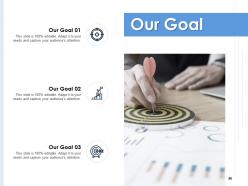
Slide 26: This is Our Goal slide. Show your firm's goals here.
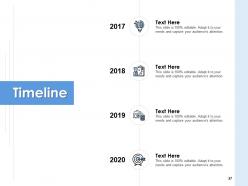
Slide 27: This is a Timeline slide to show information related with time period.
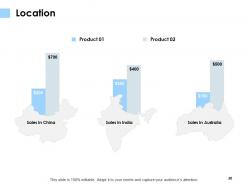
Slide 28: This is a Location slide with map to show data related with different locations.
Slide 29: This slide is titled as Post It Notes. Post your important notes here.
Slide 30: This is an Idea Generation slide to state a new idea or highlight information, specifications etc.
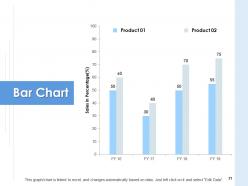
Slide 31: This slide shows Bar Graph with two products comparison.
Slide 32: This is a Thank You slide with address, contact numbers and email address.
Risk Mitigation Plan Powerpoint Presentation Slides with all 32 slides:
Use our Risk Mitigation Plan Powerpoint Presentation Slides to effectively help you save your valuable time. They are readymade to fit into any presentation structure.





FAQs for Risk Mitigation Plan
Look, you've got four main things to nail down here. Start by figuring out what could actually blow up your project - and I mean really think through the messy stuff. Then honestly assess how likely each risk is and how badly it'd hurt you (yeah, it's basically educated guessing but whatever). After that, pick your battles: avoid the big ones, reduce what you can, maybe transfer some to insurance or contractors. Oh and don't forget to actually check in on this stuff regularly - risks change. Honestly though, the whole thing's pointless if you just file it away and never look at it again.
Start with a team brainstorm - different people will spot risks you'd never think of. Go through each project phase and ask what could blow up. Past projects are goldmine for this stuff, trust me. Your assumptions? That's where risks love to hide. Don't forget external things like regulation changes or market weirdness. Dependencies on other teams are huge risk areas too (learned that the hard way). Keep a simple risk list and actually update it - I know, sounds obvious but people forget. Teams that skip this always end up scrambling later.
Look, you absolutely need everyone on board before rolling out risk plans. Different people spot different problems - finance sees budget issues, operations knows what's actually doable, etc. Can't just write something up in a vacuum and hope it works. I've watched so many initiatives crash because leadership never bothered asking the folks doing the actual work. Get input early from all departments and levels. People are way more likely to follow through when they helped shape the plan. Plus honestly? The front-line staff usually have the best insights anyway.
Honestly, data analytics is a game-changer for risk stuff. Instead of just winging it, you can actually see which risks happened before and how bad they were. Historical data shows real patterns you'd never catch otherwise. Predictive models are pretty cool too - they'll warn you about problems before they blow up. Real-time dashboards keep you on top of everything instead of flying blind. Way better than the old "trust your gut" approach, though sometimes gut instincts aren't totally wrong. Start small - pick your biggest 3-5 risks and just track trends. You'll be surprised what you find.
Honestly, the biggest pain is always budget - everyone wants bulletproof risk management until they see the price tag. People hate changing how they work too, especially if they think what they're doing already works fine. Plus nobody ever knows who's actually responsible for what risks, which makes tracking progress a nightmare. Oh and don't get me started on trying to monitor everything without decent systems in place. Start with quick wins that don't cost much. Build some momentum first, then go after the bigger structural mess once you've got credibility.
Okay so risk matrices are your best friend here - just plot everything by how likely it is vs how bad it'd be if it happened. Obviously the high-prob, high-impact stuff goes to the top of your list. Honestly, the low-risk, low-impact things? They can sit on the back burner for now (shh, don't tell your boss). Focus on anything that could mess with major business goals or get you in trouble with regulators. Don't forget to be realistic about what you can actually tackle with your current resources and timeline. I'd say start with maybe 3-5 of the worst ones, then chip away at the rest.
Don't just create your risk plan and forget about it - that's where most teams screw up. Check in monthly to see what's still relevant and what new problems might hit you. Things change constantly, right? Team members quit, deadlines get moved, scope creeps in. When that happens, your risks shift too. I'd do quick team check-ins every couple weeks to catch stuff early. Update the probabilities, ditch the outdated risks, add new strategies. Basically treat it like any other doc that actually matters to your project.
Honestly, I'd start with setting up some automated dashboards for real-time tracking - saves you from drowning in spreadsheets later. Do regular KPI monitoring and maybe quarterly risk assessments to see if your controls actually work. Your team members are gold mines for feedback since they're in the trenches daily and catch stuff you won't see from above. Monthly check-ins work well at first. Then there's the usual stakeholder feedback loops to consider. Oh, and definitely adjust how often you review things based on what patterns emerge - some risks need weekly attention, others can wait.
Ugh, regulations basically make you build compliance checkpoints right into your risk framework. Can't just spot risks and fix them anymore - gotta do it their way with all their paperwork and approval chains. Super annoying honestly. But weird thing is, those rules actually catch risks you'd probably miss on your own. Your whole strategy has to work around their timelines and reporting deadlines now. Oh, and don't forget penalty costs in your planning. I'd start by checking your current risks against whatever regs apply to you - you'll probably find some gaps you didn't know about.
Look, culture basically makes or breaks your whole risk management thing. People won't report problems if they're gonna get blamed for it - pretty obvious but you'd be surprised how many places mess this up. When your team actually trusts leadership and feels safe speaking up? That's when you catch issues before they explode. I've seen companies with amazing risk plans that totally failed because nobody wanted to be the bearer of bad news. Short version: check if your people feel comfortable raising red flags without getting their heads chopped off.
Honestly, the right tech makes risk communication so much easier. Set up shared dashboards so everyone can see what's happening in real-time. Automated alerts are clutch when things hit certain thresholds. I'd suggest creating a dedicated Slack channel for risk stuff - way better than those nightmare email threads where someone inevitably replies-all with "thanks!" You can track who's responsible for what and see actual progress on fixes. Just don't go overboard with fancy tools right away. Start with one good communication channel and build from there once you see what works.
First, figure out what could actually blow up your project - write down the odds and how bad it'd get. Then plan your backup moves for each one. Assign owners and deadlines, obviously. Here's something I wish I'd done earlier: create specific "trigger points" so you know exactly when to panic and flip to plan B. Charts help if you're visual like me. Share everything with your team because they can't help if they don't know what's coming. Oh, and update it regularly - nobody benefits from an outdated risk plan sitting in some folder.
Yeah, every industry handles risk totally differently based on what actually threatens them. Healthcare's obsessed with patient safety and staying compliant with regulations. Tech companies? They're paranoid about cyberattacks and data breaches - rightfully so these days. Manufacturing worries about supply chain mess-ups and keeping workers safe. Banks freak out over market swings and fraud. Construction deals with project delays and safety issues. Honestly, I've seen some construction sites that make you wonder how anything gets built safely. Point is, don't just copy someone else's risk plan. Figure out what could actually hurt your specific business and build around that.
Look, a contingency plan is just your backup when your main risk stuff falls apart. Plan B, basically. You know how you always think you've got everything covered? Well, you don't - nobody does. Unexpected crap happens all the time, and that's where contingency planning saves your butt. It keeps the business running when everything goes sideways. The trick is mapping out these backup moves ahead of time, not when you're already panicking. I learned this the hard way at my last job - we thought our systems were bulletproof until they weren't.
Look, good training stops problems before they blow up in your face. Your team learns to catch red flags early instead of playing defense all the time. Fewer screw-ups happen when people actually know what they're doing - and trust me, that's way cheaper than dealing with disasters later. Keep everyone sharp with regular sessions, but skip the boring stuff. You want hands-on scenario training where they practice real responses, not just sit through PowerPoint hell. Figure out your biggest vulnerabilities first, then build specific training around those threats.
-
Helpful product design for delivering presentation.
-
Awesomely designed templates, Easy to understand.
-
Unique and attractive product design.