

Mitigation Plan Powerpoint Presentation Slides





Try Before you Buy Download Free Sample Product
 Impress Your
 Audience
 100%
100% Editable
 Save Hours
 of Time


Select Mitigation Plan PowerPoint Presentation Slides to develop an action plan to mitigate business risk.. All the steps of risk management are well explained in this business presentation. Risk mitigation strategy PowerPoint complete deck comprises slides such as risk management plan, risk identification, risk register, risk assessment, risk analysis and response plan, risk response matrix, mitigation strategy, risk mitigation plan chart, risk control matrix, risk tracker, etc. The risk analysis PPT template helps you evaluate risk management plan and processes. With the help of PPT slide you can present your risk mitigation strategies. Risk control presentation slide allows you to execute risk assessment plan at organizational level. Additionally, this also goes well with the topics like risk mitigation planning, contingency plan, risk planning, mitigation strategy, hazards mitigation and many more. Download risk analysis PowerPoint template to conduct risk evaluation in a systematic manner. Identify the cause of a gridlock with our Mitigation Plan Powerpoint Presentation Slides. Come to grips with the deadlock.
People who downloaded this PowerPoint presentation also viewed the following :
Content of this Powerpoint Presentation
Slide 1: This slide introduces Mitigation Plan. State Your Company Name and get started.
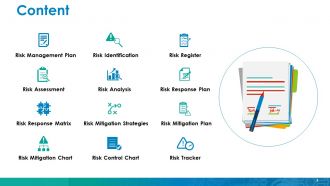
Slide 2: This slide shows the Content for the plan. The subheadings include- Risk Mitigation Strategies, Risk Mitigation Plan, Risk Analysis, Risk Tracker, Risk Control Chart, Risk Assessment, Risk Identification, Risk Management Plan, Risk Response Plan, Risk Register, Risk Response Matrix, Risk Mitigation Chart.
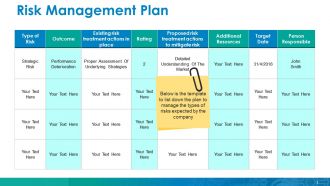
Slide 3: This slide presents a Risk Management Plan with the following subheadings- Person Responsible, Type of Risk, Outcome, Existing risk treatment actions in place, Rating, Additional Resources Target Date, Proposed risk treatment actions to mitigate risk.
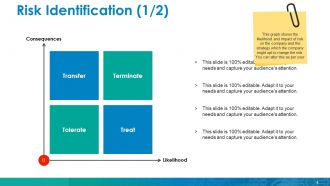
Slide 4: This slide presents a Risk Identification matrix in terms of conseuqnces and likelihood. Terminate, Treat, Tolerate, Transfer.
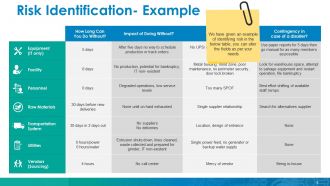
Slide 5: This slide presents Risk Identification- Example with the following headings- 1-How Long Can You Do Without? 2-Impact of Doing Without? 3-Vulnerabilities? 4-Contingency in case of a disaster?
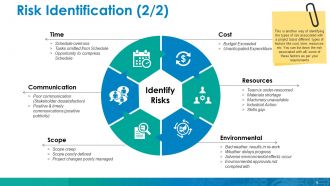
Slide 6: This slide covers Risk Identification in detail with the following sub headings- Cost (Budget Exceeded, Unanticipated Expenditure) Resources ( Team is under-resourced Materials shortage Machinery unavailable Industrial Action Skills gap) Environmental (Bad weather results in re-work, Weather delays progress, Adverse environmental effects occur, Environmental approvals not complied with) Time (Schedule overruns Tasks omitted from Schedule, Opportunity to compress Schedule) Communication {Poor communication (Stakeholder dissatisfaction) Positive & timely communications (positive publicity)} Scope (Scope creep Scope poorly defined Project changes poorly managed).
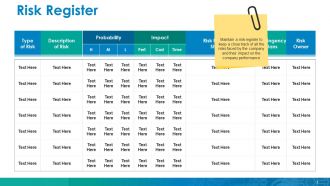
Slide 7: This slide showcases Risk Register with- Time, Impact, Type of Risk, Description of Risk, Risk Reduction Strategy, Contingency plans, Risk, Owner, HML Probability.
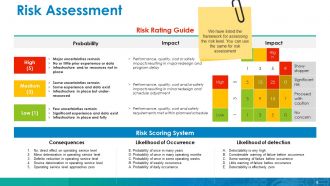
Slide 8: This slide showcases Risk Assessment with Risk Rating Guide, Probability, Impact, Consequences, Likelihood of Occurrence, Likelihood of detection. We have listed the framework for assessing the risk level. You can use the same for risk assessment
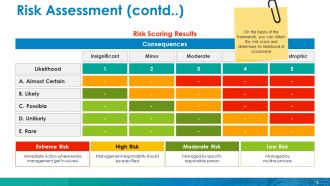
Slide 9: This is another slide on Risk Assessment with Risk Scoring Results. On the basis of the framework, you can obtain the risk score and determine its likelihood of occurrence.
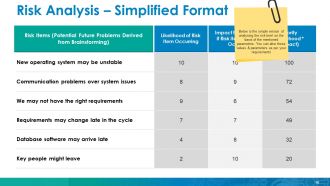
Slide 10: This slide showcases Risk Analysis – Simplified Format with the following subheadings- Likelihood of Risk Item Occurring, Impact to Project if Risk Item Does Occur, Priority (Likelihood * Impact), Risk Items (Potential Future Problems Derived from Brainstorming).
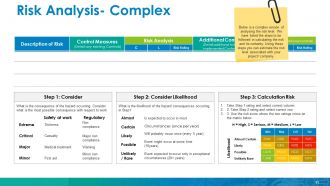
Slide 11: This slide presents Risk Analysis- Complex with three steps. The steps are- Step 1: Consider Step 2: Consider Likelihood Step 3: Caluclation Risk Below is a complex version of analysing the risk level. We have listed the steps to be followed in calculating the risk and its certainty. Using these steps you can estimate the risk level associated with your project/ company.
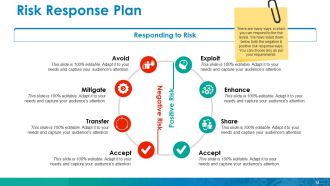
Slide 12: This slide shows a Risk Response Plan with the following subheadings- Avoid, Mitigate, Transfer, Accept, Exploit, Enhance, Share, Accept. There are many ways in which you can respond to the risk levels. We have listed down below both the negative & positive risk response ways. You can choose any as per your requirements.
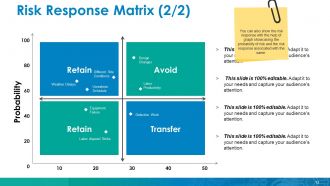
Slide 13: This slide shows a Risk Response Matrix in terms of probability with the following factors- Avoid, Transfer, Retain, Retain. You can also show the risk response with the help of graph showcasing the probability of risk and the risk response associated with the same.
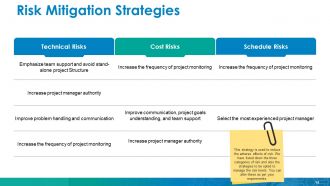
Slide 14: This slide shows Risk Mitigation Strategies classified into- Technical Risks, Cost Risks, Schedule Risks. This strategy is used to reduce the adverse effects of risk. We have listed down the three categories of risk and also the strategies to be opted to manage the risk levels. You can alter these as per your requirements.
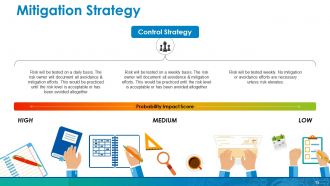
Slide 15: This slide presents Mitigation Strategy subheaded as Control Strategy with Probability Impact Score.
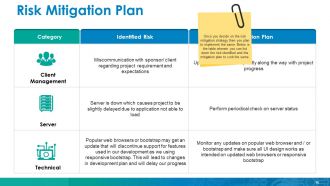
Slide 16: This slide presents a Risk Mitigation Plan divided into- Category Identified Risk Mitigation Plan Once you decide on the risk mitigation strategy then you plan to implement the same. Below is the table wherein you can list down the risk identified and the mitigation plan to curb the same.
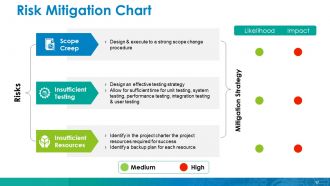
Slide 17: This slide shows a Risk Mitigation Chart in terms of Likelihood and Impact with Scope Creep, Insufficient Resources, Insufficient Testing.
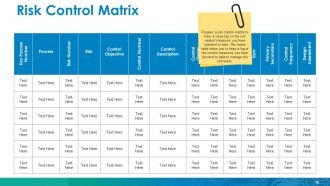
Slide 18: This slide presents a Risk Control Matrix. Prepare a risk control matrix to have a close tap on the risk related measures you have intended to take. The table helps you to keep a log of the control measures you have decided to take to manage the risk levels.
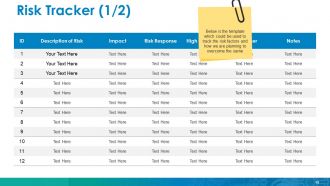
Slide 19: This slide presents a Risk Tracker to track and plan accordingly.
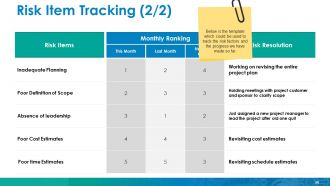
Slide 20: This slide showcases Risk Item Tracking with- Risk Items, Monthly Ranking, Risk Resources and Risk Resolution.
Slide 21: This is an Icon slide for Mitigation Plan.
Slide 22: This is a Coffee Break slide to halt. You may change it as per requirement.
Slide 23: This slide is titled Charts & Graphs to move forward.
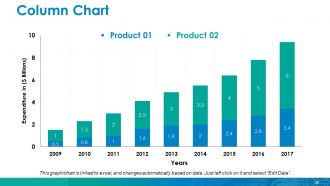
Slide 24: This is a Column Chart slide for product/entity comparison.
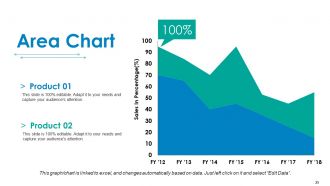
Slide 25: This is an Area Chart slide for product/entity comparison.
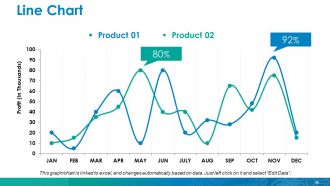
Slide 26: This is a Line Chart slide for product/entity comparison.
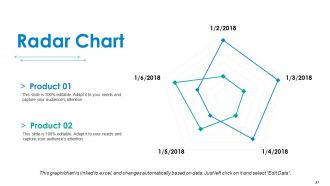
Slide 27: This is a Radar Chart slide for product/entity comparison.
Slide 28: This slide is titled Additional Slides to move forward.
Slide 29: This is a Vision, Mission and Goals slide. State them here.
Slide 30: This is an Our Team slide with name, image&text boxes to put the required information.
Slide 31: This is an About Us slide showing Our Company, Value Client, and Premium services as examples.
Slide 32: This is an Our Goal slide. State them here.
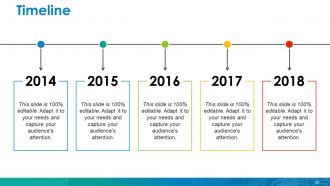
Slide 33: This is a Timeline slide to show milestones, growth or highlighting factors.
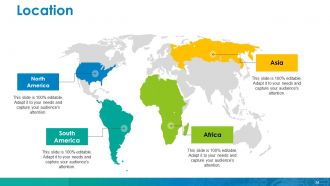
Slide 34: This is a Location slide of World map to show global presence, growth etc.
Slide 35: This is a Post it slide to mark reminders, events etc.
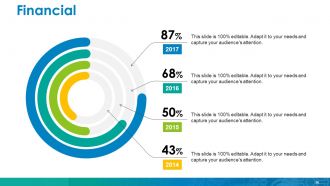
Slide 36: This is a Financial score slide. State financial aspects etc. here.
Slide 37: This is a Target slide. State targets here.
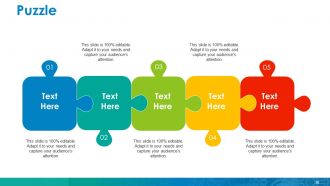
Slide 38: This is a Puzzle image slide to show information, specification etc.
Slide 39: This is a Magnifying glass image slide to show information, specification etc.
Slide 40: This is a Bulb/idea image slide to show information, ideas, innovation specific stuff etc.
Slide 41: This is a Thank You slide with Address# street number, city, state, Contact Numbers, Email Address.
Mitigation Plan Powerpoint Presentation Slides with all 41 slides:
Get different groups to join with our Mitigation Plan Powerpoint Presentation Slides. Give them inputs about acting in harmony.
-
Mitigation Plan
-
Content
-
Risk Management Plan
-
Risk Identification 1 2
-
Risk Identification Example
-
Risk Identification 2 2
-
Risk Register
-
Risk Assessment
-
Risk Assessment contd
-
Risk Analysis Simplified Format
-
Risk Analysis Complex
-
Risk Response Plan
-
Risk Response Matrix 2 2
-
Risk Mitigation Strategies
-
Mitigation Strategy
-
Risk Mitigation Plan
-
Risk Mitigation Chart
-
Risk Control Matrix
-
Risk Tracker 1 2
-
Risk Item Tracking 2 2
-
Mitigation Plan for Icon Slide
-

Coffee Break
-

Charts Graphs
-
Column Chart
-
Area Chart
-
Line Chart
-
Radar Chart
-

Additional Slides
-
Vision Missions Goals
-

Our Team
-

About Us
-
Our Goal
-
Timeline
-
Location
-
Post it
-
Financial
-
Target
-
Puzzle
-

Magnifying Glass
-
Bulb or idea
-

Thank You
FAQs for Mitigation Plan
So you need four main things: figure out what could go wrong, assess how bad each thing would be, plan your responses, and assign clear owners. Map out potential problems first, then work backwards from your worst-case scenarios. The ownership piece is honestly where most people mess up - nobody wants to be the one holding the bag when shit hits the fan, but without clear accountability it's all just paperwork. Oh, and don't forget timeline triggers for when to act. Regular check-ins help too. Start with your biggest risks though.
Start with a full risk assessment - audit everything that could blow up your operations. Tech failures, supply chain issues, you name it. Break it down department by department so it's not overwhelming. Look at past incidents and what went sideways before. Interview different teams about their biggest headaches. Industry trends matter too, plus external stuff like new regulations. Honestly, checking out competitor failures is gold - shows you what's coming. Document it all, then rank everything by how likely it is and how badly it'd hurt. Get those department interviews on the calendar this week.
Look, stakeholders are everything for your mitigation plan. Without them, you're basically planning in a vacuum. Get them involved early when you're spotting risks - they'll catch stuff you'd completely miss from your angle. They know which risks actually matter to the business too. Here's the thing though: if they don't buy into your plan upfront, forget about it. When things hit the fan, they won't follow something they had no part in creating. Oh, and don't just talk to the obvious departments - cast a wider net than you think you need to.
Quarterly reviews are the absolute minimum, but honestly? Any big scope or budget changes mean you gotta look at it right away. Don't be like those teams I've watched who kept following plans that made zero sense anymore - their whole project had shifted but they were still using old strategies. Monthly works way better for risky stuff or anything moving fast. The real trick is making sure what you planned still actually fits what's happening now, not what you thought would happen months ago. Oh and set that calendar reminder today or you'll totally forget.
Honestly, the worst part is always money and getting people on board. Half the time there's no budget, or someone's being weird about changing how they do things. Communication gets messy fast when you're dealing with different teams - like, nobody talks to each other apparently? Scope creep will absolutely destroy you if you're not careful about it. Then there's all the timeline stress and random tech problems that come out of nowhere. I learned the hard way to pad your timelines with extra time. Also get the important people involved right from the start, not halfway through when everything's already decided.
Honestly, data analytics is a game-changer for risk management. Instead of just guessing what might go wrong, you're working with actual evidence. Look at patterns from past incidents to see where problems usually pop up. Track whether your current fixes are doing anything useful (spoiler: sometimes they're not). The best part? You'll catch trends you'd miss otherwise - like risks that always spike during certain seasons or conditions. Plus it helps you figure out where to spend your budget for the biggest bang. Just start collecting data on your main risk indicators and build some simple dashboards to watch them.
So you need both types of metrics - leading and lagging. Leading ones show if you're actually doing the work (like finishing action items, getting training done, hitting deadlines on new controls). Lagging metrics tell you if it's working - fewer incidents, better risk scores, that kind of thing. Honestly, I get way too focused on the leading indicators because you can fix stuff faster. Don't go crazy though - pick maybe 3-5 metrics total or you'll hate your life. Simple dashboard, check it monthly, done.
Hey! So basically you want to look at what actually threatens your specific industry first. Healthcare folks need to worry about patient safety and HIPAA stuff, while manufacturing is all about supply chains breaking down. Financial companies? They're paranoid about cyber attacks - and honestly, they should be. Agriculture gets hit hard by weather disasters, hospitality stresses about reputation damage. Don't just grab some generic disaster plan template. Figure out what typically wrecks businesses like yours, then build your response around those real threats. Each sector's totally different, so your plan should be too.
Just map your mitigation steps to whatever risk categories you're already using - most frameworks have spots for "risk treatment" stuff anyway. Add a "mitigation status" column to your current risk register first. That's honestly the easiest starting point. Make sure your timelines match up with when you normally review risks (quarterly or whatever). Your mitigation steps should fit right into the existing assessment criteria without much tweaking. I'd focus on enhancing what's already working rather than starting over - way less headache that way. Build it out gradually once you get the basics down.
So proactive mitigation is basically spotting problems before they blow up - you know, doing risk assessments, setting up backup plans, that whole deal. Reactive is the opposite - you're putting out fires that already started. Most companies I've seen are honestly terrible at the proactive stuff and just run around fixing things constantly. Way more expensive that way too. The timing makes all the difference since preventing issues costs way less than scrambling to solve them after. You'll want both approaches, but seriously focus on getting the preventive measures down first. Saves your sanity later!
First thing - get everyone in a Slack channel or Teams chat where they can actually talk to each other. Weekly check-ins are annoying but necessary, trust me on this one. Pick someone to own each piece of the project so there's no "I thought you were handling that" drama later. Document everything as decisions happen and share it right away. Oh, and don't wait around for people to come asking for updates - stay ahead of it. The whole point is catching problems early instead of scrambling when everything's already on fire.
Honestly, you've got tons of options for this. RiskWatch and ServiceNow Risk Management are solid if you want something robust. Monday.com or Microsoft Project work great too - especially if your team's already using them. But here's the thing - I've seen plenty of teams crush it with just well-organized Excel spreadsheets. Sometimes the fancy platforms are total overkill, you know? Smartsheet's a nice middle ground with custom templates. Really though, just pick whatever your team will actually stick with. You can always upgrade later once you figure out what you actually need. Start simple.
So first thing - figure out what regulations actually apply to your situation. Those are basically your non-negotiables, the stuff you can't skip. Your mitigation plan has to hit all their requirements: reporting deadlines, who gets notified, remediation standards, all that fun stuff. Honestly, mapping it out is kind of a pain but trust me, it's way better than scrambling later when something goes wrong. Think of regs as your starting point, then add whatever else makes sense for your actual risks. I'd pull all the applicable regulations together before you even start writing - saves you from having to backtrack.
Check out the Netherlands flood management - they built this insane system of dikes and barriers after getting hammered in 1953. Works amazingly well. Japan totally redesigned their building codes after major earthquakes too. COVID supply chain stuff is interesting to look at, plus cybersecurity responses (though that gets pretty technical). The pattern's always the same: figure out what broke, build multiple backup plans, keep tweaking things. Disaster response gets all the headlines but honestly the boring prep work is what matters. I'd start by seeing what companies like yours actually did when shit hit the fan.
Look, your mitigation plan can't just sit there collecting dust once you write it. Things change constantly - new risks pop up, you learn from screwups, your whole setup evolves. I'd say review it quarterly or after any big incidents. Track how your strategies actually perform when shit hits the fan. The people doing the real work always have the best insights, so listen to them. Their feedback is gold for your next update. Honestly, most companies skip this step and wonder why their plans fall apart when they need them most.
-
Out of the box and creative design.
-
Thanks for all your great templates they have saved me lots of time and accelerate my presentations. Great product, keep them up!