


Risk Management Process Steps Powerpoint Presentation Slides





Try Before you Buy Download Free Sample Product
 Impress Your
 Audience
 100%
100% Editable
 Save Hours
 of Time


Download Risk Management Process Steps PowerPoint Presentation Slides to identify and manage potential business risk. This risk analysis and management PowerPoint complete deck includes content ready slides such as risk management lifecycle, types of risks, risk categories, stakeholder’s management and engagement, risk appetite and tolerance, procedure, risk management plan, risk identification, risk register, risk assessment, risk analysis, risk response plan, risk response matrix, risk control matrix, risk items tracking, tools and practices, risk impact & profitability analysis, risk mitigations strategies, plans, qualitative and quantitative risk analysis, etc. The content given in this Presentation has been researched by our team of experts. All slides are easy to customize. Users can edit these templates as per their requirements. Showcase risk evaluation and analysis techniques with risk response plan PPT Slides. Demonstrate the risk aspect involved in the project using the risk management approach and plan presentation graphics. Our Risk Management Process Steps Powerpoint Presentation Slides come in a fantastic array. They offer a broad canvas of exclusive craftsmanship. So, download our fully editable and customizable risk management ppt.
People who downloaded this PowerPoint presentation also viewed the following :
Content of this Powerpoint Presentation
Slide 1: This slide introduces the Risk Management Process Steps. Add your company name and proceed.
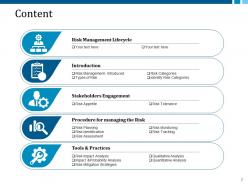
Slide 2: This slide presents Content showcasing- Introduction: Risk Management- Introduced, Types of Risk, Risk Categories, Identify Risk Categories. Procedure for managing the Risk: Risk Planning, Risk Identification, Risk Assessment, Risk Monitoring, Risk Tracking. Stakeholders Engagement: Risk Appetite, Risk Tolerance. Tools & Practices: Risk Impact Analysis, Impact &Probability Analysis, Risk Mitigation Strategies, Qualitative Analysis, Quantitative Analysis.
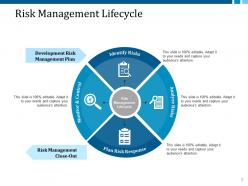
Slide 3: This slide shows Risk Management Lifecycle with four basic steps to be followed- Identify Risks, Plan Risk Response, Analyze Risks, Monitor & Control.
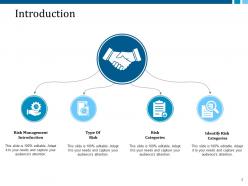
Slide 4: This is an Introduction slide with points that we have metioned.
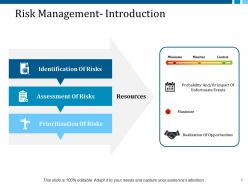
Slide 5: This slide presents Risk Management- Introduction framework. It shows the outcome of risk management for a firm which involves minimizing, monitoring & controlling unfavourable events and maximizing the opportunities.
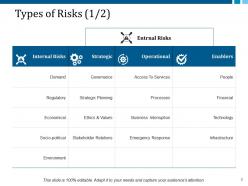
Slide 6: This slide showcases Types Of Risks. We have presented a list of internal risks and other factors. You can add/ delete the risk types as per your requirements.
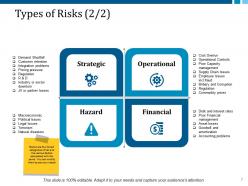
Slide 7: This is also a template showing four broad categories of Types of Risks- Strategic, Operational, Financial, Hazard. You can modify them as per your needs.
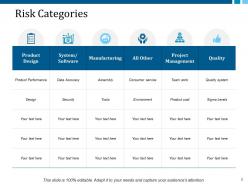
Slide 8: This slide shows Risk Categories with the following subheadings- Product Design: Product Performance, Design. System/ Software: Data Accuracy, Security. Manufacturing: Assembly, Tools. All Other: Consumer service, Environment. Project Management: Team work, Product cost. Quality: Quality system, Sigma Levels.
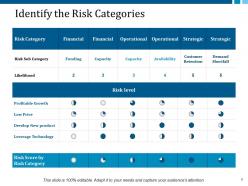
Slide 9: This slide helps to Identify the Risk Categories based on the Risk level and Risk Score.
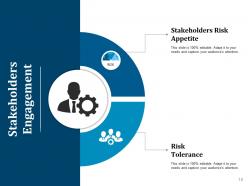
Slide 10: This slide shows Stakeholder Engagement with its two aspects- Stakeholders Risk Appetite, Risk Tolerance.
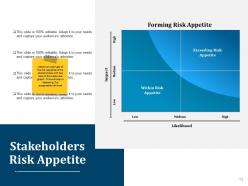
Slide 11: This slide shows Stakeholders Risk Appetite matrix. Obtain an estimate of the risk appetite of the shareholders with the help of the bar graph given which will help you in assessing the acceptable risk level.
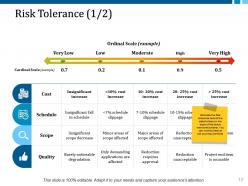
Slide 12: This slide shows Risk Tolerance scale with Very Low, Low, Moderate, High, Very High parameters which you can use to analyse Risk Tolerance Level.
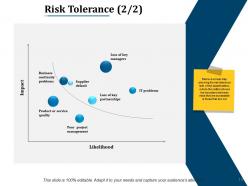
Slide 13: This slide presents a Risk Tolerance Bubble graph showing- Business Continuity Problems, Supplier Default, Loss Of Key Partnerships, IT Problems, Poor Project Management, Product Or Service Quality, Loss Of Key Managers.
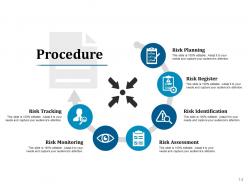
Slide 14: This slide shows the Procedure with- Risk Planning, Risk Register, Risk Identification, Risk Assessment, Risk Monitoring, Risk Tracking.
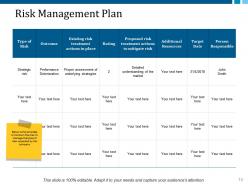
Slide 15: This slide showcases Risk Management Plan. Use this template to list down the plan to manage the types of risks expected by the company.
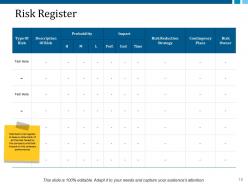
Slide 16: This slide shows Risk Register. Maintain a risk register to keep a close track of all the risks faced by the company and their impact on the company performance.
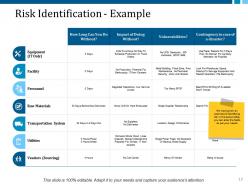
Slide 17: This slide explains Risk Identification with an Example which has been showcased by us. You can alter the fields as per your requirement.
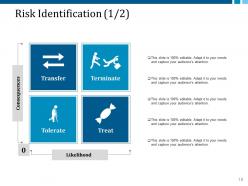
Slide 18: This slide shows another way of Risk Identification presented in a matrix form.
Slide 19: This too is a Risk Identification slide with factors like Cost, Resources, Environmental, Communication, Time, Scope.
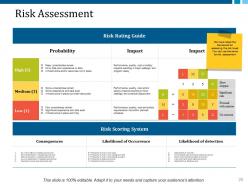
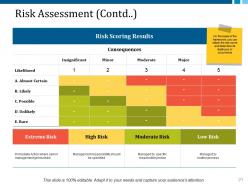
Slide 20: This slide shows Risk Assessment with Risk Rating Guide and Risk Scoring System.
Slide 21: This is another slide showing Risk Assessment framework. On the basis of this framework, you can obtain the risk score and determine its likelihood of occurrence.
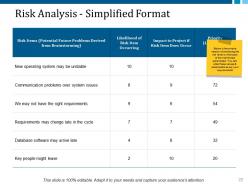
Slide 22: This slide presents Risk Analysis in a simplified format with parameters. You can alter these as per your own need.
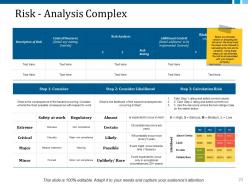
Slide 23: This is another slide presenting Risk Analysis but in a Complex format. We have also listed the steps to be followed in calculating the risk and its certainty with which can estimate the risk level associated with your project/ company.
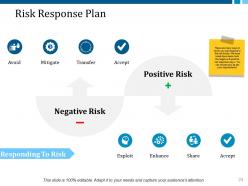
Slide 24: This slide shows Risk Response Plan listing both the Positive Risks and Negative Risks. We have also mentioned different ways to respond to these risks from which you can choose as per your requirements.
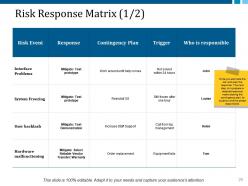
Slide 25: This slide shows Risk Response Matrix. Once you estimate the risk and plan the response. The next step is to prepare a detailed response matrix stating the contingency plan, its duration and the person responsible.
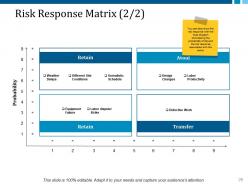
Slide 26: This is also a Risk Response Matrix slide with Avoid, Retain, Transfer, Retain as factors.
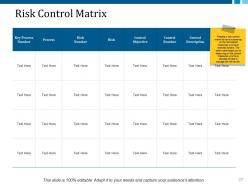
Slide 27: This slide shows Risk Control Matrix. Prepare a risk control matrix to have a close tap on the risk related measures you have intended to take. The table given will help you to keep a log of the control measures you have decided to take to manage the risk levels.
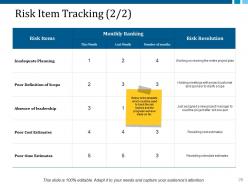
Slide 28: This slide shows Risk Item Tracking. Use this template to track the risk factors and the progress we have made so far.
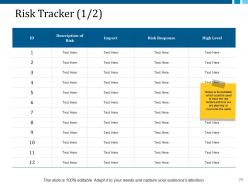
Slide 29: This slide shows Risk Tracker to track the risk factors and how we are planning to overcome the same.
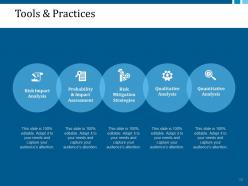
Slide 30: This slide shows Tools & Practices such as Risk Impact Analysis, Probability & Impact Assessment, Risk Mitigation Strategies, Qualitative Analysis, Quantitative Analysis.
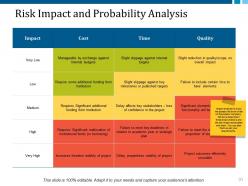
Slide 31: This slide shows Risk Impact and Probability Analysis tool. We have listed down three broad criteria's and the risk impact associated with them. You can alter them as per your requirements.
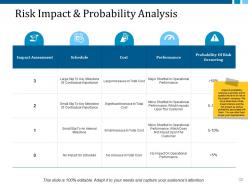
Slide 32: This slide also shows Risk Impact & Probability Analysis. Use as per your requirement.
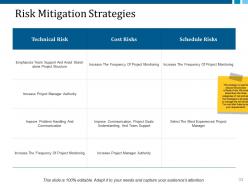
Slide 33: This slide shows Risk Mitigation Strategies. They are used to reduce the adverse effects of risk. We have also listed down the three categories of risk and also the strategies to be opted to manage the risk levels which you can alter as per your requirements.
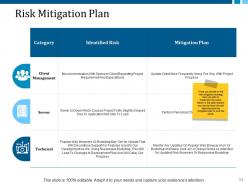
Slide 34: This slide shows Risk Mitigation Plan.
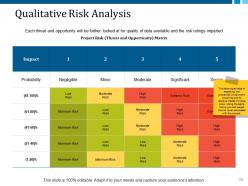
Slide 35: This slide presents Qualitative Risk Analysis. This technique helps in assessing the probability of risk event occurring and its relative impact if it does occur. Using the given table you can assess the risk level associated with the project.
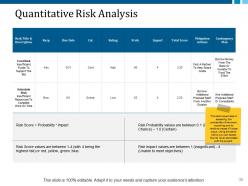
Slide 36: This slide shows Quantitative Risk Analysis technique. It helps in assessing the probability of risk event occurring and its relative impact if it does occur.
Slide 37: This is Risk Management Process Steps Icon Slide. Alter as per need.
Slide 38: This is also Risk Management Process Steps Icon Slide. Use as per your requirement.
Slide 39: This slide shows a Coffee Break image. You can alter the content as per need.
Slide 40: This slide is titled Additional Slides to move forward. You can change the slide content as per need.
Slide 41: This is Our Mission slide. Show your company mission and goals here.
Slide 42: This slide showcases Our Team with Name and Designation to fill.
Slide 43: This is an About Us slide showing Target Audiences, Values Client, and Preferred by Many as examples.
Slide 44: This is an Our Goal slide. State them here.
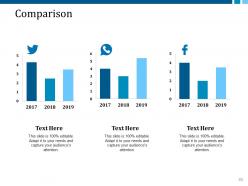
Slide 45: This is a Comparison slide for comparing entities/ products etc. here.
Slide 46: This slide displays Financial scores etc. in terms of Minimum, Medium and Maximum.
Slide 47: This is a Quotes slide. Insert a quote or whatever you desire here.
Slide 48: This is a Dashboard slide with numerals to use for presenting KPIs, metrics etc.
Slide 49: This is a Timeline slide. You can present yearly growth etc. with it.
Slide 50: This slide displays Our Target with relevant imagery.
Slide 51: This slide displays a Mind map with a brain image to go with. State any additional or special aspects here you want to cover.
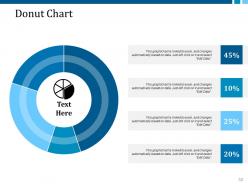
Slide 52: This slide displays a Donut Chart to show percentages of entities.
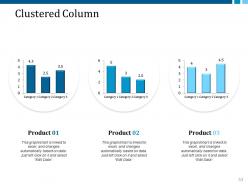
Slide 53: This is a Clustered Column slide to present product/ entity comparison, specifications etc.
Slide 54: This is a Thank You image slide with Address, Email and Contact number.
Risk Management Process Steps Powerpoint Presentation Slides with all 54 slides:
Advise folks to insist in combined effort with our Risk Management Process Steps Powerpoint Presentation Slides. Advocate joint action.











FAQs for Risk Management Process Steps
So there's basically five steps to risk management - identify what could go wrong, analyze how likely stuff is to happen, evaluate which ones actually matter (this is where people usually get stuck overthinking everything), then treat the big risks by avoiding/reducing/transferring or just accepting them. Oh, and monitor things continuously since everything changes. Honestly, just start with a simple risk register. Don't make it complicated at first - you can always add more detail later once you get the hang of it.
So it really depends on what industry you're in, right? Healthcare folks worry about patient safety and medical screwups. Manufacturing? Equipment breaking down, supply chain issues, workplace accidents. Financial companies are all about cyber attacks and market changes - honestly, they're probably the most paranoid. Tech is obsessed with data breaches and systems going down. Construction deals with totally different stuff like site safety and weather screwing up timelines. You'll want to look at what your competitors are doing and check regulatory requirements. That way you won't miss the obvious risks that could bite you later.
For risk assessment, I'd start with a basic risk matrix - plots probability vs impact and it's super visual. SWOT analysis is solid for spotting internal/external threats. When you need to trace back what causes specific failures, fault tree analysis works well. Monte Carlo sims are great if you're dealing with complex stuff and multiple variables. Honestly though, sometimes just getting the team together for a brainstorming session catches things all the fancy tools miss - weird but true. A simple risk register paired with your matrix covers most situations. Don't overthink it at first.
Honestly, just make a simple grid with likelihood on one axis and impact on the other. Plot each risk as a dot. The ones in the top-right corner? Those are your nightmares - tackle them first. What's cool is getting input from different teams since they'll see things totally differently. Finance freaks out about budget stuff while ops barely blinks at the same issue. Also think about how fast you'd catch each problem if it happened. Keep your scoring consistent across everything though - otherwise you're just making stuff up. The matrix makes it pretty obvious which fires to put out first.
Look, you really can't handle risk management solo - stakeholder input is huge. They'll catch risks you'd totally miss and actually know what'll hurt if things blow up. Different people spot different problems based on what they do day-to-day. Getting their buy-in on solutions matters too, otherwise good luck getting anyone to follow through. I mean, they're living with the consequences, right? The trick is figuring out who needs to weigh in at each step. Don't just invite everyone to everything - that's how you get useless meetings. Map out who should be involved when.
So here's the thing - your company's culture totally shapes how risk management actually works. When leadership talks openly about risks and wants people to flag issues, you get way better reporting. But that "don't bring me problems" attitude? Yeah, that's when stuff gets buried until it blows up spectacularly. I've seen this happen so many times. The culture also decides if risk management becomes just another checklist nobody cares about, or if it actually influences real decisions. Watch how your bosses react when someone raises a concern - that reaction tells you everything you need to know about where you really stand.
Dude, the worst mistakes I see? People get way too rosy about probabilities or totally lowball the actual damage something could cause. Most folks analyze risks like they exist in a vacuum - that's honestly where everything goes to hell. Also rushing through the assessment without talking to the right people first. You'll miss so much stuff it's not even funny. My advice: grab a probability/impact matrix, get different teams involved in your planning sessions, and question your gut reactions. Oh and write down why you made certain calls - future you will thank me for that one!
So basically, quantitative risk assessment is all about the numbers - you're dealing with actual probabilities, dollar figures, statistical models, that kind of thing. Way more precise but also more work. Qualitative is the opposite - you're rating stuff as high/medium/low risk based on judgment and experience. Honestly, most teams find qualitative way less intimidating to start with. Numbers can be overwhelming, you know? But if you need exact figures for budgets or regulatory stuff, you'll have to go quantitative. For initial assessments though, qualitative works great.
Basically you've got four ways to handle risks. First option - just avoid it completely by doing things differently. Second, reduce the chances through safety measures and controls. Third route is transferring it to someone else, like getting insurance or outsourcing the risky part. Last one's accepting it if you can live with the consequences. Don't overthink the small stuff though - spending thousands to avoid a tiny loss is pretty dumb. I'd rank everything by how likely and bad each risk is first. Then pick whatever makes financial sense for each one. Oh and write it down so you remember what actually helped later.
Tech is honestly a lifesaver for risk management. AI catches problems way before you'd spot them manually - we're talking patterns across huge amounts of data that would take ages to dig through otherwise. Real-time dashboards are clutch because you're not waiting months between check-ins to see what's happening. Documentation becomes so much easier too, which is great since compliance stuff is usually a nightmare. My advice? Figure out what's driving you crazy in your current setup first. Then find tools that actually fix those specific issues. Don't just buy software because it sounds fancy.
Track your leading and lagging indicators - that's where the real insights are. Look at risk exposure levels, how often incidents happen and how bad they get, plus mitigation costs vs what you actually avoided losing. Response time to new risks is honestly my favorite metric to obsess over. Stakeholder surveys show if people actually get it, and completion rates on your risk register matter too. Here's the big one though: compare actual losses to your projections. Way off consistently? Your assessment process probably sucks and needs fixing.
Honestly, the biggest thing is staying flexible since regs change all the time. Set up some kind of regular scanning process to catch new stuff early - quarterly works well. Design your framework with modular pieces you can actually swap out, not just tack things on later (trust me on that one). Document everything because auditors eat that up. Short version: don't wait for gaps to smack you in the face. I'd probably schedule those quarterly reviews against current regulations and update your risk assessments as you go. The modular approach saves so much headache down the road.
At minimum, do it yearly. But honestly? That's bare bones thinking. Big business changes or industry drama means you gotta look at it right away - don't wait around. Fast-moving industries like tech probably need quarterly check-ins. More stable stuff can get away with annual reviews. I'd rather be overly cautious than get caught off guard, you know? Set those calendar reminders now before you forget. Maybe tie them to when you're already doing strategic planning so it's not another random thing on your plate.
Honestly, you've got to stop making those risk policies so damn boring. Break them into bite-sized pieces for each team - what IT needs to know is totally different from what marketing cares about. Mix up how you share info too. Team meetings work great, but don't forget emails and your company intranet. Here's the thing though - your managers better know this stuff inside and out so they can actually answer questions when people are confused. Real examples help way more than abstract concepts. Oh, and check in regularly because people forget everything after like two weeks.
Just bake it into what you're already doing instead of treating it like some separate thing. Start identifying risks during your regular planning sessions - that part's easy. The tricky bit is actually following through with consistent reviews during sprints or milestone meetings. Most teams I know completely forget this step, which is honestly where everything falls apart. Add risk stuff to your project templates so it becomes automatic. Make risk checks part of your "done" criteria for big deliverables. That way it's just routine instead of this heavy process everyone dreads.
No Reviews