


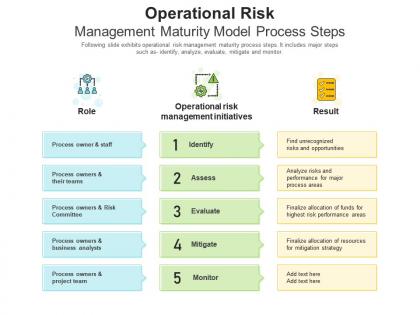
Operational risk management maturity model process steps




Try Before you Buy Download Free Sample Product
 Impress Your
 Audience
 100%
100% Editable
 Save Hours
 of Time


Following slide exhibits operational risk management maturity process steps. It includes major steps such as- identify, analyze, evaluate, mitigate and monitor.
People who downloaded this PowerPoint presentation also viewed the following :
Operational risk management maturity model process steps with all 2 slides:
Use our Operational Risk Management Maturity Model Process Steps to effectively help you save your valuable time. They are readymade to fit into any presentation structure.

FAQs for Operational risk management maturity
Key dimensions include risk governance and culture, risk identification and assessment processes, control framework effectiveness, risk monitoring and reporting systems, and technology integration capabilities. These dimensions enable organizations to systematically enhance their operational resilience by strengthening oversight structures, automating risk detection, and improving decision-making transparency, ultimately delivering competitive advantage through reduced operational losses.
Organizations assess their operational risk management maturity through comprehensive evaluation frameworks that examine risk identification processes, governance structures, data analytics capabilities, reporting mechanisms, and control effectiveness across business units. These assessments typically involve benchmarking against industry standards, conducting gap analyses, and evaluating integration levels, with many financial services and healthcare organizations finding that structured maturity models enable strategic roadmapping and competitive advantage.
Implementing an operational risk management maturity model delivers enhanced risk visibility, standardized processes, improved regulatory compliance, reduced operational losses, and stronger decision-making capabilities. Through structured assessment frameworks, organizations can systematically identify vulnerabilities, streamline control mechanisms, and allocate resources more effectively, with many financial institutions and healthcare organizations finding that mature models ultimately reduce costs while strengthening competitive positioning.
Higher maturity levels directly correlate with more sophisticated incident detection, faster response times, and comprehensive recovery protocols through automated monitoring systems, cross-functional response teams, and predictive analytics capabilities. Organizations at advanced maturity stages typically achieve 60-80% faster incident resolution while maintaining detailed post-incident analysis processes, ultimately delivering enhanced operational resilience and competitive advantage.
Common pitfalls include overestimating current capabilities, lacking standardized assessment criteria, focusing solely on compliance rather than strategic value, inadequate stakeholder involvement, and failing to benchmark against industry standards. Many organizations also struggle with siloed evaluations that miss cross-functional dependencies, ultimately delivering incomplete maturity assessments that hinder effective risk management transformation and competitive positioning.
Organizations should conduct comprehensive operational risk management maturity assessments annually, with quarterly reviews of key risk indicators and emerging threats. This balanced approach enables financial institutions, healthcare systems, and manufacturing companies to adapt swiftly to regulatory changes, technology disruptions, and market shifts, while maintaining strategic oversight and continuous improvement in their risk frameworks.
Leadership plays a pivotal role in enhancing operational risk management maturity by establishing risk governance frameworks, allocating strategic resources, and fostering organization-wide risk awareness cultures. Through executive sponsorship and clear accountability structures, leaders enable comprehensive risk assessment processes, streamlined reporting mechanisms, and proactive mitigation strategies, with many organizations finding that strong leadership commitment ultimately delivers enhanced operational resilience and competitive advantage.
Cultural aspects significantly influence operational risk management maturity through leadership commitment, employee accountability, communication transparency, and risk awareness across all organizational levels. Organizations with strong risk cultures demonstrate proactive identification and escalation of issues, collaborative cross-departmental approaches, and continuous improvement mindsets, ultimately delivering enhanced compliance, reduced operational losses, and sustained competitive advantage in increasingly regulated business environments.
Operational risk maturity metrics include risk assessment frequency, incident response time, control effectiveness ratings, loss event tracking accuracy, and regulatory compliance scores. These benchmarks enable organizations to measure progress across maturity levels, with many financial institutions and healthcare systems finding that comprehensive metric frameworks deliver enhanced risk visibility, streamlined compliance processes, and ultimately stronger operational resilience.
Regulatory requirements significantly shape operational risk management maturity models by establishing baseline compliance standards, mandatory reporting frameworks, and governance structures that organizations must integrate. These requirements drive banks and financial institutions to develop comprehensive risk assessment capabilities, automated monitoring systems, and enhanced documentation processes, ultimately delivering greater transparency and operational resilience.
Effective strategies include comprehensive risk assessment frameworks, automated monitoring systems, cross-functional training programs, integrated governance structures, and continuous improvement methodologies. Organizations across sectors like banking, healthcare, and manufacturing enhance maturity by establishing clear risk ownership, implementing real-time dashboards, and fostering risk-aware cultures, ultimately delivering improved regulatory compliance, reduced operational losses, and stronger competitive positioning.
Technology and automation enhance operational risk management by streamlining data collection, enabling real-time monitoring, and automating compliance reporting across organizational processes. These solutions deliver faster risk detection, improved accuracy in risk assessments, and reduced manual errors, with many financial institutions and manufacturing companies finding that automated systems significantly accelerate their maturity progression while minimizing operational overhead.
Training necessary for higher operational risk management maturity includes risk assessment methodologies, regulatory compliance frameworks, data analytics tools, scenario planning techniques, and crisis management protocols. Organizations typically combine formal certifications, cross-functional workshops, and technology training with ongoing coaching, ultimately delivering enhanced decision-making capabilities and regulatory confidence across departments.
Industries vary significantly in operational risk management maturity based on regulatory requirements, operational complexity, and risk tolerance levels. Financial services and healthcare typically lead with sophisticated frameworks due to strict compliance demands, while manufacturing and retail often focus on supply chain and customer-facing risks, with many organizations finding that industry-specific challenges drive their maturity development priorities and implementation timelines.
Financial institutions like JPMorgan Chase and Deutsche Bank have successfully implemented operational risk management maturity models, progressing from basic compliance to advanced predictive analytics and integrated risk governance. These organizations demonstrate enhanced risk identification, streamlined regulatory reporting, and improved decision-making capabilities, with many finding that structured maturity frameworks deliver measurable reductions in operational losses and stronger stakeholder confidence.
-
Easy to edit slides with easy to understand instructions.
-
Attractive design and informative presentation.
-
Unique design & color.
-
Top Quality presentations that are easily editable.
-
Easily Editable.