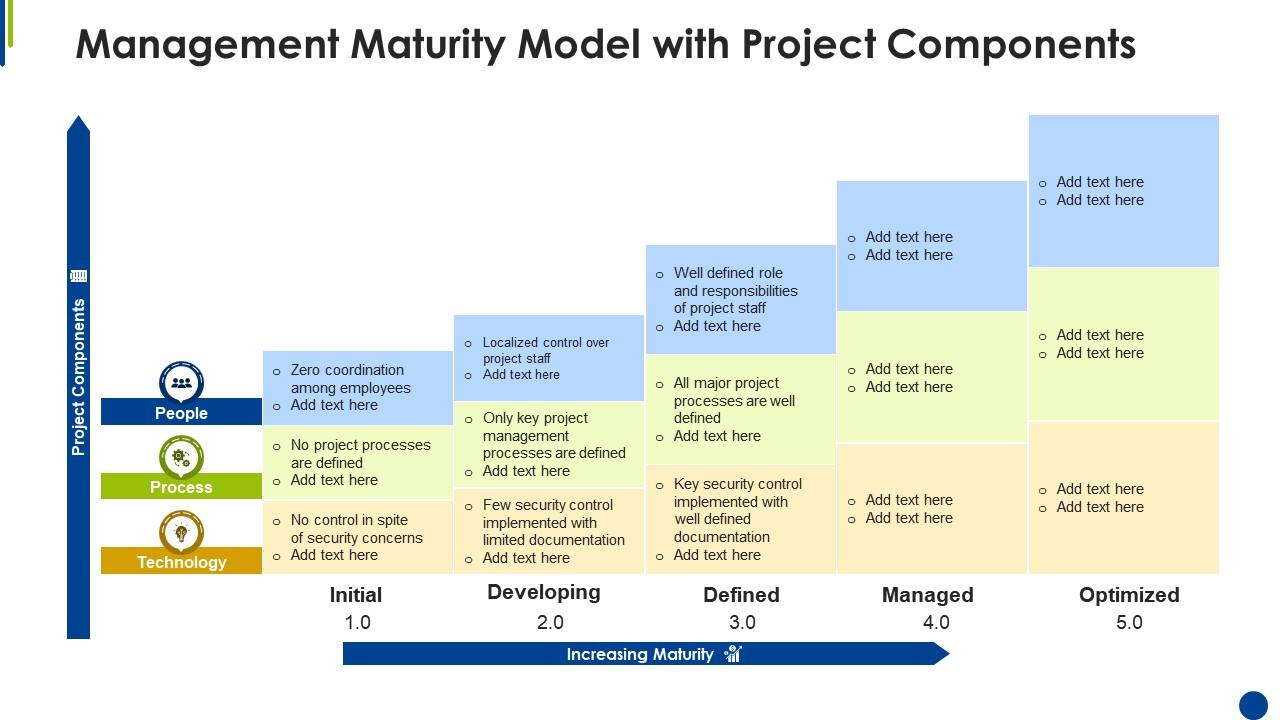
Management maturity model with project components

Rating:
90%
Management maturity model with project components
Slide 1 of 9
Favourites Favourites

Try Before you Buy Download Free Sample Product

Audience Impress Your
Audience
Editable 100%
Editable
Time Save Hours
of Time
The Biggest Sale is ending soon in
0
0
:
0
0
:
0
0
Rating:
90%
Introducing our Management Maturity Model With Project Components set of slides. The topics discussed in these slides are Initial, Developing, Defined, Managed, Optimized. This is an immediately available PowerPoint presentation that can be conveniently customized. Download it and convince your audience.

FAQs for Management maturity model

Management maturity models typically include five progressive stages: initial/chaotic, repeatable, defined, managed, and optimizing, each representing increasingly sophisticated organizational capabilities and systematic approaches. These stages differ through evolving process standardization, measurement sophistication, and strategic integration, with organizations moving from reactive firefighting to proactive optimization, ultimately delivering enhanced operational efficiency, predictable outcomes, and sustainable competitive advantage across all business functions.

Organizations assess management maturity through comprehensive evaluations including process documentation reviews, leadership capability assessments, performance metrics analysis, stakeholder feedback collection, and benchmark comparisons against industry standards. These assessment methods enable companies to identify gaps in strategic planning, operational efficiency, and organizational development, with many finding that structured maturity evaluations ultimately deliver clearer improvement roadmaps and competitive positioning insights.

Benefits include improved decision-making processes, enhanced operational efficiency, better resource allocation, standardized workflows, and measurable performance indicators. Through systematic maturity assessments, organizations streamline project management, reduce operational risks, and accelerate strategic initiatives, with many enterprises finding that structured maturity frameworks ultimately deliver competitive advantage and sustainable growth.

Management maturity models align with strategic planning by providing structured frameworks for assessing current capabilities, identifying improvement gaps, and establishing development roadmaps across organizational functions. These models enable companies to prioritize resource allocation, measure progress systematically, and ensure strategic initiatives are supported by adequate operational maturity, ultimately delivering enhanced execution consistency and competitive advantage.

A management maturity model improves decision-making by establishing standardized processes, creating clear governance frameworks, defining accountability structures, and implementing data-driven evaluation criteria. Through systematic assessment capabilities, organizations streamline approval workflows, enhance risk management protocols, and accelerate strategic responses, with many finding that structured maturity frameworks ultimately deliver more consistent outcomes and competitive advantage.

Management effectiveness metrics include performance KPIs, employee engagement scores, decision-making speed, process efficiency rates, and strategic goal achievement percentages. These indicators evolve from basic operational metrics in early stages to sophisticated predictive analytics and cross-functional integration measures at advanced levels, with many organizations finding that balanced scorecards and 360-degree feedback systems deliver comprehensive insights.

Businesses can effectively implement maturity model insights by establishing dedicated transformation teams, creating phased improvement roadmaps, and aligning changes with strategic objectives through systematic gap analysis and resource allocation. Through structured change management approaches, organizations in manufacturing, healthcare, and financial services streamline operations, enhance decision-making capabilities, and accelerate process optimization, ultimately delivering measurable performance improvements and sustainable competitive advantage.

Leadership drives organizational advancement through management maturity stages by establishing clear vision, fostering cultural transformation, and systematically implementing process improvements across departments. Effective leaders champion change initiatives, allocate strategic resources for capability development, and model behaviors that support higher maturity levels, with many organizations finding that executive commitment ultimately determines the success and sustainability of their maturity transformation efforts.

Management maturity models can be tailored by adjusting assessment criteria, success metrics, and implementation timelines to match specific industry regulations, operational complexities, and organizational scales. While larger enterprises might focus on comprehensive governance frameworks, smaller businesses can emphasize streamlined processes and agile methodologies, with sectors like healthcare prioritizing compliance-driven maturity while technology companies focus on innovation-speed metrics, ultimately delivering scalable improvement pathways.

Organizations often encounter resistance to change, insufficient leadership commitment, resource constraints, and skill gaps when advancing through management maturity levels. These challenges can slow transformation, especially in large enterprises where entrenched processes and cultural barriers persist, with many companies finding that dedicated change management and phased implementation approaches help overcome these obstacles while maintaining operational continuity.

Organizations should re-evaluate their management maturity annually, with quarterly pulse checks on key performance indicators, progress metrics, and evolving business requirements. This strategic approach enables companies to identify improvement opportunities, adapt to market changes, and maintain competitive advantage, with many successful enterprises finding that regular assessments drive sustained organizational growth and operational excellence.

Tools that complement management maturity models include balanced scorecards, performance dashboards, 360-degree feedback systems, key performance indicators (KPIs), and benchmarking frameworks. These assessment tools work together by providing real-time data visibility, comprehensive stakeholder feedback, and competitive positioning insights, with many organizations finding that this strategic combination delivers more accurate performance evaluations and accelerated organizational development.

Employee engagement strengthens significantly as management maturity advances, with mature managers demonstrating better communication skills, clearer goal-setting abilities, and more effective feedback mechanisms. Organizations with higher management maturity typically see 25-40% better engagement scores, as employees experience greater autonomy, professional development opportunities, and transparent decision-making processes, ultimately delivering improved retention and productivity.

Management maturity model principles effectively apply to non-profits and startups by providing structured frameworks for organizational development, process improvement, and strategic planning. These organizations benefit from maturity assessments to identify growth opportunities, streamline operations, and enhance donor relations or investor confidence, with many finding that systematic progression through maturity levels delivers improved accountability, operational efficiency, and sustainable scaling capabilities.

Several organizations across industries have successfully implemented management maturity models, including NASA's use of CMM for software development projects, General Electric's adoption of process maturity frameworks for operational excellence, and Siemens' implementation for project management standardization. These case studies demonstrate how structured maturity assessments enable companies to identify capability gaps, streamline operations, and achieve measurable improvements in delivery timelines, quality outcomes, and cost efficiency.

Ratings and Reviews

90% of 100
Review Form
Write a review
Most Relevant Reviews
  1. 80%

    by Dorian Armstrong

    Design layout is very impressive.
  2. 80%

    by Cordell Jordan

    Great designs, Easily Editable.
  3. 100%

    by Daron Guzman

    Professional and unique presentations.
  4. 100%

    by Danny Kennedy

    Excellent work done on template design and graphics.

4 Item(s)

per page: