


Risk management erm maturity model




Try Before you Buy Download Free Sample Product
 Impress Your
 Audience
 100%
100% Editable
 Save Hours
 of Time


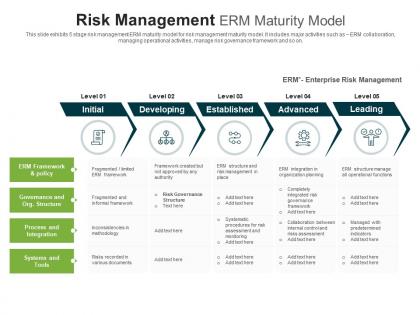
This slide exhibits 5 stage risk management ERM maturity model for risk management maturity model. It includes major activities such as ERM collaboration, managing operational activities, manage risk governance framework and so on.
People who downloaded this PowerPoint presentation also viewed the following :
Risk management erm maturity model with all 2 slides:
Use our Risk Management Erm Maturity Model to effectively help you save your valuable time. They are readymade to fit into any presentation structure.
FAQs for Risk management
So basically you need four things: figuring out what could go wrong, deciding how bad each thing would be, making plans to deal with it, and checking on everything regularly. Map out all the risks - yeah, even the weird ones that probably won't happen. Then rank them by how likely they are and how much damage they'd do. I know it feels super paranoid but trust me on this one! After that, create response plans and make sure someone actually owns each risk. Oh, and set up regular reviews because people love to write this stuff down once and never look at it again.
Honestly, don't wait until you've got your whole strategy mapped out to think about risks - that's backwards. During those early planning sessions, list out everything that could tank your goals. Market changes, new regulations, internal drama, you name it. Build your backup plans right into the strategy itself. I can't tell you how many companies I've watched scramble because they treated risk planning like an annoying box to check later. Set up those quarterly reviews too - things change fast and you don't want surprises biting you six months down the road.
Look, data analytics is basically your early warning system - it catches patterns you'd miss otherwise. Historical data shows where problems usually happen. Real-time monitoring flags issues as they're developing. Predictive models? They estimate how bad things could get. Honestly, the hardest part isn't the analysis - it's filtering out all the noise. You'll drown in alerts if you're not careful. I'd start small: pick your top 3 risk indicators and automate just those. Once you've got dashboards that actually work (not just pretty charts), you can expand. It's wild how much clarity you get once the numbers start talking.
Oh man, this is so real. Different cultures totally see risk differently - like what freaks out one team might be no big deal to another. I've watched this blow up global projects because everyone thinks they're being logical, you know? Some cultures want every detail mapped out first. Others? They're fine winging it and adjusting as they go. You can't just use the same approach for everyone - it'll backfire. Figure out who needs spreadsheets and data versus who just wants you to tell them "we've got this handled." Honestly saved me so much headache once I started doing this.
Honestly, the worst mistake is getting cocky about your first take on things. People miss those sneaky connected risks while obsessing over the obvious stuff. And don't even get me started on everyone rating everything "medium risk" - like, what's the point? Get other people's opinions when you're sizing things up. Question your own logic regularly. Set reminders to actually revisit this stuff because we all forget. Oh, and write down WHY you rated something high or low risk. Trust me, you'll thank yourself later when you can't remember what you were thinking. Way better than just winging it based on feelings.
Look, don't overthink this - just figure out your top 3-5 risks that could actually tank your business. Most small biz owners get way too in the weeds here. Cash flow issues, losing a key person, getting hacked - those are your real threats, not some crazy scenario you dreamed up. Throw together a basic risk matrix in Google Sheets (why pay for fancy software?). Get insurance sorted, back up your important stuff, and write down how you do critical tasks so you're not totally screwed when someone quits. I'd tackle one risk per quarter instead of trying to fix everything at once. Way less overwhelming that way.
Think of risk management like having a backup plan for your backup plan. You're basically trying to catch problems before they blow up your whole project - stuff like scope creep, going over budget, or team members bailing. I always make a list of my worst-case scenarios first (sounds dramatic but it works). Then figure out what you'd actually DO if each one happened. Trust me, it beats that horrible feeling when everything's on fire and you're just winging it. Way better to spend 20 minutes now than 20 hours later fixing a mess.
Dude, these technologies are actually insane for catching risks. AI can crunch through tons of data and spot problems before they blow up in your face. Meanwhile blockchain gives you this bulletproof paper trail - like, good luck trying to mess with that data. You can set up systems that basically watch your compliance stuff automatically and ping you when something's off. Smart contracts are pretty neat too since they'll trigger safety measures without you having to babysit everything. Honestly though, I'd start by figuring out where you're most vulnerable first, then see what tech makes sense.
So the main ones you'll bump into are ISO 31000, COSO's Enterprise Risk Management, and NIST's Risk Management Framework. ISO 31000 works pretty much everywhere - super flexible across different industries. COSO owns the finance and corporate world. NIST is all over cybersecurity risk, though fair warning, you can get totally lost in their documentation if you're not focused. There's also industry stuff like Basel III for banks or FAIR for cyber risk numbers. Honestly? Just start with ISO 31000 if you're building from zero - it's the easiest way in.
Yeah, so risk management totally depends on your industry. Healthcare's all about patient safety and HIPAA stuff - plus avoiding those crazy malpractice lawsuits. Finance is probably the most complicated though, dealing with market swings and credit issues. Manufacturing's got supply chain problems and keeping workers safe. The thing is, every industry has different regulatory bodies breathing down their necks. You'll need specific tools that actually match what you're up against. Like, the basic ideas are the same everywhere, but a hospital's risks are nothing like a factory's, you know?
Honestly, it's all about knowing your audience. Executives just want the big picture - show them numbers and bottom-line impact. Your project team though? They need the nitty-gritty details about what to actually do. Skip the corporate speak and lead with what matters to them - how's this gonna mess with their goals? Heat maps are clutch for showing risk levels (beats those awful spreadsheets everyone ignores). Don't pretend you've got everything figured out - be upfront about what you don't know. And here's the thing that really matters: bring solutions, not just problems. Nobody wants someone dropping disasters on their desk then disappearing.
Look, regulations are basically your baseline - like SOX for financial stuff or GDPR for data privacy. They force you to have minimum controls in place, which honestly can feel restrictive sometimes. But here's the thing: you get a solid foundation out of it. Banks deal with Basel III requirements, for example - super detailed stuff. Your risk framework has to align with whatever rules apply to your industry, and that means documenting everything, setting thresholds, regular reporting to regulators. It's not optional anymore. I'd start by checking your current risks against what regulations actually require. You'll probably find some gaps.
Track both leading and lagging indicators - trust me on this. Number of risks identified vs mitigated is huge. Incident frequency matters more than you'd think, plus how fast you detect and respond. Compare what you're spending on mitigation to actual risk event costs (always eye-opening). Risk assessment accuracy is probably the most humbling metric - basically how often you actually get your predictions right. Employee awareness surveys and training completion rates help too. Honestly though? Pick 3-5 metrics that actually matter to your business first. Don't try measuring everything right out the gate.
Risk management has to be part of daily chats, not buried in some manual nobody reads. Train your people to speak up about problems without getting blamed - honestly, nothing shuts down good communication faster than pointing fingers. Regular team meetings should include talking about close calls and what went wrong. Leadership needs to actually do this too, not just preach it. Give them tools they'll actually use (skip the crazy spreadsheets). Oh, and here's the big one - reward people when they flag issues early instead of staying quiet. You want them coming to you before stuff hits the fan.
So you know how some business disasters you just can't avoid? Insurance basically covers those big financial hits that would otherwise wreck your cash flow. First figure out what risks you're dealing with - property damage, lawsuits, cyber stuff, whatever. Then decide what you can handle yourself versus what would totally screw you over. That's what gets insured. Don't just buy whatever package your broker's selling though, that's how you end up overpaying for stuff you don't need. Your risks change as you grow too, so review everything yearly.
-
Good research work and creative work done on every template.
-
Thanks for all your great templates they have saved me lots of time and accelerate my presentations. Great product, keep them up!
-
Unique research projects to present in meeting.
-
Designs have enough space to add content.
-
Out of the box and creative design.