


Risk Management Maturity Model





Try Before you Buy Download Free Sample Product
 Impress Your
 Audience
 100%
100% Editable
 Save Hours
 of Time


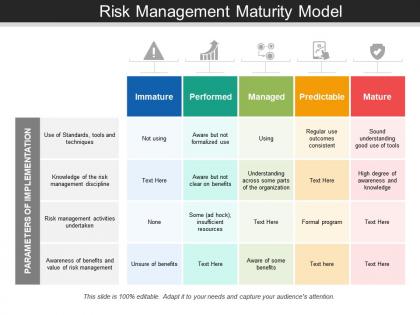
Download our risk management maturity model PowerPoint templates that will help you in the analysis, evaluation, and prioritization of business hazard. This tabular shaped risk management maturity framework PPT template slide has been designed by a team of professional PowerPoint and presentation designers while keeping consumer needs in mind. Icons of errors, a bar graph with an upward arrow, management, mobile with a hand, and winning have been used to craft this threat management maturity model presentation template design. The risk management template slide design reflects various phases such as immature, performed, managed, predictable, and mature. You can deploy the slide design to showcase the parameters of an implementation of risks which are use standard tools, knowledge of risk management discipline, risk management activities undertaken, and awareness of benefits and value. Apply this maturity model template slide in your presentation to depict the concept of business threats, risk assessment, project management, risk analysis, root and causes, and business management. Impress your audience with this editable risk assessment maturity model PPT template slide. Deliver an incisive argument with our Risk Management Maturity Model. Dispel any false impressions created.
People who downloaded this PowerPoint presentation also viewed the following :
Risk Management Maturity Model with all 5 slides:
Our Risk Management Maturity Model are highly informative. Familiarize yourself with any aspect you desire.





FAQs for Risk
So you'll want to cover four main things: figuring out what could go wrong, assessing those risks, planning how to handle them, and keeping an eye on everything over time. Map out potential problems first, then rank them by how likely they are and how much damage they'd cause. Yeah, it's kind of depressing to think about everything that might fail, but trust me it's worth it. Focus on your biggest risks and create actual action plans - both for preventing stuff and responding when things hit the fan. Oh, and don't just set it and forget it. Risks shift constantly, so review regularly. Start with your top 5 to avoid overwhelm.
So risk assessment is like being a detective - you're figuring out what could go wrong and how likely each thing is to actually happen. Management is where you take action on all that stuff you found. I always think of assessment as diagnosing the problem, then management is treating it. You're asking questions like "where are we vulnerable?" and "how screwed would we be if this happened?" But here's the thing - assessment by itself is kinda pointless if you don't act on it. Management creates your actual plan for dealing with risks. You'll decide whether to avoid them, just accept the risk, transfer it somehow, or try to reduce it. Start with good assessment first, then build from there.
Look, communication really is everything when it comes to managing risks. You've got to have clear ways for people to flag problems and escalate them up the ladder. Regular team meetings help a ton - plus simple templates that people will actually fill out instead of ignoring. Honestly, most risk disasters I've seen happen because someone knew about an issue but didn't know who to tell or how to document it properly. When communication breaks down, that's usually when everything hits the fan. Just make sure everyone knows the process and you'll catch problems before they spiral.
Qualitative risk analysis is when you rank stuff as "high," "medium," or "low risk" - basically those color-coded charts everyone loves. Way faster to do. Quantitative puts real numbers on everything: actual percentages, dollar figures, timelines. Takes forever but you get solid data to work with. I'd honestly do qualitative first to figure out what's worth worrying about, then get into the number-crunching for your biggest risks. You'll waste less time that way. Quantitative's what you need when you're trying to justify budget decisions to your boss though.
Honestly, the worst thing you can do is treat it like a one-and-done thing. People set up their risk assessments then never touch them again - huge mistake. You've gotta do quarterly reviews and actually follow through. Also, don't think too narrowly about what could go wrong. The stuff that bites you usually comes from left field. Get your frontline people involved early too, not just the executives in their ivory towers. They know where the real problems are. Oh, and those small risks everyone ignores? They pile up fast. I've seen tiny issues turn into complete disasters.
Look, organizational culture totally shapes how people view risk and whether they'll actually call out issues. Tech companies with that "move fast and break things" vibe? They're gonna have way higher risk tolerance and push aggressive strategies. Banking though - completely different story. Those places demand crazy detailed controls and play it super safe, which yeah, slows everything down but keeps them from getting hammered by regulators. The real trick is matching your risk approach to what your culture can actually handle, not just whatever sounds impressive in meetings.
Honestly? It depends on your company size and budget. ServiceNow GRC, MetricStream, or LogicGate are solid if you've got money to spend. But here's the thing - a good Excel sheet in SharePoint can be just as effective for smaller teams (I know, I know, sounds boring but it works). Some people swear by Monday.com or Asana with custom risk fields too. Don't get caught up picking the "perfect" tool though. Better to start with something simple that everyone will actually use. You can always upgrade later when you outgrow it.
Look, the math here is actually pretty straightforward - take each risk's probability and multiply by what it'd cost you. So that 20% chance of a $500k data breach? That's $100k in expected value. I'd start with your biggest 5 risks and slap dollar amounts on them, even if they're rough guesses. Way better than just winging it. Don't forget the sneaky costs either - yeah, there's the obvious stuff like fines, but then you've got angry customers jumping ship too. Oh, and definitely run some best/worst case scenarios. The basic expected value calc is solid but it doesn't tell the whole story.
So basically, a risk owner is the one person who's totally responsible for handling a specific risk. They don't just watch it - they actually create the response plan and make all the big decisions about how to deal with it. If something goes wrong, it's their head on the chopping block. Without someone clearly owning each risk, it just becomes this vague thing that everyone assumes someone else is handling (spoiler: nobody is). You need someone who actually thinks about that risk regularly and - this is key - has real power to act on it. Oh, and make sure they've got the budget and resources to actually fix problems when they pop up.
Honestly, regulatory changes are such a pain - they basically make you redo your whole risk setup. Finance gets hit hard with new banking rules that mess with capital requirements. Healthcare's always scrambling with patient data and drug safety updates. Manufacturing? Environmental regs can literally shut you down if you're caught off guard. What's annoying is how these rules ripple across industries - like GDPR affecting anyone dealing with EU data. My advice? Set up some kind of monitoring system early and build your processes to be flexible. You'll thank yourself later when the next wave hits.
Skip the boring theory stuff - nobody remembers that anyway. What actually works is getting people to practice with real scenarios they'd face at work. Set up workshops where they can role-play situations and figure out risks in their own departments. Online modules are okay for covering basics, but honestly most people just click through them. Case studies spark way better discussions. Oh, and don't do that once-a-year training thing - quarterly refreshers keep it fresh. Start by figuring out what risks each role actually deals with, then build your scenarios around those specific situations. Makes it way more relevant.
Honestly, AI is pretty crazy good at catching stuff you'd totally miss. It'll spot weird patterns in your data and basically predict problems before they happen. Machine learning can chew through tons of information instantly - like scenarios that would take your team forever to run manually. The monitoring never sleeps either, which is huge since it won't get distracted or overlook those tiny warning signs we humans miss. I'd say start with just one area where you've got solid historical data though. Don't go crazy trying to automate everything at once.
Honestly, your stakeholders are gonna catch stuff you'd never see from the inside. Customers will point out operational issues. Suppliers know where your supply chain's weak spots are. And employees? They're goldmines for this - they see the daily disasters up close. Different perspectives = way better risk picture overall. The trick is setting up regular check-ins focused on risk stuff (not just generic feedback sessions). Ask good questions and actually listen to what they're saying. I mean, they're the ones dealing with these problems anyway, so they're usually pretty eager to help you figure it out.
So you've got three options when you can't just get rid of a risk entirely. You can mitigate it - basically put controls in place to lower the chances or reduce damage. Transfer it to someone else through insurance or hiring specialists who know that stuff better than you do. Or honestly? Sometimes you just accept it, especially if fixing it would cost more than the actual risk. That's super common btw. Whatever you pick, write down why you chose that route and keep checking on it since things change. Figure out what makes sense money-wise and strategy-wise for your situation first though.
Get on this fast - within 24-48 hours while everyone still remembers what went down. Pull in all the stakeholders, not just whoever got hit directly. Timeline's crucial, plus figure out what actually broke in your controls. Don't let it turn into a blame game though, people just clam up when that happens. Write everything down, including what you did right (trust me on this one). The real win is updating your risk stuff based on what you learned. Oh, and assign owners with real deadlines for each action item, otherwise it'll just sit there forever.
No Reviews