

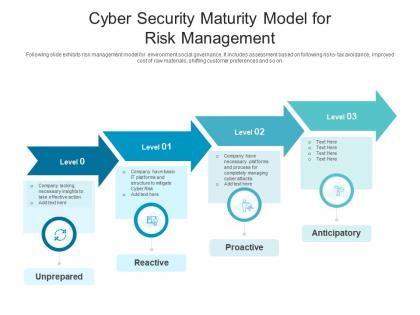
Cyber security maturity model for risk management




Try Before you Buy Download Free Sample Product
 Impress Your
 Audience
 100%
100% Editable
 Save Hours
 of Time


Our Cyber Security Maturity Model For Risk Management are topically designed to provide an attractive backdrop to any subject. Use them to look like a presentation pro.
People who downloaded this PowerPoint presentation also viewed the following :
Cyber security maturity model for risk management with all 2 slides:
Use our Cyber Security Maturity Model For Risk Management to effectively help you save your valuable time. They are readymade to fit into any presentation structure.

FAQs for Cyber security maturity model
Key components of a Cybersecurity Maturity Model include risk assessment frameworks, access controls, incident response protocols, security governance structures, and continuous monitoring systems. These components work together by establishing baseline security measures, defining progressive improvement pathways, and enabling systematic vulnerability management, with many organizations finding that structured maturity models deliver enhanced threat detection and regulatory compliance.
Organizations can assess their cybersecurity maturity level through comprehensive security audits, vulnerability assessments, compliance evaluations, gap analyses, and risk assessments against established frameworks like NIST or ISO 27001. Many financial services, healthcare, and manufacturing companies find that combining internal assessments with third-party evaluations delivers accurate baseline measurements, enabling strategic security investments and competitive advantage.
Typical cybersecurity maturity models include Initial (ad-hoc security measures), Developing (basic policies established), Defined (standardized processes implemented), Managed (metrics-driven security operations), and Optimized (continuous improvement integrated). These progressive stages enable organizations to systematically enhance their security posture by establishing governance frameworks, implementing consistent protocols, and measuring effectiveness, with many enterprises finding that structured advancement significantly reduces vulnerabilities while improving incident response capabilities.
A Cybersecurity Maturity Model enhances risk management by providing structured assessment frameworks, standardized evaluation criteria, and progressive improvement pathways that enable organizations to identify vulnerabilities systematically. Through these models, companies can prioritize security investments, streamline compliance processes, and benchmark against industry standards, with many financial services and healthcare organizations finding that maturity-based approaches ultimately deliver measurable risk reduction and operational efficiency.
Common cybersecurity maturity metrics include incident response time, vulnerability remediation rates, security awareness training completion, compliance audit scores, and threat detection accuracy. These measurements enable organizations to benchmark their security posture against industry standards, identify gaps in their defense strategies, and demonstrate measurable improvements in risk reduction and operational resilience to stakeholders.
Organizations use the CMM to systematically assess current security capabilities, identify gaps, and create structured roadmaps for improvement through defined maturity levels. By benchmarking against standardized frameworks, companies in healthcare, finance, and manufacturing can prioritize investments, allocate resources strategically, and demonstrate compliance readiness, ultimately delivering enhanced threat resilience and competitive advantage.
Employee training serves as a foundational pillar in the Cybersecurity Maturity Model, encompassing awareness programs, phishing simulation exercises, incident response protocols, and ongoing security education initiatives. These comprehensive training approaches enhance organizational resilience by reducing human error risks, strengthening security culture, and enabling faster threat detection, with many enterprises finding that well-trained employees become their strongest defense layer.
Industry standards like NIST provide structured frameworks, assessment criteria, risk management protocols, and compliance benchmarks that organizations use to evaluate their cybersecurity posture. These frameworks enable companies across sectors like healthcare, financial services, and manufacturing to systematically identify vulnerabilities, prioritize improvements, and demonstrate regulatory compliance, ultimately delivering enhanced security resilience and competitive advantage.
Cybersecurity maturity models differ in scope, structure, and focus areas, with NIST emphasizing risk management frameworks, CMMC targeting defense contractors with certification requirements, ISO 27001 providing international standards, and C2M2 focusing on critical infrastructure sectors. These models vary in their assessment methodologies, compliance mandates, and industry applications, with organizations increasingly selecting frameworks that align with their regulatory requirements and operational contexts, ultimately delivering tailored security improvements and competitive advantages.
Smaller organizations can implement a CMM effectively by starting with basic security fundamentals, prioritizing high-impact controls within budget constraints, and leveraging cloud-based security solutions that scale affordably. Through phased implementation and strategic partnerships with managed security providers, these organizations streamline compliance requirements while building robust defenses, ultimately achieving enterprise-level security maturity without overwhelming resource demands.
Advancing to higher cybersecurity maturity levels presents challenges including resource constraints, skill gaps, legacy system integration, cultural resistance, and complex compliance requirements. Organizations often find that while upgrading security infrastructure and training staff requires significant investment, the strategic combination of technology and process improvements ultimately delivers enhanced threat protection, operational efficiency, and competitive advantage in an increasingly digital landscape.
A Cybersecurity Maturity Model streamlines regulatory compliance by establishing structured frameworks that align security practices with requirements like GDPR, HIPAA, and SOX. These models enable organizations to systematically assess gaps, implement necessary controls, and maintain continuous monitoring, with many financial services and healthcare institutions finding that higher maturity levels significantly reduce audit complexities while enhancing regulatory transparency.
Organizations that regularly revisit their cybersecurity maturity model gain enhanced threat detection, improved compliance alignment, optimized resource allocation, and stronger incident response capabilities. This strategic practice enables businesses to adapt to evolving cyber threats, identify security gaps before they become vulnerabilities, and maintain competitive advantage through proactive defense strategies, ultimately delivering reduced risk exposure and increased operational resilience.
Maturity assessments identify cybersecurity improvement areas by evaluating current practices against established benchmarks, analyzing gaps in policies, processes, and technologies, and mapping vulnerabilities across organizational layers. Through systematic evaluation frameworks, organizations pinpoint weaknesses in threat detection, incident response, and compliance readiness, while establishing clear roadmaps for enhancement, ultimately enabling strategic resource allocation and measurable security advancement.
Successful cybersecurity maturity model implementations include the U.S. Department of Defense's CMMC framework across defense contractors, financial institutions adopting NIST frameworks for regulatory compliance, and healthcare organizations implementing tiered security assessments. These strategic approaches streamline risk management, enhance operational resilience, and deliver measurable security improvements, with many organizations finding significant reductions in breach incidents and faster compliance achievements.
-
Editable templates with innovative design and color combination.
-
Top Quality presentations that are easily editable.
-
Easily Understandable slides.
-
Excellent work done on template design and graphics.
-
Great designs, really helpful.