


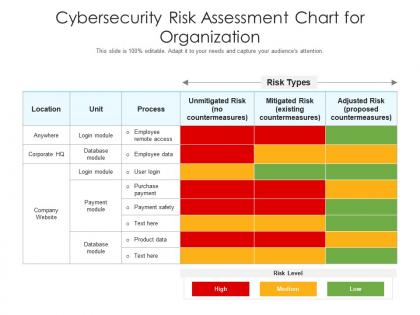
Cybersecurity risk assessment chart for organization




Try Before you Buy Download Free Sample Product
 Impress Your
 Audience
 100%
100% Editable
 Save Hours
 of Time


Our Cybersecurity Risk Assessment Chart For Organization are topically designed to provide an attractive backdrop to any subject. Use them to look like a presentation pro.
People who downloaded this PowerPoint presentation also viewed the following :
Cybersecurity risk assessment chart for organization with all 2 slides:
Use our Cybersecurity Risk Assessment Chart For Organization to effectively help you save your valuable time. They are readymade to fit into any presentation structure.
FAQs for Cybersecurity risk assessment
Okay so break it down into five chunks: what assets you're protecting, who might come after you, where your weak spots are, how bad things could get, and how likely each scenario is. Honestly, the vulnerability part trips up everyone I know - there's just so much to look at. Start with your critical systems and work from there. After that, you basically multiply impact times probability to figure out your biggest risks. Oh and definitely document everything and make sure someone actually owns each high-priority issue, otherwise nothing gets fixed.
Honestly, just figure out what would actually screw you over if it went down. Talk to your department heads - they'll tell you stuff IT never thinks about. I'd group things by "oh shit" level: what kills the business immediately vs what's just a headache. Those connections between systems will bite you though. Like that random database nobody thinks about that feeds your main customer site? Yeah, that matters. Write it all down with who owns what. The trick is thinking about real business impact, not just the fancy tech stuff that sounds important.
Think of threat modeling as figuring out how bad guys might mess with your stuff. You map out attack vectors and entry points - like playing detective but backwards. Can't calculate real risks if you don't know what threats exist first, right? I usually start with the crown jewels (your most critical assets) and imagine how someone would try to get at them. It's weirdly entertaining once you get in the hacker mindset. Some people hate this part but honestly? Way better than finding out the hard way what you missed.
Honestly, I'd build a simple high/medium/low system based on two things: how easy it is to exploit and how badly it'd mess you up. Network infrastructure stuff comes first - anything that could crash systems or leak customer data is automatic priority. CVSS scores help but they're not perfect since they don't know your setup. Also check if there's actual exploit code floating around online (makes it way more dangerous). The whole "likelihood vs impact" matrix thing works pretty well once you get the hang of it. Start with your high-risk stuff and work down from there.
So there's three big ones you'll run into: NIST Cybersecurity Framework, ISO 27005, and OCTAVE. NIST is probably your best bet starting out - it's free and the docs are actually decent. ISO 27005 gets more formal, works great if your company's already doing other ISO stuff. OCTAVE's kinda cool because it focuses more on operations than just tech. Honestly though? Most places I've seen just grab bits from different frameworks instead of sticking to one. My coworker swears by mixing NIST with some OCTAVE elements. Start with NIST for sure - way better examples than the others.
Honestly, regulations just set your bare minimum - you've gotta hit those security controls no matter what. Start by figuring out which ones even apply to you (SOX, HIPAA, PCI DSS, whatever). Then map your risk findings against those frameworks. It's kinda frustrating because being compliant doesn't mean you're actually secure, but hey, at least it gives you clear priorities. You'll probably spend way more time on the data and systems regulators obsess over. My advice? Don't even begin your risk assessment until you know which regulations you're stuck with - that shapes everything else.
Honestly, start with OpenVAS since it's free - perfect for testing the waters. Nessus is solid too if you've got budget for vulnerability scanning. Asset discovery? Lansweeper's pretty decent for mapping what you actually own (which is harder than it sounds, trust me). For bigger picture stuff, Risklens and ServiceNow handle organization-wide risk tracking well. But real talk - don't overlook basic spreadsheets. They're often way more practical than expensive platforms when you're figuring things out. Build up your program first, then throw money at fancy tools later.
Honestly? Once a year isn't cutting it anymore. Most places I've seen do quarterly assessments now - threats move way too fast these days. Major changes are another trigger: new systems, big vulnerabilities, or after you've been hit. My old team used to scramble every time something happened because we treated it like a checkbox thing instead of building it into our regular routine. If you're handling sensitive stuff or in a regulated space, definitely go quarterly. But really, just pick a schedule and stick to it. Oh, and schedule your next one right now before you forget!
Honestly, the biggest mistake is treating it like a one-and-done thing. Map out your critical assets first - that's your starting point. Then loop in people from different departments because they actually know what systems matter. Don't just obsess over external hackers either. Insider threats and plain old human screwups cause way more damage than people realize. Oh, and teams always think "rare" events won't happen to them... until they do. Keep updating it as your tech changes too. I've seen companies skip the human element completely and wonder why they missed half their vulnerabilities.
Look at what's actually happening in your industry first - that's where you'll find the real threats. Healthcare? Patient data breaches are your nightmare, plus HIPAA breathing down your neck. Financial companies deal with fraud and PCI compliance instead. Manufacturing is completely different - think hackers messing with your actual equipment and shutting down operations. Map out the attack vectors that hit businesses like yours recently. NIST's framework works well as a starting point, but honestly, you've got to tweak it for what matters to your specific situation. I'd dig into some recent breach reports from your sector - they're pretty eye-opening about what you're actually facing.
Get upper management involved right from day one - don't just loop them in at the end. They need to set your risk priorities and appetite upfront since they're stuck with whatever business decisions come from your assessment. Have them help define which assets actually matter for operations and sign off on your scope. This isn't some IT checkbox exercise, it's business strategy stuff. Oh, and get their commitment on resources and timelines early. Trust me, you don't want to be begging for remediation budget later when everything's already mapped out.
Look at your incident reduction rates first - that's the obvious one. Time to detect threats matters too. But honestly? The real test is catching stuff before it becomes a disaster. Track if your risk ratings actually match what happens when things go sideways. Coverage is huge - you gotta assess all your critical assets regularly, not just the easy ones. I'd also check if you're identifying risks that turn into actual problems later. Set some baselines now, then review every few months. Otherwise you're just making pretty reports that don't actually protect anything.
Dude, training your people is absolutely critical for risk assessments. Untrained employees just shrug when you ask about vulnerabilities - they literally don't know what they don't know. But when they've got basic security awareness? Suddenly you're getting actual useful intel instead of blank stares. They'll catch sketchy stuff happening that your fancy tools completely miss. I've watched assessments transform from useless paperwork exercises to genuinely valuable once teams knew what to look for. Without training though, your staff becomes this massive blind spot you can't even see. Do some basic awareness training before your next assessment - honestly, the difference is night and day.
Write everything up in a clean report that connects risks to actual business problems. Include specific fixes with deadlines. Use consistent scoring and ditch the tech speak - executives don't want to decode that mess when they're worried about getting breached. Board members only care about business risk and money, so give them executive summaries. Your IT folks need the detailed technical stuff though. Honestly, the hardest part is getting everyone to actually act on your recommendations afterward. Different audiences need totally different messages. Follow up religiously or nothing'll happen.
Honestly, don't treat risk assessments like some yearly chore you check off and forget about. Build them into the big stuff - new systems, vendor picks, policy changes, anything that shifts your security landscape. I've watched too many companies do one huge assessment then ignore it completely (classic mistake). Break it down instead. Run smaller assessments for different areas throughout the year. Actually use what you find for budgeting and staffing decisions. Train your people to naturally think about risk daily rather than dreading formal assessments.
-
Use of icon with content is very relateable, informative and appealing.