

Cyber security risk management plan framework




Try Before you Buy Download Free Sample Product
 Impress Your
 Audience
 100%
100% Editable
 Save Hours
 of Time


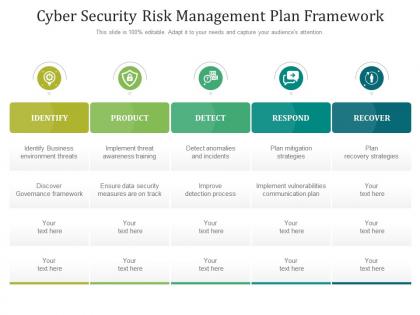
The Risk Management Framework (RMF) of the Department of Defense (DoD) establishes rules for identifying and managing cybersecurity threats. Categorize, choose, implement, analyse, approve, and monitor are the six important processes in RMF's cyber risk management strategy. The Factor Analysis of Information Risk (FAIR) methodology was created to assist businesses in measuring, analysing, and comprehending information hazards. The purpose is to guide businesses through the process of developing cybersecurity best practises by assisting them in making well-informed decisions. he cyber security risk management plan framework is an important tool for any business. By understanding the different components of the framework, you can create a plan that will help protect your company from online threats. SlideTeam’s cyber security PowerPoint templates can provide you with all the tools you need to get started. Download them now and be on your way to creating a foolproof risk management plan for your business.
People who downloaded this PowerPoint presentation also viewed the following :
Cyber security risk management plan framework with all 2 slides:
Use our Cyber Security Risk Management Plan Framework to effectively help you save your valuable time. They are readymade to fit into any presentation structure.

FAQs for Cyber security risk
Core cybersecurity framework components include risk assessment protocols, access control systems, incident response procedures, continuous monitoring tools, and recovery planning mechanisms. These elements work together by identifying vulnerabilities, restricting unauthorized access, and enabling rapid threat response, with many organizations finding that this integrated approach significantly reduces security breaches while maintaining operational efficiency.
Organizations can assess their cybersecurity posture using frameworks through comprehensive audits, risk assessments, vulnerability scans, compliance evaluations, and gap analyses against established standards. These systematic approaches enable companies to identify security weaknesses, prioritize remediation efforts, and benchmark against industry best practices, with many financial institutions and healthcare organizations finding that regular framework-based assessments significantly enhance their defensive capabilities and regulatory compliance.
Standards and regulations provide foundational guidelines, compliance requirements, legal obligations, and industry benchmarks that shape cybersecurity framework development. These frameworks enable organizations to systematically address security risks, ensure regulatory compliance, and maintain stakeholder trust, with sectors like healthcare, finance, and government finding that adherence ultimately delivers operational resilience and competitive advantage.
A Cybersecurity Framework enhances risk management by providing structured methodologies for identifying vulnerabilities, assessing threats, and implementing protective controls across organizational systems. Through standardized approaches like NIST or ISO frameworks, organizations streamline security assessments, prioritize critical assets, and establish incident response protocols, ultimately delivering reduced exposure and improved regulatory compliance.
Common challenges include insufficient budget allocation, lack of skilled cybersecurity personnel, resistance to organizational change, complex legacy system integration, and inadequate executive support. These obstacles often interconnect, with many organizations finding that strategic phasing, comprehensive staff training, and strong leadership commitment help streamline implementation while delivering enhanced security posture and operational resilience.
The NIST Cybersecurity Framework emphasizes risk management through five core functions (Identify, Protect, Detect, Respond, Recover), while ISO 27001 focuses on establishing comprehensive information security management systems with formal certification requirements. NIST delivers flexible, scalable guidance that organizations can adapt without mandatory compliance, whereas ISO 27001 provides structured certification processes, with many enterprises finding that combining both frameworks enhances their security posture significantly.
Small businesses can significantly benefit from adopting cybersecurity frameworks through enhanced data protection, regulatory compliance, risk management, and incident response capabilities. These frameworks enable smaller organizations to implement cost-effective security measures, streamline their defense strategies, and build customer trust, ultimately delivering competitive advantages while protecting against increasingly sophisticated cyber threats.
Organizations ensure framework relevance by conducting regular risk assessments, implementing continuous monitoring systems, and establishing threat intelligence feeds that track emerging vulnerabilities. Through adaptive security protocols, companies like financial institutions and healthcare providers regularly update their defenses, conduct penetration testing, and maintain incident response capabilities, ultimately delivering proactive protection and competitive resilience.
Cybersecurity framework effectiveness metrics include incident response time, breach detection rates, system vulnerability counts, compliance audit scores, and security training completion percentages. These measurements enable organizations to assess their defensive capabilities, identify gaps in protection, and demonstrate ROI to stakeholders, with many financial institutions and healthcare providers finding that comprehensive metrics ultimately deliver enhanced risk management and regulatory confidence.
Employee training serves as a critical human firewall within cybersecurity frameworks, addressing phishing recognition, password management, incident reporting, and social engineering awareness. Through regular simulations and education programs, organizations significantly reduce breach risks by 70%, enhance compliance with security protocols, and create a security-conscious culture, ultimately transforming employees from vulnerabilities into active defense assets.
A Cybersecurity Framework aids incident response planning by establishing standardized procedures, defining roles and responsibilities, creating communication protocols, and integrating threat intelligence systems. Through systematic preparation and coordinated response mechanisms, organizations streamline detection timelines, minimize breach impacts, and ensure regulatory compliance, with many financial institutions and healthcare providers finding that structured frameworks reduce recovery costs while maintaining operational continuity.
Organizations customize cybersecurity frameworks by conducting industry-specific risk assessments, aligning controls with regulatory requirements, and integrating sector-relevant threat intelligence. Financial institutions, for example, emphasize transaction monitoring and data encryption, while healthcare organizations prioritize patient data protection and HIPAA compliance, ultimately delivering tailored security that addresses unique operational vulnerabilities.
Neglecting cybersecurity frameworks during remote work exposes organizations to data breaches, ransomware attacks, unauthorized access, and compliance violations. Without structured security protocols, companies face significant financial losses, damaged reputation, and regulatory penalties, while remote employees become vulnerable entry points for cybercriminals, ultimately compromising business continuity and competitive advantage.
Organizations should review cybersecurity frameworks quarterly for tactical updates and annually for comprehensive strategic assessments, with additional reviews triggered by major incidents, regulatory changes, or business expansions. This regular evaluation cycle enables companies to adapt to evolving threats, maintain compliance standards, and strengthen security postures, ultimately delivering enhanced protection and competitive advantage in an increasingly complex digital landscape.
**INPUT**: What are some best practices for integrating a cybersecurity framework with existing IT processes? **OUTPUT**: Best practices include conducting comprehensive risk assessments, aligning security policies with operational workflows, implementing phased rollouts, establishing clear governance structures, and ensuring continuous monitoring capabilities. These approaches streamline integration by minimizing disruption, enhancing compliance readiness, and strengthening threat detection, with many organizations finding that strategic alignment ultimately delivers improved operational efficiency and robust security posture.
-
Informative design.
-
Editable templates with innovative design and color combination.
-
Excellent products for quick understanding.
-
Great designs, really helpful.
-
Excellent Designs.
-
Very unique and reliable designs.
-
Excellent work done on template design and graphics.
-
Informative presentations that are easily editable.
-
Great product with highly impressive and engaging designs.