


Cybersecurity Framework Model Comparative Analysis





Try Before you Buy Download Free Sample Product
 Impress Your
 Audience
 100%
100% Editable
 Save Hours
 of Time


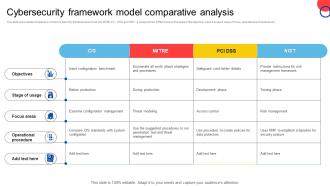
This slide showcases comparison of internet security frameworks such as CIS,MITRE,PCI DSS and NIST. It analyze their differences on the basis of its objective,when it is used, area of focus, operational procedures etc.
People who downloaded this PowerPoint presentation also viewed the following :
Cybersecurity Framework Model Comparative Analysis with all 6 slides:
Use our Cybersecurity Framework Model Comparative Analysis to effectively help you save your valuable time. They are readymade to fit into any presentation structure.





FAQs for Cybersecurity Framework
Key cybersecurity framework components include risk assessment protocols, access control mechanisms, incident response procedures, continuous monitoring systems, and compliance validation measures. These elements work together by identifying vulnerabilities, restricting unauthorized access, and ensuring rapid threat response, with many organizations finding that this strategic combination ultimately delivers enhanced operational security and regulatory compliance.
NIST focuses on critical infrastructure protection with flexible, risk-based guidelines, while ISO 27001 emphasizes comprehensive information security management systems with formal certification requirements. NIST suits organizations seeking adaptable cybersecurity improvement, particularly in healthcare and finance, whereas ISO 27001 appeals to companies requiring internationally recognized compliance standards, ultimately delivering structured security governance and enhanced stakeholder confidence.
Employees serve as the first line of defense in cybersecurity frameworks through security awareness training, adherence to protocols, incident reporting, and responsible data handling practices. Their vigilance enables organizations to detect phishing attempts, prevent social engineering attacks, and maintain compliance standards, with many companies finding that well-trained staff significantly reduce security breaches and enhance overall framework effectiveness.
Organizations can assess their cybersecurity framework effectiveness through comprehensive security audits, penetration testing, compliance assessments, vulnerability scans, and incident response evaluations. Through regular testing and metrics analysis, companies across banking, healthcare, and retail sectors identify gaps, measure response times, and benchmark against industry standards, ultimately strengthening their security posture while ensuring regulatory compliance.
Organizations face implementation challenges including resource constraints, complex regulatory requirements, legacy system integration difficulties, skills gaps, and resistance to change. These obstacles are particularly pronounced in healthcare and financial services sectors, where compliance demands are stringent, though strategic planning and phased deployment ultimately deliver enhanced security posture and operational resilience.
Cybersecurity frameworks should be reviewed quarterly and updated annually, with additional assessments triggered by major security incidents, regulatory changes, or significant infrastructure modifications. This regular evaluation ensures frameworks remain effective against evolving threats, with many organizations finding that proactive updates significantly reduce vulnerabilities while maintaining compliance and operational resilience.
A risk management approach within cybersecurity frameworks enables organizations to systematically identify, assess, and prioritize threats while allocating resources strategically based on potential business impact. This approach streamlines security investments by focusing on critical assets first, ultimately delivering cost-effective protection and operational continuity, with many enterprises finding that structured risk assessment significantly reduces both security incidents and compliance costs.
Cybersecurity frameworks help achieve regulatory compliance by providing structured policies, standardized controls, and systematic risk assessments that align with regulatory requirements. Through frameworks like NIST or ISO 27001, organizations streamline audit processes, demonstrate due diligence, and maintain consistent security postures, ultimately reducing compliance costs while ensuring adherence to industry-specific regulations.
Organizations can leverage NIST guidelines, ISO 27001 standards, CISA resources, vendor-specific tools like Microsoft Security Center, and third-party platforms such as RSA Archer for framework development. These resources streamline policy creation, risk assessment, and compliance monitoring, with many financial institutions and healthcare organizations finding that combining multiple frameworks delivers comprehensive protection while reducing implementation complexity and costs.
Small businesses can implement cybersecurity frameworks by prioritizing essential controls like access management, regular backups, and employee training, while leveraging cost-effective cloud-based security tools and automated solutions. By focusing on foundational protections first, many small organizations find that strategic resource allocation delivers significant risk reduction and competitive advantage, ultimately enabling scalable security without overwhelming operational budgets.
Real-world case studies include Target's post-breach NIST Framework implementation reducing incidents by 60%, JPMorgan Chase's ISO 27001 adoption streamlining compliance across global operations, and Equifax's comprehensive framework overhaul following their data breach. These implementations demonstrate how structured cybersecurity approaches enable faster threat detection, reduce regulatory penalties, and ultimately restore customer trust while delivering measurable cost savings.
A cybersecurity framework integrates with incident response planning by establishing structured protocols, defining roles and responsibilities, and creating standardized communication channels for threat detection and mitigation. Through frameworks like NIST or ISO 27001, organizations streamline threat assessment, automate response workflows, and ensure compliance requirements, ultimately delivering faster containment and reduced operational downtime during security incidents.
Aligning cybersecurity frameworks with business objectives ensures security investments directly support organizational goals, regulatory compliance, and operational continuity while minimizing disruption to core business processes. This strategic combination enables companies to prioritize critical assets, allocate resources effectively, and maintain customer trust, ultimately delivering enhanced operational resilience and competitive advantage in an increasingly digital marketplace.
Organizations ensure stakeholder buy-in for cybersecurity frameworks by demonstrating clear ROI through risk reduction metrics, aligning security investments with business objectives, and presenting framework adoption as competitive advantage rather than compliance burden. Through executive briefings highlighting cost savings from breach prevention, phased implementation showcasing quick wins, and regular progress reporting, stakeholders increasingly recognize cybersecurity frameworks as strategic enablers that enhance operational resilience while protecting organizational assets.
Emerging cybersecurity frameworks increasingly emphasize zero-trust architectures, AI-driven threat detection, cloud-native security models, quantum-resistant encryption, and automated incident response capabilities. These evolving approaches streamline security operations by integrating predictive analytics, continuous monitoring, and adaptive authentication, with many organizations finding that proactive, intelligence-driven frameworks ultimately deliver enhanced resilience and competitive advantage.
-
Understandable and informative presentation.
-
I can say with full confidence that all your business, academic, or professional work requirements will be sufficed with SlideTeam. Their gallery is as rich as 2Million+!!