


Cyber Security Risk Governance Operating Model




Try Before you Buy Download Free Sample Product
 Impress Your
 Audience
 100%
100% Editable
 Save Hours
 of Time


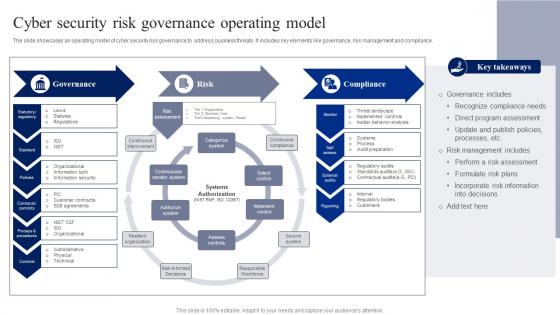
The slide showcases an operating model of cyber security risk governance to address business threats. It includes key elements like governance, risk management and compliance.
People who downloaded this PowerPoint presentation also viewed the following :
Cyber Security Risk Governance Operating Model with all 6 slides:
Use our Cyber Security Risk Governance Operating Model to effectively help you save your valuable time. They are readymade to fit into any presentation structure.





FAQs for Cyber Security Risk
Phishing's still the worst - people fall for it constantly no matter how much we warn them. Ransomware and insider threats are brutal too. Then you've got malware, data breaches from crappy access controls, plus supply chain attacks where hackers sneak in through your vendors. Cloud stuff is a mess since everyone's rushing to AWS without knowing what they're doing. Oh, and definitely get multi-factor auth set up everywhere. Security training helps but honestly some people will click anything.
Honestly, just nail the basics before you blow money on fancy security stuff. Train your people first - I can't tell you how many companies get wrecked because someone clicked a sketchy email. Multi-factor authentication is your best friend, costs basically nothing and works like crazy. Auto-update everything, make people use decent passwords, and back up your data religiously. I know it sounds boring compared to all the shiny security tools out there, but this stuff actually works. Pick one thing and do it right this month, then move on.
Dude, most cyber breaches happen because someone clicked a sketchy link or got fooled by a fake email - not some master hacker breaking your firewall. Training your people is huge. Show them real phishing examples and what social engineering looks like. Yeah, it's kinda boring but honestly? You'll block most attacks just by teaching folks to spot suspicious stuff and make decent passwords. Run fake phishing tests every few months too. My old company did this and it actually worked - people got way better at catching the obvious scams.
Dude, first thing - disconnect those infected systems ASAP so it doesn't spread everywhere. Get your incident response people together and start documenting literally everything you see. Screenshots, logs, when stuff happened - trust me, you'll need all that later for the investigation and maybe cops if it's really bad. Figure out how much damage they actually did, then tell whoever needs to know. Start shutting down their access and kicking them out. Oh, and this is probably obvious but - fix whatever hole they used to get in before you bring anything back online. Otherwise they'll just waltz right back in.
Okay so first things first - get a VPN and turn on 2FA for everything work-related. I cannot stress this enough lol. Your home wifi should have WPA3 encryption (not that old WEP garbage). Keep your stuff updated too, I know it's a pain but those patches matter. Don't work on sensitive stuff at coffee shops where people can peek over your shoulder. Oh and use whatever cloud storage your company provides instead of random apps. If you can swing it, having a dedicated work spot at home helps keep things separate. Honestly the VPN thing is probably the biggest game-changer.
So it really depends on what kind of data you're dealing with. Healthcare companies obsess over HIPAA because patient info is super sensitive. Banks and finance? They're all about PCI-DSS and SOX - those compliance audits are brutal from what I hear. Manufacturing usually goes with NIST frameworks. Honestly, I'd start by figuring out which regulations actually apply to your industry first. Don't try to tackle everything at once. Build your security program around those specific requirements instead of just throwing money at random security tools.
Honestly, AI in cybersecurity is wild right now. You've got these tools that can spot threats instantly and crunch through security data faster than any human team. Pretty amazing stuff. But here's where it gets messy - hackers are using the exact same tech to build nastier phishing attacks and malware that actually learns from your defenses. It's basically turned into this crazy arms race. The trick is keeping your AI security updated constantly because once you go static, you're toast. Oh, and the learning curve for this stuff? Steep as hell.
Okay, so three main things to nail down: encryption, access controls, and actually vetting your vendor. Make sure data's encrypted both moving around and sitting there - cloud providers usually offer this but you gotta double-check it's turned on. Set up multi-factor auth and role-based permissions so random people can't get into your sensitive stuff. Here's what kills me though - people never actually read the security certs and compliance reports, they just trust the flashy marketing. Back up your data in multiple spots too because even AWS goes down sometimes. I'd start by figuring out what you've got in the cloud right now and where your biggest risks are.
Honestly, you need to look at AI threat detection first - it's getting ridiculously good at catching stuff we'd totally miss. Zero-trust is where everything's at now too, basically treating your whole network like it's already hacked until something proves it isn't. Makes me paranoid but whatever, it works. XDR platforms are clutch because nobody wants to stare at 12 different security dashboards all day. Cloud security posture management is blowing up right now as well. I'd figure out where you can't see what's happening in your current setup, then pick whichever of these actually fixes those blind spots.
Basically these scammers are just really good at reading people. They'll pretend to be IT saying your account gets locked in 30 minutes, or some "colleague" who desperately needs help with something. Honestly, it's pretty manipulative but it works because we want to help people or we panic about getting in trouble. Your natural instincts kick in - trust, fear, that urge to be helpful. Meanwhile they're completely bypassing all the security stuff by just... talking to you. Always double-check through a different method when someone wants sensitive info or pressures you to act fast.
First thing - map out everything you've got. Devices, users, traffic patterns. Can't secure what you don't know about, right? Multi-factor auth needs to go everywhere, no exceptions. Network segmentation is huge too - stop letting everything talk to everything else like it's some kind of digital free-for-all. That whole "never trust, always verify" thing actually matters here, even though it sounds like consultant speak. Watch user behavior patterns and lock down permissions to bare minimums. Oh, and don't try tackling everything at once. Start with your crown jewels first.
Start with pen testing - get ethical hackers to poke holes in your stuff. I'd track how fast you respond to incidents, patch vulnerabilities, and get employees through security training. Third-party audits are clutch too. The wake-up call hits when you realize how many blind spots you actually have. Monitor if your security tools are catching real threats or just being annoying with false alarms. Build a monthly dashboard for these metrics so you can catch patterns early. Oh, and don't forget internal audits - they're cheaper than external ones but still pretty revealing.
Dude, data breaches absolutely wreck companies. Customers feel totally violated when their info gets stolen - they just bail and never come back. Equifax is still trying to recover from their 2017 disaster, honestly it's kinda sad. Stock prices tank immediately, media tears you apart, and rebuilding that trust? Takes forever and costs a fortune. Like, way more than just investing in solid security upfront. Prevention beats damage control every single time. Nobody wants to be the next cautionary tale everyone points to.
Honestly, threat intel is a game changer - it's like having insider info on what hackers are actually up to in your industry. Instead of panicking over every security alert, you'll know which ones matter and why. Your team can see attack patterns, understand what bad actors are targeting, and tune your tools to catch the real threats. Way better than flying blind, right? I'd grab a threat feed for your sector first and watch how it transforms your daily security grind. The weather forecast analogy is pretty spot-on too.
So incident response plans are basically your safety net when cyber stuff hits the fan. You get a clear roadmap - who handles what, how to stop the bleeding fast, all that good stuff. Trust me, scrambling without a plan is the worst. It cuts down on downtime and keeps you from hemorrhaging money. Plus regulators love seeing you've got your act together. Honestly, even a crappy plan beats winging it completely. If you don't have one, just throw together something basic this week. Better than nothing, right?
-
“Immediate response, professional support, and effective solutions that were customized and immediately provided. Well done- Thank you!”
-
Incredibly beautiful designs that will help you get noticed! These eye-catching templates are perfect for corporate presentations that can be altered to fit any occasion or taste.