


Cyber Security Risk Analysis And Control Matrix




Try Before you Buy Download Free Sample Product
 Impress Your
 Audience
 100%
100% Editable
 Save Hours
 of Time


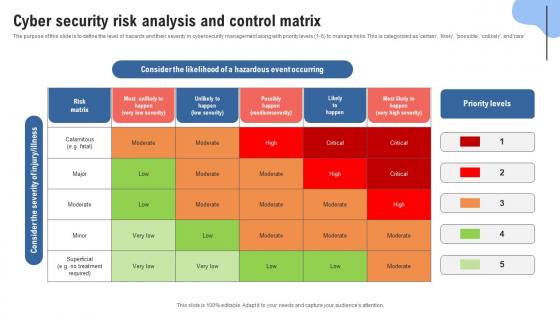
The purpose of this slide is to define the level of hazards and their severity in cybersecurity management along with priority levels 15 to manage risks. This is categorized as certain, likely, possible, unlikely, and rare
People who downloaded this PowerPoint presentation also viewed the following :
Cyber Security Risk Analysis And Control Matrix with all 6 slides:
Use our Cyber Security Risk Analysis And Control Matrix to effectively help you save your valuable time. They are readymade to fit into any presentation structure.





FAQs for Cyber Security Risk Analysis
So you've got two main things to look at - how likely something is to actually happen, and how bad it'll mess you up if it does. Picture a grid where one side shows probability (like rare to almost guaranteed) and the other shows impact (minor annoyance to total disaster). Most places go with either 3x3 or 5x5 grids, though personally I think 5x5 gives you way better detail. You color-code each spot - green for chill, yellow for watch out, red for oh crap. Then you can see what fires to put out first.
Start by mapping out what your business actually does and what assets matter most. Generic templates are basically worthless - way too broad to be useful. Figure out the real threats based on your industry and tech setup first. Then customize everything around what actually impacts you - could be customer data breaches, system downtime, compliance issues, whatever. Adjust those likelihood ratings based on your actual security setup too. The whole point is making it specific enough that your team can use it for real decisions instead of just checking boxes. Otherwise you're just wasting time on paperwork that sits in a folder somewhere.
So you can't build a decent risk matrix without first figuring out what you're actually protecting. Think about it - losing your customer database is catastrophic, but someone hacking the office printer? Annoying but not exactly company-ending. You'll want to sort everything by value and how critical it is to operations. This stuff directly impacts your scoring when you build the matrix later. The more valuable an asset, the heavier it weighs in your risk calculations. Makes sense, right? That's how you figure out where to throw your security budget instead of just guessing.
So basically, grab all your security threats and throw them on a grid - likelihood vs impact. That way you can actually see what matters. Like ransomware hitting your main systems? That's going straight to the "oh shit" corner. Someone leeching your office WiFi? Meh, probably not worth losing sleep over. I'd start with your top 10 threats first, then plot them out. The whole point is stopping yourself from getting distracted by small stuff when there's bigger problems that could seriously mess up your business. Plus it makes it way easier to figure out where you should actually spend your security money.
So for likelihood stuff, NIST's framework is solid - they've got good historical data to build from. Impact assessment though? FAIR is where it's at. Yeah, it looks scary at first but trust me, having actual dollar amounts instead of those vague high/medium/low ratings makes everything clearer. Leadership actually listens when you can say "this costs us $X." I'd start with NIST to get your structure down, then work in FAIR's methodology for the business impact side. Way better than those basic color-coded charts everyone uses.
Quarterly updates are the bare minimum, but honestly don't just stick to that schedule. New threats pop up constantly, plus any major system changes or security incidents mean you need to revisit it right away. I've watched teams basically forget these matrices exist once they're done - huge mistake. Monthly reviews work better if you're in a particularly sketchy period or just rolled out new infrastructure. Set a calendar reminder though, seriously. And make sure someone actually owns keeping it current, otherwise it'll just sit there getting more useless by the day.
The vague scales will kill you - skip "low/medium/high" without actual definitions. Everyone dumps stuff in the middle boxes too, which makes the whole thing useless. Get other teams involved because IT sees risks totally different than finance does. Oh, and don't treat it like homework you finish once. These things need constant updates or they become pretty wall decorations. Most people forget to define what each risk level means for actual response - like, what do you DO when something hits red? Otherwise you're just making colorful charts that sit in meetings while everyone argues about next steps.
Skip the generic risk ratings - they're useless. Map everything directly to what your business actually cares about. Revenue, customer trust, whatever keeps your CEO up at night. Here's what works: show executives exactly how a breach kills customer retention or how outages destroy quarterly numbers. Suddenly those budget talks get way easier (trust me on this one). Your risk matrix should scream "this is why we need funding" not just list technical stuff. Oh, and definitely loop in business leaders regularly - priorities change fast and your matrix needs to keep up or it becomes another dusty document nobody reads.
Track probability and impact first - that's your bread and butter for any risk matrix. Throw in threat frequency, vulnerability severity, and how critical your assets are. Detection time matters too, plus response and recovery metrics. Honestly, half the battle is knowing how quickly you can get back up and running after something hits. Compliance status and control effectiveness are solid additions since auditors eat that stuff up. Oh, and start simple - you can always pile on more detailed metrics once you figure out what actually moves the needle for your team.
Look, risk matrices are honestly genius because they turn all that techy stuff into something execs can actually wrap their heads around. You're not explaining buffer overflows anymore - you're pointing at red squares saying "this hits us monthly and costs $2M." The colors make priorities dead obvious. I swear, most security presentations put people to sleep by slide three. But your CISO can walk into any boardroom with a matrix and suddenly everyone's having real conversations about where the money should go. No computer science degree required.
Honestly, skip the boring PowerPoint route. Get your team doing actual workshops where they map real scenarios to the matrix - way better for learning. People constantly mix up likelihood vs impact, so drill that difference hard. I'd use examples from your specific industry since generic ones are useless. Have them role-play different threats and argue about placement - gets heated but they remember it better. Oh, and you'll need quarterly refreshers because this stuff vanishes from people's brains fast. Give them reference cards they can actually keep at their desk.
Ugh, compliance totally dictates how you build your risk matrix - there's no way around it. First thing? List out all the regs you're stuck with (SOX, HIPAA, whatever applies). Then your risk categories have to match those frameworks, which honestly limits your options. The scoring gets weird too - something that looks "medium" risk might actually be "high" if it breaks compliance rules. Oh and don't forget the timeline thing - your remediation deadlines need to sync with regulatory requirements or you're screwed. It's annoying but makes sense when auditors come knocking.
Honestly, automation is a game changer for risk matrices. You can set up continuous monitoring that updates risk scores automatically instead of doing those painful quarterly reviews everyone dreads. Real-time data feeds will flag when risks shift or new vulnerabilities pop up - way faster than any manual process. The cool part? It pulls from multiple sources like threat intel, vulnerability scanners, incident reports. No more human bias screwing up your scoring either. I'd probably start with whatever's eating up most of your time first, then expand from there.
Honestly, just start with Excel or Google Sheets - everyone knows how to use them and they work fine for basic risk matrices. Most teams begin there anyway. Once you get the hang of your process, then look into GRC platforms like ServiceNow or Rsam if you need something fancier. There's also specialized stuff like RiskLens for quantitative analysis, though that might be overkill depending on what you're doing. Riskalyze is decent too for simpler setups. My take? Figure out your workflow with a basic spreadsheet first, then upgrade when you actually know what features you'll need.
Here's the thing - your risk matrix should literally tell you which response playbook to use. High-risk stuff gets the full treatment with all hands on deck. Lower risk? More streamlined approach. Map out your escalation paths and team assignments ahead of time based on those risk ratings. Trust me, you don't want to figure this out when you're already in crisis mode at 2am. It stops you from either panicking over minor stuff or - worse - sleepwalking through something actually serious. Getting this sorted now will save your sanity later.
-
It makes easy work of my work presentations. I’ve never had to be nervous about my presentations for meetings.
-
I was never satisfied with my own presentation design but SlideTeam has solved that problem for me. Thank you SlideTeam!