


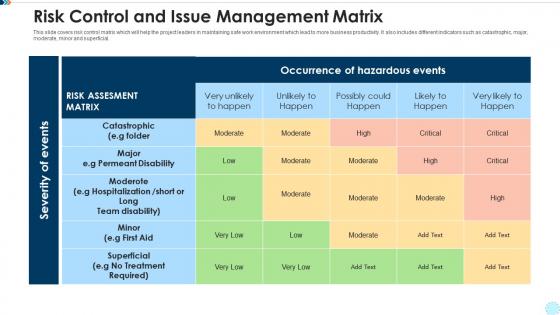
Risk control and issue management matrix




Try Before you Buy Download Free Sample Product
 Impress Your
 Audience
 100%
100% Editable
 Save Hours
 of Time


Our Risk Control And Issue Management Matrix are topically designed to provide an attractive backdrop to any subject. Use them to look like a presentation pro.
People who downloaded this PowerPoint presentation also viewed the following :
Risk control and issue management matrix with all 9 slides:
Use our Risk Control And Issue Management Matrix to effectively help you save your valuable time. They are readymade to fit into any presentation structure.









FAQs for Risk control and
Honestly, risk management saved my butt on the last project I ran. Start by spotting potential problems early - what could go wrong? Then figure out how likely each thing is and how badly it'd hurt. Make someone own each risk because otherwise everyone assumes someone else is handling it. Keep updating your list too since new stuff always comes up. Oh, and don't just write risks down and call it done - that's useless. Actually talk about them in meetings and track what's happening. Set aside like 30 minutes this week to identify your biggest 5 risks. Trust me on this one.
Start by mapping out what could actually hurt your business - cyber stuff, supply chain issues, losing key people, whatever. I'd go department by department so it's not totally overwhelming. Then grab people from different teams because honestly, they'll catch things you'd never think of from your spot. Plot everything on a simple grid: how likely vs how bad the damage would be. The nasty high-probability, high-impact risks? Those get your attention first. Don't overthink the matrix part - keep it simple. Focus your energy on the stuff that'll actually keep you up at night.
So risk assessment is like your radar for spotting problems before they blow up your plans. You're weighing what could tank your strategy against what you're hoping to achieve. Think weather check before a road trip, but with way more money on the line. It helps you figure out which moves are actually smart, where to put your resources, and what your backup plans should be. Honestly, most people only do this when stuff's already hitting the fan, but you want it baked into how you plan everything.
Honestly, you need to make risk management part of the actual decision-making, not just some afterthought. Set up dedicated board committees that review risk appetite regularly - and make sure your executives actually own this stuff in their job descriptions and performance metrics. Nobody gets to dodge responsibility when things blow up! Bake risk assessments right into strategic planning and big business calls. The trick is discussing it constantly, not waiting until you're already in trouble. Oh, and don't let it become one of those boring monthly check-the-box meetings either.
Dude, cyber attacks are seriously the worst right now - ransomware can destroy you in hours. Supply chain mess, cash flow problems, and keeping up with regulations are all major headaches too. Equipment breaking down when you need it most? Classic. Then there's the whole talent shortage thing everyone's dealing with. Oh and climate stuff is getting real - floods, storms, whatever can wreck your whole setup. Social media can tank your reputation super fast these days. I'd honestly just list out what could actually kill your business first, then tackle those. Everything else can wait.
Honestly, tech has been a game-changer for risk management. AI can spot patterns and predict problems way faster than doing it manually. Real-time dashboards show you exactly what's happening across all your risk areas instantly. Automated alerts are clutch too - saves you from babysitting everything 24/7. Cloud platforms let your team work together from wherever they are, which is pretty convenient these days. I'd start by figuring out which manual processes are eating up most of your time (probably more than you realize). Those are the ones worth upgrading first.
Start with probability/impact matrices and expert interviews to figure out your biggest threats - that's the qualitative stuff. Once you know what you're dealing with, Monte Carlo simulations and decision trees give you actual numbers to work with. SWOT analysis honestly works for both. I'd probably just use Excel unless you want to get fancy with @RISK or Crystal Ball. The quantitative methods look scary but they're worth it for risks that could wreck your budget. Don't skip the qualitative step though - you need to know which risks are even worth analyzing first.
Honestly, diversifying revenue streams is huge - don't put everything on one income source. Keep solid cash reserves too because unexpected stuff always hits. Regular audits and good internal controls help catch problems before they get messy. Insurance is worth it for major risks, and if you're dealing with currency/commodity stuff, hedging can save your butt. Cash flow forecasting is boring but super helpful. Oh, and definitely do a risk assessment first to figure out where you're most vulnerable - no point fixing everything if only two things actually matter, you know?
Honestly, communication and culture can totally make or break your risk management. When people don't feel safe speaking up about problems, you're just asking for trouble. I've watched this destroy projects firsthand - risks get stuck in departments and never bubble up to leadership. But here's the thing: if you build a culture where transparency actually gets rewarded instead of punished, employees will flag issues early. People need to know they won't get thrown under the bus for raising concerns. It's all about creating that psychological safety where red flags don't get ignored.
Ugh, compliance stuff is such a pain but you've gotta stay on top of SOX, GDPR, whatever hits your industry. Document literally everything - risk assessments, how you're handling things, all your decisions. The regulatory world changes constantly which is honestly exhausting to track. Your legal team will thank you later when auditors come knocking. Don't forget you'll need to report material risks to your board and stakeholders too. I'd start by figuring out which rules actually matter for your business, then build everything around those. Makes the whole process way less overwhelming.
Honestly, quarterly reviews beat annual ones every time - those yearly assessments are basically useless by month two. Build your risk framework so it can actually pivot when stuff hits the fan. Cross-functional teams work best here, and don't get attached to processes that suck. Your risk indicators should trigger real responses, not just pretty dashboards that nobody looks at. Think of it like a living system instead of some compliance thing you check off. Oh, and start small - pick your three biggest operational risks first and see how fast you can actually react when they change.
Honestly, you really need the basics down first - finance, stats, and being able to think analytically. A bachelor's in finance or economics is pretty much expected. The FRM or PRM certifications can set you apart if you're competing for better roles. Communication skills matter way more than people think since you'll be explaining scary financial scenarios to executives who zone out at spreadsheets. Oh, and get comfortable with risk software early. Detail work is huge, but don't get so lost in the weeds that you miss bigger trends. I'd start with basic risk assessment tools and maybe pursue a cert later.
Risk management totally depends on your industry - what you're protecting changes everything. Finance people are constantly worried about market crashes, credit defaults, and staying compliant with regulations. Basically trying not to lose millions overnight. Healthcare is different though - they're focused on patient safety, HIPAA stuff, and clinical outcomes since people's lives are actually at risk. The frameworks look similar when you write them down, but honestly the day-to-day stress is completely different. A data breach with medical records? That's way worse than if trading algorithms get leaked. You've got to tailor your risk assessments to whatever threats actually matter in your field.
You seriously can't do risk management solo - you'll miss stuff that's obvious to other people. Customers see problems you don't, employees know when processes are broken, suppliers catch supply chain issues early. Map out who matters for each risk area first. Then - and this might sound annoying but it works - set up regular check-ins to actually listen to what they're saying. When people feel heard upfront, they're way more likely to help when you need to make changes later. Nobody wants to get blindsided by problems that could've been avoided.
Track stuff like how often bad things happen, how fast you fix problems, and what it costs you. Compare where you are now to where you started - that's honestly the best way to tell if you're improving. Sometimes you think you can handle more risk than you actually can, so check if your comfort level matches reality. Get feedback from your team regularly because they'll catch things you miss. I do quarterly check-ins to see what's working and dump what isn't. The real question is: are you actually preventing the risks you worried about, and bouncing back faster when crap hits the fan?
-
Great experience, I would definitely use your services further.