


Cybersecurity Maturity Assessment Levels Matrix




Try Before you Buy Download Free Sample Product
 Impress Your
 Audience
 100%
100% Editable
 Save Hours
 of Time


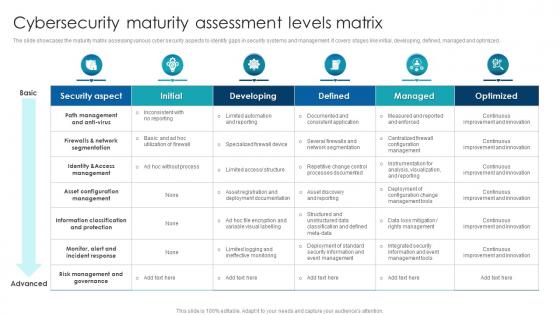
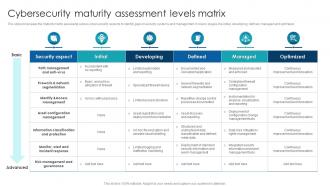
The slide showcases the maturity models to measure and benchmark clients information security maturity. It consists of levels like initial, developing, defined, managed and optimized with defined characteristics of each state.
People who downloaded this PowerPoint presentation also viewed the following :
Cybersecurity Maturity Assessment Levels Matrix with all 6 slides:
Use our Cybersecurity Maturity Assessment Levels Matrix to effectively help you save your valuable time. They are readymade to fit into any presentation structure.





FAQs for Cybersecurity Maturity
So CMMC breaks down into three parts: practices (the actual security stuff you do, like multi-factor authentication), processes (how you document everything), and people (making sure your team knows what they're doing). There are five levels total - Level 1 is basic cyber hygiene, Level 5 is like advanced stuff most companies won't even need. You can't jump levels either, which is kinda annoying but makes sense. First thing - figure out what level your contracts will actually require, then see where you're falling short. Way easier to work backwards from there.
Start with NIST or CMMI frameworks - they've got solid questionnaires that'll show you where you actually stand. Most companies think they're way more mature than reality (guilty as charged). Get a third-party assessment or pen test for the real truth. Focus on five areas: governance, risk management, asset protection, threat response, and recovery. Score each one honestly - and I mean brutally honest, not the "we're pretty good at this" version. Find your biggest gaps first. That's honestly the hardest part because nobody wants to admit their security posture kinda sucks in certain areas.
NIST CSF, ISO 27001, and CIS Controls are the big three you'll run into everywhere. I'd personally go with NIST first - it's free, government-backed, and plays nice with most maturity models. ISO 27001 works if you need that formal cert, but it'll cost you. CIS gives you really practical stuff you can actually implement right away. Start with NIST unless you're in a super regulated industry. Just pick whatever fits your current setup best and don't stress about it too much - you can always pivot later.
So the Cybersecurity Maturity Model is basically like getting a physical for your company's security setup. You compare where you are now against what the industry expects. It breaks everything down into different areas and practices - honestly, way more detailed than I thought it would be when I first looked into it. Each level builds up from the last one, which makes it super easy to see exactly where you're vulnerable. Attackers love finding those gaps, obviously. Start with figuring out your baseline first. That'll show you what you're actually working with right now.
Look, cybersecurity maturity models are basically just fancy checklists that actually help. They show you exactly where your security sucks right now and what to fix first - way better than just throwing money at random security tools and hoping for the best. The thing is, you can tackle improvements based on what you can actually afford, not some consultant's dream budget. Your clients are starting to ask about this stuff too, so there's that business angle. Honestly? Just grab one of those free assessments online first. I was shocked at how bad our basics were when we did ours last year.
Honestly? Once a year minimum, but that's barely scraping by. Smart companies check every 6-12 months since threats evolve crazy fast these days. Had a breach or major business change? Don't wait - reassess immediately. The trick is making it routine instead of just ticking boxes. I set mine for every 8 months or so - works better than annual reviews that everyone forgets about. Stick it on your calendar like any other important meeting. Trust me, catching problems early beats explaining expensive disasters to your boss later.
Training your people is huge for cybersecurity maturity - honestly, it's where most companies should start. Your fancy security tools won't matter if employees keep falling for phishing emails or using terrible passwords. I've seen places with million-dollar setups get wrecked because someone clicked the wrong link. Regular phishing sims work really well, plus basic awareness sessions. It builds that culture where everyone's watching out for threats, not just the IT team. Super cost-effective too compared to buying more tech. You'll notice improvements pretty fast once people start caring about security.
So this framework is basically your translator between tech stuff and executive language. Start by figuring out where your security stands now, then show how the gaps create real business risks - like revenue hits or reputation damage. Each maturity level you move up = fewer threats to worry about. It's honestly the best way I've seen to get budget approved because you're not just asking for cybersecurity money, you're showing how it protects what they actually care about. Focus on the gaps that would hurt the business most. Way better than just saying "we need better firewalls" or whatever.
Focus on the basics first - mean time to detect incidents, how fast you're patching critical vulns, and whether people are actually completing security training. Phishing sim click rates are gold for measuring awareness (honestly, some results will shock you). Track your incident response times too. Don't go crazy with metrics though - I've seen teams drown in data they never use. Pick maybe 5-7 that actually match your risks and maturity goals. Security controls implementation vs. what you planned is another good one. Get these dialed in before adding more, trust me on this.
CMMC stays relevant through regular updates and a flexible design that adapts to new threats. It builds in emerging tech like AI, IoT, and cloud security as they become real business risks. Honestly, the principle-based approach is way smarter than just ticking boxes - especially with how crazy fast everything changes these days. Your org can apply those core security principles to whatever new tech or threats show up next. Oh, and definitely start with foundational practices first, then add the emerging threat stuff as you mature.
So there's a few good frameworks you can use - NIST CSF, ISO 27001, or CMMI. I'd honestly just pick NIST since it's free and everyone uses it anyway. Do a self-assessment first (most companies are shocked at how many gaps they find). Then grab some industry benchmarking reports to see how you stack up against peers. Consulting firms put out sector-specific maturity data too, which is pretty helpful. The main thing is sticking with whatever framework you choose so you're measuring consistently over time. Don't jump around between different standards or you'll never get a clear picture.
Honestly, the hardest part is just getting people on board with change. Everyone acts like they want better security until they realize how much extra work it actually involves. Budget's always tight too - proper assessments cost way more than leadership expects. I'd say pick one small department first and focus on some quick wins there. Once you've got something to show off, it's way easier to get other teams interested. Oh, and don't even bother without leadership backing you up from the start. They need to see the value or you'll be fighting uphill battles constantly.
Yeah, definitely helps with trust. Customers feel way more confident when they see you've got solid security practices and the right certifications. Strong cybersecurity keeps you from becoming the next data breach disaster story - and honestly, those headlines can destroy companies overnight. It's actually becoming a huge selling point, especially in B2B where clients will literally audit your security before signing contracts. I'd say document what you're doing security-wise and don't be shy about showing it off. Makes you stand out from competitors who are probably winging it.
Honestly, you gotta be real with yourself first - do a proper gap assessment and don't sugarcoat where you actually are right now. I've seen too many people fool themselves on this part. Build your foundation before getting fancy with advanced stuff. Document everything because you'll need proof later that your processes actually work. Your team needs regular training too - people mess up more than systems do, unfortunately. Tackle one level at a time and nail it completely. Don't rush ahead until you're rock solid where you are.
Look, you gotta build this into a regular rhythm - quarterly check-ins work well to see where you actually stand vs where you want to be. Track stuff that matters: how fast you respond to incidents, how quickly vulns get fixed, whether your team actually knows basic security stuff. Monthly retrospectives with your team are honestly game-changers for spotting what's broken. Don't just chase compliance boxes (though yeah, you need those too). The whole thing should feel like an ongoing conversation, not some massive project you do once. When something goes wrong, feed those lessons right back into your next cycle. That's how you actually get better instead of just spinning wheels.
-
Making a presentation has never been this easy for me. Thank you SlideTeam for offering a splendid template library.
-
Colors used are bright and distinctive.