Cyber Security Risk Assessment Matrix

Rating:
80%
Cyber Security Risk Assessment Matrix
Slide 1 of 6
Favourites Favourites

Try Before you Buy Download Free Sample Product

Audience Impress Your
Audience
Editable 100%
Editable
Time Save Hours
of Time
The Biggest Sale is ending soon in
0
0
:
0
0
:
0
0
Rating:
80%
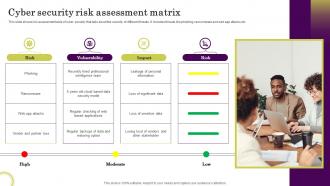
This slide shows risk assessment table of cyber security that tells about the severity of different threats. It includes threats like phishing, ransomware and web app attacks etc Introducing our premium set of slides with Cyber Security Risk Assessment Matrix Ellicudate the one stages and present information using this PPT slide. This is a completely adaptable PowerPoint template design that can be used to interpret topics like Risk, Vulnerability, Impact So download instantly and tailor it with your information.

FAQs for Cyber Security

Key components include asset identification, threat analysis, vulnerability assessment, impact evaluation, and likelihood determination. These elements work together by cataloging critical systems and data, identifying potential attack vectors, and quantifying business risks, with many organizations finding that structured matrices streamline security prioritization and resource allocation.

A cybersecurity risk assessment matrix helps prioritize threats by systematically plotting their likelihood against potential impact, enabling organizations to identify high-priority vulnerabilities requiring immediate attention versus lower-risk issues. This structured approach streamlines resource allocation and decision-making, with many enterprises finding that visual risk mapping accelerates incident response planning, enhances security budget optimization, and ultimately delivers more strategic threat management across their digital infrastructure.

Cybersecurity risk assessment matrices typically use five levels: very low, low, moderate, high, and critical, often color-coded from green to red for visual clarity. These levels help organizations prioritize vulnerabilities by combining threat probability with potential impact, enabling security teams to allocate resources strategically and address the most critical exposures first.

Organizations customize their risk assessment matrix by adjusting risk categories, threat vectors, impact scales, and compliance requirements to match industry-specific vulnerabilities and regulatory frameworks. Financial services might emphasize fraud detection and data breaches, while healthcare organizations focus on patient data protection and medical device security, with many finding that tailored matrices deliver more accurate risk prioritization and strategic resource allocation.

Asset identification forms the foundation of risk assessment matrices by cataloging critical systems, data, infrastructure, applications, and personnel that require protection. This comprehensive inventory enables organizations to prioritize vulnerabilities based on asset value and business impact, with financial institutions focusing on customer databases and manufacturing companies protecting operational systems, ultimately delivering targeted security investments and strategic resource allocation.

Organizations effectively quantify cybersecurity risks by assigning numerical values to impact categories like financial losses, operational disruption, regulatory penalties, and reputational damage across scaled ratings. Through structured frameworks, companies assess potential costs, recovery time, and compliance violations, while many financial institutions and healthcare organizations finding that combining quantitative metrics with qualitative assessments delivers more accurate risk prioritization and strategic resource allocation.

Maintaining current cybersecurity risk assessment matrices faces challenges including rapidly evolving threat landscapes, integration complexities with existing security frameworks, resource constraints for continuous monitoring, and difficulty quantifying emerging vulnerabilities. Organizations struggle with keeping pace alongside technological changes, regulatory updates, and sophisticated attack vectors, while balancing comprehensive coverage with operational efficiency, ultimately requiring dedicated expertise and automated tools.

A cybersecurity risk assessment matrix should be reviewed quarterly and updated immediately following significant changes like new threats, system implementations, or security incidents. Organizations typically conduct comprehensive annual reviews while maintaining continuous monitoring, with many financial institutions and healthcare providers finding that more frequent assessments enhance threat detection, improve response times, and ultimately deliver stronger security postures in an increasingly dynamic threat landscape.

Cybersecurity risk assessment matrix creation can be aided by tools like Nessus, Qualys VMDR, RiskLens, ServiceNow GRC, and Microsoft's risk assessment templates. These platforms streamline vulnerability identification, risk quantification, and compliance tracking, with many organizations finding that automated scanning combined with comprehensive reporting enables faster threat prioritization, enhanced security postures, and more strategic resource allocation across their cybersecurity initiatives.

A risk assessment matrix facilitates communication between IT and management teams by translating complex technical vulnerabilities into clear visual formats, standardized risk ratings, and business impact categories that both audiences understand. This shared framework enables IT professionals to effectively convey cybersecurity priorities to executives while allowing management to make informed resource allocation decisions, ultimately aligning technical security measures with strategic business objectives.

Key metrics include risk identification accuracy, threat coverage completeness, vulnerability detection rates, false positive percentages, and response time efficiency. Organizations should also evaluate mitigation success rates, cost-benefit ratios of implemented controls, and stakeholder satisfaction scores, with many financial institutions and healthcare systems finding that regular metric reviews enhance their security posture while streamlining resource allocation.

Regulatory requirements significantly influence cybersecurity risk assessment matrix design by mandating specific compliance frameworks, risk categorization standards, and documentation protocols that organizations must integrate. Industries like healthcare following HIPAA, financial services adhering to SOX, and manufacturing complying with NIST standards find that regulatory alignment streamlines audit processes, enhances operational transparency, and ultimately delivers competitive advantage through demonstrated security governance.

A cybersecurity risk assessment matrix integrates with overall risk management strategy by providing standardized risk scoring, aligning cyber threats with business impact assessments, and enabling consistent reporting across all organizational risk categories. Through centralized dashboards and regular cross-functional reviews, organizations streamline resource allocation, prioritize mitigation efforts based on business criticality, and ensure cybersecurity risks receive appropriate board-level attention alongside operational and financial risks.

A cybersecurity risk assessment matrix educates employees by visually demonstrating threat likelihood, impact severity, and organizational vulnerabilities through clear, color-coded frameworks that make abstract risks tangible and understandable. This educational approach enables teams across departments like finance, healthcare, and retail to recognize phishing attempts, data breach scenarios, and insider threats more effectively, ultimately delivering enhanced security awareness and stronger organizational defense mechanisms.

When presenting a cybersecurity risk assessment matrix to stakeholders, best practices include using clear visual formatting with color-coded risk levels, providing executive summaries with key findings, contextualizing risks with business impact scenarios, and offering actionable mitigation recommendations with timelines and resource requirements. These approaches enhance stakeholder understanding by translating technical vulnerabilities into business language, enabling informed decision-making around budget allocation and strategic priorities, with many organizations finding that structured presentations accelerate approval processes and strengthen cybersecurity investment support.

Ratings and Reviews

80% of 100
Review Form
Write a review
Most Relevant Reviews
  1. 80%

    by Cyrus Ellis

    Superb! The innovative and inspiring template designs provide an edge to the presentation.
  2. 80%

    by Taylor Hall

    Informative presentations that are easily editable.

2 Item(s)

per page: