

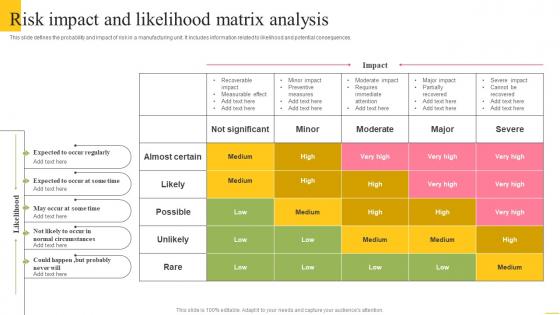
Risk Impact And Likelihood Matrix Analysis




Try Before you Buy Download Free Sample Product
 Impress Your
 Audience
 100%
100% Editable
 Save Hours
 of Time


This slide defines the probability and impact of risk in a manufacturing unit.It includes information related to likelihood and potential consequences.
People who downloaded this PowerPoint presentation also viewed the following :
Risk Impact And Likelihood Matrix Analysis with all 6 slides:
Use our Risk Impact And Likelihood Matrix Analysis to effectively help you save your valuable time. They are readymade to fit into any presentation structure.





FAQs for Risk Impact And
Look, you need four main pieces: figuring out what could go wrong, analyzing how likely and bad each thing is, deciding if you can live with it, and having a plan to deal with it. Someone's gotta be in charge of this whole thing - can't just be everyone's job and no one's job, you know? Document everything but don't go crazy with paperwork. I'd start with a simple grid ranking stuff by how probable it is versus how much it'd hurt. Honestly, the biggest thing is reviewing it regularly since everything changes. Build it up slowly based on what actually makes sense for your situation.
Start by listing out everything that could screw up your business - cyber attacks, supply chain issues, whatever. Get people from different teams involved since they'll catch stuff you totally missed. Then make a simple grid: probability on one side, impact on the other. Score each risk and plot them out. The high probability + high impact stuff? That's where you focus first. Honestly, even rough estimates beat treating every risk the same. You don't want to waste time on tiny problems when there's bigger threats that could actually sink you.
Dude, you absolutely have to get stakeholders involved early. Different people see totally different risks - like, finance worries about cash flow while operations thinks about supply chain stuff. Without their input, you're just guessing at what actually matters. And here's the thing - if you skip them during planning, they'll fight you later when you need them to actually do something about the risks. I learned this the hard way on a project last year. Talk to people at different levels too, not just managers. Front-line folks often spot the real day-to-day issues that higher-ups miss completely.
Tech tools are honestly a game-changer for getting better at spotting risks. AI can scan through tons of historical data and catch patterns that would take you forever to find manually. Real-time monitoring means you'll see problems coming instead of scrambling after they hit. The automation cuts down on those stupid mistakes we all make when staring at endless spreadsheets - though I still double-check the important stuff because I'm paranoid like that. Cloud platforms let you pull data from different sources too. I'd start by figuring out what parts of your current process eat up the most time, then find tools to handle those headaches.
Ugh, the data thing is the worst - you're always missing pieces and making educated guesses. People are weird about risk too. Half will freak out over nothing while the other half ignores actual problems. Leadership wants everything done yesterday but still expects you to be thorough (make it make sense?). Oh, and risks change while you're analyzing them, so that's fun. Time pressure is just constant. Honestly though, work with whatever data you've got and write down your assumptions. That way you can circle back when better info comes in.
Once a year minimum, but that's honestly bare bones. Any big operational changes? New regulations? Some incident that made you go "oh shit"? Don't wait - review immediately. I've watched companies get completely wrecked because they were like "nah, we'll wait till our scheduled review in March" while their whole industry was shifting under them. Kinda wild how stubborn people get about calendars. Set your annual reminders, sure. But also bake in automatic triggers for when stuff actually changes. You'll be glad you did.
Look, there are a few solid ways to tackle this. Most people start with probability matrices - just plot how likely something is against how bad it'd be. Works pretty well for most stuff. Monte Carlo simulations are cool for complicated scenarios but honestly they can eat up way too much time if you get obsessed with them. Financial risks? Try Value at Risk calculations or sensitivity analysis. Oh, and fault tree analysis is decent for operational headaches. The real trick is matching your method to what data you actually have and how much time you're working with. Don't overthink it.
Yeah, so industries basically worry about whatever could wreck them specifically. Healthcare's all about patient safety and staying compliant with regulations. Manufacturing? Equipment breaking down and keeping workers safe. Finance teams are super paranoid about market swings and fraud - honestly makes sense though. Tech companies lose sleep over cyberattacks and data breaches more than anything else. It's kinda interesting how each sector learned from their own epic failures over the years. That's why their risk frameworks look so different. I'd just look at what's historically destroyed companies in your industry.
You basically want to run "what if" drills on your risk models - stuff like market crashes, supply chain disasters, regulatory curveballs. Historical data's nice but it won't tell you how screwed you'd be if three bad things hit at once. Think of it like those earthquake drills we did in school, except for business risks. Most companies are terrible at spotting their blind spots until it's too late. Start with maybe 4 scenarios that genuinely worry your executives - the ones they probably lose sleep over. Way more useful than just hoping past patterns repeat.
Honestly, digging through old incident reports is where the gold is. Pull stuff from the last 2-3 years and you'll start seeing patterns you missed before. Sometimes what actually goes wrong isn't what you expected at all - kinda wild how that works. Focus on how often things happen and how bad they get when they do. Near-misses are super telling too. I'd say review everything quarterly so you're not flying blind. The whole point is using real data to fix your probability guesses instead of just winging it.
Document everything super clearly - I can't stress this enough. Use templates so it's consistent, record how you did the assessment, and actually explain your likelihood/impact ratings. Like, don't just slap "high risk" on something without saying why! Include your evidence, timelines, who owns what. Honestly, half the risk assessments I've seen are garbage because they're way too vague. Put it all in one central spot where everyone can find it. Date your versions too - trust me on this. If someone couldn't understand your risk ratings just from reading your docs six months later, you need way more detail.
Okay so basically those regulatory requirements aren't suggestions - they're the bare minimum you have to hit for risk assessments. Different industries have their own specific methodologies you'll need to follow, plus all the documentation and sometimes third-party validation stuff. Honestly it's kind of annoying but keeps everyone honest I guess. They also set your risk tolerance levels and define what counts as "acceptable" risk. Oh and definitely learn your specific regs upfront - way easier than trying to shoehorn them in later when you're already halfway through your process.
Look, there are basically four ways to handle risks: dodge them entirely by switching up your plan, pass them off through insurance or outsourcing, minimize damage with safety measures, or just live with the small stuff that's not worth stressing over. Most people want to fix literally everything - total waste of energy if you ask me. Hit the big scary ones first, you know? The stuff that's likely to happen AND would really mess you up. Write down what you're doing for each risk so everyone's on the same page, then check back regularly to see if anything's shifted.
Look, risk assessment is basically figuring out what'll actually mess up your business and how bad it'd be. You list out stuff like cyberattacks, natural disasters, supplier issues - then rank them by how likely they are and how much damage they'd cause. Honestly, most companies waste time on crazy scenarios when they should worry about boring stuff like ransomware. Focus on your 5 most critical operations first. That way you know what absolutely has to keep running and what you need to bounce back fast. It's like triage but for your business.
Keep tabs on stuff inside your company first - turnover rates, customer complaints, financials going south, any operational hiccups. Outside, watch for regulatory changes, what competitors are doing, market trends. Industry news is obvious but don't sleep on social media chatter (though seriously, don't spend three hours scrolling). Financial dashboards are your friend here - way better than digging through reports weekly. I've seen too many businesses miss early warning signs because they weren't paying attention to the right metrics. Patterns matter more than individual incidents.
-
The way SlideTeam professionals work is exceptional. Thanks for being so helpful!
-
The website is jam-packed with fantastic and creative templates for a variety of business concepts. They are easy to use and customize.