Enterprise Risk Assessment Heat Map
Try Before you Buy Download Free Sample Product
Audience
Editable
of Time
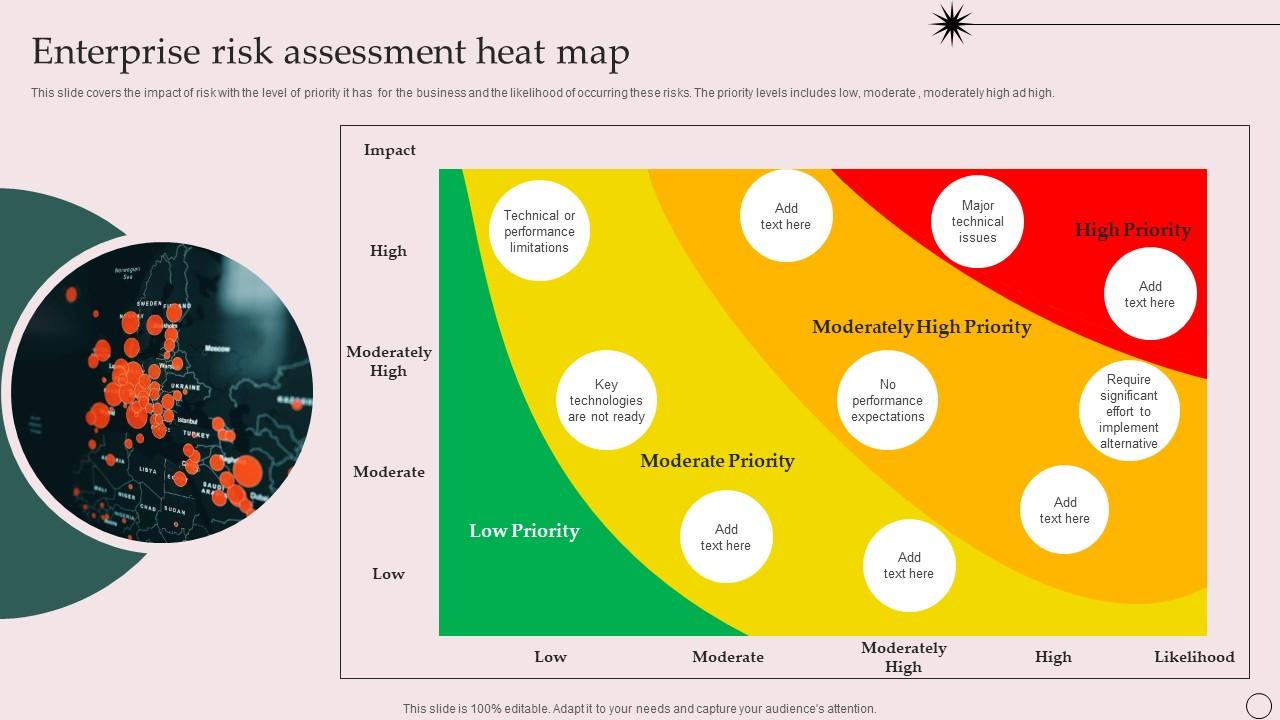
This slide covers the impact of risk with the level of priority it has for the business and the likelihood of occurring these risks. The priority levels includes low, moderate, moderately high ad high.
People who downloaded this PowerPoint presentation also viewed the following :
Enterprise Risk Assessment Heat Map with all 6 slides:
Use our Enterprise Risk Assessment Heat Map to effectively help you save your valuable time. They are readymade to fit into any presentation structure.
FAQs for Enterprise Risk
Honestly, start with defining your risk appetite first - that'll save you tons of headaches later. From there, you need five main pieces: risk identification (basically mapping everything that could blow up), assessment and prioritization (fair warning - you'll drown in spreadsheets here), response strategies, monitoring systems, and governance with clear roles. The biggest mistake I see? These components never actually communicate with each other. They just sit in their own little bubbles. Make sure yours don't - it defeats the whole purpose otherwise.
Start with your industry's typical nightmare scenarios - what regulations trip people up and where companies usually mess up. Industry reports help, but honestly the best intel comes from chatting with people at conferences who'll spill the real tea about what went wrong at their companies. Once you've got that list, figure out which risks actually apply to how YOUR business works. Some might sound scary but won't really affect you. Focus on the ones that could both realistically happen AND seriously damage your company. Don't just go by industry averages since every business is different.
You absolutely need stakeholders involved from the start - don't wait until the end to show them your findings. Finance spots totally different risks than IT or ops teams do. Get them helping you prioritize what actually matters to the business, not just what looks scary on paper. Honestly, they're the ones stuck dealing with whatever solutions you come up with anyway. I'd map out your key people early and set up regular check-ins throughout the whole process. They'll catch blind spots you'd never see and validate whether your assessment actually makes sense in the real world.
Dude, technology totally changes the game for risk assessment. AI can rip through tons of documents and financial records in days instead of weeks - honestly saved my sanity last quarter. Risk management platforms are clutch because they pull everything into one place rather than dealing with a million spreadsheets (which I still somehow end up with anyway). Real-time monitoring catches problems as they pop up instead of waiting months for reviews. Just make sure whatever you pick plays nice with your current systems. Start by listing what data sources you're already using, then find something that connects to those.
Mix leading and lagging indicators for the full picture. Start with risk exposure reduction percentages, incident rates, and resolution times. Cost of risk events vs mitigation spend is crucial too. Near-miss reporting rates are honestly my favorite metric - shows people actually trust the system enough to speak up. Don't forget risk register completion and control testing frequency. Business continuity during real disruptions tells you everything. Stakeholder confidence scores matter more than most people think. Pick 3-5 metrics tied to your biggest risks first, then expand from there.
Look, regulations basically control your whole risk assessment setup. They tell you what risks to find, how often to check them, plus all the paperwork you'll need. SOX handles financial stuff, GDPR covers data privacy, Basel III for banks - seriously, there's an acronym for everything. You can't just wing it anymore like the old days. These rules set baseline standards for finding risks, measuring them, and reporting timelines. My advice? Map out what you're doing now against the regs that apply to you. Do it early before audit season hits and you're freaking out about gaps.
So there are basically two ways to tackle this. Qualitative stuff uses risk matrices and expert interviews - you're just ranking things as high, medium, or low risk based on how likely they are and how bad they'd be. Quantitative gets into actual numbers with Monte Carlo simulations and financial models. Way more precise but also way more work. Most companies I've seen do both honestly - start with the qualitative approach to spot your biggest threats, then crunch the numbers on anything that could seriously mess up your business. Don't overcomplicate it if you're just getting started though.
Build flexibility into your risk assessment from day one. Quarterly scanning sessions work well - have your team hunt for emerging threats, not just rehashing old ones. Too many companies get caught off-guard focusing on yesterday's issues. Monitor industry trends, regulatory shifts, even geopolitical stuff that might hit you later. Creating a culture where people can flag weird-sounding risks early is huge. Honestly, the "far-fetched" concerns often end up being the ones that actually bite you. Don't wait for risks to become obvious - by then you're already behind.
Oh man, the worst thing you can do is turn it into some bureaucratic box-checking nightmare. Like, you'll end up with this massive binder that nobody ever looks at again. Start small with your most important stuff - trying to tackle everything at once is a recipe for burnout. The sneaky risks are usually the ones staring you right in the face, not the dramatic Hollywood scenarios. Get people from different teams involved too, because your IT folks won't catch the same issues as someone from operations. Trust me on this one - siloed risk assessment is basically useless.
Scenario analysis is basically stress-testing your risks by running "what-if" situations that go way beyond normal planning. Pick your top 3-5 risks and model them under best case, worst case, and "holy crap this would suck" scenarios. You'll get way better data on potential losses instead of just identifying what could go wrong. It's like war-gaming your business risks - honestly makes those boring quarterly reviews actually useful for once. The cool part is you start spotting how risks interact with each other under different conditions, which you'd totally miss otherwise.
Look, risk awareness culture is what actually makes your whole risk program work instead of just sitting there looking pretty on paper. When your team naturally thinks "what could go wrong here?" during regular decisions, you catch problems early. Way better than scrambling after everything's already hit the fan. Having everyone watching for issues beats relying on just your risk team - honestly, they can't see everything anyway. The key part? People need to feel safe raising red flags without getting blamed for it. Start small - just ask "what could go wrong?" in team meetings and actually listen when someone speaks up.
Look, you gotta weave risk assessment into your actual planning process from the start. Don't just bolt it on later. When you're doing strategic planning sessions, have your risk people in the room - seriously, this makes such a difference. Map your key risks directly against business objectives so you can see the overlap. Too many companies treat risk assessment like some separate thing, then act shocked when it doesn't help them make better decisions. Build risk discussions into quarterly reviews too. The whole point is letting risk concerns actually shape your strategic choices upfront, not playing catch-up after you've already committed to stuff.
Think of stress testing as throwing worst-case scenarios at your business to see what breaks. Market crashes, cyber attacks, supply chain disasters - you run these simulations to catch weak spots your regular risk analysis probably missed. What's really useful is seeing how problems spread. Like, if the market tanks 30%, you'll map out exactly how that hits every part of your operation instead of just going "oh we have some credit risk." Honestly, most companies overthink this at first. Just pick your 3 biggest worries and build test scenarios from there.
Start with standardized templates that capture likelihood, impact, and current controls - honestly makes everything so much cleaner. Document your methodology too so people actually understand how you got there. Heat maps work great for executives, but ops teams need the detailed action plans with timelines and owners. Oh, and don't forget to schedule regular reviews because things change fast. I learned this the hard way when our assessments got stale after like 6 months. Tailor your communication though - what works for the C-suite won't work for frontline managers.
So risk appetite is basically your boundary-setter for the whole thing. It decides what level of risk you're cool with across different parts of your business. Your assessment process uses this as the measuring stick - affects how you bucket risks into high/medium/low, what thresholds make you actually do something, which ones get bumped up to leadership. Honestly, without it you're just hoarding data that doesn't mean anything. Oh and make sure your framework actually matches these appetite levels so your risk ratings translate into real decisions people can use.
-
Their products can save your time, effort and money. What else you need. All in one package for presentation needs!
-
SlideTeam is the way to go when you are in a time crunch. Their templates have saved me many times in the past three months.