


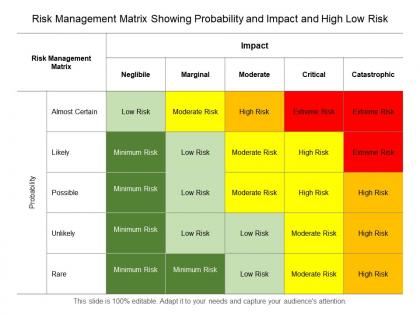
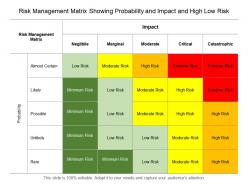
Risk management matrix showing probability and impact and high low risk




Try Before you Buy Download Free Sample Product
 Impress Your
 Audience
 100%
100% Editable
 Save Hours
 of Time


Contests become enjoyable with our Risk Management Matrix Showing Probability And Impact And High Low Risk. They find challenges exciting.
People who downloaded this PowerPoint presentation also viewed the following :
Risk management matrix showing probability and impact and high low risk with all 5 slides:
Explain judicial jargon with our Risk Management Matrix Showing Probability And Impact And High Low Risk. Enable folks to figure out the implications.



FAQs for Risk management matrix showing probability and impact and
So basically you've got four main steps: spot potential problems, figure out how bad they'd be and how likely, decide which ones actually need your attention, then make a plan to deal with them. Also keep monitoring because stuff changes all the time - honestly that's the part most people skip and then wonder why their risk plan fell apart. Document everything so you're not the only one who knows what's going on. Set your "acceptable risk" thresholds upfront too. Oh, and map out what you're actually protecting first - can't assess risks if you don't know what assets you have.
Honestly, just do a simple risk matrix - probability vs impact. Plot everything on those two axes. High chance AND high damage? Drop everything and handle those first. I'd tackle medium risks next, whether they're likely but not catastrophic, or rare but devastating. Low probability, low impact stuff can just sit in a document somewhere for now (don't stress about it). Create some kind of scoring system so you can actually rank things instead of just guessing. Oh, and revisit this every few months since new threats pop up all the time.
Look, data analysis is like having a crystal ball for catching problems before they smack you in the face. Historical patterns and weird anomalies in your numbers? That's where the gold is. Cash flow dips in financial records, equipment breaking down in cycles - this stuff is usually sitting right there waiting for you to notice it. Way better than just going with your gut, honestly. I'd start with whatever data you've got lying around already (doesn't have to be fancy) and hunt for warning signs that showed up before past disasters. You'll be shocked what patterns emerge.
So qualitative is basically "high, medium, low" ratings - risk matrices and gut feelings from experts. Way easier to start with. Quantitative actually calculates percentages and dollar amounts, which honestly takes forever but executives love hard numbers. I'd go qualitative first for most cybersecurity stuff since it's tough to put exact figures on "what if someone clicks a phishing link?" Then switch to quantitative when you need budget approval or compliance reports. Quick team chats? Stick with qualitative. Board presentation where they want ROI? Time to break out the spreadsheets.
Honestly, the biggest mistake is being way too narrow - like you can't just look at the obvious stuff, you need to think about how things connect and cascade. Most teams do it once then never touch it again, which is pretty pointless since threats change constantly. Don't let one department run the whole show either because they'll miss things. Keep it collaborative and treat your assessments like living documents. I'd say review quarterly at minimum and actually update when you learn new stuff. Oh, and outdated data will kill you - that's probably the worst one.
Look, each industry has totally different risks you've gotta account for. Healthcare? Patient safety and HIPAA stuff. Manufacturing worries about equipment breaking down and people getting hurt. Finance companies are paranoid about hackers and regulatory fines - rightfully so tbh. You want to figure out what could actually tank that specific business. A restaurant stresses about food poisoning, not so much data breaches. Start with industry standards and regulations, then talk to people who work there. They'll catch stuff you'd miss sitting at your computer. Those conversations are honestly worth more than any framework document.
Honestly, it depends on what you're dealing with. If you're at a big company, ServiceNow or Archer are pretty solid - MetricStream too. For smaller stuff? Excel templates work fine, or maybe Riskalyze. I swear, people overthink this and waste months comparing features when they could've just used a good spreadsheet. Qualys and Rapid7 are great if it's cybersecurity focused. Don't overcomplicate it though - figure out your budget first, then grab whatever's simplest that actually does what you need. No point buying enterprise software for basic risk tracking.
Look, once a year is the bare minimum - don't let anyone tell you otherwise. What actually works? Quarterly check-ins for your riskiest stuff, then do the full deep dive annually. Also kick off a new assessment whenever something major changes - new tech, regulations, whatever. Honestly, the biggest mistake I see is treating this like a checkbox exercise. Make it routine or you'll be panicking right before your next audit (been there). Set those calendar reminders now and actually assign someone to own it. Otherwise it just sits there forever.
Get stakeholders in from day one - seriously, don't do half the work first then ask for opinions. Figure out who's actually dealing with these risks daily. Brainstorm with them because they'll catch stuff you'd never think of. Honestly, I've watched so many risk assessments crash because nobody bothered talking to the people on the ground doing the work. Be upfront about what you need from everyone. Some folks love meetings, others would rather just shoot you an email with thoughts. Both work fine. Write it all down and loop back to show how their ideas made it into the final thing.
Honestly, AI is pretty incredible for risk stuff because it can churn through mountains of data while you're having coffee. Market trends, customer patterns, operational metrics - things that would take your team forever to analyze manually. It never gets cranky on Monday mornings either (though it definitely has weird blind spots sometimes). The real win is catching problems before they blow up. I'd suggest testing it on just one area first rather than going all-in. Maybe start with whatever risk area bugs you most? Then expand from there once you see how it performs.
Dude, skipping risk assessments is like driving blindfolded - you're gonna hit something eventually. Financial losses, safety incidents, regulatory fines - all stuff that's totally preventable. Auditors will tear you apart too, and good luck getting decent insurance or investors without proper documentation. Resources get wasted when you don't know what you're actually dealing with. Honestly, I've seen companies get burned by this more times than I can count. Set aside some time soon to check what gaps you have in your current process. Way better to catch problems now than after they've already cost you money.
Look, you can't just slap together a risk assessment after you've already made your strategic plans - that's backwards. Figure out what could actually tank your goals first, then build your roadmap around those realities. Most companies I've worked with do these elaborate risk reports that literally nobody looks at again. What a waste. Instead, bake those mitigation strategies right into your planning process. Review everything quarterly and actually talk about how new risks might mess with your priorities. The whole point isn't to avoid every risk - it's to make smarter decisions knowing what's out there.
Track how many risks you spot vs actual incidents that hit. Also check if your risk ratings match real damage when stuff goes sideways. False positives/negatives matter too - you don't want to miss critical things or cry wolf constantly. Are teams actually using your mitigation plans? That's huge. I get way too into the weeds on this, but honestly the baseline approach works best. Start measuring what you've got now, then tweak from there. The whole point is making assessments that people will act on.
Honestly, you've got to bake review sessions into your process and actually show up to them. Most teams say they'll do quarterly check-ins but then get swamped with daily chaos - I've seen it a million times. Compare what you predicted would happen vs. what actually went down. That's how you get better at spotting trouble early. Mix up who's in the room too. Fresh eyes catch stuff you've been blind to. Oh, and track everything - sounds boring but it's gold for improving your gut instincts. Block out 30 minutes this week to talk through what went sideways recently. Just do it now before you forget.
Get your team trained on whatever risk framework you're using first - ISO 31000, FAIR, etc. Risk identification workshops are honestly pretty fun once people stop being awkward about it. Everyone needs to understand probability vs impact scoring and your risk register tools. Don't forget industry-specific stuff like cybersecurity or operational risks. Templates and checklists will save you so much headache later, trust me. Oh, and definitely run a pilot on something small first. Let them practice before you throw them into the deep end with major risks. Way less stressful that way.
No Reviews