

 0 Comment
 Customer Reviews

“One of the true tests of leadership is the ability to recognize a problem before it becomes an emergency.”
—Arnold Glasow
In 2013, Target, a retail giant, fell victim to a huge data breach that compromised more than 40 million customers' credit and debit card information. The breach originated from a poorly secured third-party HVAC vendor through which hackers had access to the Target network. The aftermath? Financial losses, lawsuits, brand damage, and a wake-up call of how underrated threats can turn into newsworthy nightmares.
What’s even worse is that they failed to intercept and act upon those threats proactively!
Rise above uncertainties and induce smarter decision-making by utilizing our Top 10 Risk and Opportunity Matrix Templates!
This is where SlideTeam’s Threat Matrix Templates prove their worth! They help companies identify, assess, and prioritize potential threats. These layouts help teams oversee the likelihood and impact matrix of each threat or risk on business operations and assets, whether it’s cybersecurity risks or operational disruptions.
These templates help you with:
- Risk assessment and responsible resource allocation
- Running a threat landscape analysis
- Implementing a threat matrix for accelerating incident response
- Evaluate the consequences
- Developing mitigation strategies
- Monitoring changes
- Conducting periodic assessments
Plus, they are 100% content-ready and customizable, giving you the flexibility to focus on things like the severity of threats/ risks and risk management, and skip the formatting headache.
Let’s see how they work and why they’re a must-have!
Understand a delicate balance between risks and opportunities with these Top 10 Risk Assessment Matrix Templates!
Template 1: Threat Matrix PPT Graphics ACP PPT Slide
If properly assessed and followed, a threat matrix like this one can instantly help you spot danger zones. It helps you map out threats, understand threat landscape analysis, evaluate their impact, and plan your response. Some of its key slides are:
- Introduction: Covers Risk assessment and incident response
- Threat matrix framework: Illustrate the potential risks and threats and give steps to tackle them.
- Importance of threat modeling: Helps you detect weak spots and loopholes in your security framework.
- Defining threat categories: Helps group dangers based on threat, impact, and type of mitigation strategy to better understand and handle them.
[product_image id=1286994]
Template 2: Threat Matrix for Incident Response Reporting to Management PPT Slide
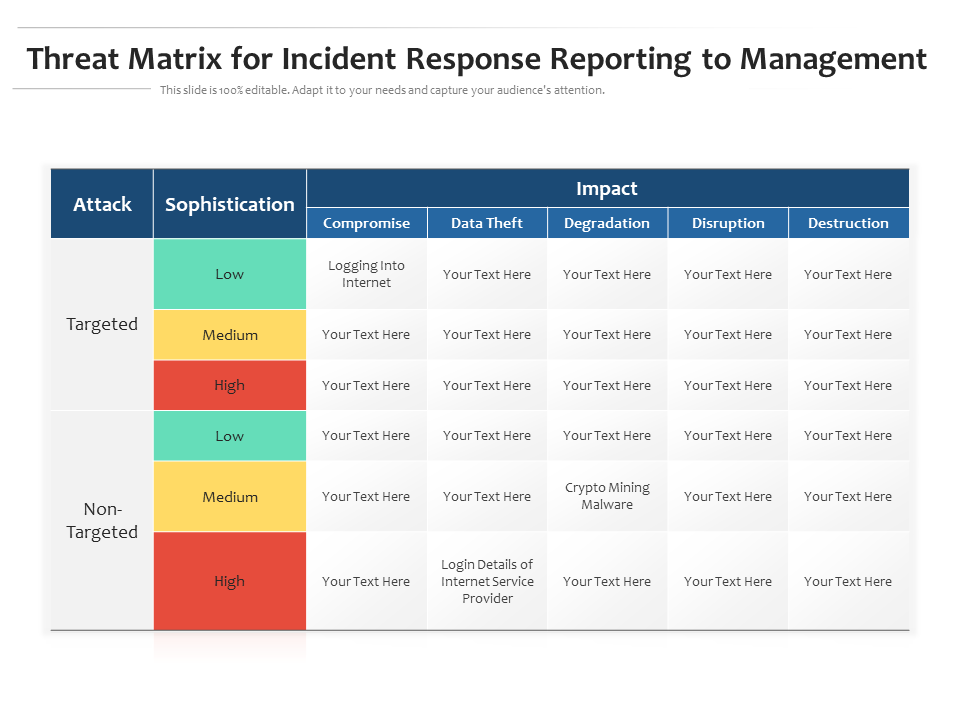
Keep leadership well informed when digital trouble hits, outlining the ‘who,’ ‘what,’ ‘how,’ and ‘what to do’ of cyber threats faced. This visual and comprehensive story translates the technical jargon of attacks and impacts into actionable insights. This cyber threat matrix classifies threats into types of attacks, sophistication levels, and the type of impact. Such classification helps you prioritize risks, demonstrate the seriousness of the impact of the incident, track ongoing risks, and present necessary security measures with precision. Get things under control by downloading this template today!
Template 3: Information Security Program Cybersecurity Management PPT Template
This threat vulnerability matrix gives you a 360-degree view of your digital battlefield, where you lay it all out, whether it's assets (like server systems or data), sources, threat agents, or weaknesses. This template lets you connect the dots, highlighting:
- Ranked critical resources
- Threat agents: This includes insider threats, special engineering, malware, specific cyber threats, and insider maintenance threats.
- Server systems
- Local area network
- Internet sources exposing vulnerabilities and threats
- IT safeguards: IT features threat detection and security methods, such as firewalls, IPS, anti-virus software, system redundancy, encryption, UPS, incident response plans, training, etc.

Template 4: Competitive Business Threats Analysis Matrix, Business Improvement Strategies
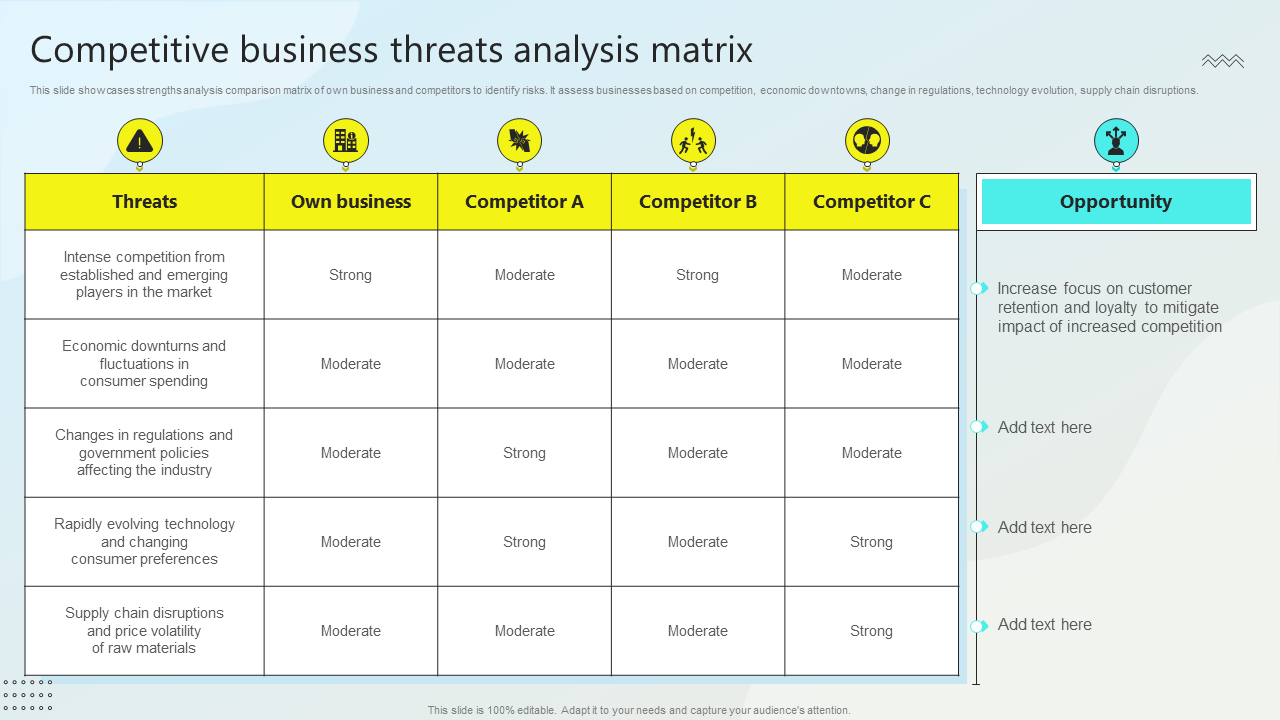
For busting risks and threats like a pro, it is important that your defense mechanisms are at their strongest when and where you want them to be, especially when you stand alone in the fierce competition. This is where this strategic blueprint does its work. It showcases a clear and organized comparison matrix of a business and its competitors. It helps you determine the key competitor threats and their intensity, specific threats they pose, and prioritize threats based on the following:
- Intense competition
- Economic downturns and fluctuations
- Changes in regulations and policies
- Changing technology and customer preferences
- Supply chain disruptions

Template 5: Risk Assessment Matrix With Vulnerability And Threat Level Information Security Risk Management
This template acts like your command centre, which allows you to defend your market position, tackle cybersecurity risks, and color-code risk levels to spot alarming concerns easily. This risk assessment matrix directs your attention and resources toward high-priority risks and threats. The color-coding vulnerability level chart quantifies the danger and marks each risk into different threat levels, like very high, high, moderate, low, and very low. This classification enables smarter decision-making and easy danger identification. Grab it now!

Template 6: Matrix for Threat Solution and Risk Management Information System Security and Risk Administration Plan
So, you've got a long list of potential threats and a bunch of security tools, right? But how safe are you really? Find out with this solution and risk management matrix. It breaks down each threat solution’s implication for different types of information security attacks like SQL injection, malware, weak audit trail, privilege abuse, virus, storage exposure, etc. The following threat solutions let you see what you’re up against while effectively planning, managing, and tracking their impact:
- Blocking malicious web requests
- Monitoring database activity
- Validating database protocols
- Capturing detailed transactions
- Archiving external data

Template 7: Digital Safety Threat and Risk Assessment Matrix PPT Template
What if you had a sure-shot guide to pinpointing the loopholes and potential weak areas in the digital world, and how serious might it be? We heard you! This safety and risk assessment matrix clears up the complexity fog, giving you a clear snapshot of where your safety efforts should matter the most. It classifies the impact of several threats like hacking, data breaches, information misuse, malware, and system failure into a likelihood and impact matrix. In a nutshell, this “watch out” checklist highlights an easy-to-understand view of the most important areas to secure. Get access to it today!

Template 8: Cyber Terrorism Threats and Safeguard Assessment Matrix PPT Template
Does Cyber Terrorism sound like some fancy term from a fictional movie? Tell that to companies that face ransomware and data breaches every single day! This is where this template steps in! It helps you manage each scary-sounding threat like an expert, providing information on functions and safeguards:
- How can you identify and assess the type of threat?
- How likely is each threat?
- How much damage can it cause, or has it already been caused?
- What can you do to gain protection against it?
- How to respond?
- What are the ways to recover from it?

Template 9: Competitive Business Threats Analysis Matrix Steps for Business Growth Strategy SS
According to a study, 94% of business leaders believe their industry will be drastically disrupted within the next five years. This is the reason that makes competitor threat analysis not only essential but non-negotiable. This template plays a critical role in assessing threats against your competitors, allowing you to focus on customer retention, enhance brand reputation, manage risk strategies, and proactively plan business processes to tackle potential threats. It showcases a diverse yet easy-to-grasp blueprint, outlining types of internal and external threats. Internal threats represent one’s own company’s threats, and external threats involve threats from competitors, such as:
- Intense competition from existing and emerging competitors in your industry
- Economic downturns and consumer spending fluctuations
- Industrial and government regulatory and policy changes
- Evolving technology and consumer needs
- Supply chain and demand misalignments
Template 10: Assessment Matrix Indicating Impact of Technologies on Insider Threat Use Cases
Have you ever wondered how rapidly changing technologies can either fight or fuel insider threats? This assessment matrix is designed to answer that question. It effectively explains key insider threat use cases, such as information leaks, unauthorized access, malicious operations, etc. Plus, this template helps assess how various technologies like Firewalls, Data Loss Prevention methods, SIEM, User Behavior Analytics, and Process Control Systems impact risks and threats. Download it right away!

Analyze Systems Like an Attacker Would!
Spotting vulnerabilities, understanding threats, and building controls isn’t an easy feat when you are constantly dealing with ever-changing and unknown technology, rising competition, and shifting customer demands. This is where our ultimate Threat Matrix Templates steps in to save the day!
How do they make a difference?
- Structured & flexible: Our templates encourage critical thinking and replace gut instinct with reliable methodology.
- Designed considering an attacker’s mindset: Know how they think so you can stay one step ahead
- Risk-focused: Our templates help you tackle the threats that are truly worth acting upon, keeping you away from distractions.
- Early-stage impact: They help you act early and plan your security efforts in advance
- Evolves with your system: Our templates seamlessly blend with your business objectives and operations.
So download one of the above templates to sniff out the villains and kick them out before they even reach the doorknob!
- Never let negligence and unpreparedness hinder your business growth. Explore these Top 10 Risk Probability and Impact Matrix Templates to sniff out any possible threats to your business!
FAQs on Threat Matrix Templates
1. What are the 5 steps of threat modeling?
Key steps for threat modeling include:
- Identifying what to build: Describe the servers, databases, APIs, and other system components, and create a data flow diagram to present data flows.
- Recognizing threats: Apply the STRIDE method, illustrated as spoofing, tampering, repudiation, information disclosure, denial of service, and elimination of privilege.
- Mitigating risks and threats: Define strategies such as prevention, detection, response, and recovery, and apply security controls such as authentication, encryption, and validation.
- Validating and documenting: Review whether mitigation methods cover all threats and document decisions for tracking.
2. What is the ultimate goal of threat modeling?
Regardless of methodology, a proficient threat modeling infrastructure must:
- Follow a systematic approach rather than standard security reviews.
- Assess threats from a source’s or an attacker’s point of view.
- Let you prioritize security efforts based on the type of risk.
- Allow early integration and intervention of mitigation strategies.
- Update models and functionalities as technology and regulations evolve, leaving scope for continuous refinement.
3. What are the potential impacts and severity of each threat?
Possible impacts are generally categorized into:
- Financial Loss: Costs resulting from data breaches, fraud, and inefficient operations.
- Reputational Damage: Loss of customer trust and brand value.
- Operational Disruption: System downtime and its effect on productivity.
- Compliance Risks: Fines, penalties, or legal fees from regulatory breaches.
- Information Breaches: Loss or theft of private and sensitive data
- Competitive Harm: This happens when you lose market share due to unidentified and unresolved vulnerabilities.
- Security Risks: Physical or cyber safety concerns impacting assets, data, software, or individuals.