


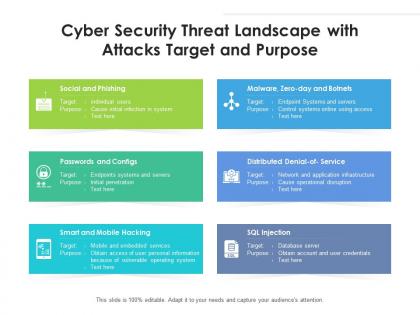
Cyber security threat landscape with attacks target and purpose




Try Before you Buy Download Free Sample Product
 Impress Your
 Audience
 100%
100% Editable
 Save Hours
 of Time


Our Cyber Security Threat Landscape With Attacks Target And Purpose are topically designed to provide an attractive backdrop to any subject. Use them to look like a presentation pro.
People who downloaded this PowerPoint presentation also viewed the following :
Cyber security threat landscape with attacks target and purpose with all 2 slides:
Use our Cyber Security Threat Landscape With Attacks Target And Purpose to effectively help you save your valuable time. They are readymade to fit into any presentation structure.

FAQs for Cyber security threat landscape with attacks
Look, phishing emails are your biggest headache - people click stuff they shouldn't. Ransomware's brutal too, can lock down everything (never pay those jerks). You've got malware, insider threats from pissed off employees, weak passwords causing data breaches. Oh, and DDoS attacks that just flood your systems. Honestly? Your employees are gonna be the problem 90% of the time. Get them some security training and keep your software updated. I know it sounds boring but it actually works.
Okay so first thing - get a vulnerability assessment done to find weak spots before the bad guys do. Penetration testing is huge too, where white hat hackers basically try to break in. I'd also do regular audits of your software, hardware, and how employees handle security stuff. Oh and those social engineering tests? Super important because people fall for phishing way more than they admit. Third-party vendors are honestly where most breaches happen these days. Do this quarterly minimum, and tackle the scariest vulnerabilities first.
Dude, training your people is honestly the biggest thing you can do. Like 95% of breaches happen because someone clicked something they shouldn't have or used a terrible password. You could spend thousands on security software, but if Janet from accounting keeps falling for phishing emails, you're screwed anyway. Teach them to spot sketchy emails and create decent passwords - oh, and don't plug in random USB drives they find lying around (people actually do this!). Monthly sessions work great, just don't make them sit through boring slides or they'll zone out completely.
So ransomware is basically digital extortion - they encrypt all your stuff and won't give it back until you pay up. It's way more in-your-face than other malware that tries to hide. Most cyber attacks are sneaky, right? They steal data quietly or mess with systems behind the scenes. But ransomware attackers *want* you to know you've been screwed because they need that immediate payday. They're not playing the long game like data thieves who sell info later - they want cash now. Honestly, it's pretty ballsy. Your best bet is having solid backups and actually testing them regularly.
Honestly, AI and machine learning are total game-changers for cybersecurity right now. They spot weird stuff and predict attacks way faster than old-school methods. Zero-trust is another big one - basically you treat everything like it's already hacked until it proves it's not. Behavioral analytics have gotten scary good at catching when someone's acting fishy, even with legit credentials. Quantum encryption is starting to pop up too, though that's still pretty niche. My buddy at work swears by AI-powered threat detection - says it's basically required now if you want to stay ahead of hackers.
First thing - figure out what assets you actually need to protect and who's doing what during a crisis. Map out your detection, containment, investigation, and recovery steps so you're not scrambling. Communication is huge here because trust me, you don't want executives blowing up your phone every two seconds when you're trying to handle things. Get your external contacts sorted too - legal, PR, law enforcement, the works. Here's the thing though: none of this matters if you don't practice. Run tabletop exercises quarterly or you'll find out what doesn't work during the worst possible moment.
Dude, the legal stuff can get really messy depending on your industry. GDPR and state privacy laws hit hard - like millions in fines if personal data gets breached. Healthcare and finance? Even worse penalties. Customers will definitely sue you for damages too if it's your fault. The whole regulatory thing just keeps getting stricter honestly - kinda feels like they add new rules every month. But yeah, document whatever security measures you've got and definitely have some kind of response plan ready. Shows you weren't just winging it.
Dude, phishing is getting scary good now. They're using AI to make fake emails that look legit, plus deepfake videos that'll mess with your head. Business email scams are huge - they pretend to be your boss asking for wire transfers. Text message phishing is everywhere too. And don't get me started on those voice calls that sound exactly like real people. They've moved past just wanting passwords now - it's malware downloads and straight-up money transfers. Some days I look at these emails and think "yeah, I might've fallen for that one." Best thing? Always double-check through another channel before you do anything with money.
Dude, social engineering is seriously scary stuff. Hackers basically skip trying to break your tech and just mess with people's heads instead. They'll send fake "urgent" emails pretending to be your boss, trick employees into clicking bad links, or straight-up ask for passwords. I swear, people fall for the weirdest things sometimes. Your company could lose tons of money or get totally hacked because someone thought they were helping the CEO. Best thing you can do? Train everyone to spot these tricks. Make sure people aren't afraid to double-check sketchy requests too.
Start with VPNs for everyone working remotely - that's non-negotiable. Multi-factor auth on email and cloud stuff too. Your employees' home WiFi is probably sketchy (mine definitely was during the pandemic), so bug them about router updates and basic security. Phishing emails are everywhere now, so train people to actually recognize them. Endpoint protection software needs to be on every single device touching company data. Oh, and create actual policies about what data goes where - then audit access regularly. People tend to accumulate way more permissions than they need over time.
Dude, first thing - change those default passwords! Hackers absolutely feast on "admin/admin" setups. Keep your firmware updated too, it's annoying but worth it. I'd set up a separate network just for smart devices so if one gets hacked, they can't touch your main stuff. Trust me on the network thing - total lifesaver. Also turn off features you don't actually use. Oh and maybe do a quick check every few months to see what's still connected? I found like three random devices I forgot about last time I did this. Basically treat them like any other computer that needs protection.
So zero-trust is basically being paranoid about everything - and I mean that in the best way possible. Nobody gets trusted by default, even if they're already "inside" your network. Every single user and device has to prove who they are before accessing anything. It stops hackers from bouncing around your systems after they break in, plus it catches insider threats and stolen passwords. Honestly, given how crazy things are getting with cybersecurity, it's probably the smart move. I'd start with multi-factor authentication and micro-segmentation if you're thinking about it.
Dude, cyberattacks are ridiculously expensive - like $4.5 million on average according to IBM's report. Companies get hit with immediate stuff like forensics and system repairs, then there's all the legal fees and credit monitoring costs. What really kills them though is being offline for weeks and losing customers. Plus regulatory fines are brutal these days. The reputation damage is probably the worst part since people lose trust and stop buying from you. I was reading about this one company that... anyway, bottom line is spending money upfront on security beats dealing with this nightmare later.
So frameworks like NIST and CIS are basically your cheat sheet for not panicking when security stuff goes sideways. They walk you through the basics - figure out what you're protecting, catch threats early, respond fast, then bounce back. NIST is pretty flexible and works for everyone. CIS gets more specific about what actions to take. Honestly, I'd pick whichever one matches where your company's at right now maturity-wise. Use it to see where you suck currently. Both help you spend money smarter and keep auditors happy, which is half the battle anyway.
Start with CISA alerts and SANS Internet Storm Center for the official stuff. Krebs on Security is solid, plus Threatpost and The Hacker News - though I probably waste too much time scrolling through articles when I should be working lol. Twitter's actually useful if you follow the right security researchers and @CISAgov. Google alerts work great for industry-specific threats. Maybe grab some vendor threat feeds if you've got budget for it. Honestly though? Pick 2-3 sources you'll actually read instead of bookmarking a million things you'll never touch again.
-
Excellent work done on template design and graphics.
-
Designs have enough space to add content.
-
Visually stunning presentation, love the content.
-
Illustrative design with editable content. Exceptional value for money. Highly pleased with the product.
-
Professional and unique presentations.
-
Best way of representation of the topic.