

Cyberterrorism it powerpoint presentation slides




Try Before you Buy Download Free Sample Product
 Impress Your
 Audience
 100%
100% Editable
 Save Hours
 of Time


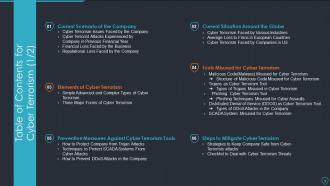
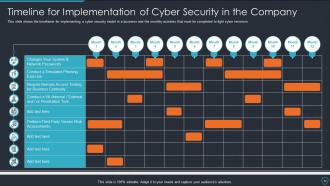
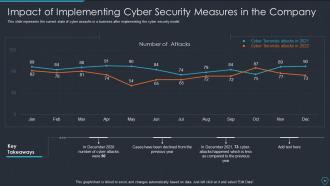
Cyber Terrorism is the fusion of cyberspace with terrorism; it refers to illegal assaults and threats of attacks on computers networks. Here is an efficiently designed template on Cyber Terrorism IT that is of significant assistance to learn about the problems faced by the company and the current scenario of cyber terrorism around the globe. In this presentation, we have incorporated the elements of cyber terrorism, which include types and forms of cyber terrorism and the tools misused. In addition, PPT shows preventive measures to protect the company from tools of cyber terrorism. Furthermore, it includes strategies to mitigate cyber terrorism. Moreover, this presentation represents an assessment matrix to determine the financial impacts of cyber-terrorist attacks on business and the companys implementation of cyber security measures. Further, the template caters to a checklist to deal with cyber-terrorism in the industry, a timeline, and a roadmap to monitor the implementation process. Lastly, the Delivery Network deck comprises a 30-60-90-day plan to implement cyber security in business and a dashboard to measure the organizations performance and impact of the cyber security implementation. Get access now.
People who downloaded this PowerPoint presentation also viewed the following :
Content of this Powerpoint Presentation
As defined by researchers Jordan Plotnek and Jill Slay, “Cyberterrorism is a premeditated action by people which is an act of terror, by using the world of cyberspace to cause physical, economic, political, and other harms.”
Cyberterrorism is a global threat that occurs due to reliance on Information Technology, harming the society and the nation’s stability as well. Nowadays, every other industry is dependent on the Internet network including government services and financial systems. The data is also exposed to third parties whose accountability is uncertain, giving an easy opportunity for attackers to cause interruptions.
Talking about modern businesses that rely on technology to perform certain tasks, their data, and resources have become prone to cyberterrorism.
The codification and implementation of cybersecurity best-practices can minimize the damage of attacks by educating employees and implementing safe systems that prevent threats. Since cybercrime has emerged as the prime concern for the globe, it requires immediate attention and prevention measures to reduce the chances of attack.
While you are hard-pressed to perform the major steps to prevent network vulnerabilities, creating PPTs will add to the burden. What if you take support from us in developing content-ready slides to help you inform the debate on this highly-sensitive topic in a much more professional manner?
Slideteam’s 100% editable and customizable cyberterrorism templates will assist you and your team members in understanding the dynamics of cyberspace. With that, you can explore our cybersecurity PPT Templates, which can draw quick attention to the key issues in computer systems and measures to prevent data theft.
This blog is about our cyberterrorism PPT Slides that elaborate on major preventive measures and protections against this nefarious crime.
Let’s explore!
Template 1: Cyber Terrorism Issues Companies Face PPT Template

With this slide, depict the company's key cyber terrorism issues, such as increased costs, reputational damage, lost revenue, and intellectual property theft. Explain each issue one by one. This template helps provide a broader picture of cybersecurity problems so that organizations can take proactive steps to combat emerging vulnerabilities.
Template 2: Cyber Terrorist Attacks Experienced by Company in Previous Financial Year

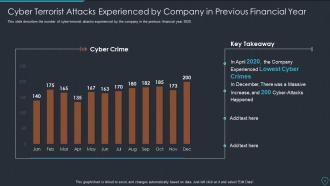
History is important to consider as it impacts the present as well. Use this PPT Template to showcase the cyber-terror attacks experienced by the company in the past in a graphical pattern. You can elaborate on the extent of seriousness when you talk in numbers. It is a good way to create an impact on your audience, whether you are educating your employees or pitching your prevention plan.
Template 3: Financial Loss Faced by the Business

The impact of cyber terrorism on business is substantial, which requires a thorough explanation to influence the audience. This interactive slide will do justice to your approach as it effectively describes the financial losses faced by the company. The properly organized information, with projects as the variable, will impress your audience. Leverage the oversight of the effects of critical risk incidents with a quick download of this slide.
Template 4: Reputational Loss Faced by the Company

Apart from financial loss, cyber terrorism affects a company's reputation. This slide flags the reputational consequences of cyber attacks. You can create awareness regarding the damage to stakeholders and understand the potential consequences of the loss. This template will encourage you to have a risk management focus to prioritize risk management efforts.
Template 5: Cyber Terrorism Faced by Industries

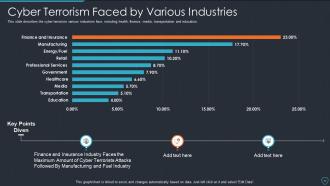
This is another graphical template that demonstrates the industry dynamics of cyberterrorism. With the effective use of this slide, you can provide industry-specific insights to your target audience. Plus, you can have an opportunity for a cross-sector collaboration which creates a collective resilience towards cyber attacks. Hence, it is possibly a good way to get an oversight of experiences and learn from them to regulate them on time.
Template 6: Average Loss to Firms in European Countries

This slide will help a business owner to determine the average loss in European countries. With an analysis across countries, one can get a bird’s-eye view of the magnitude of the impact of cyber terrorism. You have an analysis of regional trends and benchmark the industry standards. Also, a cost-benefit analysis can be made with the identification of the potential impact of cyber terrorism on European countries.
Template 7: Cyber Terrorism Faced by Companies in US

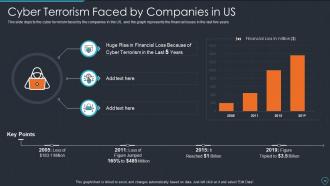
Use this slide to depict key issues companies in the US face. You can make a thorough vulnerability assessment graphic, to check the system, networks, and processes. Afterward, a proactive action can be undertaken. It will act as a demonstration of cyber terrorism risks to the audience by highlighting the key issues. Likewise, you can gain customer trust by showing regard to the protection of sensitive information.
Template 8: Simple Advanced and Complex Types of Cyber Terrorism

Recognizing types of cyberterrorism is necessary to analyze the right approach towards the threat. This slide is just the right way to depict key points under each category. You can point out the basic or unsophisticated attacks in simple structure, the advanced structure will include sophisticated malware attacks, and lastly, the complex structure will include coordinated or multifaceted attacks. This lucrative classification is essential in knowing the correct strategy for coping with them.
Template 9: Three Major Forms of Cyber Terrorism

With the sharp increase in cyber terrorism, IT security professionals have to be aware of the kinds of attacks that can disrupt the system. Use this template to describe the forms of attacks such as privacy violations, network damage, and disruptions, and distributed denial of service attacks. Further, you can depict the explanation of each point in the compact boxes which adds to the visual appeal of the slide.
Template 10: Malicious Code (Malware) Misused for Cyber Terrorism

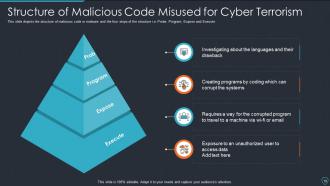
This slide will assist IT security professionals in helping the audience understand the cyber-terrorism landscape through malware tracking. Malware is used to cause interruptions with sensitive information. It can also be misused to damage critical infrastructure, which can sabotage the service. This slide elaborates on those dynamics in a clear format. Your stakeholders will love to see this information assimilation as it captures the maximum points to be elaborated in a single slide.
******
Explore the Dynamics of Cyber Terrorism with Slideteam
In this digital age, where everything has turned online, the probability of cyber threats has risen over the past few years. Cyberterrorism comes into the picture, when clever attackers steal and misuse national information. With the use of cyber terrorism PPT Slides, you will get confidence in user education and employing attack prevention strategies.
Check out our other cyber security powerpoint bundles to present stats, figures, and graphics on the issue.
To make a defensive plan for cyber terrorism, getting hands on the right platform is necessary to make the presentation look more professional and value-oriented. Download this PPT deck today if you want to maintain cyber security resilience across your company.
Cyberterrorism it powerpoint presentation slides with all 82 slides:
Use our Cyberterrorism IT Powerpoint Presentation Slides to effectively help you save your valuable time. They are readymade to fit into any presentation structure.







































FAQs for Cyberterrorism it
So cyberterrorists basically want the same things as regular terrorists - ideology, politics, spreading fear. But here's the thing: they don't have to blow themselves up or risk getting caught on camera. They can mess with power grids, banks, steal massive amounts of data from their bedroom if they want. Way harder to track down too. Traditional terrorists need that shocking violence for media coverage, right? Cyber attacks can be just as damaging but the guy behind it stays anonymous. Honestly makes it way easier for someone to get started - no bombs, just coding skills.
Okay so first things first - update your software regularly and get multi-factor authentication set up. Your employees are probably gonna be the biggest risk tbh, so train them well. Most of these cyberterrorist attacks? They're hitting really basic security gaps that should've been covered ages ago. Network segmentation is huge too - if hackers get into one part, you don't want them wandering around your whole system. Run penetration tests regularly. Oh and seriously, keep offline backups. I've seen too many companies get completely screwed because they skipped that step. Nail these basics before you blow money on the latest security gadgets.
Dude, it's wild how these cyberterrorists use social media now. They're basically hunting for vulnerable people through targeted messages and those algorithm bubbles we all get stuck in. Twitter, Facebook, encrypted apps - they use everything. The psychological stuff they do is honestly creepy as hell. First they build these communities that slowly make extreme ideas seem normal, then boom - private chats for the real planning. If you're keeping an eye on things, watch for weird coordinated posting and tons of new accounts popping up at once. That's usually when recruitment's ramping up.
So basically countries use cyber attacks instead of actual wars now. Russia, China, North Korea - they're constantly hitting power grids, banks, government stuff to mess with their enemies. Way cheaper than sending troops, plus it's super hard to prove who did what. They steal data, crash systems, make people lose trust in institutions. Honestly, it's pretty scary how effective it is. Your company's probably on someone's target list whether you realize it or not, so definitely get your cybersecurity sorted and have backup plans ready.
Ugh, there's no real global system for this stuff - it's basically a mess of different agreements scattered everywhere. The Budapest Convention covers 65+ countries but that's just general cybercrime, not terrorism specifically. UN has some resolutions but they're pretty toothless tbh. EU and ASEAN do their own thing with separate frameworks. Problem is everyone defines cyberterrorism differently so good luck getting countries to work together smoothly. Oh and if you're dealing with actual cases, you'll need to figure out which treaties even apply between the countries you're looking at first.
Look, teaching people about cyber threats is honestly huge for preventing attacks. Most cyberterrorists get in through basic tricks - phishing emails, fake websites, that kind of stuff. When your coworkers know what sketchy links look like, they won't click them. Same goes for social engineering attempts. I swear, half the data breaches happen because someone falls for an obvious scam. Regular training sessions work really well. Get everyone up to speed on current threats and basic security habits. It's like building a human wall that makes hackers' jobs way harder from the start.
Yeah, cyberattacks definitely make people way more paranoid about digital stuff. After big incidents, you'll see folks suddenly scared to use online banking or whatever smart devices they have at home. Can't really blame them tbh. New tech adoption takes a hit too - people get hesitant about services they used to trust without thinking twice. Companies end up spending tons rebuilding confidence through better security and being more transparent about their practices. My advice? Stay informed but don't let media hysteria freak you out too much about the actual risks.
Honestly, it's way more effective when private companies and government work together on cyber stuff. Most of our critical infrastructure is privately owned anyway, so they kinda have to coordinate. Companies have the latest tech and know their systems inside out, while government brings intelligence resources and regulatory clout. The real magic happens when they share threat info quickly - like, companies spot weird activity and agencies can connect it to bigger attack patterns they're seeing. Trust is huge though. They need solid agreements and practice runs so everyone knows their role when shit hits the fan. Otherwise you're just wasting time during an actual crisis.
So AI and machine learning are honestly where it's at - they catch weird network stuff humans totally miss. Behavioral analytics learns your system's "normal" then freaks out when something's off. Threat intelligence platforms share attack info between companies super fast now, which is pretty neat. Advanced endpoint detection blows traditional antivirus out of the water. There's also this deception tech that sets up fake honeypots to trick attackers. But here's the thing - you can't rely on just one tool. Stack different detection methods because nothing's foolproof on its own.
Honestly, cyberterrorism messes with your head way more than people realize. The fear and anxiety hit different because you can't see it coming - attacks on infrastructure or your personal data just feel so random and invisible. People lose sleep over it, constantly feeling vulnerable. Whole communities end up traumatized and stop trusting the institutions that should protect them. It's actually scarier than physical attacks sometimes? The ripple effects are wild too - folks isolate themselves, avoid digital spaces, become hypervigilant about everything online. Best thing you can do is learn digital literacy and have some kind of response plan ready.
Cyberterrorism hits different than regular hacking - these guys aren't after your credit card info, they want chaos and headlines. Communication becomes huge here since they're literally trying to scare people and get media coverage. I'd probably spend twice as long on messaging to stakeholders compared to normal incidents. You'll need direct lines to law enforcement and maybe even national security folks, plus share intel with other companies way faster. The tricky part is handling it like both a tech problem AND a public safety crisis right from the start.
Dude, it's such a minefield honestly. You've got the whole proportionality thing - like, how do you hit cyberterrorists without accidentally taking out hospitals or power grids? Attribution is nightmare fuel too. Can't exactly bomb someone if you're not even sure they did it, right? Here's what really gets me though - cyber ops usually mean exploiting the same security holes that are supposed to protect regular people. Borders make everything messier since attacks bounce around globally. International law tries to cover it, but cyber warfare is basically still figuring itself out as it goes.
So basically, the dark web gives these cyberterrorists total anonymity to do whatever they want. Tor and other encrypted networks hide their IP addresses and locations - makes tracking them down almost impossible. Think of it like a digital invisibility cloak, which is honestly terrifying. They use this cover to recruit people, share attack strategies, coordinate operations, and sell stolen data or weapons without getting caught. Traditional monitoring tools are pretty much useless here. You'd need specialized dark web intelligence software to have any shot at detecting this stuff. It's a whole different ballgame.
Look at Estonia in 2007 - those cyberattacks were brutal but led to NATO creating their Cooperative Cyber Defence Centre. Pretty smart move. Stuxnet in 2010 scared everyone into air-gapping critical systems and ramping up monitoring. Tech companies and governments also worked together to crush ISIS propaganda networks, though honestly they keep coming back like weeds. The main thing? You can't fight this stuff alone. Your org needs to join threat-sharing groups because international cooperation is what actually works against these attacks.
Honestly, just think of your data like cash - don't leave it lying around. Strong passwords for everything (I know, I know, it's a pain). Turn on two-factor auth too. Those software updates you keep ignoring? Actually do them - they patch holes hackers love to exploit. Don't click sketchy links even if they look real, and maybe don't post your entire life on Instagram. Scammers literally build profiles from that stuff. Oh, and back everything up regularly. External drive or cloud, whatever works for you.
-
Unique design & color.
-
Innovative and Colorful designs.
-
Qualitative and comprehensive slides.
-
Unique and attractive product design.
-
Great quality product.