


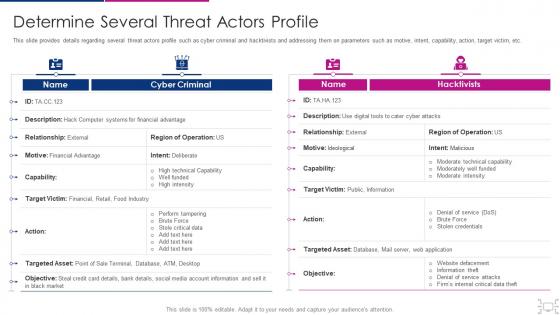
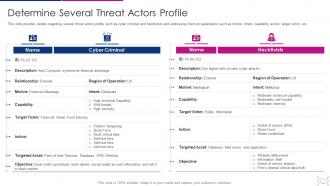
Cyber threat management workplace determine several threat actors profile




Try Before you Buy Download Free Sample Product
 Impress Your
 Audience
 100%
100% Editable
 Save Hours
 of Time


This slide provides details regarding several threat actors profile such as cyber criminal and hacktivists and addressing them on parameters such as motive, intent, capability, action, target victim, etc.
People who downloaded this PowerPoint presentation also viewed the following :
Cyber threat management workplace determine several threat actors profile with all 6 slides:
Use our Cyber Threat Management Workplace Determine Several Threat Actors Profile to effectively help you save your valuable time. They are readymade to fit into any presentation structure.





FAQs for Cyber threat management workplace determine several
Primary motivations behind cyber threat actors include financial gain through ransomware and fraud, espionage for competitive intelligence, political activism, state-sponsored surveillance, and personal recognition. These drivers increasingly shape cybersecurity landscapes across industries, with financial institutions, healthcare organizations, and government agencies finding that understanding attacker psychology enhances their defensive strategies and incident response capabilities.
State-sponsored cyber threat actors differ from criminal underground operators through their government backing, advanced persistent threat capabilities, strategic geopolitical objectives, and extensive resource access. While criminal actors focus on immediate financial gain through ransomware and fraud, state-sponsored groups target critical infrastructure, intellectual property, and sensitive government data for long-term national advantage, ultimately operating with greater sophistication and persistence.
APT groups employ sophisticated TTPs including spear-phishing campaigns, zero-day exploits, lateral movement techniques, credential harvesting, and advanced malware deployment to establish persistent network access. These methodologies enable prolonged data exfiltration, intellectual property theft, and infrastructure compromise across sectors like finance, healthcare, and government, with organizations increasingly finding that multi-layered defense strategies are essential for detecting and mitigating these persistent, evolving threats.
Ransomware attacks have evolved from simple file encryption to sophisticated multi-stage operations involving data theft, supply chain targeting, and ransomware-as-a-service models. Cyber threat actors now operate like organized businesses, with specialized groups handling different attack phases, enabling more targeted campaigns against healthcare systems, financial institutions, and critical infrastructure, ultimately delivering higher ransom demands and broader operational disruptions.
Common cyber threat actors include nation-state groups, organized crime syndicates, hacktivist collectives, insider threats, and opportunistic individuals. These actors target organizations through phishing campaigns, ransomware deployment, social engineering tactics, and exploiting system vulnerabilities, with many financial institutions and healthcare providers finding that layered security approaches significantly reduce successful breach attempts.
Cyber threat actors leverage social engineering by exploiting human psychology through phishing emails, pretexting calls, baiting with malicious downloads, and tailgating into secure facilities. These psychological manipulation techniques enable attackers to bypass technical security controls, gain unauthorized access to sensitive systems, and establish persistent network footholds, with many organizations finding that employee training significantly reduces successful breach attempts.
The dark web provides cyber threat actors with anonymous marketplaces for trading stolen data, malware, and hacking services, while enabling secure communications and financial transactions through cryptocurrencies. This hidden ecosystem facilitates collaboration between criminal organizations, with many cybersecurity firms finding that threat intelligence from dark web monitoring significantly enhances their defensive strategies and incident response capabilities.
Organizations effectively identify cyber threat actors through comprehensive threat intelligence platforms, industry-specific threat feeds, security frameworks like MITRE ATT&CK, and collaboration with sector-specific information sharing organizations. These approaches enable security teams to categorize threats by motivation, capability, and targeting patterns, with many financial institutions and healthcare organizations finding that combining internal monitoring with external intelligence sources delivers enhanced threat visibility and faster incident response capabilities.
Cross-border collaboration among cyber threat actors amplifies attack sophistication, enables resource sharing, creates jurisdictional enforcement challenges, and complicates attribution processes for security teams. These international networks leverage diverse expertise, time zone advantages, and regulatory gaps, with many organizations finding that traditional security approaches struggle against coordinated global threats, ultimately requiring enhanced international cooperation and adaptive defense strategies.
Machine learning and AI anticipate cyber threats by analyzing network patterns, detecting anomalies, automating threat responses, and predicting attack vectors through behavioral analysis. These technologies enable organizations to identify sophisticated threats in real-time, streamline incident response processes, and enhance security postures, with financial institutions and healthcare systems finding significantly faster threat detection and reduced breach impacts.
Organizations can develop robust incident response plans by establishing dedicated response teams, implementing real-time monitoring systems, creating detailed communication protocols, conducting regular tabletop exercises, and maintaining updated threat intelligence databases. These comprehensive measures enable businesses to detect threats faster, minimize operational disruption, and reduce recovery costs, with many financial institutions and healthcare organizations finding that proactive planning significantly enhances their cybersecurity resilience.
Insider threats differ from external actors through their authorized system access, intimate knowledge of organizational vulnerabilities, and ability to bypass traditional security perimeters, while external threats rely on penetration techniques and social engineering. Organizations address these distinct risks by implementing zero-trust architectures, behavioral monitoring systems, and comprehensive access controls, with many financial institutions and healthcare providers finding that combining employee training with advanced analytics ultimately delivers enhanced security postures and reduced incident response times.
Threat intelligence sharing enhances defenses by pooling collective knowledge about attack patterns, indicators of compromise, and emerging tactics across organizations. Through collaborative platforms and industry partnerships, financial institutions, healthcare systems, and government agencies can identify threats faster, strengthen incident response capabilities, and develop proactive countermeasures, ultimately delivering enhanced security posture and reduced vulnerability windows.
The increasing number of IoT devices significantly expands the attack surface for cyber threat actors, providing countless new entry points through smart homes, industrial sensors, medical devices, and connected vehicles. These devices enable threat actors to launch larger-scale botnet attacks, conduct sophisticated surveillance operations, and pivot into previously secure networks, with many cybersecurity experts finding that inadequately secured IoT ecosystems ultimately deliver both massive computational resources for malicious activities and unprecedented access to sensitive personal and corporate data.
Regulatory frameworks significantly shape cyber threat actor strategies by creating varying enforcement landscapes, compliance requirements, and legal consequences across regions. Stricter data protection laws like GDPR in Europe drive threat actors toward jurisdictions with weaker cybersecurity regulations, while regions with robust international cooperation frameworks experience more sophisticated, cross-border attacks as criminals adapt their tactics to exploit regulatory gaps and enforcement limitations.
-
Design layout is very impressive.
-
Use of icon with content is very relateable, informative and appealing.