

Information security awareness powerpoint presentation slides




Try Before you Buy Download Free Sample Product
 Impress Your
 Audience
 100%
100% Editable
 Save Hours
 of Time


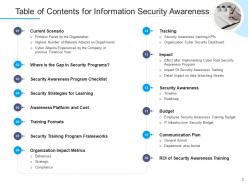
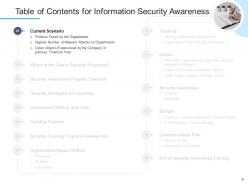
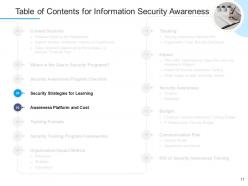
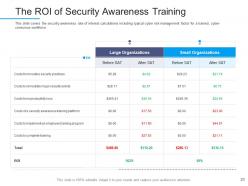
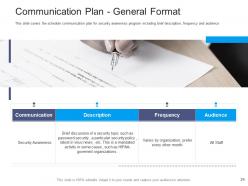
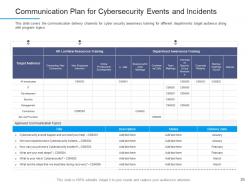
Introducing our security awareness PowerPoint presentation slides. Make your employees aware of cyber threats with the help of this network security PowerPoint deck. This IT data security PPT theme consists of a slide that discusses the cyber attacks experienced by the company in the previous financial year. Assimilating this security recognition assignment PPT layout will help you in discussing gaps in the security programs. This readymade web security PowerPoint design contains a slide that showcases different training formats for different organization levels. Incorporating this particular organization network security PPT theme allows you to exchange ideas on the communication plan for cybersecurity events and incidents. This data safety coaching PowerPoint creative set contains a slide that discusses the impact of security awareness training. Selection of this internet security awareness PowerPoint template lets you represent the ROI (Return on Investment) of security awareness training. Choose this company information safety guide PowerPoint design to showcase organization and assurance. Download this PPT slide to explore true perfection.
People who downloaded this PowerPoint presentation also viewed the following :
Content of this Powerpoint Presentation
In today's digital age, where cybersecurity threats and data breaches are not just possible but expected, how prepared is your business? You are mistaken if you think information security is just an IT concern! It's a cornerstone of corporate integrity that requires awareness and vigilance from every employee.
How to ensure everyone in your organization is as driven and cautious about IT security as you? Verbal reminders, disciplinary emails, and warnings are things of the past. They won’t cut it in today's information-sensible corporate environment! You need a reliable solution that engages and speaks to a broader spectrum of the workforce.
We have just the solution for you!
SlideTeam presents an Information Security Awareness PPT designed for corporate companies. This PowerPoint Presentation is a comprehensive tool that helps your team understand the risks, recognize the signs of a breach, and respond responsibly to protect your organization’s assets. From phishing scams to data encryption, our PPT will guide your team through:
-
The latest in cybersecurity threats and prevention techniques.
-
Best practices for secure communication and data handling.
-
Strategies to create a culture of security awareness throughout your organization.
Our fully editable and customizable templates are more than a presentation; it's the critical step toward safeguarding your company against cyber threats. Dive into the details and equip your workforce with the knowledge they need to be the first line of defense in information security.
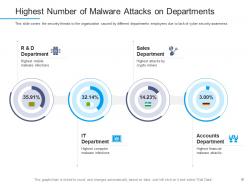
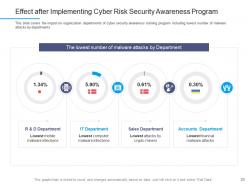
Template 1: Malware Attacks on Departments
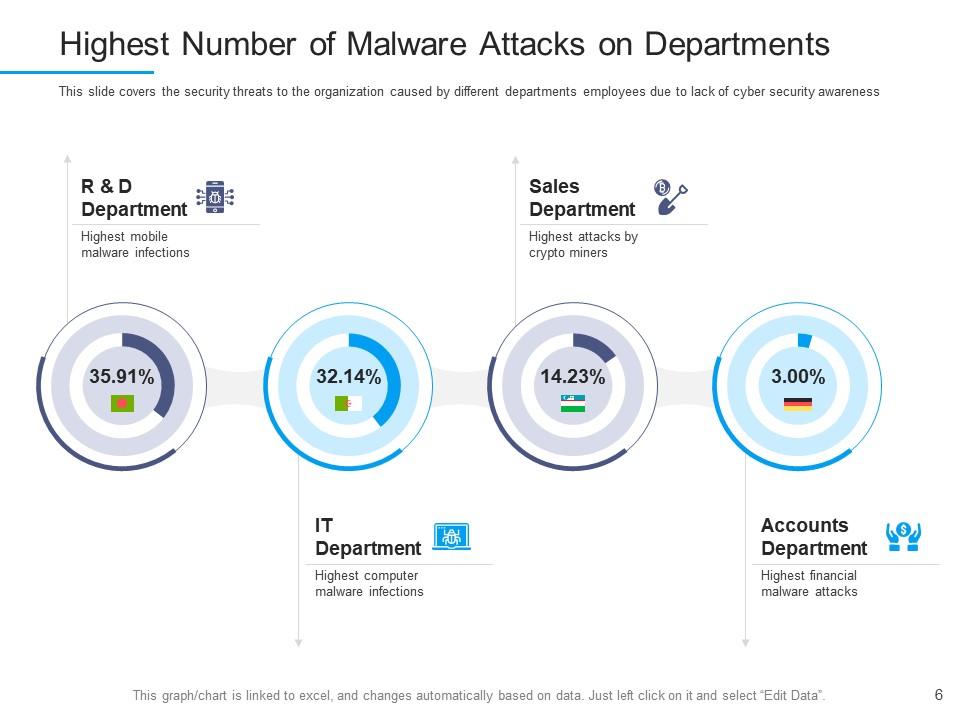
You must know your vulnerable departments to malware attacks to design and implement strategies for security. Use this PPT to ensure your security chain is always strong. The slide layout depicts malware attacks of up to four departments, helping you evaluate threat tolerance and pinpoint areas that need immediate attention.
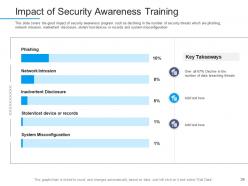
Template 2: Cyber Attacks Experienced by the Company in Previous Financial Year
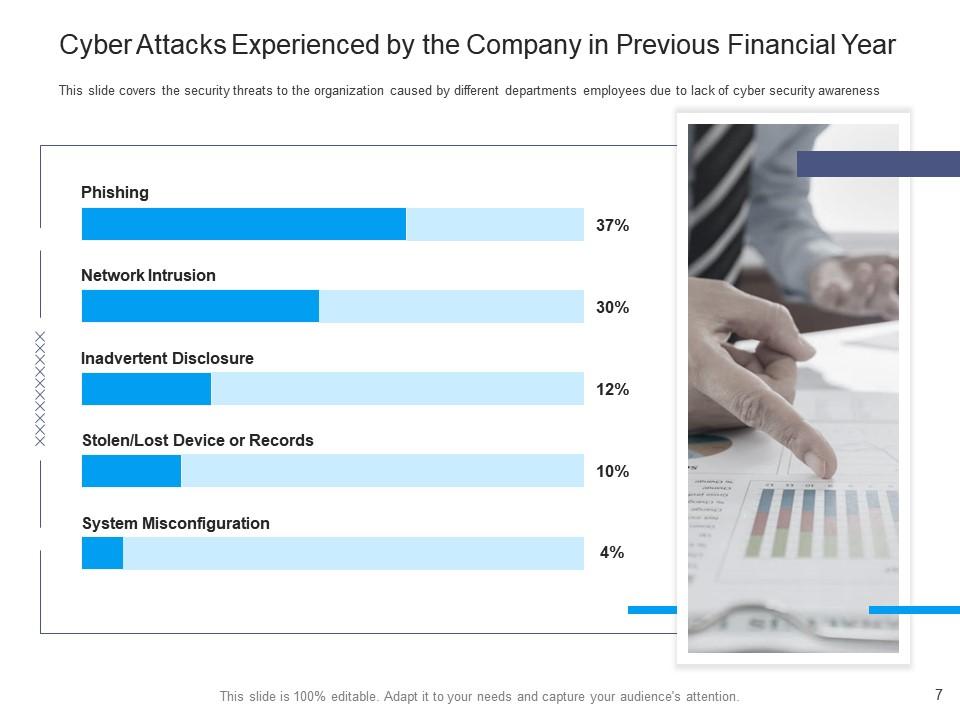
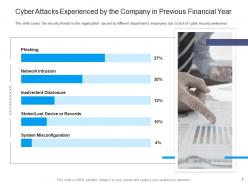
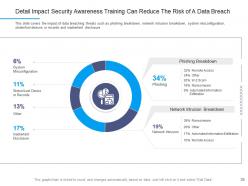
This PPT Set highlights the cyber attacks your company faced in the last financial year. It educates your employees about areas they must be watchful of and activities they must avoid. The PPT incorporates a horizontal bar graph that explains five types of threats, including phishing, network intrusion, inadvertent disclosure, stolen/lost devices or records, and system misconfiguration.
Template 3: Where is the Gap in Security Programs?
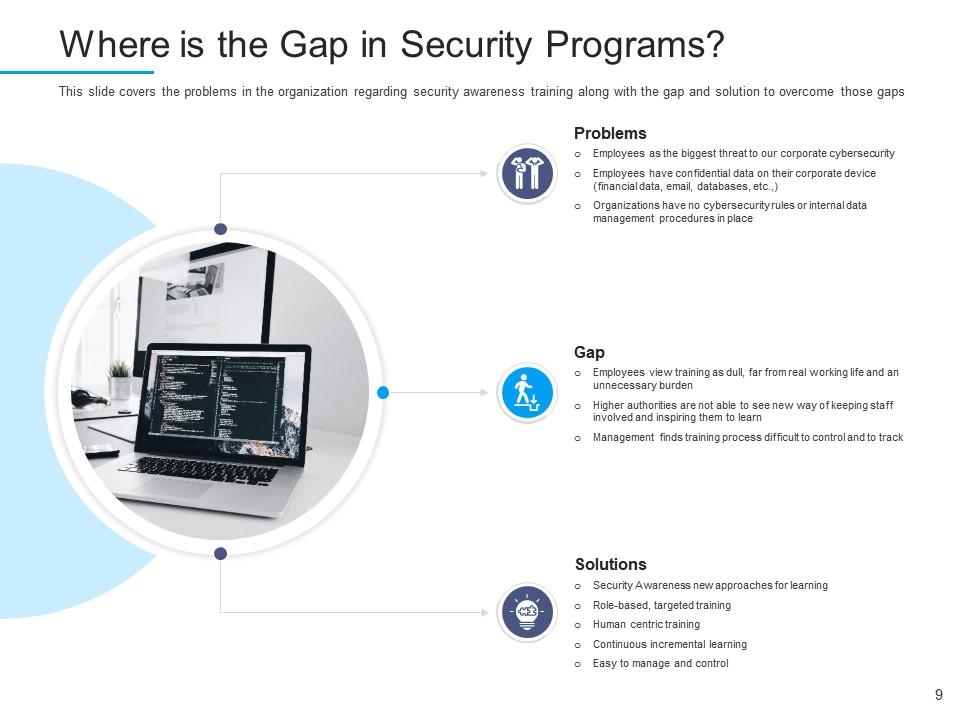
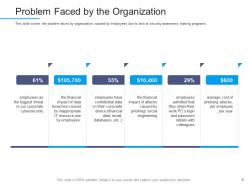
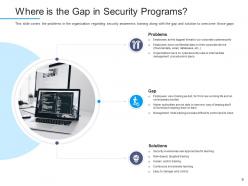
This strategic PPT Slide helps address the gap in your security programs. How? First, it explains the problems you face, which can include employees having confidential data on their corporate devices, a lack of internal data management procedures, etc. After stating the problems, the PPT moves on to assess the gaps, which may include employees viewing training as dull or the inability of management to control and track training processes. After finding the gaps, you brainstorm solutions, such as crafting new security awareness training approaches, human-centric training, etc.
Template 4: Security Awareness Program Checklist
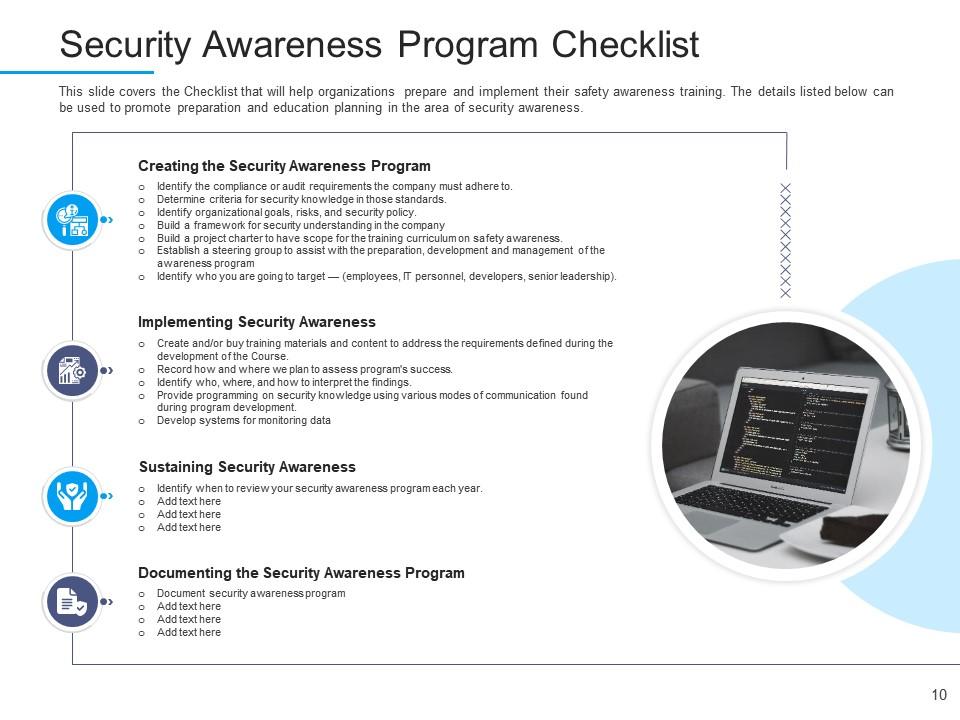
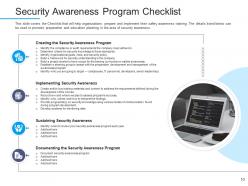
This content-rich PPT details a comprehensive security awareness program checklist. It has four broad topics: Creating a security awareness program, implementing security awareness, sustaining security awareness, and documenting the program. The PPT has pre-written activities for each topic to ensure a holistic approach is followed. Let’s take the first point in the checklist as an example, which is creating the security awareness program. In it, there are six sub-activities:
-
Identify the compliance or audit requirements the company must adhere to. Determine criteria for security knowledge in those standards.
-
Identify organizational goals, risks, and security policy.
-
Build a framework for security understanding in the company.
-
Build a project charter to create acceptance for and the scope of a training curriculum on safety awareness.
-
Establish a steering group to assist with the preparation, development, and management of the awareness program
-
Identify who you are going to target - (employees, IT personnel, developers, senior leadership).
Template 5: New Strategies for Learning
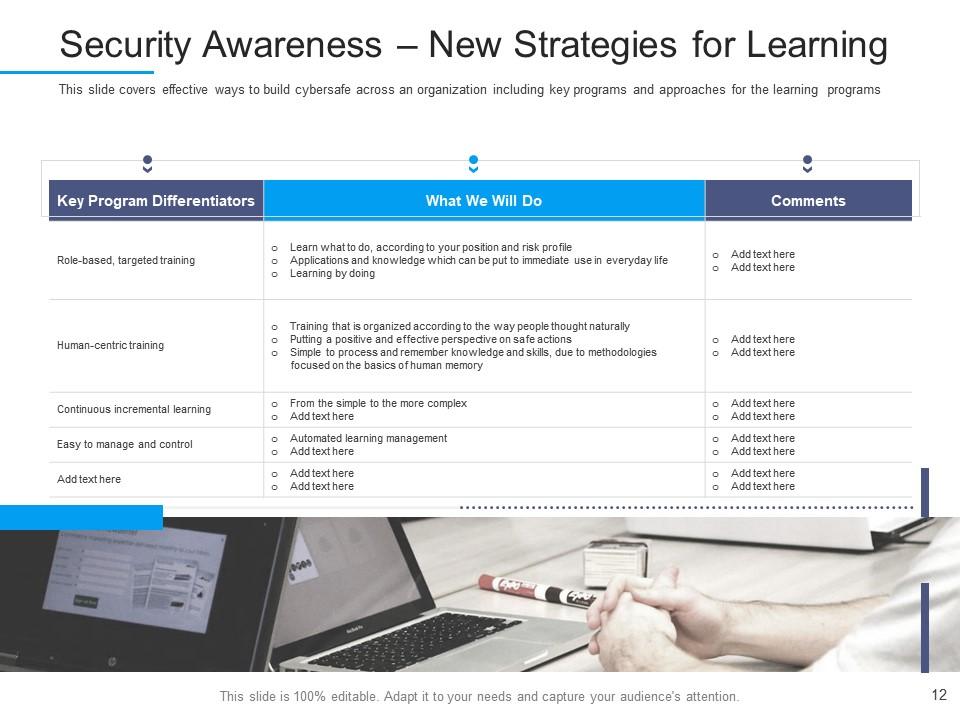
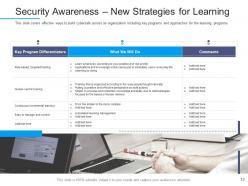
As discussed in Template 3, new strategies for learning become essential in a corporate environment where employees see training processes as boring. This PPT Slide explains three learning techniques. Each strategy is supplemented with insights about what needs to be done there, and comments are recorded, ensuring feedback is well taken. The learning strategies explained here include role-based, targeted learning, human-centric training, and continuous and incremental learning.
Template 6: Automated Security Awareness Platform and Cost
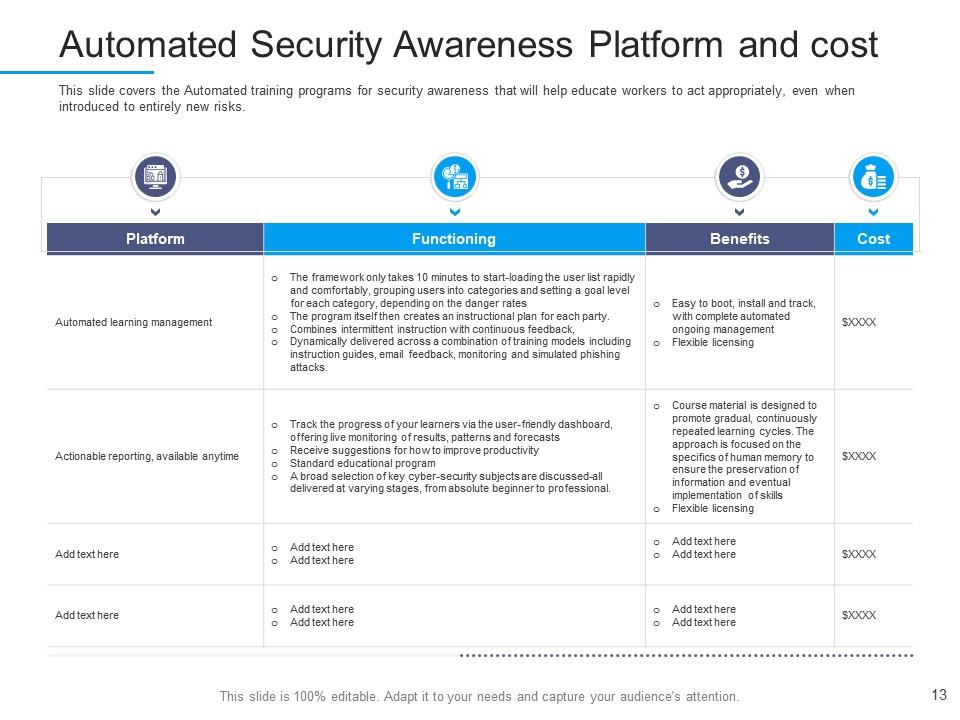
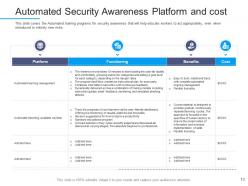
This PPT Template addresses financial considerations, making it a comprehensive guide for determining how much to spend on security training. This slide is ideal for businesses looking to launch an affordable and effective security awareness campaign. Download it now!
Template 7: Training Formats for Organizational Levels
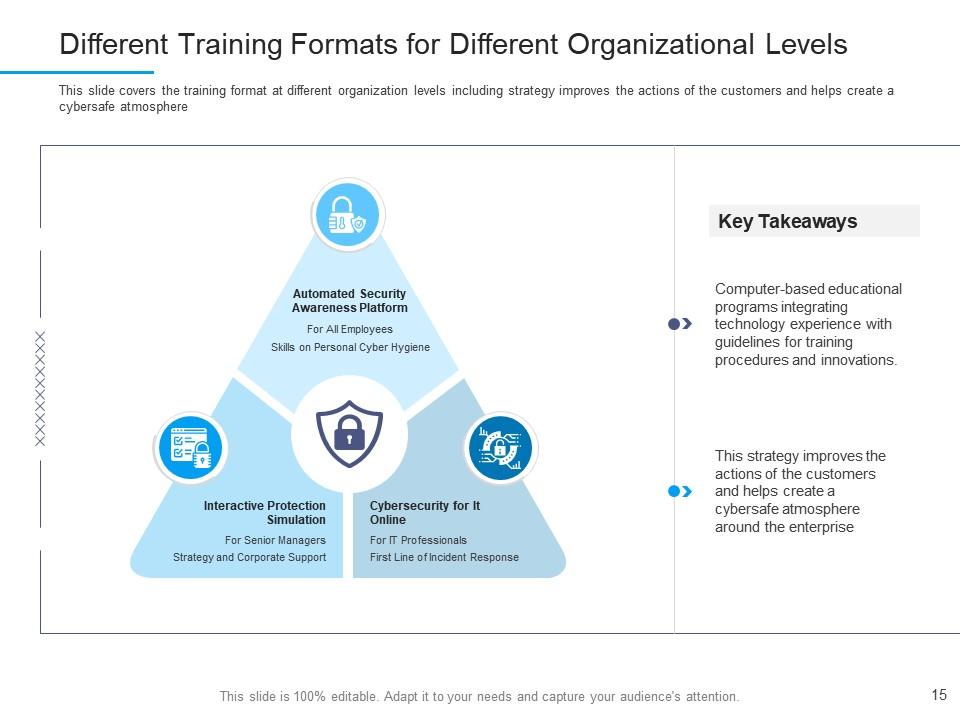
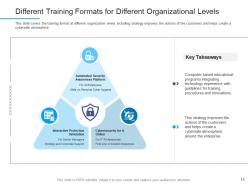
This PPT Preset describes three training formats, each focusing on a specific target audience. The automated security awareness platform invites participation from employees organization-wide. The interactive protection simulation is designed for senior managers, and cybersecurity for IT commands the attention of IT professionals. The PPT has a section for key takeaways where you can document relevant insights to be presented to stakeholders.
Template 8: Security Training Program Frameworks

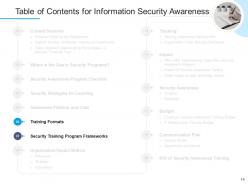
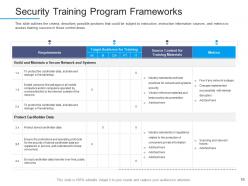
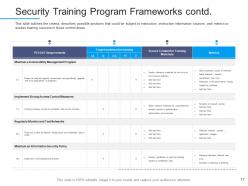
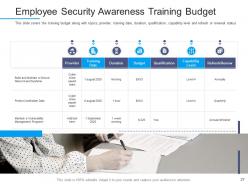
This PowerPoint presentation has a layout that includes specific security requirements, the target audience for each training segment, and suggested resources. It also provides metrics to assess training effectiveness. Use this slide to cover aspects of network and data protection, with actionable steps and clear performance indicators, all in an editable format that can be tailored to any organization. Get this today!
Template 9: Organization Impact Metrics - Behaviors
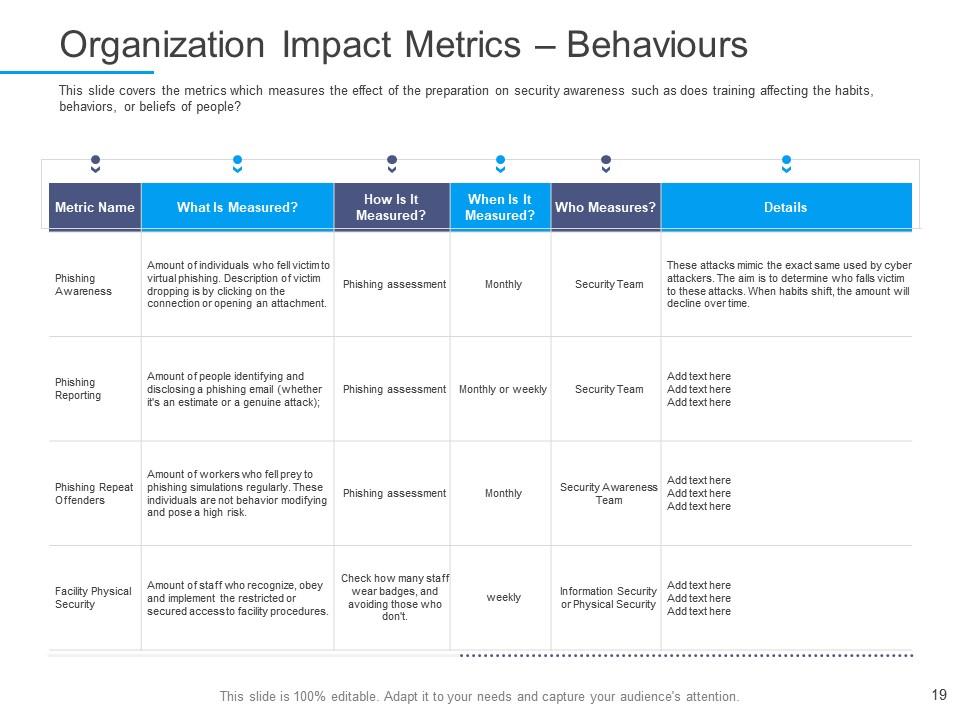
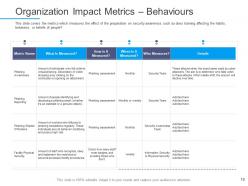
This PPT evaluates four important metrics: phishing awareness, phishing reporting, phishing repeat offenders, and facility physical security. For each metric, five criteria are taken into account: What is measured, how it is measured, when it is measured, who measures it, and details. Let’s take the phishing awareness metric as an example. Here, the number of people who fell victim to virtual phishing is measured. The security team measures it using phishing assessment tools. Similarly, other metrics are reviewed using the same criteria.
Template 10: Organization Impact Metrics - Strategic
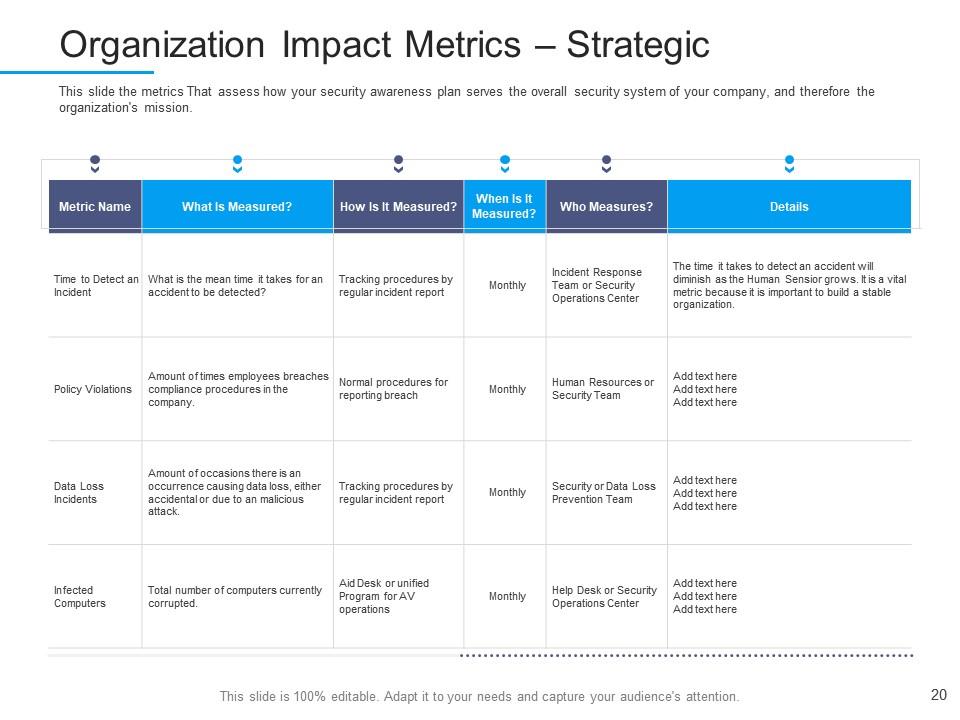
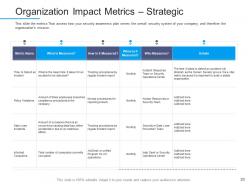
For business executives who want to match strategic business goals with security measures, this PowerPoint Template is a vital resource. The information on what's measured, how it's measured, how often it's measured, and who is responsible. Download now!
DIGITAL SECURITY PARAMOUNT
Staying ahead of security threats, today, is not just necessary; it's imperative. Our Information Security Awareness Templates are full of insights you need to do this well.
Empower your workforce to become proactive defenders against cyber threats.
Information security awareness powerpoint presentation slides with all 50 slides:
Use our Information Security Awareness Powerpoint Presentation Slides to effectively help you save your valuable time. They are readymade to fit into any presentation structure.
FAQs for Information security awareness
You'll want regular training sessions and those fake phishing tests - they actually work pretty well. Clear policies help too, plus keeping everyone updated on new threats. Leadership support is huge, otherwise people just ignore it. Honestly, the hardest part is making it not boring as hell. Nobody wants to sit through another "cyber hygiene" presentation, you know? Focus on stuff that actually relates to their jobs instead of generic warnings. Oh, and definitely figure out what your team doesn't know first - like test them or whatever. Then build everything around fixing those gaps. Way more effective than random training.
Dude, you gotta tailor training to what people actually do at work. Finance team? Hit them hard with wire fraud and invoice scams since that's their world. Marketing should learn about social media threats and sketchy emails from randos. HR handles so much personal stuff - they need the privacy protection training. Honestly, those boring "don't click suspicious links" sessions are pretty much worthless now. Build scenarios that match real threats each team sees. Show sales how scammers pose as fake prospects to steal customer info. When training connects to their daily grind, people actually remember it instead of just zoning out.
Watch out for phishing emails - they're so good now it's scary. Fake emails that look totally legit but steal your login info or get you to click bad links. Also never download sketchy stuff or plug in random USB drives (who even does that anymore though?). Social engineering's another big one where scammers call pretending they're from IT asking for passwords. Pretty ballsy if you ask me. Just stay suspicious and double-check through official channels before giving out sensitive stuff. When in doubt, verify first.
Phishing is basically scammers pretending to be legit companies to steal your info. They're getting really good at it too - almost got me with a fake Amazon email recently. Always double-check who's actually sending stuff before you click anything. URLs are a dead giveaway if you look close enough. Weird domains, random typos, that kind of thing. When something feels super urgent or sounds too good to be true? Yeah, it probably is. I always go directly to the company's real website instead of clicking email links. Takes like two extra seconds but saves you from potentially getting screwed over.
Honestly, social engineering is how most hackers actually get in - way more than the technical stuff you see in movies. They're basically just manipulating people instead of breaking code. Like they'll call pretending to be from IT support, or create some fake emergency to pressure you. Sometimes they even build trust over weeks first, which is kinda creepy if you think about it. Even super secure systems don't matter if someone just gives away their password or clicks a bad link. Best thing you can do? Stay suspicious of random urgent requests, especially for passwords. Always double-check through another way first.
Dude, you really need a password manager. I know it sounds like a pain, but hackers literally just try common passwords until something works - and if you're using "password123" for multiple sites, you're screwed. I've been using Bitwarden for like two years now and it's honestly saved me so much hassle. It generates crazy strong passwords and remembers them all. Plus it'll tell you if any of your accounts got breached, which happens way more than you'd think. Just start with your bank and email accounts first, then work your way down.
Ugh, compliance is such a headache but you gotta figure out what applies to you. GDPR if you're dealing with EU folks' data, HIPAA for health stuff, SOX for public companies. Processing credit cards? That's PCI DSS. California has CCPA too - I swear every state's gonna have their own thing soon. First thing I'd do is audit what sensitive data you're actually collecting and where it lives. Then you can map out which regulations hit your business. Way easier than trying to tackle everything at once. Most companies overthink this part honestly.
Working from home opens up some sketchy security holes you probably haven't thought about. Your home WiFi isn't bulletproof like the office network, and coffee shop internet? Forget about it. Family members might hop on your laptop when you're not looking - my brother totally did this once. Phishing emails love targeting remote workers too since we're more distracted. Always fire up that VPN before doing anything work-related. Update your software regularly and throw a strong password on your router. Oh, and if you get a weird email asking for sensitive stuff, call or text the person directly to double-check it's legit.
So first thing - figure out what data you're actually dealing with that's sensitive. Encrypt everything when it's moving around and when it's stored. Only give access to people who really need it, and use good authentication. I can't tell you how many times I've seen people just email confidential stuff like it's nothing - drives me crazy! Back everything up properly and don't just keep data sitting around forever. Honestly, just start by looking at what sensitive info your team handles right now, then tackle each security measure one by one. You'll get there.
So honestly, the best way is mixing hard data with real-world tests. Track your completion rates and quiz scores, sure, but follow up later to see what people actually retained. Those fake phishing emails? Total game changer - they show if people's behavior really changed, not just if they crammed for the test. Also check your incident reports - are you seeing fewer "oops I clicked that sketchy link" situations? The trick is measuring knowledge AND whether they're actually doing things differently. Oh, and definitely get baseline numbers before you start, then check quarterly. Otherwise you're just guessing if it worked.
Honestly, just report it right away to IT security or your manager - even if you're not totally sure something's fishy. Time really matters with this stuff. Jot down what seemed weird (strange emails, files acting up, whatever) but resist the urge to poke around and investigate yourself. I know it's tempting, but you could accidentally make things worse. Don't chat about it with coworkers either until security says it's cool - you never know if someone internal might be involved. Better to look paranoid than let a small problem blow up into something massive.
Honestly, mix up your security training with videos and interactive stuff - it's so much better than those endless text modules. Show actual phishing examples through video scenarios. Create simulations where people practice responding to incidents. Infographics work great for breaking down tricky concepts like encryption too. Our brains just absorb information better when we're seeing, hearing, and doing things simultaneously. I mean, anything's better than another death-by-PowerPoint session about passwords, right? Try throwing in some real testimonials from breach victims or add quiz games. Different formats hit different learning styles, so you'll actually see people remembering this stuff later.
Honestly, most people fall for stuff because of overconfidence - that whole "it won't happen to me" thing. Once you've clicked sketchy links a few times without problems, you start getting careless. Authority bias is huge too - nobody questions an email from "the CEO," right? Time pressure makes it worse since you're rushing through security warnings. I'll admit I've done it myself when I'm being lazy and want the easy route. Social engineering works because it hits our trust and curiosity buttons. My advice? Stay suspicious of everything, even if it feels paranoid.
Honestly, security training works best when it doesn't feel like training. Do short sessions about stuff they'll actually encounter - phishing emails, data handling, that kind of thing. Make it hands-on instead of death by PowerPoint (we've all been there). When someone spots something sketchy or follows protocol? Give them props for it. Monthly security tips work better than cramming everything into one annual session. Quick team chats about current threats keep people alert. The whole point is making everyone feel responsible, not just dumping it all on IT.
Honestly, the scariest stuff right now is AI-powered attacks. Criminals are using machine learning to make phishing emails and deepfake videos that'll fool almost anyone. Supply chain attacks are getting worse too - they're going after your vendors to reach you. There's also this ransomware-as-a-service thing that's basically letting amateur hackers launch pro-level attacks (kinda wild how accessible cybercrime has become). Oh, and those IoT devices in your office? Still security disasters. My advice: if an email looks too polished, question it. Also bug your IT people about vetting third-party vendors better.
-
Unique and attractive product design.
-
Appreciate the research and its presentable format.
-
Topic best represented with attractive design.
-
Very unique and reliable designs.
-
Awesomely designed templates, Easy to understand.
-
Use of icon with content is very relateable, informative and appealing.
-
It saves your time and decrease your efforts in half.
-
Great experience, I would definitely use your services further.
-
Awesomely designed templates, Easy to understand.