Risk Profile And KPIs Dashboard Snapshot With Heat Map

Rating:
90%
Risk Profile And KPIs Dashboard Snapshot With Heat Map
Slide 1 of 7
Favourites Favourites

Try Before you Buy Download Free Sample Product

Audience Impress Your
Audience
Editable 100%
Editable
Time Save Hours
of Time
The Biggest Sale is ending soon in
0
0
:
0
0
:
0
0
Rating:
90%
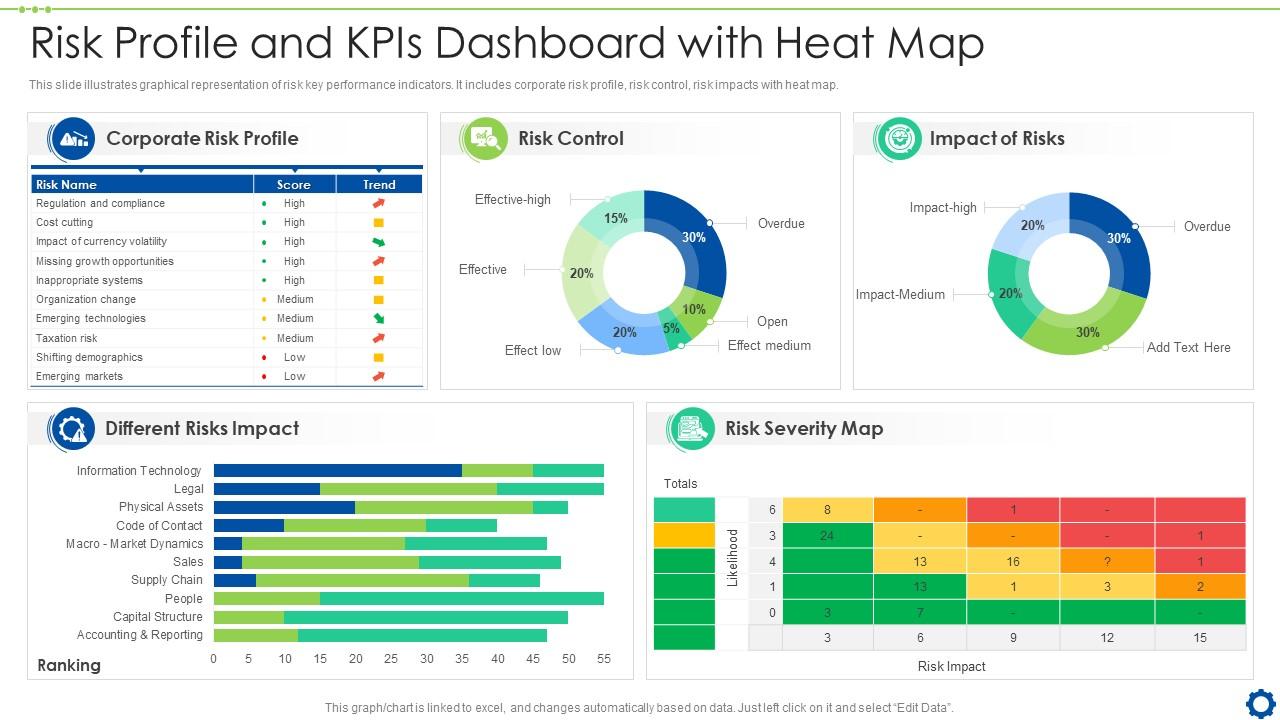
This slide illustrates graphical representation of risk key performance indicators. It includes corporate risk profile, risk control, risk impacts with heat map. Introducing our Risk Profile And KPIs Dashboard Snapshot With Heat Map set of slides. The topics discussed in these slides are Corporate Risk Profile, Risk Control, Impact of Risks, Different Risks Impact. This is an immediately available PowerPoint presentation that can be conveniently customized. Download it and convince your audience.

People who downloaded this PowerPoint presentation also viewed the following :

FAQs for Risk Profile And KPIs Dashboard Snapshot

So there's five main parts you gotta think about: spotting risks, figuring out how bad they could be, deciding what to do about them, keeping an eye on things, and making sure everyone's on the same page. Start by listing what could actually mess up your business - be realistic here, not paranoid. Then rate each one on how likely it is and how much damage it'd cause. The assessment part honestly sucks at first but gets way easier. After that, you'll either avoid the risk, reduce it, pass it off to someone else (like insurance), or just live with it. Oh, and don't forget to check back regularly since things change.

Get your team together for brainstorming sessions - they're gold for catching stuff you'd miss alone. Look back at old projects too, see what went sideways before. I always ask stakeholders directly what worries them most. SWOT analysis is clutch, but honestly just asking "what breaks if this fails?" works wonders. Dependencies between tasks will bite you if you don't map them out. The biggest thing though? Don't treat this like a checkbox exercise. Schedule monthly check-ins and create a culture where people actually speak up early. Your future self will thank you when you're not scrambling later.

So risk assessment is like your early warning system - helps you catch problems before they blow up your plans. You're mapping out what could go wrong, how likely it is, and what kind of damage it'd do to your goals. Kind of like checking weather before a road trip, but obviously way more crucial for business stuff. Once you build it into your planning process, you can prep backup plans and spend money smarter. Honestly, most people overthink this part. Just start by listing your top 3-5 risks for whatever big thing you're doing. Makes decisions way easier when you actually know what you're walking into.

Most places use risk registers - just fancy spreadsheets that track and score potential problems. SWOT analysis and failure mode stuff are pretty standard too. Heat maps help visualize what's actually worth worrying about versus minor headaches. Monte Carlo simulations pop up a lot in finance, scenario planning everywhere else. Insurance is massive but companies weirdly treat it like an add-on instead of planning it from day one. Honestly, don't go crazy with complex tools if you're just getting started. Match whatever system to how complicated your business actually is.

Set up small experiments where failing won't kill your budget - I call them "safe-to-fail" tests. Maybe dedicate 10-15% of your resources to riskier stuff without needing tons of approvals. The trick is knowing upfront when to keep going vs. when to quit. Honestly, I've watched companies either play things way too safe and go nowhere, or chase every random idea. Try running 3-4 pilots at once, then scale whatever actually works. That way you're being smart about risk instead of just throwing darts blindfolded.

So basically qualitative risk assessment is like saying "this could really mess us up" while quantitative puts actual numbers to it - like "15% chance we lose $50K." Qualitative relies more on experience and gut instinct. You're just bucketing things as high/medium/low risk. Way faster to do, but obviously less precise than crunching the actual data. Most people I know start with qualitative to spot the big threats quickly, then get into the math for whatever seems scariest. Makes sense - who wants to calculate probabilities for every tiny risk right off the bat?

Look, compliance might feel like a pain, but it actually makes you get your shit together with risk management. You're forced to write things down, create real controls, and measure stuff instead of just guessing. Yeah, the paperwork sucks sometimes - I get it. But those frameworks catch things you'd totally miss otherwise. Here's the thing though: skipping compliance creates way bigger problems. Fines, lawsuits, your reputation going down the drain. Best approach? Use it as your baseline, then add whatever risk stuff actually makes sense for your business on top.

So the big thing right now is AI doing predictive analytics - it's honestly scary how much faster it catches stuff than we do. Real-time dashboards are everywhere too. Cloud platforms are kind of a no-brainer since you can access everything remotely and they scale easily. Oh, and ESG tracking is blowing up because regulators won't leave it alone. Automated compliance is huge too, though honestly half the companies I know still do it manually for some reason. You should probably ask your vendor what AI tools they've got - most people aren't using half the automation that's already there.

Honestly, ditch the jargon-heavy stuff and just talk to people like humans. When stakeholders actually understand what's happening, they stop just nodding along and start giving you real input. Don't pretend you've got everything figured out either - being upfront about what you don't know makes people feel like they're part of the team, not just getting managed. I always mess this up myself, but try opening your next meeting with "what questions do you have?" instead of diving straight into presentations. Trust me, the whole dynamic changes when people feel heard.

Mix leading and lagging indicators to get the real story. I'd track incident frequency, how fast you resolve stuff, and near-miss reports. Risk assessment coverage across units matters too - plus how quickly you're closing vulnerabilities. Don't forget the money side: loss ratios and insurance claims year over year. Honestly? Most companies obsess over metrics that look pretty but don't actually show if you're safer. My old boss did this constantly. Start with maybe 3-5 core ones tied to your biggest risks, then expand. Way better than drowning in dashboards that don't mean anything.

So basically, you gotta bake crisis prep right into your risk planning upfront. Figure out your biggest risks first, then write up response playbooks for each one. Clear communication chains are huge - nobody should be wondering who's doing what when stuff hits the fan. Here's the thing though: actually test these plans! Don't just file them away somewhere. I've seen too many companies do that. Map out both your immediate response stuff and longer recovery plans. Oh, and assign specific owners to each crisis type so there's zero confusion about who's running point when everything's chaos.

Corporate culture is everything when it comes to risk management, honestly. When leadership actually talks about problems openly and rewards people for spotting issues early? You get amazing risk identification. But if your company shoots the messenger, people hide problems until they blow up - I've seen this disaster firsthand. The magic happens when people feel safe speaking up about concerns, even tiny ones. Here's what works: thank people first when they raise risks, then figure out solutions. Makes all the difference. You want folks thinking "I should mention this" instead of "maybe I'll just stay quiet."

Pandemics basically blow up everything you thought you knew about risk management. Like, suddenly all those supply chains and remote work setups that seemed fine? Total disasters waiting to happen. Most companies I've seen were walking around with way less liquidity than they actually needed - kinda embarrassing honestly. These massive events don't just hit one area either. They cascade through everything at once, which is terrifying when you think about it. Now everyone's scrambling to build scenario planning for these crazy "black swan" situations. Can't just worry about the obvious stuff anymore - gotta think about the weird, interconnected threats nobody saw coming.

Look at Enron, the 2008 mess, Wells Fargo - they all had risk management on paper but ignored it when it mattered. Wells Fargo literally had compliance teams while employees were opening fake accounts to hit quotas! The real issue? These places created cultures where hitting numbers trumped everything else. When your risk alarms go off, you can't just pretend they're broken because it's inconvenient. Companies need to actually reward people who speak up about problems, not shoot the messenger. Otherwise you're just playing pretend with fancy frameworks that mean nothing.

Honestly, just weave it into stuff you're already doing instead of making it this big separate thing. When you're planning projects, throw in a quick "what could blow up here?" moment. Most teams totally skip that part, which is kinda nuts when you think about it. Make some basic checklists your people can actually use without rolling their eyes. Train everyone to catch problems before they become disasters. The trick is keeping it simple - nobody wants more bureaucracy. Pick one project to test it on first. Once people see it actually helps instead of just creating busywork, they'll buy in.

Ratings and Reviews

90% of 100
Review Form
Write a review
Most Relevant Reviews
  1. 80%

    by Darwin Mendez

    The pricing page of this website is very sorted. I felt no pain while buying the PPTs.
  2. 100%

    by Cristopher Cole

    The PPTs are extremely simple to modify. Thank you for providing the slides that are ready to be used. They assist me in saving a lot of time.

2 Item(s)

per page: