


Business Operating Model Risk Management Framework




Try Before you Buy Download Free Sample Product
 Impress Your
 Audience
 100%
100% Editable
 Save Hours
 of Time


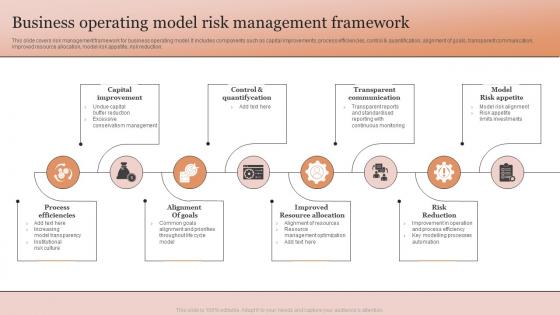
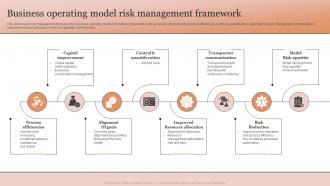
This slide covers risk management framework for business operating model. It includes components such as capital improvements, process efficiencies, control and quantification, alignment of goals, transparent communication, improved resource allocation, model risk appetite, risk reduction.
People who downloaded this PowerPoint presentation also viewed the following :
Business Operating Model Risk Management Framework with all 6 slides:
Use our Business Operating Model Risk Management Framework to effectively help you save your valuable time. They are readymade to fit into any presentation structure.





FAQs for Business Operating Model
An effective business operating model risk management framework should include risk identification processes, governance structures, assessment methodologies, mitigation strategies, and continuous monitoring systems. These components work together by establishing clear accountability, enabling proactive threat detection, and ensuring rapid response capabilities, with many organizations finding that integrated frameworks significantly reduce operational vulnerabilities while enhancing strategic decision-making.
Organizations can assess operating model alignment through strategic mapping exercises, performance gap analysis, stakeholder feedback mechanisms, operational efficiency audits, and cross-functional capability reviews. These assessments enable leadership teams to identify misaligned processes, resource allocation inefficiencies, and structural barriers, while many institutions find that regular alignment reviews ultimately deliver enhanced strategic execution and competitive positioning.
The most common risks include operational disruption, employee resistance, customer experience degradation, technology integration failures, and financial performance volatility. These challenges particularly impact organizations during digital transformations or market expansions, with many companies finding that proactive change management, phased implementations, and stakeholder engagement significantly minimize disruptions while accelerating successful transitions.
Technology and data analytics enhance risk management by providing real-time monitoring, predictive modeling, automated compliance tracking, and comprehensive risk visualization across operating models. Through AI-powered analytics and integrated dashboards, organizations streamline risk identification, accelerate decision-making, and minimize operational vulnerabilities, with many financial services and manufacturing companies finding that these technologies ultimately deliver enhanced transparency and competitive advantage.
Organizational culture and employee engagement serve as critical risk mitigation mechanisms by fostering proactive problem identification, encouraging transparent communication, and promoting adherence to established processes and controls. Strong cultural alignment enables faster risk detection and response, with engaged employees more likely to report potential issues early, ultimately reducing operational disruptions and enhancing overall business resilience.
Businesses identify and prioritize operating model risks through comprehensive risk assessments, stakeholder interviews, process mapping, financial impact analysis, and scenario planning. These methodologies enable organizations to evaluate potential disruptions across supply chains, technology systems, and operational processes, with many companies finding that regular risk audits and cross-functional collaboration ultimately deliver better preparedness and strategic resilience.
Best practices for implementing risk management during operating model transformation include establishing cross-functional risk committees, conducting continuous risk assessments, implementing real-time monitoring systems, creating clear escalation protocols, and maintaining transparent communication channels. These approaches enable organizations to identify vulnerabilities early, adapt quickly to emerging threats, and ensure business continuity, with many companies finding that integrated risk frameworks ultimately deliver greater operational resilience and competitive advantage.
Businesses should review their operating model risk management practices quarterly for routine assessments, annually for comprehensive evaluations, and immediately following significant operational changes, market shifts, or regulatory updates. This dynamic approach enables organizations to identify emerging vulnerabilities, adapt to evolving threats, and maintain competitive advantage, with many financial services and healthcare institutions finding that proactive updates significantly reduce operational disruptions.
Regulatory compliance significantly impacts business operating model risk management by establishing mandatory frameworks, requiring continuous monitoring systems, and demanding documented risk assessment processes. These requirements enhance organizational transparency and accountability while creating additional operational complexities, with many financial services and healthcare organizations finding that compliance-driven risk management ultimately delivers stronger governance and competitive advantage.
Scenario planning enables organizations to anticipate operating model risks by modeling potential disruptions like supply chain failures, regulatory changes, market shifts, and technology breakdowns across different probability contexts. Through systematic analysis of these scenarios, companies develop contingency strategies, diversify critical dependencies, and build operational resilience, ultimately delivering faster crisis response and sustained competitive advantage.
Companies balance innovation and risk management by implementing staged pilot programs, establishing cross-functional governance committees, and creating risk-adjusted innovation budgets that enable controlled experimentation. Through agile frameworks and continuous monitoring systems, organizations in sectors like fintech and healthcare can pursue breakthrough opportunities while maintaining operational stability, ultimately delivering competitive advantage and sustainable growth in an increasingly dynamic business environment.
Key metrics include risk exposure ratios, incident response times, business continuity recovery rates, operational loss frequencies, and compliance audit scores. These measurements enable organizations to track risk mitigation effectiveness across departments, identify vulnerabilities before they impact operations, and demonstrate regulatory compliance, with many institutions finding that comprehensive metric frameworks ultimately deliver enhanced operational resilience and competitive advantage.
External factors like market volatility, regulatory shifts, supply chain disruptions, and geopolitical tensions significantly amplify operating model risks by creating uncertainty in resource allocation, customer demand, and operational continuity. Organizations increasingly adopt scenario planning, diversified supply chains, and agile operating structures to navigate these challenges, with many financial services and manufacturing companies finding that flexible risk frameworks enable faster adaptation while maintaining competitive advantage in volatile environments.
Supply chain disruptions significantly elevate the business operating model's risk profile by increasing operational vulnerability, financial exposure, customer satisfaction risks, and strategic dependency concerns. These disruptions force organizations to reassess supplier relationships, inventory strategies, and contingency planning, with many companies finding that diversified supply networks, enhanced visibility systems, and flexible operational frameworks ultimately deliver greater resilience and competitive advantage.
Employee training and development enhance risk management by building risk awareness, teaching identification techniques, establishing response protocols, and fostering a proactive risk culture throughout the organization. Through comprehensive programs, companies streamline incident reporting, minimize operational disruptions, and accelerate recovery processes, with many financial services and healthcare organizations finding that well-trained employees significantly reduce both compliance violations and operational risks.
-
Time saving slide with creative ideas. Help a lot in quick presentations..
-
Extensive range of templates! Highly impressed with the quality of the designs.