


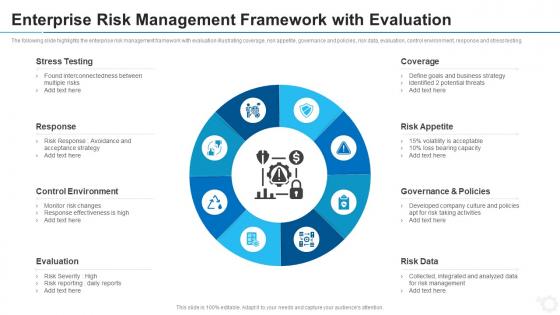
Enterprise risk management framework with evaluation




Try Before you Buy Download Free Sample Product
 Impress Your
 Audience
 100%
100% Editable
 Save Hours
 of Time


Our Enterprise Risk Management Framework With Evaluation are topically designed to provide an attractive backdrop to any subject. Use them to look like a presentation pro.
People who downloaded this PowerPoint presentation also viewed the following :
Enterprise risk management framework with evaluation with all 6 slides:
Use our Enterprise Risk Management Framework With Evaluation to effectively help you save your valuable time. They are readymade to fit into any presentation structure.





FAQs for Enterprise risk management
So basically you need four main things: spotting risks, figuring out how bad they are, deciding what to do about them, and keeping an eye on everything ongoing. Get your executives and board actually caring about this stuff - without that you're screwed honestly. Build out what risks you're okay with vs not okay with. Communication is where most places totally blow it though. Make sure info flows both ways in your org. Oh and definitely map out what you're dealing with right now first. That'll show you the biggest gaps. Don't try to boil the ocean - just tackle what matters most.
Start with the regulatory stuff in your industry - that's where the worst surprises usually come from. Hit up conferences and trade groups, but honestly? The real gold is in those industry forums where people vent about their disasters. I've learned more from complaint threads than any whitepaper. Map your whole supply chain too because risks love to hide with suppliers. Check what's gone wrong at similar companies historically. Oh, and get some outside consultants who know your sector - you're probably too close to see everything. Fresh perspective makes a huge difference.
Think of ERM as your decision-making safety net. You're not going in blind anymore - you can actually spot the potholes and golden opportunities before diving in. It's honestly like having GPS that warns you about traffic ahead (which, let's be real, saves so much headache). The whole thing forces you to ask "what could go wrong?" way earlier than you normally would. You'll get better at weighing trade-offs and figuring out what level of risk makes sense for your situation. Quick tip: try mapping out the main risks for whatever big project you're tackling next. Watch how differently you start thinking about the whole thing.
Honestly, tech just makes ERM so much easier - it automatically pulls data and monitors risks 24/7 instead of you doing it by hand. Those real-time dashboards beat the hell out of monthly Excel spreadsheets (we've all been there). You'll get automated alerts when risk indicators spike, plus way better analytics for spotting trends. The best part? Your team stops being data entry clerks and actually gets to make strategic decisions. Scenario modeling becomes pretty straightforward too. My advice: don't go crazy trying to digitize everything at once. Pick one risk area first and nail that.
Mix hard numbers with gut checks - incident rates, insurance costs, audit scores, response times. But honestly? The real win is when people stop treating it like paperwork they have to get through. Watch if departments actually use your frameworks. Leadership caring about risk talks is huge. I'd also track how fast you spot new risks and whether your predictions were right (that one's humbling sometimes). Pick 3-5 metrics that actually matter to your business. Review quarterly. Don't overthink it at first - you'll figure out what works as you go.
Getting leadership on board is brutal - they see it as more red tape. Departments hate sharing risk info because they think it makes them look incompetent or something. Plus everyone speaks different "risk languages" which is annoying as hell. Data quality is usually garbage too. Most companies try to roll out everything at once, which never works. I'd honestly just pick one department first. Get some quick wins under your belt, then slowly expand. Way less painful that way. Oh and breaking down those departmental silos? Good luck with that one.
Honestly, you gotta weave this into daily work instead of just doing those boring annual training sessions. Get your managers talking about close calls and screw-ups in regular meetings - that tone-setting really matters. Train people to actually speak up about problems without getting their heads bitten off, then reward them for it. Give them basic tools to think through risks while they're doing their jobs. Oh, and here's the thing - connect it to what they actually do every day and how the company makes money. Nobody cares about abstract corporate nonsense, but they'll pay attention if it's relevant to their world.
So ERM and corporate governance? They're like teammates - governance creates your oversight structure while ERM spots the risks that could mess up your plans. Governance is your guardrails, ERM is more like having a lookout. Here's the thing though - you can't really do one without the other effectively. Strong governance means you actually understand what risks you're dealing with, and good ERM needs solid governance so the right people hear about problems early. I'd start by looking at which committees you have now and figuring out where risk conversations are actually happening. Makes the whole thing less abstract.
So ERM sets up this organized system that makes dealing with regulators way less of a headache. You're not frantically digging for compliance stuff when they show up - everything's already tracked and documented through your regular risk monitoring. The system pulls together risk data, how well your controls work, incident reports, all that feeds right into what regulators want to see. Think of it like having compliance info ready 24/7 instead of scrambling last minute (which honestly never goes well). You just need to make sure your ERM actually matches the regulations you deal with, then reporting becomes pretty automatic.
Honestly, risk heat maps are your best friend here - they show probability vs impact in a way that actually makes sense. Track your KRIs for early warnings, plus the usual suspects like incident rates and financial losses. Near-miss reports are seriously underrated goldmines, btw. Also monitor if you're staying within risk appetite limits and how well your controls are working. Here's the thing though - don't go crazy with metrics. Pick maybe 5-7 that executives actually care about, the stuff that keeps them awake. Otherwise you'll drown in spreadsheets and nobody will pay attention to your dashboard anyway.
So scenario analysis is basically stress-testing your risk stuff with "what if" situations. You run different conditions through your models - economic crashes, cyber attacks, supply chain mess, whatever. Way better than looking at risks one by one because you actually see how they pile up together. That cascading effect thing is brutal if you're not ready for it. Pick maybe 3-4 scenarios that actually matter for your business (don't go crazy with like 20 different doomsday situations). Then map out how your biggest risks would play out in each one. You'll catch stuff you'd totally miss otherwise.
Company size totally changes how you handle risk management. Big corporations? They've got whole teams, fancy frameworks, board meetings about it. Smaller places just have the CEO and maybe a few others figuring it out as they go. Here's the thing though - those big companies with all their resources move like molasses when something actually goes wrong. Startups can pivot fast but might completely miss the bigger picture stuff. You've gotta match whatever system you build to what you can actually handle. Don't copy Google's playbook if you're running a 50-person shop, but don't just wing it either.
At minimum, do it once a year. But honestly? That's not nearly enough if your business is actually growing. Any major shift should trigger a review – new markets, reg changes, revenue jumps. I've watched companies get completely blindsided because they waited for their "annual review" while everything changed around them. Build in specific triggers, like when revenue hits certain milestones or you face new compliance stuff. Really though, think of it as ongoing rather than this big yearly event. Quick question – what's changed in your business since last year? That'll tell you if once annually is even realistic.
Honestly, just ditch the corporate speak first - nobody has time to figure out what "operational risk exposure mitigation" means. Templates are your friend here, trust me. You'll want to hit both directions: keep leadership in the loop but also make sure the people actually doing stuff know what's going on. Dashboards work great for regular updates, save the detailed reports for when you really need to dig in. Oh, and set up clear escalation rules so the scary stuff doesn't get lost in weekly emails. Maybe start by figuring out where your communication is currently falling apart?
Honestly, cybersecurity risks are totally flipping ERM on its head. You can't just tack them onto your existing framework anymore - they change way too fast for that approach to work. What protected you six months ago? Probably outdated now with all these new attack methods showing up. Your risk assessments need to be way more agile. Build in continuous monitoring and get different teams talking to each other regularly. I've seen too many companies stick with those yearly reviews, but that's like bringing a knife to a gunfight these days. Real-time adaptation is where it's at.
-
Best Representation of topics, really appreciable.
-
Unique design & color.